Tag Archives: Church

The Thoroughly Rational Conversion of Michael Minot

C.S. Lewis has some words to live by for you

One of the things I’ve noticed hanging around in church on and off the last 20 years or so is that it often seems to be the case the church leaders seem to value some people as leaders more than others. Specifically, it seems to me that church leaders prefer to put athletes and cheerleaders into leadership positions, and they tend to be skeptical of people who have intellectual conversion stories, and intellectual interests. I think I actually got the phrase “jocks and cheerleaders” from Dr. John Mark Reynolds when describing who churches tend to prefer, so I’m not just making this up.

But not everyone sees things that way. Of all the people I’ve met or read, I probably agree with Terrell Clemmons the most. And if I disagree with her, then I usually find out that she is right later on. Pretty much everything she writes about is not only relevant, but practical, which is amazing for a person who writes about topics related to Christian belief and practice. One of the things she likes to write about is the background stories of people who were intelligent and successful as non-Christians, who then went on to become Christians through a careful study of the evidence, and then went on to make a difference through outward-focused enterprises.

Let’s start with this article from Salvo Magazine about a successful atheist lawyer named Michael Minot.

Terrell writes:

Never in his 28 years did Mike Minot imagine he would entertain this unthinkable thought, yet lately of an evening he might easily be found pacing around his house like an awestruck research scientist muttering things like, “It just can’t be! . . . Can it?”

The seismic shift had started quite unexpectedly just a few months prior. He was three years out of law school, and life was great. After years of living on beans and weenies as a student, he had arrived on the scene of success. He had a growing law practice, money in his pocket, and a teeming social life. The world was his oyster.

Then he had received an odd phone call. Normally confident and well-spoken, Jim, whom he’d met while studying for the Florida bar exam, spoke awkwardly, struggling uncharacteristically to get his message out. Finally he got to his point. “Sharon and I have been watching what’s been going on in your life. And we decided we would give you a call and invite you to do something. We believe the Scriptures are very important. They’re very important to our lives, and they’re helpful to us. We know what you think about spiritual matters, but we want to challenge you to take some time at this point in your life and reexamine these things.”

To say Mike was taken aback would be an understatement. He was a perfectly contented atheist, and he had no interest in interrupting his prosperous life to look at anyone’s answers to questions he wasn’t even asking. But he did value the relationship he had with Jim, Sharon, and their two adorable kids. If he were to summarily dismiss this suggestion, what would that do to their friendship? It seemed he should at least put forth a cursory effort, if for no other reason than for the health of the relationship.

First thing to note is that the people who ask Michael to give Christianity a look are successful and intelligent themselves. Not only is Jim studying for the Florida bar exam (so that he has credibility to another lawyer), but Jim’s wife has also given him more credibility by marrying him. Married couples are typically more “grown-up” than singles, and I’m saying that as a chaste single myself who has been successful in education, career and finances. Marriage requires a whole set of behaviors from people that singles don’t have to perform. The point is, though, that Michael is being approached by people from the same professional and social background. He is not being approached by a missionary or a street preacher, but by someone who has been effective in their education, career and marriage.

This really does matter – Christians are often perceived (rightly) as over-emotional, irrational, impractical, and driven more by community than by truth-seeking. It’s very important for Christians who want to produce a return that they not be living with their parents in their 20s, have gap-filled minimum-wage resumes, have $20,000 in student in outstanding student loans from an easy, unused non-STEM degree, and no achievements except zip-lining, skydiving, surfing, and fear-of-missing-out travel.

The journey starts with science:

With no predetermined plan, he delved into both the Scriptures and science. The Scriptures felt intimidating, though, and he was more comfortable with science. Not two weeks in, he found something that totally blew his mind. Ironically, it was something that had been there all along: the solar system—and the mind-boggling precision by which it operates. He marveled at the elegant complexity of it. It appeared way too precise, statistically speaking, to be an accident.

Suddenly, this was no longer a casual exercise. He had to find the natural explanation for the solar system. If he continued on his merry life without it, he would forever live plagued by lingering thoughts that he could be living a lie. Never did he want to go in for a lie, and intellectual honesty demanded that he keep searching.

So he put on his miner’s lighted helmet, so to speak, and went to work. But instead of locating the natural explanation for the solar system, he found himself turning up all manner of equally troublesome phenomena—the fine-tuning of the earth for supporting life, with its balance of nitrogen to oxygen ratios and plate tectonics; the information content of DNA; and the complexities of animal and human life, to name a few. The perplexities mounted, and the whole project snowballed. He would go looking for the explanation for one natural marvel, only to encounter two more crying out for explanation.

If I could communicate one thing to the church, it would be this: whether you agree with the old universe and old Earth timelines or not, everyone who attends church for a decade should be able to state the kalam cosmological argument, the fine-tuning argument, the intelligent design argument, the fossil record argument, and the habitability argument, to the degree where they are naming scientists, discoveries and specific books where the evidence for these arguments are laid out.

Unfortunately, thanks to the “leadership” of many prominent fideist pastors, many Christians have adopted an attitude of outright suspicion to science, preferring instead to pre-suppose the truth of the Bible by blind faith (“the burning of the bosom”, as the Mormons say), and refusing to study anything outside the Bible that might establish the necessary prerequisites to taking the Bible seriously. Successful non-Christian professionals looking to evaluate Christianity, this blind-faith approach is rightly seen as anti-intellectualism.

More:

Other complications did follow, though. He had trustingly believed teachers and authorities who had taught that everything could be explained naturalistically. What else, now, needed to be reexamined? This went beyond science and philosophy to sociology, psychology—everything had to be rethought according to this completely new paradigm. He would later liken it to being planted on a whole new planet.

And his entire social life collapsed in a matter of weeks. But he joined a church, and it became his new social center as well as his spiritual lifeline. He volunteered to serve as a jail chaplain in the evenings, a post he filled to great satisfaction for fifteen years. He met his wife Nichole at church, and they went on to adopt five children. Life settled into a richly rewarding concert of family, jail ministry, and law. Nothing he’d ever envisioned back in his atheist days could match the prosperity of these blessings.

At first glance, it may seem ironic that an atheist committed to seeing everything through the “lens of science” would come back around to see God through the lens of science. But the truth is, it wasn’t science per se that had hidden his Creator from view. Rather, it was the lens of philosophical naturalism imposed onto science—both in education and throughout the broader culture—that had fostered and fueled Mike’s unchallenged atheism.

Naturalism is a philosophy – a philosophical assumption. It’s not science. The origin and design of the universe are science. DNA is science. Habitability constraints are science. The sudden origin of major body plans in the fossil record is science. There are no scientific arguments for atheism. There’s just speculation driven by naturalistic philosophy.

In the end, Minot turns his life around 180 degrees, and puts his intellect and professional abilities to work for the gospel. You can read about all the ways he is making an impact in Terrell’s article in Salvo Magazine. Always remember stories like these when you are making decisions about your own education and career. God is still working, still reaching out to people through science and history, appealing to their minds for a fair hearing, and then asking for their best efforts for the gospel of Jesus Christ.
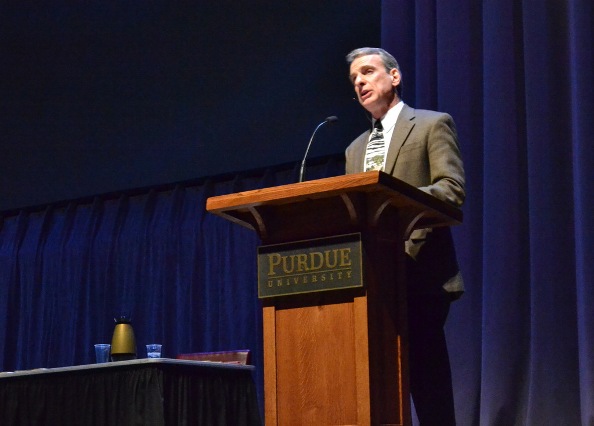
William Lane Craig discusses faith and reason with university students

William Lane Craig lecturing to university students

This is an interview of Dr. William Lane Craig before college students at the University of Central Florida. (95 minutes)

You can get an MP3 of the lecture here. (33 MB)

Questions from the interviewer: (40 minutes)

  • What started you on his journey of studying faith and reason?
  • How would you define the word “faith”?
  • Are faith and reason compatible? How are they related?
  • How can reasonable faith help us to avoid the two extremes of superstition and nihilism?
  • Who makes the best arguments against the Christian faith?
  • Why are angry atheists like Dawkins and Hitchens more well known than better-informed academic atheists?
  • Does the Bible require Christians to give the unbeliever reasons for their faith?
  • How does faith spur Christians to think carefully about the big questions in life?
  • Should the American church prod churchgoers to develop their minds so they can engage the secular culture?
  • When talking about Christianity intellectually, is there a risk of neglecting the experience of being a Christian?
  • Which Christian apologist has shaped your thinking the most?
  • Which Christian philosopher has shaped your thinking the most?
  • Does the confidence that comes from apologetics undermine humility and reverence?
  • If you had to sketch out a 5 minute case for Christianity, what would you present?
  • Can non-Christians use their reason to arrive at truth?
  • Are there cases where atheists must affirm irrational things in order to remain atheists?
  • Can the universe have existed eternal, so that there is no need to explain who created it?
  • Even if you persuade someone that Christianity is true, does that mean they will live it out?

There is also a long period of questions, many of them hostile, from the audience of students (55 minutes).

  • Haven’t you said nasty things about some atheists? Aren’t you a meany?
  • What do you make of the presuppositional approach to apologetics?
  • Can a person stop being a Christian because of the chances that happen to them as they age?
  • Why did God wait so long after humans appeared to reveal himself to people through Jesus?
  • Can a person be saved by faith without have any intellectual assent to truth?
  • How do you find time for regular things like marriage when you have to study and speak so much?
  • How would you respond to Zeitgeist and parallels to Christianity in Greek/Roman mythology?
  • Do Christians have to assume that the Bible is inerrant and inspired in order to evangelize?
  • If the universe has a beginning, then why doesn’t God have a beginning?
  • Can you name some philosophical resources on abstract objects, Platonism and nominalism?
  • How can you know that Christianity more right than other religions?
  • Should we respond to the problem of evil by saying that our moral notions are different from God’s?
  • Define the A and B theories of time. Explain how they relate to the kalam cosmological argument.
  • How can Christians claim that their view is true in the face of so many world religions?
  • What is the role of emotions in Christian belief and thought?
  • Can evolution be reconciled with Christian beliefs and the Bible?
  • When witnessing person-to-person, should you balance apologetics with personal testimony?
  • Is there a good analogy for the trinity that can help people to understand it? [Note: HE HAS ONE!]
  • How can Christians reconcile God’s omniscience, God’s sovereignty and human free will?

This is a nice introductory lecture that is sure to get Christians to become interested in apologetics. As you watch or listen to it, imagine what the world would be like if every Christian could answer the questions of skeptical college students and professors like Dr. Craig. What would non-Christians think about Christianity if every Christian had studied these issues like Dr. Craig? Why aren’t we making an effort to study these things so that we can answer these questions?

It is really fun to see him fielding the questions from the skeptical university students. My favorite question was from the physics student who sounds really foreign, (at 1:19:00), then you realize that he is a Christian. I do think that Dr. Craig went a little far in accommodating evolution, but I put that down to the venue, and not wanting to get into a peripheral issue. I’m also surprised that no one asked him why God allows humans to suffer and commit acts of evil.

If you are looking for a good basic book on apologetics, then I would choose “Is God Just a Human Invention?” by Sean McDowell and Jonathan Morrow.

Who is William Lane Craig?

About William Lane Craig:

William Lane Craig is Research Professor of Philosophy at Talbot School of Theology in La Mirada, California.

Dr. Craig pursued his undergraduate studies at Wheaton College (B.A. 1971) and graduate studies at Trinity Evangelical Divinity School (M.A. 1974; M.A. 1975), the University of Birmingham (England) (Ph.D. 1977), and the University of Munich (Germany) (D.Theol. 1984). From 1980-86 he taught Philosophy of Religion at Trinity… In 1987 they moved to Brussels, Belgium, where Dr. Craig pursued research at the University of Louvain until assuming his position at Talbot in 1994.

He has authored or edited over thirty books, including The Kalam Cosmological ArgumentAssessing the New Testament Evidence for the Historicity of the Resurrection of JesusDivine Foreknowledge and Human FreedomTheism, Atheism and Big Bang Cosmology; and God, Time and Eternity, as well as over a hundred articles in professional journals of philosophy and theology, including The Journal of PhilosophyNew Testament StudiesJournal for the Study of the New TestamentAmerican Philosophical QuarterlyPhilosophical StudiesPhilosophy, and British Journal for Philosophy of Science.

Craig’s CV is here.

Craig’s list of publications is here.

William Lane Craig is, without a doubt, the top living defender of Christianity. He has debated all of the most famous atheists, including Christopher Hitchens, Sam Harris, etc. as well as academic atheists like Quentin Smith, Peter Millican, etc. if you search this blog, you’ll find many debates posted here, sometimes even with snarky summaries.

Is the Big Bang cosmology a theistic or atheistic theory of cosmic origins?

Christianity and the progress of science

Dr. Michael Strauss is a practicing particle physics employed as a professor at University of Oklahoma. He does research in particle physics at CERN, a large hadron collider. It’s safe to assume that he knows something about experimental physics.

Here’s what he writes about Christians and the Big Bang at his new blog:

When my children were young, I would often drive to the home of the person babysitting my kids, usually a young teenage girl, pick her up, then drive her back to my house.  In the car I would ask questions about her interests or her school.  In addition, I would sometimes ask a question that intrigued me since I am a scientist and a Christian, “Do you think the Big Bang is a theistic theory or an atheistic theory?”  Now that question is not on most people’s list of babysitter interview questions, but I was interested to know their answer even though it would not affect their monetary tip. Every time I asked this question I always got the same answer, that the Big Bang is an atheistic theory.  This is just one example of the fact that many kids growing up in an evangelical church environment have the perception that the Big Bang is an idea which removes God as the creator.  It seems that many Christians may disdain the Big Bang.

Subsequent conversations with people of all ages have shown me that many individuals (1) don’t really understand what the Big Bang is, (2) don’t know the scientific evidence for the Big Bang, and (3) don’t comprehend the theistic significance of the Big Bang.   So let’s explore these ideas a little bit.

Here is his overview of the scientific evidence for the Big Bang:

There are three primary observations that are best explained by the Big Bang.  First, the universe is expanding so that it must have had a beginning of expansion in the past.  Second, because the universe was once very hot, we can still see the remnants of that heat in the Cosmic Microwave Background (CMB) radiation.  The latest measurements of the CMB spectrum made by the Planck satellite (shown above) agrees almost perfectly with theoretical calculations using the standard Big Bang cosmological model (see the plot at the end of this post).  Third, the theory predicts the amount of primordial light elements that should have been created in the first few minutes of the Big Bang, like hydrogen and helium.  Again the observations and the theoretical calculations align almost exactly.   A few other observations are supported by Big Bang predictions, like the distribution of galaxies and primordial gas.  The agreement between what we measure and what is expected from a Big Bang is so remarkable that just about all scientists accept the Big Bang as the origin of our universe, despite its implication that the universe had a beginning.

Does this scientific evidence support theism, or atheism?

Because we don’t have any observations that tell us exactly what happened “in the beginning” of our universe, we can only speculate.  But let me point out the obvious.  All of the observations we do have, and all the theoretical calculations, and even some projective calculations like the Borde-Guth-Vilenkin theorem (which I should probably blog about at some time) give credence to the conclusion that all of the space, time, matter, and energy of this universe had a beginning.  The Big Bang is a misnomer for it is not some kind of explosion since there was nothing that existed to explode.  It is the origin of the universe.  So if this universe had a beginning, then the cause of the universe can not be a part of the universe.  The cause must be transcendent, like the Christian idea of God.  Is the fact that all the evidence points to our universe having a transcendent cause proof for God?  No, but it is extremely powerful evidence.  If one hundred years ago you had predicted that scientists would obtain unambiguous evidence about the history of the universe for 13.8 billion years, all of its lifetime except the first fraction of a second, and that all of the evidence would point to an actual beginning consistent with a transcendent cause, I don’t think anyone would have taken you seriously.  But that is exactly what has happened.  Theists could not have outlined a better scenario to support theism.  The scientific facts are completely consistent with the statement, “In the beginning God created the heavens and the earth.”

Now I’ve had conversations with atheists about this scientific evidence during my lifetime. And the conversations always go like this: I lay out the experimental evidence and theoretical evidence for a cosmic beginning, and they start to talk about science fiction: Star Wars and Star Trek. But there are also famous atheists who have tried to account for the Big Bang cosmology in their atheistic worldview.

Here’s Oxford University professor of physical chemistry (and atheist) Peter Atkins explaining how he grounds the Big Bang cosmology:

Easy! Nothing actually exists, according to Peter Atkins.

What about a theoretical physicist, like Lawrence Krauss? Well, he just redefines the nothing that causally preceded the origin of the universe so that it is actually something. Pure speculation, and it goes against the experimental scientific evidence we have. Exactly what you’d expect from a man who wrote a book about the physics of “Star Trek”.

You don’t get to start with the laws of physics in the Big Bang cosmology. You don’t get to start with an electron. You don’t get to start with a quantum vacuum, nor even quantum foam. You start with nothing: no matter, no energy, no space, and no time. From that state, the universe begins to exist. Atheists hate the Big Bang cosmology. And they also hate the fine-tuning of the initial conditions of the Big Bang that allows the universe to support complex, embodied intelligent life. (Another miraculous evidence for God that is opposed by the anti-science fundamentalists).

I see resistance against the use of scientific evidence to support the existence of God from many pious pastors like Al Mohler, Russell Moore, etc. Some pastors think that you can just read the Bible out loud to someone and it will convert them to Christianity, as if the words of the Bible, in and of themselves, were some sort of incantation. It’s sort of like the “burning of the bosom” that Mormons are supposed to have when reading the Mormon Bible, which Mormons use in place of evidence, since they don’t have any. Many fideist pastors adopt this Mormon approach to trusting in God. Never mind that Jesus offered his resurrection as evidence of his claims to divinity to skeptics. Apparently, These pious pastors know better than Jesus how to evangelize non-Christians, and they’ve decided that the magic words fideist approach is better than use of scientific and historical evidence. It’s really annoying that the pious pastors have so much more influence in churches than the witness of experimental science, which is just God speaking to us through nature. I’d trust scientific evidence over an uneducated fundamentalist pastor any day of the week.