Tag Archives: Church

How does church appear to someone raised in a non-Christian home?

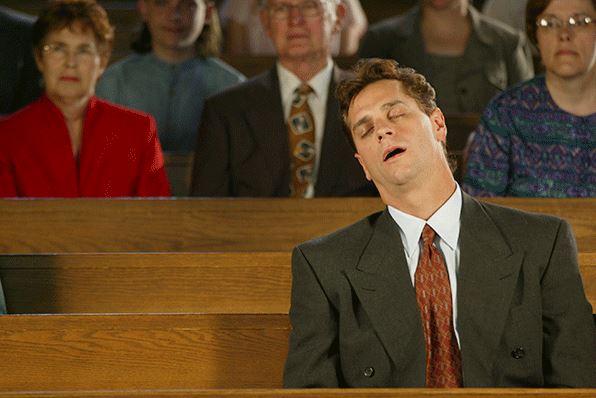
Church sucks, that's why men are bored there

My friend Wes posted an article about how communication is set up in the church, and why it’s not effective at equipping Christians to defend their worldview in hostile environments. The article describes what I encountered in church, after I was raised in a non-Christian home and become a Christian on my own by reading the New Testament. The view presented in the essay is how I viewed the church, and is probably how most outsiders view church. I think it explains why young people leave the church in droves once they move out of their parents’ houses.

The author writes:

On the Internet, one soon discovers that many respected church leaders are quite unable to deal directly with opposing viewpoints. In fact, many of them can’t even manage meaningful engagement with other voices. Their tweets may be entirely one-way conversations. They talk at their audiences. They can talk about other voices, but fail to talk to them, let alone with them. Their representations of opposing viewpoints reveal little direct exposure to the viewpoints in question.

[…]Around this point, it can start to dawn on one that many church leaders have only been trained in forms of discourse such as the sermon and, to a much lesser extent, the essay. Both forms privilege a single voice—their voice—and don’t provide a natural space for response, questioning, and challenge. Their opinions have been assumed to be superior to opposing viewpoints, but have never been demonstrated to be so. While they may have spoken or written about opposing voices, they are quite unaccustomed to speaking or writing to them (not to mention listening to or being cross-examined by them). There are benefits to the fact that the sermon is a form of discourse that doesn’t invite interruption or talking back, but not when this is the only form of discourse its practitioners are adept in.

Many church leaders have been raised and trained in ideologically homogenous cultures or contexts that discouraged oppositional discourse. Many have been protected from hostile perspectives that might unsettle their faith. Throughout, their theological opinions and voices have been given a privileged status, immune from challenge. Nominal challenges could be brushed off by a reassertion of the monologue. They were safe to speak about and habitually misrepresent other voices to their hearers and readers, without needing to worry about those voices ever enjoying the power to answer them back. Many of the more widely read members of their congregations may have had an inkling of the weakness of their positions in the past: the Internet just makes it more apparent.

One of my friends who comments here as “Wintery’s Friend” actually did his M. Div, and I think it was he who told me that his seminary had dropped the lone course in apologetics that had been part of the curriculum. Now seminary grads don’t learn any opposing views. They just pre-suppose that the Bible is true in the same way that Mormons pre-suppose their Bible is true. It’s a Mormon epistemology that’s been adopted by Christian seminarians.

More:

If one’s opinion has never been subjected to and tried by rigorous cross-examination, it probably isn’t worth much. If one lacks the capacity to keep a level head when one’s views are challenged, one’s voice will be of limited use in most real world situations, where dialogue and dispute is the norm and where we have to think in conversation with people who disagree with us.

The teachers of the Church provide the members of the Church with a model for their own thinking. The teacher of the Church does not just teach others what to believe, but also how to believe, and the process by which one arrives at a theological position. This is one reason why it is crucial that teachers ‘show their working’ on a regular basis. When teaching from a biblical text, for instance, the teacher isn’t just teaching the meaning of that particular text, but how Scripture should be approached and interpreted more generally. An essential part of the teaching that the members of any church need is that of dealing with opposing viewpoints. One way or another, every church provides such teaching. However, the lesson conveyed in all too many churches is that opposing voices are to be dismissed, ignored, or ‘answered’ with a reactive reassertion of the dogmatic line, rather than a reasoned response.

You can imagine that the first questions that you’ll be asked by a non-Christian co-worker would be things like “why think God exists?” and “why think the Bible is history rather than legend?”. What I’ve learned from listening to pastors is that very few are equipped to answer those questions. Most just assume that God exists and that the Bible is inerrant. And they don’t show their work, because they haven’t done the work. Moreover, they actively oppose apologetics as “divisive” and “prideful”. And so their flocks can attend church for 20 years and never learn a single useful piece of information that can be used in a real-world discussion. If you’re wondering why kids raised in married Christian homes start getting drunk and shacking up with atheists the minute they hit college, then look at the pastors who mocked their honest questions instead of preparing to answer them with evidence.

More:

I believe that there are various problems in the Church that are exacerbated by this. Where they are led by voices that can’t cope with difference or challenge, churches will tend to become fissiparous echo chambers, where people are discouraged from thinking critically about what leaders are saying and doing. The integrity of the Church’s theological conversation will not be tested through criticism and challenge. Churches that are led by such leaders will habitually develop polarized oppositions with their critics.

Unfortunately, in conservative churches, pious church leaders like Al Mohler, Russell Moore, Denny Burk, etc. oppose the use of evidence in apologetics, especially scientific and historical evidence. They don’t like the idea that humans can consider evidence rationally, and make a decision – even though Jesus regularly presents evidence to people who don’t believe in him in the Bible, and expects them to respond to it. The approach of pious Christian leaders to Christian teaching is to parrot Bible verses and hope that it has a magical effect of compelling faith in unbelievers. I call this the magic-words view of the Bible. For example, these pastors would not use peer-reviewed evidence from the social sciences when discussing moral issues like premarital sex, they would just cite the Bible’s teaching on it – to non-Christians!

I don’t know about you, but I think that a peer-reviewed paper on the dangers of premarital promiscuity has far more weight than something like this from Denny Burk:

If the Bible is the word of God, then it merely needs to be proclaimed. It has intrinsic power that cannot be nullified by the most hardened of skeptics. For that reason, we can have confidence in proclaiming it to anyone. And we can say “the Bible tells me so” without blushing.

That’s just fideism, and it’s the majority view among conservative church leaders. If you had to pick a single passage that explained the decline of Bible-based Christianity in America, you couldn’t find a better passage. What’s most surprising is that this fideistic view of Christianity is not even Biblical. The Biblical view of faith is that faith is trust in God, based on evidence. This is why Jesus offered his own resurrection as evidence to a generation of unbelievers. His miracles were also evidence offered to unbelievers. And the Old Testament is filled with examples of people like Isaiah presenting evidence to unbelievers. The fideist view sounds more like the Mormon “burning of the bosom” view.

I think the Mormon / fideist camp is just imposing their own man-made views onto the text in order to get out of the hard work of having to actually study and prepare to have debates with non-Christians. The motivation is laziness, and piety is just how they dress up their laziness to make it seem positive. Unfortunately, the product of this pious laziness is ignorance, and ignorance costs young people their faith. It doesn’t seem to bother these pastors at all that they can’t have meaningful engagements with non-Christians, or that they don’t equip young Christians to defend themselves. They’re oblivious to the world outside of the church doors.

In conclusion, we really need to stop giving respect to fideist pastors, if we expect to train up a generation of young Christians who are able to retain their faith and have an influence. We would never accept Mormon fideism as a sign of competence in any other real-world area of our lives, e.g. – auto repair, software engineering, surgery or tax law. We shouldn’t accept Mormon fideism as a sign of competence in teaching the Bible, either.

Positive arguments for Christian theism

J. Warner Wallace: different answers to the question “why are you a Christian?”

This assault rifle is OK, but apologetics is better
LAPD homicide detective Jim Wallace examining an assault rifle

I sometimes think about the horrible experiences I had encountering “normal” Christians in American churches after having become a Christian on my own through reading the New Testament, reading apologetics, and watching William Lane Craig debates. I heard a lot of different reasons to be a Christian from the church Christians, and what struck me was 1) their reasons had nothing to do with objective truth, and 2) their reasons hadn’t prepared them to have serious conversations about Christianity with non-Christians.

Well, J. Warner Wallace recently posted an episode of his podcast about this, and I thought that this might be useful to people who (like me) were confused by what they found in the church.

Here is the video:

And he has a blog post about it, where he explains all the responses to the question “why are you a Christian?” which he got from the church – none of which were like his answer for why he became a Christian.

Here are some answers that were not like his answer:

I Didn’t Become a Christian Because I Was Raised in the Church
I didn’t come from a Christian family. I wasn’t raised in the church or by people who attended church regularly. While students often tell me this is the reason they’re Christians, this wasn’t the case for me.

I Didn’t Become a Christian Because My Friends Were Christians
I also didn’t know any Christians. I was never invited to church by anyone as a child, and although I knew Christians in my college years, none of these folks ever invited me to church either. My friends were all happy atheists. I didn’t become a Christian to be part of a club.

I Didn’t Become a Christian Because I Wanted to Know God
I can honestly say I had no interest in God growing up, while in college, or while a young married man. I felt no “hole” in my life, had no yearning for the transcendent, no sense something was missing. I was happy and content. I didn’t become a Christian to fulfill some need.

I Didn’t Become a Christian Because I Wanted to Go to Heaven
I was also comfortable with my own mortality. Sure it would be nice if we could all live forever, but that’s just not the way it is. Live life to the fullest, enjoy your friends and family while you have them, and stop whining. I didn’t become a Christian because I was afraid of dying.

I Didn’t Become a Christian Because I Needed to Change My Life
My life prior to becoming a Christian was great. I had a meaningful and fulfilling career, a beautiful family, an incredible wife, and lots of friends. I wasn’t struggling and looking for a solution. I didn’t become a Christian to stop beating my wife or to sober up.

I’m sure that all my readers know that Wallace is a homicide detective, and an evidentialist. He handles evidence and builds cases with evidence, and that’s how he approaches his worldview as well. So he didn’t answer any of those.

Wallace’s answer was different:

[…][A]lthough these reasons might motivate students to start their journey, I hope these aren’t the only reasons they’re still here. I’m not sure any of these motivations will suffice when push comes to shove, times get tough or students face the challenges of university life. In the end,truth matters more than anything else. I’m not looking for a useful delusion, a convenient social network, or an empty promise. I just want to know what’s true. I think the students I met in Montreal resonated with this approach to Christianity. They are already members of the Church, have friends in the group, understand the importance of a relationship with God and the promise of Heaven. Now they want to know if any of this stuff is true. It’s our job, as Christian Case Makers, to provide them with the answer.

I’m actually much harder on church Christians than he is, because I found that the more fideistic the Churchian, the less you could count on them to act like authentic Christians. I have never met an evidential apologist who was soft on moral questions or tough theology, for example. To me, if you have an evidentialist approach to Christianity, then you have no problem with things like a bodily resurrection of Jesus, with exclusive salvation through faith alone in Christ alone, with a literal eternal separation from God called Hell, and so on.

What about people in other religions? Well, if evidence is your first concern, then it doesn’t bother you that someone of a different religion won’t be saved. For example, I like my Mormon friends, but I know that they’re wrong in their belief in an eternal universe. When I present evidence to them for the beginning of the universe, they just tell me that science isn’t as important to them as the burning in the bosom, their family, their community, etc. Well, if those things are more important to you than knowing the truth about God as he really is, then I’m fine with whatever God decides to do with you when you eventually get old, die and face judgement.

A truth-centered approach to life makes you indifferent to what people think of you. And that’s something that we could all use as Christians, especially those Christians who are more driven by feelings than by facts. A lot of people raised in the church drop out because they go somewhere (e.g. – college) where they are made to feel bad for being different. That’s not a problem for evidentialists. We like to be right. We don’t care what people who are wrong think about us. Christians should all read 1 Corinthians 4:1-4, and accept the fact that being truth-centered isn’t going to make you popular.

Positive arguments for Christian theism

Why do some Christians say “all sins are equally bad” and “everyone is equally guilty”?

Young women very supportive of premarital sex

We were having a discussion about whether the Bible teaches that sex before marriage is morally wrong, and someone said “impure thoughts counts as adultery… there isn’t a virgin among us”.

Regarding her point that lust is equal to adultery, and so no one is really a virgin, here’s Ligonier Ministries:

In demonstrating that the seventh commandment was given also to prohibit lust, Jesus is not somehow saying that an unconsummated lustful intent is sinful to the same degree as an actual extramarital affair (though both sins merit punishment). The latter is a more blatant violation of the statute against adultery, and it has greater consequences in the form of divorce and the loss of one’s reputation as a trustworthy person.

Any serious student of the Bible is aware of Jesus’ tendency to exaggerate / use hyperbole.

Also, 1 Corinthians 7 says that wives are not supposed to make a habit of denying their husbands sex. Sex withholding is more of an epidemic today than pornography, and it should also be on the adultery spectrum. It isn’t as bad as adultery, but it definitely breaks the marital covenant.

So why would someone say that lust is the same as adultery, and that there is no such thing as a virgin?

Dr. Michael Krueger recently blogged about this “all sins are equal” view.

Krueger says this:

First, to say all sins are the same is to confuse the effect of sin with the heinousness of sin. While all sins are equal in their effect (they separate us from God), they are not all equally heinous.

Second, the Bible differentiates between sins. Some sins are more severe in terms of impact (1 Cor 6:18), in terms of culpability (Rom 1:21-32), and in terms of the judgment warranted (2 Pet 2:17; Mark 9:42; James 3:1).

Krueger explains the motivation behind the slogans:

[S]ome Christians… use this phrase as way to “flatten out” all sins so that they are not distinguishable from each other. Or, to put it another way, this phrase is used to portray all human beings as precisely the same. If all sins are equal, and all people sin, then no one is more holy than anyone else.

In a world fascinated with “equality,” this usage of the phrase is particularly attractive to folks. It allows everyone to be lumped together into a single undifferentiated mass.

Such a move is also useful as a way to prevent particular behaviors from being condemned. If all sins are equal, and everyone is a sinner, then you are not allowed to highlight any particular sin (or sinner).

Needless to say, this usage of the phrase has featured largely in the recent cultural debates over issues like homosexuality. Yes, homosexuality is a sin, some Christians reluctantly concede. But, they argue, all sins are equal in God’s sight and therefore it is no different than anything else. Therefore, Christians ought to stop talking about homosexuality unless they are also willing to talk about impatience, anger, gluttony, and so on.

Krueger also posted this fascinating follow up post, where he looks at how the phrase is being used by people on Twitter.

Look at these tweets:

  • All sins are equal. People tend to forget that. There is no bigger or smaller sin. Being gay and lying, very equal.

  • all sins are equal in God’s eyes. whatever you’re doing, is no better than what someone else is doing.

  • If you have sex before marriage please don’t come on social media preaching about the wrongs of homosexuality. All sins are equal

  • Need people to realize that all sins are equal… don’t try to look down on me or question my faith just cuz you sin differently than I do.

  • Don’t understand why you’re so quick to judge me, when all sins are equal. So much for family..

  • if you think being gay is a sin, let me ask you something, have you not done anything wrong in your life? all sins are equal. we’re sinners

  • Nope no difference at all. All sins are equal no matter what you’re running for. The bible says do not judge lest ye be judged

  • A huge problem I have with religion is the notion that all sins are equal. Like pre-martial sex and murder are the same amount t of bad.

  • people do bad things because they believe that all sins are equal and ~god~ loves y’all equally so he’s going to forgive you naman ha ha ha

  • It a sin to condemn another sinner and their actions. All sins are equal. So what makes you better than the person you’re condemning?

  • I think so b/c having sex before marriage doesn’t make you less of a women then if you waited until marriage.. all sins are equal soo

  • friendly reminder, all sins are equal in gods eyes so you’re not better than I am in any way. please worry about your own sins before mine.

  • People don’t like when I suggest abortion as an option. This is a free country and all sins are equal so mind your business!!!

  • What I do is no worse than wat you do… all sins are equal no matter what it is… a sin is a sin

  • to god all sins are equal so you have no right to compare your sins to someone else’s bc in the end it doesn’t matter

The first thing that I noticed is that premarital sex and homosexuality are the most popular sins. I would think that divorce and abortion would be up there in the rankings, as well.

People want to be free to follow their hearts when seeking pleasure, then quote the Bible (badly) afterwards, to attack anyone who says that anything they’ve done is morally wrong. They would rather escape the judgment of their peers than admit fault and try to fix the mistake, and do better next time. And they would rather tell people who are hurting themselves by breaking the rules that there are no rules. It makes them feel good to “not judge” – they feel as if they are being kind. Their compassion looks good to non-Christians. And they’re promoting moral relativism which, when it becomes widespread, prevents anyone from judging them.

It’s so bad now, that the people who have morals and who make moral judgments are seen as the real bad people. The immoral people are on the offense, and even trying to ban people from being able to disagree with them.