
Tag Archives: Christianity

Trying to make Christianity entertaining makes people think that it’s fake

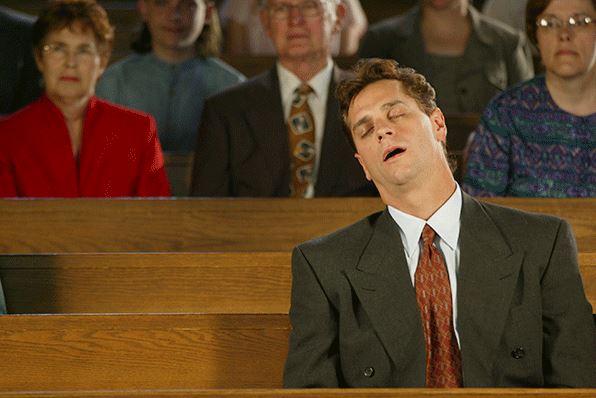
Church sucks, that's why men are bored there
Church sucks, that’s why men are bored there

My friend Bruce shared this article from the leftist The Atlantic on Facebook. It’s written by Larry Taunton of Fixed Point Foundation.  Larry surveyed some people who had left the church, and I thought it was worth it to look at this case of Phil.

Larry writes:

“Church became all about ceremony, handholding, and kumbaya,” Phil said with a look of disgust. “I missed my old youth pastor. He actually knew the Bible.”

[…]Phil was in my office as part of a project that began last year. Over the course of my career, I have met many students like Phil. It has been my privilege to address college students all over the world, usually as one defending the Christian worldview. These events typically attract large numbers of atheists. I like that. I find talking to people who disagree with me much more stimulating than those gatherings that feel a bit too much like a political party convention, and the exchanges with these students are mostly thoughtful and respectful.

[…]A smart, likable young man, he sat down nervously as my staff put a plate of food before him. Like others after him, he suspected a trap. Was he being punk’d? Talking to us required courage of all of these students, Phil most of all since he was the first to do so. Once he realized, however, that we truly meant him no harm, he started talking — and for three hours we listened.

Now the president of his campus’s SSA, Phil was once the president of his Methodist church’s youth group. He loved his church (“they weren’t just going through the motions”), his pastor (“a rock star trapped in a pastor’s body”), and, most of all, his youth leader, Jim (“a passionate man”). Jim’s Bible studies were particularly meaningful to him. He admired the fact that Jim didn’t dodge the tough chapters or the tough questions: “He didn’t always have satisfying answers or answers at all, but he didn’t run away from the questions either. The way he taught the Bible made me feel smart.”

Listening to his story I had to remind myself that Phil was an atheist, not a seminary student recalling those who had inspired him to enter the pastorate. As the narrative developed, however, it became clear where things came apart for Phil. During his junior year of high school, the church, in an effort to attract more young people, wanted Jim to teach less and play more. Difference of opinion over this new strategy led to Jim’s dismissal. He was replaced by Savannah, an attractive twenty-something who, according to Phil, “didn’t know a thing about the Bible.” The church got what it wanted: the youth group grew. But it lost Phil.

An hour deeper into our conversation I asked, “When did you begin to think of yourself as an atheist?”He thought for a moment. “I would say by the end of my junior year.”

I checked my notes. “Wasn’t that about the time that your church fired Jim?”

He seemed surprised by the connection. “Yeah, I guess it was.”

A couple of years ago, I was talking to a woman who grew up in a Christian home that was very focused on externals. There was a lot of bullying to get her to comply with expected Christian behavior, although the expected Christian behavior was often arbitrary, and had nothing to do with Christianity and more with just appearing “nice”. There was no discussion of the evidence, no talking through objections. No focus on truth at all. She was always very curious about me, and how come I didn’t drink, and how come I was able to stay a virgin through college, grad school, to the present day when many people who were raised in the church fell away from it in college. My answer was simple. I never grew up in a Christian home so I was never bullied into acting like a Christian beyond what I was convinced of myself. There was no rebellion, I just took my time and proved everything out before I had to act any particular way.

I didn’t ever have to go to church. I didn’t go to church until  was comfortable going, and I would say that I still am not comfortable in church – ever. If I felt bored in church, I read an apologetics book, and I did this openly. If I didn’t like the words of a song, then I didn’t sing. I liked to read apologetics books from the beginning, and when I talked to church Christians, I just classified the ones who didn’t read apologetics as non-Christians – as fakes. So I never felt like there was anything wrong with me because I didn’t sing, pray, read the Bible or do more church stuff. To me, if you didn’t like apologetics, you were a fake and you were faking behaviors that you had no way of verifying. Apologetics is the baseline activity of church, and only fakers try to skip over it. From the existence of God, we move on to the accuracy of the Bible, and on to theology, and then and only then do we start the outward behaviors of a Christian. If you skip to the behaviors, that is unnatural – like acting a part of a doctor when you have never been to medical school. It’s morally wrong to try to pretend to be something you are not.

Bruce commented this above the post:

When authentic conviction is lacking in your words and actions–or your “zeal” lacks the requisite knowledge to back it up–your teenager knows it.

Right. Young people in the church can tell when old people are more interested in feelings and posing. All they have to do is ask you how much you have done to study whether the things you believe are true. If you have read more devotional literature than you have read apologetics, then you’re a fraud. And that, more than anything, is what causes young people to step away from a two-way relationship with God.

My friend Stephen Bedard tweeted this, recently:

“Frankly, I find it hard to understand how people today can risk parenthood without having studied apologetics.” – William Lane Craig

I think you have to blame parents and the pastors when young people reject Christianity.  They are the ones who focus on outward behaviors, feelings and rituals instead of frank discussions about truth where reason and evidence are center stage.

It also might also be a good idea to have an occasional sermon on morality, where we talk about how the Bible condemns premarital sex, drunkenness and divorce.  Maybe quote some studies on the harm of premarital sex and single motherhood. Maybe talk about how the divorce laws and divorce courts encourage women to initiate divorces. Something practical about moral issues, and not just the ones that are politically correct. We should be speaking out against sinful behaviors. Setting up moral boundaries against hedonism and peer pressure is an important way to protect children, for one thing. And I don’t think that religious liberty can survive in a society that affirms sinful behaviors like drunkenness, premarital sex and divorce as normal. Is there a pastor alive who has ever preached against radical feminism, and how radical feminism caused the sexual revolution: premarital promiscuity, unilateral divorce and abortion?

If I had to rely on deciding what Christianity was from looking at people in the church, or from looking to my parents or peers, I would never be where I am today. I can barely tolerate church, especially the singing. Pastors who assume the Bible is true. Pastors who never connect their preaching to historical context, historical evidence, philosophical arguments or scientific evidence. Pastors who try to make me feel things, instead of engaging with non-Christian critics.  Pastors who never mention current events or public policy. Christianity ought to be more like engineering or lab work if you want to appeal to young people – testable, repeatable, practical. Think back to math class, and how teachers would insist that students show their work, instead of just writing the answer down. Instead of just saying “the Bible says”, pastors and parents really need to show young people their work – how did they arrive at their worldview? It’s not respectable to be ignorant about these things – there should be no respect in the church for people who put piety above truth.

Is the definition of atheism “a lack of belief in God”?

I have a key that will unlock a puzzling mystery

First, let’s see check with the Stanford University Encyclopedia of Philosophy:

‘Atheism’ means the negation of theism, the denial of the existence of God.

Stanford University is one of the top 5 universities in the United States, so that’s a solid definition. To be an atheist is to be a person who makes the claim that, as a matter of FACT, there is no intelligent agent who created the universe. Atheists think that there is no God, and theists think that there is a God. Both claims are objective claims about the way the world is out there, and so both sides must furnish forth arguments and evidence as to how they are able to know what they are each claiming.

Philosopher William Lane Craig has some thoughts on atheism, atheists and lacking belief in God in this reply to a questioner.

Question:

In my discussions with atheists, they  are using the term that they “lack belief in God”. They claim that this is different from not believing in God or from saying that God does not exist. I’m not sure how to respond to this. It seems to me that its a silly word-play and is logically the same as saying that you do not believe in God.
What would be a good response to this?
Thank you for your time,

Steven

And here is Dr. Craig’s full response:

Your atheist friends are right that there is an important logical difference between believing that there is no God and not believing that there is a God.  Compare my saying, “I believe that there is no gold on Mars” with my saying “I do not believe that there is gold on Mars.”   If I have no opinion on the matter, then I do not believe that there is gold on Mars, and I do not believe that there is no gold on Mars.  There’s a difference between saying, “I do not believe (p)” and “I believe (not-p).”   Logically where you place the negation makes a world of difference.

But where your atheist friends err is in claiming that atheism involves only not believing that there is a God rather than believing that there is no God.

There’s a history behind this.  Certain atheists in the mid-twentieth century were promoting the so-called “presumption of atheism.” At face value, this would appear to be the claim that in the absence of evidence for the existence of God, we should presume that God does not exist.  Atheism is a sort of default position, and the theist bears a special burden of proof with regard to his belief that God exists.

So understood, such an alleged presumption is clearly mistaken.  For the assertion that “There is no God” is just as much a claim to knowledge as is the assertion that “There is a God.”  Therefore, the former assertion requires justification just as the latter does.  It is the agnostic who makes no knowledge claim at all with respect to God’s existence.  He confesses that he doesn’t know whether there is a God or whether there is no God.

But when you look more closely at how protagonists of the presumption of atheism used the term “atheist,” you discover that they were defining the word in a non-standard way, synonymous with “non-theist.”  So understood the term would encompass agnostics and traditional atheists, along with those who think the question meaningless (verificationists).  As Antony Flew confesses,

the word ‘atheist’ has in the present context to be construed in an unusual way.  Nowadays it is normally taken to mean someone who explicitly denies the existence . . . of God . . . But here it has to be understood not positively but negatively, with the originally Greek prefix ‘a-’ being read in this same way in ‘atheist’ as it customarily is in . . . words as ‘amoral’ . . . . In this interpretation an atheist becomes not someone who positively asserts the non-existence of God, but someone who is simply not a theist. (A Companion to Philosophy of Religion, ed. Philip Quinn and Charles Taliaferro [Oxford:  Blackwell, 1997], s.v. “The Presumption of Atheism,” by Antony Flew)

Such a re-definition of the word “atheist” trivializes the claim of the presumption of atheism, for on this definition, atheism ceases to be a view.  It is merely a psychological state which is shared by people who hold various views or no view at all.  On this re-definition, even babies, who hold no opinion at all on the matter, count as atheists!  In fact, our cat Muff counts as an atheist on this definition, since she has (to my knowledge) no belief in God.

One would still require justification in order to know either that God exists or that He does not exist, which is the question we’re really interested in.

So why, you might wonder, would atheists be anxious to so trivialize their position?  Here I agree with you that a deceptive game is being played by many atheists.  If atheism is taken to be a view, namely the view that there is no God, then atheists must shoulder their share of the burden of proof to support this view.  But many atheists admit freely that they cannot sustain such a burden of proof.  So they try to shirk their epistemic responsibility by re-defining atheism so that it is no longer a view but just a psychological condition which as such makes no assertions.  They are really closet agnostics who want to claim the mantle of atheism without shouldering its responsibilities.

This is disingenuous and still leaves us asking, “So is there a God or not?”

So there you have it. We are interested in what both sides know and what reasons and evidence they have to justify their claim to know. We are interested in talking to people who make claims about objective reality, not about themselves, and who then go on to give reasons and evidence to support their claims about objective reality. There are atheists out there that do make an objective claim that God does not exist, and then support that claim with arguments and evidence. Those are good atheists, and we should engage in rational conversations with them. But clearly there are some atheists who are not like that. How should we deal with these “subjective atheists”?

Dealing with subjective atheists

How should theists respond to people who just want to talk about their psychological state? Well, my advice is to avoid them. They are approaching religion irrationally and non-cognitively – like the person who enters a physics class and says “I lack a belief in the gravitational force!”.  When you engage in serious discussions with people about God’s existence, you only care about what people know and what they can show to be true. We don’t care about a person’s psychology.

Dealing with persistent subjective atheists

What happens when you explain all of that to a subjective atheist who continues to insist that you listen to them repeat over and over “I lack a belief in God, I lack a belief in God”? What if you tell them to make the claim that God does not exist, and then support it with arguments and evidence, but instead they keep leaving comments on your blog telling you again and again about their subjective state of mind: “I lack a belief in cupcakes! I lack a belief in icebergs!” What if they keep e-mailing you and threatening to expose you on Twitter for refusing to listen to them, or denounce you via skywriting: “Wintery Knight won’t listen to me! I lack a belief in crickets!”. I think at this point you have to give up and stop talking to such a person.

And that’s why I moderate and filter comments on this blog. There are uneducated people out there with access to the Internet who want attention, but I am not obligated to give it to them. And neither are you. We are not obligated to listen to abusive people who don’t know what they are talking about. I do post comments from objective atheists who make factual claims about the objective world, and who support those claims with arguments and evidence. I am not obligated to post comments from people who refuse to make objective claims or who refuse to support objective claims with arguments and evidence. And I’m not obligated to engage in discussions with them, either.

Related posts

Bible study: the importance of truth in religion

Bible study that hits the spot

Here’s an interesting passage of the Bible. What do you all think the practical value of this passage is?

1 In the second year of his reign, Nebuchadnezzar had dreams; his mind was troubled and he could not sleep.

2 So the king summoned the magicians, enchanters, sorcerers and astrologers to tell him what he had dreamed. When they came in and stood before the king,

3 he said to them, “I have had a dream that troubles me and I want to know what it means.”

4 Then the astrologers answered the king, “May the king live forever! Tell your servants the dream, and we will interpret it.”

5 The king replied to the astrologers, “This is what I have firmly decided: If you do not tell me what my dream was and interpret it, I will have you cut into pieces and your houses turned into piles of rubble.

6 But if you tell me the dream and explain it, you will receive from me gifts and rewards and great honor. So tell me the dream and interpret it for me.”

7 Once more they replied, “Let the king tell his servants the dream, and we will interpret it.”

8 Then the king answered, “I am certain that you are trying to gain time, because you realize that this is what I have firmly decided:

9 If you do not tell me the dream, there is only one penalty for you. You have conspired to tell me misleading and wicked things, hoping the situation will change. So then, tell me the dream, and I will know that you can interpret it for me.”

10 The astrologers answered the king, “There is no one on earth who can do what the king asks! No king, however great and mighty, has ever asked such a thing of any magician or enchanter or astrologer.

11 What the king asks is too difficult. No one can reveal it to the king except the gods, and they do not live among humans.”

12 This made the king so angry and furious that he ordered the execution of all the wise men of Babylon.

13 So the decree was issued to put the wise men to death, and men were sent to look for Daniel and his friends to put them to death.

14 When Arioch, the commander of the king’s guard, had gone out to put to death the wise men of Babylon, Daniel spoke to him with wisdom and tact.

15 He asked the king’s officer, “Why did the king issue such a harsh decree?” Arioch then explained the matter to Daniel.

16 At this, Daniel went in to the king and asked for time, so that he might interpret the dream for him.

17 Then Daniel returned to his house and explained the matter to his friends Hananiah, Mishael and Azariah.

18 He urged them to plead for mercy from the God of heaven concerning this mystery, so that he and his friends might not be executed with the rest of the wise men of Babylon.

19 During the night the mystery was revealed to Daniel in a vision. Then Daniel praised the God of heaven

20 and said:

“Praise be to the name of God for ever and ever;
wisdom and power are his.

21 He changes times and seasons;
he deposes kings and raises up others.
He gives wisdom to the wise
and knowledge to the discerning.

22 He reveals deep and hidden things;
he knows what lies in darkness,
and light dwells with him.

23 I thank and praise you, God of my ancestors:
You have given me wisdom and power,
you have made known to me what we asked of you,
you have made known to us the dream of the king.”

24Then Daniel went to Arioch, whom the king had appointed to execute the wise men of Babylon, and said to him, “Do not execute the wise men of Babylon. Take me to the king, and I will interpret his dream for him.”

25 Arioch took Daniel to the king at once and said, “I have found a man among the exiles from Judah who can tell the king what his dream means.”

26 The king asked Daniel (also called Belteshazzar), “Are you able to tell me what I saw in my dream and interpret it?”

27 Daniel replied, “No wise man, enchanter, magician or diviner can explain to the king the mystery he has asked about,

28 but there is a God in heaven who reveals mysteries. He has shown King Nebuchadnezzar what will happen in days to come. Your dream and the visions that passed through your mind as you were lying in bed are these:

29 “As Your Majesty was lying there, your mind turned to things to come, and the revealer of mysteries showed you what is going to happen.

30 As for me, this mystery has been revealed to me, not because I have greater wisdom than anyone else alive, but so that Your Majesty may know the interpretation and that you may understand what went through your mind.

This passage is interesting to me because it shows the kind of attitude that God answers. The King in this passage was tired of hearing man-made stories from his servants – stories that were undoubtedly influenced by the servants desire to survive the King’s wrath. The servants would only have told the King things that were vague and happy, so that they could never be proved wrong or found to be judgmental or offensive. But the King was tired of that. He wanted someone with authority to tell him the truth about the way the world was.

In the rest of the chapter, Daniel interprets the dream, and concludes by saying this: “The great God has shown the king what will take place in the future. The dream is true and its interpretation is trustworthy.”. The King replies: “Surely your God is the God of gods and the Lord of kings and a revealer of mysteries, for you were able to reveal this mystery.”

I think it is is going to be difficult for Christians living today to be able to tell people their dreams like that. But what we can do is talk about God’s miracles as revealed by science and history. We can study astrophysics, biochemistry and history and we can explain what God did in creating and fine-tuning the universe for life, in sequencing amino acids into functioning proteins, in creating brand new body plans in the Cambrian explosion, in raising Jesus from the dead as a matter of historical record, and so on. We have to show how great God is to people who do not even think he exists, and without assuming that they believe in the Bible.

There are still people out there like the King who are looking for someone who can speak to them with authority. All it takes from us is a little studying, and we can be like Daniel, too. But we have to know what God has done from science and history, and speak with authority about how we can know that God has acted supernaturally. Authority to speak comes from having knowledge about what we are talking about, and knowledge comes from studying and debating with people we disagree with. Nebuchadnezzar  was not a believer in the God of Israel, but he was still interested in truth. That won’t always be the case, but it is the case for some people.