First, let’s take a look at what the Bible says in general about capital punishment, using this lecture featuring eminent theologian Wayne Grudem.
About Wayne Grudem:
Grudem holds a BA from Harvard University, a Master of Divinity from Westminster Theological Seminary, and a PhD from the University of Cambridge. In 2001, Grudem became Research Professor of Bible and Theology at Phoenix Seminary. Prior to that, he had taught for 20 years at Trinity Evangelical Divinity School, where he was chairman of the department of Biblical and Systematic Theology.
Grudem served on the committee overseeing the English Standard Version translation of the Bible, and in 1999 he was the president of the Evangelical Theological Society. He is a co-founder and past president of the Council on Biblical Manhood and Womanhood. He is the author of, among other books, Systematic Theology: An Introduction to Biblical Doctrine, which advocates a Calvinistic soteriology, the verbal plenary inspiration and inerrancy of the Bible, the body-soul dichotomy in the nature of man, and the complementarian (rather than egalitarian) view of gender equality.
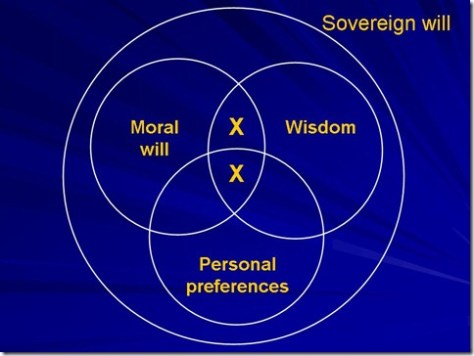
Here’s a wonderful post on decision making and the will of God posted on Neil’s blog. In his post, Neil explains the Biblical model for making good decisions.
Excerpt:
Really short version: Aside from direct and clear personal revelation from God, you don’t have access to his sovereign will when making decisions. Therefore you must look at other factors. If it isn’t moral, don’t do it. If it is moral but not wise, don’t do it. If it is moral and wise, then use your personal preferences.
Using this model you can end up with a wise and biblical decision, but you have avoided the traps of the “God told me to ____” routine. People who run around saying that God told them this and that convey a super-spirituality that can leave less mature believers wondering if they really have a relationship with God (i.e., “God doesn’t tell me every little thing to do, so maybe I don’t really know him.”).
He has a helpful picture posted as well:
This is actually a very important topic for me, because I like making plans and making good decisions. I like being the quarterback or squad leader of my own life. I like to pick objectives and then make plans to achieve them. (Nothing too exotic, just simple stuff like saving money or reading more books)
Actually, I really oppose the idea that God has a magical fairy tale will for each person that will make them happy and fulfilled. For me, life isn’t like that. I don’t expect God to lead me along like a child at a scavenger hunt. I expect to survey the battlefield where I am and then do something to make a difference. There are lots of things you can do that will please God. Should you focus on your career and sponsor apologetics conferences? Or should you use your spare time preparing Sunday school lessons? There are lots of good things you could do to please God. Your job is to pick the one that will be the most effective. It doesn’t matter if it makes you happy, it only matters if it’s effective and if you are good at it.
Who is Rifleman Dodd?
A while back, I was busily working my way through the U.S. Marine Corps Official Reading List, and I came across a book by C.S. Forester called Rifleman Dodd, or alternatively titled Death to the French. It’s a work of historical fiction that takes place during the Napoleonic wars. The story is about a British marksman named Dodd, who is cut off from his own lines during a withdrawal maneuver. He is subsequently left to fend for himself behind enemy lines. An ordinary man might be full of despair and forget about his mission entirely. But Dodd is no ordinary man. Not only does he find a way to survive by finding food to eat, water to drink and places to sleep, but he also tries to remember his orders and to think about what he can do to advance the cause of his General, the Duke of Wellington.
It’s about a green-coated British infantry rifleman in the Napoleonic Wars, an age when rifles were a novelty and most of the army was red-coated and carried muskets. Private Matthew Dodd gets separated from his regiment during a retreat and finds himself stranded behind enemy (French) lines in Portugal. With the occasional aid of some natives, but mostly on his own, he harasses the French with his rifle and tries to prevent them from building a bridge across the Tagus River. It’s a remarkable tale of survival and solitary achievement, of a rank-and-file soldier who lives by his wits and slowly learns to make plans without orders, and shows leadership qualities and a knowledge of warfare.
I think we’re in the same situation as Dodd.
There is no point in us looking for breadcrumb trails to happiness at this point. That’s not the point of Christianity. The point of Christianity is friendship with God, imitation of Christ, honoring moral obligations, self-sacrificial love for your neighbor (and even your enemies!), and dedication to the truth – whether anyone else likes you or not. It’s not supposed to make you happy, and it’s not necessarily going to be a normal life like everyone else has. Things may not work out the way you’d like them to.
We seem to be making such a big deal about compassion and forgiveness in the Christian life these days – such a big emphasis on our feelings. Almost like we have forgotten that we have obligations to our friend. A relationship doesn’t mean that one person does whatever they feel like, completely disregarding the character and goals of the other person and then is automatically granted forgiveness whenever they want it. That’s not a friendship – that’s using someone else for your own ends.
For a lot of people today, Christianity only comes into play after you’ve made a mistake and you’re feeling guilty. For example, suppose you decide to go to a party with your secular friends, then you drink too much, and you do something sexual that you shouldn’t have done. Or maybe you watched some prosperity gospel preacher on TV, then made irresponsible business decisions thinking that God would bail you out and make you rich, and you went bankrupt. Most people think Christianity is for this situation: you’re a Christian so that you don’t have to feel guilty about sin. And so that you can tell people that God forgives you, so that they can’t think anything bad about you, either. You sort of get your idea about what you should be doing in order to feel good from the culture, and God is just there to forgive it all when it blows up in your face.
But in my case, putting myself in a situation like that is not even possible. I’m more likely to try to plan to do something for God. Like, I might try to mentor a young Christian by sending them books. Or, I might try to teach a class in apologetics at my church. These are things that are for God, not for me. I’m not just being dragged along by the culture, and trying to find happiness by feeling good (e.g. – with alcohol) or being liked by non-Christians. And if my plans fail because the mentoree doesn’t grow up into anything, or nobody comes to my apologetics class, that’s when I go to God and say “I screwed up. but can I still be in your army?” And God always says yes to that. You don’t have to be the best player on the team for the Coach to like you. He already likes you.
One of the great things about being a Christian is that you can never lose your identity as a Christian by failing to do something for him that you planned to do. That’s what forgiveness is for. If you set out to do something for God’s glory, and you mess it all up, that’s OK. But I do think that, like Dodd, our ambition should not be about just making ourselves happy, or making non-Christians like us. We should be trying to make plans and carry them out for God.
That’s how I understand forgiveness. It’s not just something that’s there for you to use to fix your feelings when you’ve been irresponsible while seeking your own happiness in secular ways. It’s also there when you’re trying to do something good for God, and you fail. A lot of times in life you try your best, but you fail, and then you lose something that you really wanted. With God, when you try your best for his glory, and fail, you don’t lose your identity as a member of his team. I think that not losing your identity in Christ is even more important than not feeling guilty about selfish decision making.
So, have you got a plan to serve your General? Let’s focus more on what operations we’re planning for God than on being happy and being popular with non-Christians. Your life should not be all about you, with God just there to make your bad feelings go away. Your life should be about God’s goals and God’s interests.
In my last job, I had two interesting encounters, first with a secular Jewish leftist man and second with a New Age prosperity gospel feminist Christian woman.
So let’s talk about the two people.
The man who thinks that conservative Christians are stupid
The first kind of person who tried to shame me for being a Christian is the person who thinks that Christianity is stupid. This kind of person invokes things that he hears in secular leftist pop culture as if it is common knowledge that theism generally, and Christianity in particular, is false. He’s watched a documentary on the Discovery channel which said that the eternally oscillating cosmology was true. Or maybe he watched a documentary on the History Channel that said that Jesus never presented himself as God stepping into history. He presents these things that he reads in the New York Times, or sees on MSNBC or hears on NPR with the authority tone that Ben Carson might take when explaining modern medicine to a witch doctor.
Here is how things usually go with him:
Me: here are two arguments against naturalistic evolution, the origin of life and the Cambrian explosion.
Him: but you don’t believe in a young-Earth do you? I mean, you believe in evolution don’t you?
Me: let’s talk about how proteins and DNA is sequenced, and the sudden origin of Cambrian body plans
Him: (shouting) Do you believe in evolution? Do you believe in evolution?
And this:
Me: there hasn’t been any global warming for 18 years, and temperatures were warmer in the Medieval Warming Period
Him: but you don’t deny climate change, do you? everyone on NPR agrees that climate change is real
Me: let’s talk about the last 18 years of no warming, and the temperatures during the Medieval Warming Period
Him: (shouting) Do you believe in climate change? Do you believe in climate change?
He asks these questions so he can either label me as a nut, without having to weigh the evidence I’m presenting, or have me agree with him, without having to weigh the evidence I’m presenting. It’s all about ignoring the evidence, so he can get back to his busy, busy practical life – and get back to feeling smug about being smarter than others. I think a lot of men are like this – they don’t want to waste their valuable time studying, they just want to jump to the right conclusion, then get back to doing whatever they want – like running marathons, or driving their kids to hockey practice, etc.
So how do you respond to a man who gets his entire worldview from the culture, but never deals with peer-reviewed evidence? Well, I think you just defeat his arguments with evidence and then present your own (peer-reviewed) evidence, and then leave it at that. If the person just wants to jump to the conclusion that all the “smart” people hold to, without doing any of the work, then you can’t win. There are atheists out there who believe in the eternal oscillating universe they saw Carl Sagan talking about in their elementary school. You might try to argue for an origin of the universe by citing new evidence like the CMB and light element abundances. But sometimes, they won’t care. Carl Sagan said it 50 years ago, and that settles it. It doesn’t matter that the new evidence overturns the old theories, they don’t care.
Do you think that Christianity will make non-Christians like you?
1 I charge you in the presence of God and of Christ Jesus, who is to judge the living and the dead, and by his appearing and his kingdom:
2 preach the word; be ready in season and out of season; reprove, rebuke, and exhort, with complete patience and teaching.
3 For the time is coming when people will not endure sound teaching, but having itching ears they will accumulate for themselves teachers to suit their own passions,
4 and will turn away from listening to the truth and wander off into myths.
5 As for you, always be sober-minded, endure suffering, do the work of an evangelist, fulfill your ministry.
15 but in your hearts honor Christ the Lord as holy, always being prepared to make a defense to anyone who asks you for a reason for the hope that is in you; yet do it with gentleness and respect,
16 having a good conscience, so that, when you are slandered, those who revile your good behavior in Christ may be put to shame.
If you have orthodox theological beliefs in this day and age then you are going to be shamed, humiliated and reviled by people. And it’s not just having an orthodox view of who Jesus is that annoys them (e.g. – deity, exclusivity of salvation, morality, etc.). No, their disapproval spreads on into politics, especially abortion and gay marriage – basically any kind of rules around sexuality. That’s what’s really bugging these people, I think.
The woman who thinks Christianity is life-enhancement
This one is especially difficult when you are a young man, because we naturally look to women for approval and respect. You find yourself sitting in church or youth group, hoping for the approval and respect from the Christian women for your sound theology and effective apologetics. Little do you know that many Christian women understand Christianity as life-enhancement, designed to produce happy feelings. God is their cosmic butler whose main responsibility is to meet their needs and make their plans work out. Although you might be keen on sound theology and good apologetics arguments, she doesn’t think that’s important.
So how to deal with this unmet need for approval and respect from women in the church?
First thing, be careful that you don’t attend a church where the pastor in preaching and picking hymns that give you the idea that God is your cosmic butler. Second, read the Bible very carefully, and understand that with respect to God’s purposes for you in this world, your happiness is expendable. You cannot be looking to attractive Christian women that you happen to meet in church to support you, as many of them have long-since sold out to the culture. They are not interested in learning evidential apologetics to defend God’s reputation, or in defending the unborn, or in defending natural marriage, or in defending the free enterprise system that supports family autonomy from the state, etc. Those things are hard and unpopular, especially for those women who were raised to think that Christianity is about life enhancement and peer-approval.
1 This is how one should regard us, as servants of Christ and stewards of the mysteries of God.
2 Moreover, it is required of stewards that they be found faithful.
3 But with me it is a very small thing that I should be judged by you or by any human court. In fact, I do not even judge myself.
4 For I am not aware of anything against myself, but I am not thereby acquitted. It is the Lord who judges me.
5 Therefore do not pronounce judgment before the time, before the Lord comes, who will bring to light the things now hidden in darkness and will disclose the purposes of the heart. Then each one will receive his commendation from God.
4 No soldier gets entangled in civilian pursuits, since his aim is to please the one who enlisted him.
Or, since I like Ronald Speirs from Band of Brothers so much:
This is the situation in which we find ourselves, so get used to it. And believe me, I have to deal with this, too. So I have all the sympathy in the world for you. Resign yourself to the fact that no one is going to approve of you for being faithful to the gospel of Jesus Christ; not secular men, not Christian women. There is no cavalry coming to rescue you.



 WINTERY KNIGHT