Tag Archives: Christianity

What do Democrats like Joe Biden think about the moral teachings of Jesus in the Bible?

Enraged Joe Biden howls out his hatred for Bible-believing Christians
Enraged Democrat Joe Biden howls out his hatred for Bible-believing Christians

Joe Biden gave a speech to the largest gay rights organization in the United States, the HRC. The co-founder of the HRC, Terry Bean, was recently charged with sexual abusing a 15-year-old boy. Do you disagree with what Terry Bean is charged with? If so, then I think it’s important to know how far Joe Biden would go to punish you for your refusal to approve and celebrate Terry Bean.

Here’s the report on the speech from PJ Media:

Biden announced at an event in Ohio on Saturday that his number one priority, if elected, will be to enshrine LGBTQ rights into federal law via the Equality Act, a contentious, Orwellian effort by left-wing bullies to silence Christians who believe biblical teachings on marriage and reject the view that boys can be girls and girls can be boys.

During a half-hour speech at the Hum4n R1ghts C4mp4ign’s annual gala in Columbus, Ohio, Biden said, “It’s wrong and it is immoral what [the Trump administration] is doing,” citing efforts to bar transgender troops from the U.S. military and protect medical providers from being forced to violate their consciences.

[…]During his speech Biden portrayed LGBTQ individuals as victims, ignoring the fact that it is people of faith who have been the big losers in this war of ideas. Bakery owners are being sued out of existence, medical professionals are being pressured to embrace transgender ideology, and major corporations are pulling their business out of states that seek to protect religious freedom — which, by the way, is what made Mike Pence Public Enemy #1 in the eyes of the cultural revolutionaries.

[…]”The current vice president uses religious freedom as an excuse to license discrimination across broadly [sic] areas and denying LGBTQ Americans their basic rights. It is wrong and it is immoral what they are doing,” he declared.

“Just look at how much damage has been done in the past two weeks,” Biden said. […]The Department of Housing and Urban Development announced plans to allow homeless shelters to turn away transgender people. This is beyond the scope of anything remotely what we’ve seen before.”

To be clear, when he’s talking about homeless shelters, he’s talking about putting biological males in with women who are victims of sexual abuse. But if the HRC pays the piper, then the HRC calls the tune. They’re certainly calling the tune for many of our largest corporations.

When Joe Biden talks about people’s “beliefs”, he means the beliefs of Bible-believing Christians that might cause them to disagree with gay activists like Terry Bean. He’s talking about their right to refuse to participate in, subsidize or celebrate LGBT initiatives, such as same-sex marriage, sex-change surgeries, HRT drug treatments for children, etc. He’s talking about forcing parents to step aside while doctors and educators give hormone blockers to their children. Drugs that can have permanent effects. He basically wants to give gay activists like Terry Bean a veto over the Bible, the church, Christian organizations and Christian parents. A veto backed by the full force of the government.

By the way, the Terry Bean story wasn’t the first time that prominent Democrats have been involved in sex with underage boys. I’ll give just one more example. The Democrat mayor of Seattle – a champion of same-sex marriage in the state of Washington – was also charged, and resigned.

Now, the teaching of the Bible is pretty clear. No sex outside of marriage, and marriage defined as between one woman and one man. The definition of marriage is straight out of the mouth of Jesus. If you deny that, then you don’t accept Jesus as anything other than a normal man. Now, it’s a free country. Non-Christians should be able to vote how they please, and act how they please. But we need to be clear that no Democrat politician accepts the Bible as an authority on moral issues, and that no Democrat politician thinks that Jesus is other than a normal man. No Democrat politician thinks that Jesus knew what he was talking about when he spoke authoritatively about chastity and marriage. Democrat politicians like Joe Biden think Terry Bean knows more these moral issues than Jesus, and that’s why Joe Biden is speaking at the HRC rather than speaking at a Bible-believing organization like Liberty University or the Family Research Council or the Alliance Defending Freedom.

To be clear, I have no problem with people on the other side, like Dave Rubin, who disagree with me on moral issues. Dave lives his life in a way that would not be permissible for a Bible-believing Christian. But Dave accepts and defends my right to disagree with him on moral issues. That is not what we have with Democrat politicians like Joe Biden, who want to use the power of the state to suppress basic human rights, like free speech, freedom of association, parental authority, etc. I don’t want to force other people to act as if they believed what I believe. But I don’t think Bible-believing Christians should vote for someone who wants to use the power of government to force me to act as if I believed what they believe.

New study: As Christianity declines, so do stable relationships and marriage

Man and woman working on a computer upgrade
Man and woman working on a computer upgrade together

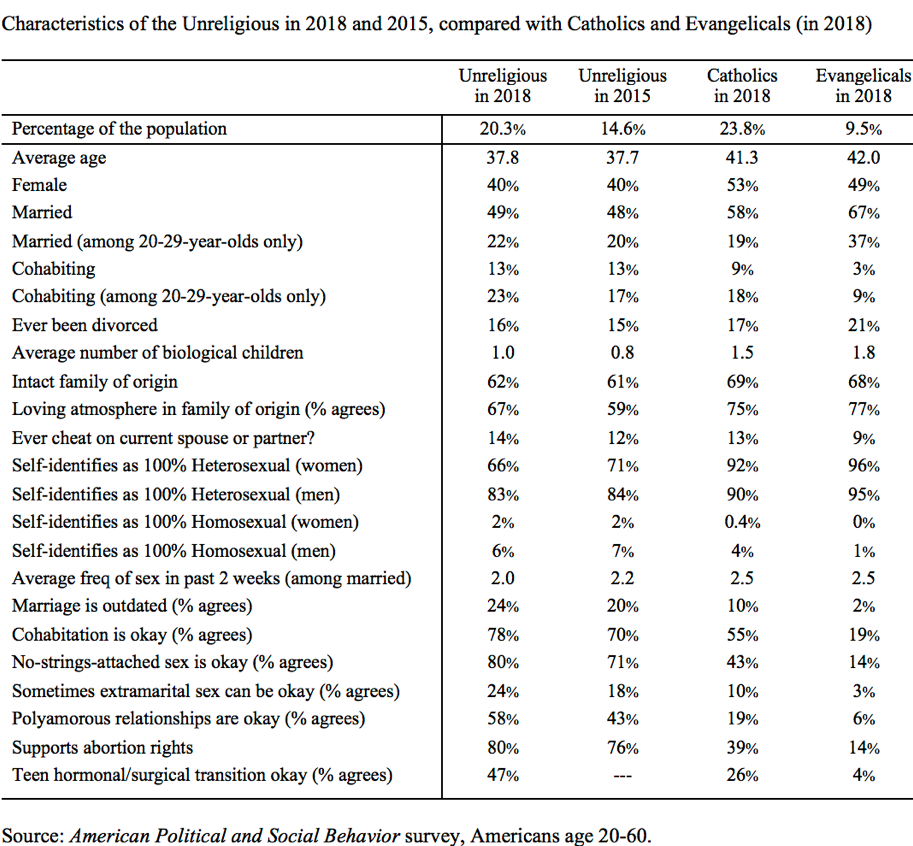
Mark Regnerus is a sociologist at the University of Texas, Austin. He publishes a lot of his books with Oxford University Press. So, his research methods are generally seen as reliable. I noticed that he had done a survey of views on religion, sexuality and marriage in 2018, and he published a popular level article about it earlier this week. I think it’s worth taking a look at his findings.

He writes:

Let me offer a word about the survey. I call it the American Political and Social Behavior survey, which interviewed 5,285 Americans in November 2018, just days after the midterm election. The data collection was conducted by Ipsos… a research firm with a very strong record of generating high-quality data for academic projects.

Here are his findings:

Views of unreligious, Catholic and evangelical Americans
Views of unreligious, Catholic and evangelical Americans (click to expand)

This is interesting:

Even when I limit the group to respondents below age thirty—which is just north of the median age at marriage in the United States—it is notable that 22 percent of the unreligious are married and 23 percent are currently cohabiting, not radically different from the 19 and 18 percent of Catholics that are married and cohabiting, respectively. For comparison, 37 and 9 percent of younger evangelicals are married and cohabiting, respectively. The cohabiting habits of the unreligious, however, have shifted—note the uptick in cohabitation—six percentage points in just under four years. That amounts to a 35 percent increase. Since it’s unlikely that the unreligious have recently changed their minds about the morality or pragmatics of living together, my bet is in the other direction: cohabiting leads many to no longer identify as religious at all.

Got that part in bold? Their attitudes are changing because of their sexual behaviors. So, if you want to reverse the decline of Christianity, we’re going to need to come up with some arguments and evidence to counter the sexual revolution. And on this blog, we’ve done that many times, looking at studies showing the future instability of marriages that occur after cohabitation. I’ve never heard a church preach on that, though. And it’s not something that even many Christian apologists focus on. Most Christian apologists, particularly the women, tend to focus on soft arguments,. They stay away from arguments about morality, because it’s divisive and abrasive to their desired audience. However, if the goal is persuading people that Christianity is a viable worldview, then we need to focus more on sexuality.

More Regnerus:

[O]n each of seven attitude measures I examined, the unreligious are notably more permissive than even the spiritual-but-not-religious (not shown). Nearly 80 percent of unreligious Americans agree (or strongly agree) that cohabitation is okay, no-strings-attached sex is okay, and abortion should be a legal right. This is all unsurprising. But even some of the more radically “progressive” attitudes demonstrate strong support among the unreligious: 24 percent agree that it is “sometimes permissible for a married person to have sex with someone other than his/her spouse.” (I thought perhaps women would differ from men here, but they didn’t—or at least not by much.) Although few Americans are actually in polyamorous living arrangements, the unreligious would support them should someone choose such an arrangement; 58 percent of them agreed that “it is okay for three or more consenting adults to live together in a sexual/romantic relationship,” a percentage that is far more supportive than Catholics or evangelicals. Among the latter, only 6 percent thinks polyamory could be okay.

A more interesting theme, however, is the surge in support for such alternatives. On each statement, note the rise in agreement that has occurred in just under four years. Polyamory tops the list—a 35-percent leap in the share of unreligious who now endorse polyamorous arrangements (from 43 to 58 percent). Even support for extramarital affairs grew by one-third (from 18 to 24 percent). The unreligious aren’t alone here. Catholics, too, have witnessed liberalization in attitudes. Evangelical numbers display a more modest uptick, and from lower starting points.

The non-religious people in my office who were raised Christian like to tell me that the existence of the Christian God isn’t important to them, because they can achieve marriage via cohabitation, and behave like good people without the need for any sort of framework to rationally ground it. They think that you can just pull out God, and the marriage will stay the same. They expect the people they start relationships with to act on Christian morality, even if the worldview was rejected as superstitious nonsense. But as you can see from the data, removing God has an enormous effect on the person’s ability to be stable and faithful.  The truth is that when you take out the vertical relationships with God, then the blueprint for the relationship becomes completely different. Relationships used to be seen as an enterprise where each person’s primary commitment was to lead and protect their spouse before delivering them to God with faith intact. Now, relationships are contingent on continuous happiness.

More Regnerus:

Only 66 percent of unreligious women say they are “100% Despite the permissive reputation of the unreligious, their actual marital sexual frequency is lower than that of Catholic and evangelical couples—at two instances in the past two weeks. As has been documented extensively in the past few years, the frequency of sex among American couples—whether cohabiting or married—has been declining at statistically significant rates. This pattern has not spared the godless.

I think this is interesting. I believe that men are facing an epidemic of sex-withholding from their wives, and I have an idea why that is. Today, women most commonly use sex to “jump start” a relationship with men who they perceive as “high value”, but who refuse to commit to them. This behavior is not focused on men who have commitment abilities, e.g. – provider, moral leader, spiritual leader, accurate worldview rooted in logic and evidence. Instead, most women use sex to get men who have the appearance of high value, e.g. – tall, tattoos, piercings, violent tendencies, exciting, fun, etc. Having established that pattern over and over with no-commitment bad boys, they marry someone who they see as beneath them, and then withhold sex. Commitment isn’t worthy of sex. It’s the man’s appearance and entertainment value that makes him worthy of sex. The comparison of this low-quality man to previous partners makes women more likely to initiate divorce for “unhappiness” later on.

William Lane Craig explains the doctrine of penal substitutionary atonement

I have a key that will unlock a puzzling mystery

Probably one of the most common questions that you hear from people who don’t fully understand Christianity is this question: “why did Jesus have to die?”. The answer that most Christians seem to hold to is that 1) humans are rebelling against God, 2) Humans deserve punishment for their rebellion, 3) Humans cannot escape the punishment for their rebellion on their own, 4) Jesus was punished in the place of the rebellious humans, 5) Those who accept this sacrifice are forgiven for their rebelling.

Are humans rebellious?

Some people think that humans are not really rebellious at all, but it’s actually easy to see. You can see it just by looking at how people spend their time. Some of us have no time for God at all, and instead try to fill our lives with material possessions and experiences in order to have happy feelings. Some of us embrace just the parts of God that make us feel happy, like church and singing and feelings of comfort, while avoiding the hard parts of that vertical relationship; reading, thinking and disagreeing with people who don’t believe the truth about God. And so on.

This condition of being in rebellion is universal, and all of us are guilty of breaking the law at some point. All of us deserve to be separated from God’s goodness and love. Even if we wanted to stop rebelling, we would not be able to make up for the times where we do rebel by being good at other times, any more than we could get out of a speeding ticket by appealing to the times when we drove at the speed limit, (something that I never do, in any case).

This is not to say that all sinners are punished equally – the degree of punishment is proportional to the sins a person commits. However, the standard is perfection. And worse than that, the most important moral obligation is a vertical moral obligation. You can’t satisfy the demands of the moral law just by making your neighbor happy, while treating God like a pariah. The first commandment is to love God, the second is to love your neighbor. Even loving your neighbor requires you to tell your neighbor the truth – not just to make them feel good. The vertical relationship is more important than the horizontal one, and we’ve all screwed up the vertical relationship. We all don’t want God to be there, telling us what’s best for us, interfering with our fun. We don’t want to relate to a loving God if it means having to care what he thinks about anything that we are doing.

Who is going to pay for our rebellion?

The Christian answer to the problem of our rebellion is that Jesus takes the punishment we deserve in our place.

However, I’ve noticed that on some atheist blogs, they don’t like the idea that someone else can take our punishment for us to exonerate us for crimes that we’ve committed. So I’ll quote from this post by the great William Lane Craig, to respond to that objection.

Excerpt:

The central problem of the Penal Theory is, as you point out, understanding how punishing a person other than the perpetrator of the wrong can meet the demands of justice. Indeed, we might even say that it would be wrong to punish some innocent person for the crimes I commit!

It seems to me, however, that in other aspects of human life we do recognize this practice. I remember once sharing the Gospel with a businessman. When I explained that Christ had died to pay the penalty for our sins, he responded, “Oh, yes, that’s imputation.” I was stunned, as I never expected this theological concept to be familiar to this non-Christian businessman. When I asked him how he came to be familiar with this idea, he replied, “Oh, we use imputation all the time in the insurance business.” He explained to me that certain sorts of insurance policy are written so that, for example, if someone else drives my car and gets in an accident, the responsibility is imputed to me rather than to the driver. Even though the driver behaved recklessly, I am the one held liable; it is just as if I had done it.

Now this is parallel to substitutionary atonement. Normally I would be liable for the misdeeds I have done. But through my faith in Christ, I am, as it were, covered by his divine insurance policy, whereby he assumes the liability for my actions. My sin is imputed to him, and he pays its penalty. The demands of justice are fulfilled, just as they are in mundane affairs in which someone pays the penalty for something imputed to him. This is as literal a transaction as those that transpire regularly in the insurance industry.

So, it turns out that the doctrine of substitionary atonement is not as mysterious or as objectionable as everyone seems to think it is.