
Tag Archives: Christianity

Rob Bowman reviews new book that refutes Bart Ehrman’s “How Jesus Became God”

A very good, but very long, review of skeptical historian Bart Ehrman’s new book. It’s written by Rob Bowman, co-author of “Putting Jesus in his Place“.

Here are some of the really bad mistakes made by Bart Ehrman, according to the review.

#2: Ehrman thinks that Jesus didn’t think he was the “Son of Man” figure from Daniel:

A second notable weakness in Ehrman’s theory is his claim that Jesus expected to fill the role of the Messiah but not of the Son of Man. This interpretation gets its initial plausibility from the fact that Jesus routinely referred to the Son of Man in the third person. However, even in most of the Synoptic Son of Man sayings, it is quite clear in the immediate context that Jesus is referring to himself (Matt. 8:20; 9:6; 11:19; 12:8; 16:13; 17:22-23; 20:18-19, 28; 26:2, 24, 45; Mark 2:10; 8:31; 9:31; 10:33; 14:21, 41; Luke 5:24; 7:34; 9:22, 44, 58; 19:10; 22:22, 48). The Messiah and the Son of Man are both understood as eschatological figures that receive an eternal kingdom on behalf of God’s people; it is simply not plausible that Jesus, who used the title Son of Man incessantly and rarely used the title Messiah or Christ, claimed to be the latter but not the former.

#3: Ehrman can’t explain the early church’s proclamation that Jesus was divine:

Ehrman’s main thesis on its face appears completely lacking in credibility. According to Ehrman, whereas Jesus did not view himself as anything more than a man and did not expect to become anything more than a glorious earthly king, within a few weeks or months of Jesus’ death his original followers were sincerely proclaiming that Jesus was a divine figure ruling over all creation at God’s right hand in heaven. Keep in mind that in Ehrman’s mind, Jesus did not rise from the dead and did not actually speak to his disciples after his death. Nor does Ehrman suggest that the disciples thought Jesus had made these stupendous claims about himself during his appearances to them. Rather, Ehrman credits the disciples with inferring these things about Jesus by interpreting their visionary experiences in the light of the apocalyptic worldview he had taught them before his death (205-206). What all this means is that Ehrman’s view requires that Jesus’ original disciples, who had walked all over Galilee and Judea with him and listened to him teach for hours on end, simply discounted Jesus’ own self-image as nothing more than the future human Messiah.

#4: Ehrman denies the burial of Jesus, which makes him one of a handful of ancient historians who do:

To make his theory work, Ehrman has abandoned his earlier view that the burial of Jesus in a tomb just outside Jerusalem was historically likely. He now accepts something like John Dominic Crossan’s view that Jesus received no decent burial at all. In a way, denying the tomb is a smart move on Ehrman’s part. As long as he acknowledged both the tomb and the appearances, he remained vulnerable to the vise grip of the historical argument for the Resurrection. Accept the empty tomb and discount the appearances, and you can postulate that the body was moved or stolen or lost. Accept the appearances and reject the empty tomb, and you can speculate that the disciples had hallucinations or “bereavement visions.” Accept both the empty tomb and the appearances and you have to come up with a blatantly ad hoc explanation like Greg Cavin’s identical-twin theory (what William Lane Craig mischievously labeled “the Dave theory”) or strain credulity by accepting two unrelated explanations for the evidence (e.g., the body was stolen and the disciples had hallucinations). So Ehrman, who knows he cannot deny that at least some of the disciples had experiences in which they thought they saw Jesus alive from the dead, has gone the more sensible skeptical route and questioned the burial in the tomb. But this move, while sensible enough from his agnostic perspective, lands him in evidential hot water, because the evidence that the Gospels are telling the truth about the empty tomb is very good.

#5: Ehrman discounts Paul’s resurrection appearance, which he speaks about in 1 Cor 15:

Ehrman’s attempts to explain the appearances of Jesus naturalistically ignore entirely the testimony of the apostle Paul that Jesus had appeared to him when Paul was still a persecutor of Christians. Ehrman quietly omits any mention of Paul’s experience throughout his treatment of the resurrection appearances in the fifth chapter of his book. Then, having finished with the subject of Jesus’ resurrection, at the beginning of chapter 6 Ehrman says only that Paul, after converting to faith in Jesus, “later claimed that this was because he had had a vision of Jesus alive, long after his death” (214, emphasis added). That is all he says—and it is difficult even to take his statement seriously. That Paul sincerely thought he had a vision of the risen Christ is really beyond debate. That fact is a stubborn datum that Ehrman failed to incorporate into his account of the origins of the Christian movement.

The post mentions a new book out that challenges Ehrman’s book, and describes all of the responses to Ehrman’s views. It is edited by well-known Australian scholar Michael F. Bird, whom I have blogged about before.

Here’s one snippet:

Craig Evans’s treatment on the burial of Jesus is the stand-out chapter of the book. Evans rightly criticizes Ehrman’s argument from silence regarding the omission of the name of Joseph of Arimathea from the pre-Pauline confession of Jesus’ death, burial, and resurrection in 1 Corinthians 15:3-5 (90-91). Evans shows, against Ehrman, that rabbinical and Qumran texts attest to the Sanhedrin taking responsibility for the burial of executed criminals (80-81, 88-89). This means that the supposed discrepancy between Acts 13:29 and the Gospel accounts of Jesus’ burial (even Luke’s account!) evaporates. Evans is especially in his element when he documents painstakingly from both literary and archaeological evidence that burial in a tomb was not, as Ehrman had argued at length, inconsistent with Roman policies and practices regarding criminals who were crucified (73-80, 83-86). This chapter alone is worth the price of the book.

You really can’t deny the burial – it’s in 1 Cor 15:3-7, and that’s early eyewitness testimony. I really am not sure what has gone wrong with Bart. You can’t say the things he says in this book and maintain your respect as a historian, in my opinion. His views are fringe, and worse, they are in conflict with evidence that is undeniable, historically speaking. He’s reaching, because something other than history is making him reach.

Here’s a video about the new book, featuring Craig Evans:

He talks about the evidence for the burial. That video is 20 minutes, but worth watching. If you want to get a full treatment of the divinity of Jesus, then click here and buy Robert M. Bowman Jr. and J. Ed Komoszewski, Putting Jesus in His Place: The Case for the Deity of Christ (Grand Rapids: Kregel, 2007), for $1.99 (Kindle edition).

You can also view a debate on Youtube between William Lane Craig and Bart Ehrman here. (Transcript here)
World Vision endorses same-sex marriage, denies Biblical definition of marriage

I frankly don’t care to link to any source on this story other than Al Mohler and Franklin Graham. Lapsed Christian organizations and secular news sources are celebrating this decision, but they will have nothing valuable to say to anyone who takes the Bible seriously as an authority on moral issues. Even though  I keep posting secular evidence and research to confirm what the Bible teaches, I still get my moral positions from the Bible. Clearly, this is not the case with organizations like World Vision any more.

Al Mohler first, on what happened:

The headline in the news story by Christianity Today made the issue easy enough to understand — “World Vision: Why We’re Hiring Gay Christians in Same-Sex Marriages.”

As the magazine reported, “World Vision’s American branch will no longer require its more than 1,100 employees to restrict their sexual activity to marriage between one man and one woman.”

World Vision U.S. President Richard Stearns announced the change in a letter to World Vision staff. The organization, one of the largest humanitarian organizations in the world, “will continue to expect abstinence before marriage and fidelity within marriage for all staff,” Stearns said. He then added that “since World Vision is a multi-denominational organization that welcomes employees from more than 50 denominations, and since a number of these denominations in recent years have sanctioned same-sex marriage for Christians, the board—in keeping with our practice of deferring to church authority in the lives of our staff, and desiring to treat all of our employees equally—chose to adjust our policy.” That led to the key change Stearns was then to announce: “Thus, the board has modified our Employee Standards of Conduct to allow a Christian in a legal same-sex marriage to be employed at World Vision.”

Stearns basically claimed that the Bible is not clear on whether gay marriage is permissible. No theologians were cited, no Bible passages were references. He merely said that disagreement among denominations means that there is no right answer. Before continuing with Mohler, let me just point out the relevant quotation from the Bible.

Matthew 19:3-6: [NASB]

Some Pharisees came to Jesus, testing Him and asking, “Is it lawful for a man to divorce his wife for any reason at all?”

And He answered and said, “Have you not read that He who created them from the beginning made them male and female,

and said, ‘For this reason a man shall leave his father and mother and be joined to his wife, and the two shall become one flesh’?

So they are no longer two, but one flesh. What therefore God has joined together, let no man separate.”

So Richard Stearns either doesn’t believe that Jesus said that OR he believes that Jesus was wrong, and therefore fallible. It’s one or the other.

Now, more from Al Mohler:

Richard Stearns has every right to try to make his case, but these arguments are pathetically inadequate. Far more than that, his arguments reveal basic issues that every Christian ministry, organization, church, and denomination will have to face — and soon.

The distinction between an “operational arm” of the church and a “theological arm” is a fatal misreading of reality. World Vision claims a Christian identity, claims to serve the kingdom of Christ, and claims a theological rationale for its much-needed ministries to the poor and distressed. It cannot surrender theological responsibility when convenient and then claim a Christian identity and a theological mandate for ministry.

Add to this the fact that World Vision claims not to have compromised the authority of Scripture, even as its U.S. president basically throws the Bible into a pit of confusion by suggesting that the Bible is not sufficiently clear on the question of the morality of same-sex sexuality. Stearns insists that he is not compromising biblical authority even as he undermines confidence that the church can understand and trust what the Bible reveals about same-sex sexuality.

The policy shift points back to a basic problem with World Vision’s understanding of the church. No organization can serve on behalf of churches across the vast theological and moral spectrum that would include clearly evangelical denominations, on the one hand, and liberal denominations such as the Presbyterian Church (USA), the Episcopal Church, and the United Church of Christ, on the other. That might work if World Vision were selling church furniture, but not when the mission of the organization claims a biblical mandate.

Furthermore, it is ridiculous to argue that World Vision is not taking sides on the issue. The objective fact is that World Vision will now employ openly-gay employees involved in openly homosexual relationships. There is no rational sense in claiming that this represents neutrality.

[…]Writing to the Corinthian Christians, the Apostle Paul stated: “Or do you not know that the unrighteous will not inherit the kingdom of God? Do not be deceived: neither the sexually immoral, nor idolaters, nor adulterers, nor men who practice homosexuality, nor thieves, nor the greedy, nor drunkards, nor revilers, nor swindlers will inherit the kingdom of God.” [1 Corinthians 6:9-10]

The leader of World Vision U.S. now claims that the Bible is not sufficiently clear on the sinfulness of same-sex sexuality and relationships, but he also claims a “mission of building the kingdom.” The Apostle Paul makes homosexuality a kingdom issue, and he does so in the clearest of terms.

Of course, Paul’s point is not that homosexuals are uniquely sinful, but that all of us are sinners in need of the grace and mercy of God that come to us in the gift of salvation. Thanks be to God, Paul follows those words with these: “And such were some of you. But you were washed, you were sanctified, you were justified in the name of the Lord Jesus Christ and by the Spirit of our God.” [1 Corinthians 6:11]

The worst aspect of the World Vision U.S. policy shift is the fact that it will mislead the world about the reality of sin and the urgent need of salvation. Willingly recognizing same-sex marriage and validating openly homosexual employees in their homosexuality is a grave and tragic act that confirms sinners in their sin — and that is an act that violates the gospel of Christ.

Now my comments. Be aware that I wrote the stuff below in 20 minutes and was very agitated and upset when I wrote it – it may be revised when I calm down.

My thoughts

I have a long-standing policy of NEVER, EVER, EVER giving money to Christian organizations who do anything except apologetics. I am willing to give money to groups who do pro-life apologetics and pro-marriage apologetics. I am open to giving money to Christian organizations who put forward good economic policy and good foreign policy, too, like the Heritage Foundation or the Family Research Council. But I think the safest thing to do is to take your money and give it to groups like Reasonable Faith, Ratio Christi, Faith Beyond Belief, Stand to Reason, Please Convince Me, Cross Examined, Reasons to Believe, etc. I just sent $300 to Ratio Christi for an event yesterday. So generosity is not the issue – stewardship is.

Apologetics groups are the SAFEST groups to give money to, because they are the ones who are guided by truthWorld Vision and other “works-based” groups, including some missionary groups are some of the WORST places to put your money if you care about theological accuracy. People don’t get into apologetics in order to feel good or be liked, they go into it to discover truth and defend truth. We are hard-core in this business. So again, if you want to be a good steward of your money, put your money into apologists who are active in research, active on the university campus, and actively engaged for the truth of Christianity.

I realize I am being controversial here, but trust me on this. There is something different about people who go out and study philosophy, history and science and then get into debates with people. There is something inside them that is resistant to the spirit of the age, which is secularism, postmodernism and moral relativism. A lot of non-apologists think that God is primarily interested in making people good, and making them do good things here on Earth. And that’s what leads to the apostasy that you see in groups like World Vision – this focus on doing good, rather than on having true beliefs first, then doing good second.

What does the Bible say is most important?

Look at the words of Jesus in Matthew 22:36-40: [NASB]

36 “Teacher, which is the greatest commandment in the Law?”

37 Jesus replied: “‘Love the Lord your God with all your heart and with all your soul and with all your mind.’

38 This is the first and greatest commandment.

39 And the second is like it: ‘Love your neighbor as yourself.’

40 All the Law and the Prophets hang on these two commandments.”

If people settle on a false set of beliefs about whether God exists and whether Jesus is Lord and Savior, it doesn’t matter how nice they are to other people – that’s not what God is looking for, primarily. Everyone has to answer the question that Jesus asked of Peter in Luke 18. “Who do you say that I am?”

Is World Vision right to focus on the poor rather than Biblical Christianity?

Matthew 26:6-11: [NASB]

Now when Jesus was in Bethany, at the home of Simon the leper,

a woman came to Him with an alabaster vial of very costly perfume, and she poured it on His head as He reclined at the table.

But the disciples were indignant when they saw this, and said, “Why this waste?

For this perfume might have been sold for a high price and the money given to the poor.”

10 But Jesus, aware of this, said to them, “Why do you bother the woman? For she has done a good deed to Me.

11 For you always have the poor with you; but you do not always have Me.

So the real issue in this life is not being nice to people. That is a good thing, it’s not the main thing. The main thing is Jesus. Not a single verse in the Bible declares homosexuality to be anything other than a sin. By claiming that Christianity is somehow compatible with homosexuality, World Vision has ceased to be a Christian organization. My warning to you is to not focus so much on helping the poor at the expense of having true beliefs about God and Christ, and making those true beliefs known to others. We are here for just a few years and our purpose is not a worldly purpose. Our purpose is also not to feel good nor to be seen by others as kind, tolerant and compassionate. Be generous in your horizontal relationships, but not at the expense of that crucial vertical relationship.

UPDATE: My friend Neil wrote to me and suggested that I endorse giving to the poor directly, and I do endorse that. That respects the repeated Biblical commands to care for the poor, without getting in the mess described above.

Are Christians responsible for making plans and making good decisions?

Here’s a wonderful post on decision making and the will of God posted on Neil’s blog. Neil links to another post where someone is trying to figure out what God wants him to do.

Excerpt:

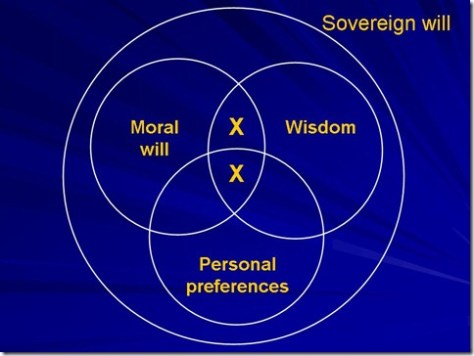
Really short version: Aside from direct and clear personal revelation from God, you don’t have access to his sovereign will when making decisions.  Therefore you must look at other factors.  If it isn’t moral, don’t do it.  If it is moral but not wise, don’t do it.  If it is moral and wise, then use your personal preferences.

Using this model you can end up with a wise and biblical decision, but you have avoided the traps of the “God told me to ____” routine.  People who run around saying that God told them this and that convey a super-spirituality that can leave less mature believers wondering if they really have a relationship with God (i.e., “God doesn’t tell me every little thing to do, so maybe I don’t really know him.”).

He has a helpful picture posted as well:

This is actually a very important topic for me, because I like making plans and making good decisions. I like being the quarterback or squad leader of my own life. I like to pick objectives and then make plans to achieve them. (Nothing too exotic, just simple stuff like saving money or reading more books)

Actually, I really oppose the idea that God has a magical fairy tale will for each person that will make them happy and fulfilled. For me, life isn’t like that. I don’t expect God to lead me along like a child at a scavenger hunt. I expect to survey the battlefield where I am and then do something to make a difference. There are lots of things you can do that will please God. Should you focus on your career and sponsor apologetics conferences? Or should you use your spare time preparing Sunday school lessons? There are lots of good things you could do to please God. Your job is to pick the one that will be the most effective. It doesn’t matter if it makes you happy, it only matters if it’s effective and if you are good at it.

Who is Rifleman Dodd?

A while back, I was busily working my way through the U.S. Marine Corps Official Reading List, and I came across a book by C.S. Forester called Rifleman Dodd, or alternatively titled Death to the French. It’s a work of historical fiction that takes place during the Napoleonic wars. The story is about a British marksman named Dodd, who is cut off from his own lines during a withdrawal maneuver. He is subsequently left to fend for himself behind enemy lines. An ordinary man might be full of despair and forget about his mission entirely. But Dodd is no ordinary man. Not only does he find a way to survive by finding food to eat, water to drink and places to sleep, but he also tries to remember his orders and to think about what he can do to advance the cause of his General, the Duke of Wellington.

Here’s an excerpt from a gritty book review:

It’s about a green-coated British infantry rifleman in the Napoleonic Wars, an age when rifles were a novelty and most of the army was red-coated and carried muskets. Private Matthew Dodd gets separated from his regiment during a retreat and finds himself stranded behind enemy (French) lines in Portugal. With the occasional aid of some natives, but mostly on his own, he harasses the French with his rifle and tries to prevent them from building a bridge across the Tagus River. It’s a remarkable tale of survival and solitary achievement, of a rank-and-file soldier who lives by his wits and slowly learns to make plans without orders, and shows leadership qualities and a knowledge of warfare.

I think we’re in the same situation as Dodd.

There is no point in us looking for breadcrumb trails to happiness at this point. That’s not the point of Christianity. The point of Christianity is friendship with God, imitation of Christ, honoring moral obligations, self-sacrificial love for your neighbor (and even your enemies!), and dedication to the truth – whether anyone else likes you or not. It’s not supposed to make you happy, and it’s not necessarily going to be a normal life like everyone else has. Things may not work out the way you’d like them to.

We seem to be making such a big deal about compassion and forgiveness in the Christian life these days – such a big emphasis on our feelings. Almost like we have forgotten that we have obligations to our friend – and his objectives. A relationship doesn’t mean that one person completely disregards the character and goals of the other person and then is automatically granted forgiveness whenever they want it. That’s not a friendship – that’s using someone else for your own ends. Maybe it’s time to remember what this is all about.