
Tag Archives: Christianity

World Vision endorses same-sex marriage, denies Biblical definition of marriage

I frankly don’t care to link to any source on this story other than Al Mohler and Franklin Graham. Lapsed Christian organizations and secular news sources are celebrating this decision, but they will have nothing valuable to say to anyone who takes the Bible seriously as an authority on moral issues. Even though  I keep posting secular evidence and research to confirm what the Bible teaches, I still get my moral positions from the Bible. Clearly, this is not the case with organizations like World Vision any more.

Al Mohler first, on what happened:

The headline in the news story by Christianity Today made the issue easy enough to understand — “World Vision: Why We’re Hiring Gay Christians in Same-Sex Marriages.”

As the magazine reported, “World Vision’s American branch will no longer require its more than 1,100 employees to restrict their sexual activity to marriage between one man and one woman.”

World Vision U.S. President Richard Stearns announced the change in a letter to World Vision staff. The organization, one of the largest humanitarian organizations in the world, “will continue to expect abstinence before marriage and fidelity within marriage for all staff,” Stearns said. He then added that “since World Vision is a multi-denominational organization that welcomes employees from more than 50 denominations, and since a number of these denominations in recent years have sanctioned same-sex marriage for Christians, the board—in keeping with our practice of deferring to church authority in the lives of our staff, and desiring to treat all of our employees equally—chose to adjust our policy.” That led to the key change Stearns was then to announce: “Thus, the board has modified our Employee Standards of Conduct to allow a Christian in a legal same-sex marriage to be employed at World Vision.”

Stearns basically claimed that the Bible is not clear on whether gay marriage is permissible. No theologians were cited, no Bible passages were references. He merely said that disagreement among denominations means that there is no right answer. Before continuing with Mohler, let me just point out the relevant quotation from the Bible.

Matthew 19:3-6: [NASB]

Some Pharisees came to Jesus, testing Him and asking, “Is it lawful for a man to divorce his wife for any reason at all?”

And He answered and said, “Have you not read that He who created them from the beginning made them male and female,

and said, ‘For this reason a man shall leave his father and mother and be joined to his wife, and the two shall become one flesh’?

So they are no longer two, but one flesh. What therefore God has joined together, let no man separate.”

So Richard Stearns either doesn’t believe that Jesus said that OR he believes that Jesus was wrong, and therefore fallible. It’s one or the other.

Now, more from Al Mohler:

Richard Stearns has every right to try to make his case, but these arguments are pathetically inadequate. Far more than that, his arguments reveal basic issues that every Christian ministry, organization, church, and denomination will have to face — and soon.

The distinction between an “operational arm” of the church and a “theological arm” is a fatal misreading of reality. World Vision claims a Christian identity, claims to serve the kingdom of Christ, and claims a theological rationale for its much-needed ministries to the poor and distressed. It cannot surrender theological responsibility when convenient and then claim a Christian identity and a theological mandate for ministry.

Add to this the fact that World Vision claims not to have compromised the authority of Scripture, even as its U.S. president basically throws the Bible into a pit of confusion by suggesting that the Bible is not sufficiently clear on the question of the morality of same-sex sexuality. Stearns insists that he is not compromising biblical authority even as he undermines confidence that the church can understand and trust what the Bible reveals about same-sex sexuality.

The policy shift points back to a basic problem with World Vision’s understanding of the church. No organization can serve on behalf of churches across the vast theological and moral spectrum that would include clearly evangelical denominations, on the one hand, and liberal denominations such as the Presbyterian Church (USA), the Episcopal Church, and the United Church of Christ, on the other. That might work if World Vision were selling church furniture, but not when the mission of the organization claims a biblical mandate.

Furthermore, it is ridiculous to argue that World Vision is not taking sides on the issue. The objective fact is that World Vision will now employ openly-gay employees involved in openly homosexual relationships. There is no rational sense in claiming that this represents neutrality.

[…]Writing to the Corinthian Christians, the Apostle Paul stated: “Or do you not know that the unrighteous will not inherit the kingdom of God? Do not be deceived: neither the sexually immoral, nor idolaters, nor adulterers, nor men who practice homosexuality, nor thieves, nor the greedy, nor drunkards, nor revilers, nor swindlers will inherit the kingdom of God.” [1 Corinthians 6:9-10]

The leader of World Vision U.S. now claims that the Bible is not sufficiently clear on the sinfulness of same-sex sexuality and relationships, but he also claims a “mission of building the kingdom.” The Apostle Paul makes homosexuality a kingdom issue, and he does so in the clearest of terms.

Of course, Paul’s point is not that homosexuals are uniquely sinful, but that all of us are sinners in need of the grace and mercy of God that come to us in the gift of salvation. Thanks be to God, Paul follows those words with these: “And such were some of you. But you were washed, you were sanctified, you were justified in the name of the Lord Jesus Christ and by the Spirit of our God.” [1 Corinthians 6:11]

The worst aspect of the World Vision U.S. policy shift is the fact that it will mislead the world about the reality of sin and the urgent need of salvation. Willingly recognizing same-sex marriage and validating openly homosexual employees in their homosexuality is a grave and tragic act that confirms sinners in their sin — and that is an act that violates the gospel of Christ.

Now my comments. Be aware that I wrote the stuff below in 20 minutes and was very agitated and upset when I wrote it – it may be revised when I calm down.

My thoughts

I have a long-standing policy of NEVER, EVER, EVER giving money to Christian organizations who do anything except apologetics. I am willing to give money to groups who do pro-life apologetics and pro-marriage apologetics. I am open to giving money to Christian organizations who put forward good economic policy and good foreign policy, too, like the Heritage Foundation or the Family Research Council. But I think the safest thing to do is to take your money and give it to groups like Reasonable Faith, Ratio Christi, Faith Beyond Belief, Stand to Reason, Please Convince Me, Cross Examined, Reasons to Believe, etc. I just sent $300 to Ratio Christi for an event yesterday. So generosity is not the issue – stewardship is.

Apologetics groups are the SAFEST groups to give money to, because they are the ones who are guided by truthWorld Vision and other “works-based” groups, including some missionary groups are some of the WORST places to put your money if you care about theological accuracy. People don’t get into apologetics in order to feel good or be liked, they go into it to discover truth and defend truth. We are hard-core in this business. So again, if you want to be a good steward of your money, put your money into apologists who are active in research, active on the university campus, and actively engaged for the truth of Christianity.

I realize I am being controversial here, but trust me on this. There is something different about people who go out and study philosophy, history and science and then get into debates with people. There is something inside them that is resistant to the spirit of the age, which is secularism, postmodernism and moral relativism. A lot of non-apologists think that God is primarily interested in making people good, and making them do good things here on Earth. And that’s what leads to the apostasy that you see in groups like World Vision – this focus on doing good, rather than on having true beliefs first, then doing good second.

What does the Bible say is most important?

Look at the words of Jesus in Matthew 22:36-40: [NASB]

36 “Teacher, which is the greatest commandment in the Law?”

37 Jesus replied: “‘Love the Lord your God with all your heart and with all your soul and with all your mind.’

38 This is the first and greatest commandment.

39 And the second is like it: ‘Love your neighbor as yourself.’

40 All the Law and the Prophets hang on these two commandments.”

If people settle on a false set of beliefs about whether God exists and whether Jesus is Lord and Savior, it doesn’t matter how nice they are to other people – that’s not what God is looking for, primarily. Everyone has to answer the question that Jesus asked of Peter in Luke 18. “Who do you say that I am?”

Is World Vision right to focus on the poor rather than Biblical Christianity?

Matthew 26:6-11: [NASB]

Now when Jesus was in Bethany, at the home of Simon the leper,

a woman came to Him with an alabaster vial of very costly perfume, and she poured it on His head as He reclined at the table.

But the disciples were indignant when they saw this, and said, “Why this waste?

For this perfume might have been sold for a high price and the money given to the poor.”

10 But Jesus, aware of this, said to them, “Why do you bother the woman? For she has done a good deed to Me.

11 For you always have the poor with you; but you do not always have Me.

So the real issue in this life is not being nice to people. That is a good thing, it’s not the main thing. The main thing is Jesus. Not a single verse in the Bible declares homosexuality to be anything other than a sin. By claiming that Christianity is somehow compatible with homosexuality, World Vision has ceased to be a Christian organization. My warning to you is to not focus so much on helping the poor at the expense of having true beliefs about God and Christ, and making those true beliefs known to others. We are here for just a few years and our purpose is not a worldly purpose. Our purpose is also not to feel good nor to be seen by others as kind, tolerant and compassionate. Be generous in your horizontal relationships, but not at the expense of that crucial vertical relationship.

UPDATE: My friend Neil wrote to me and suggested that I endorse giving to the poor directly, and I do endorse that. That respects the repeated Biblical commands to care for the poor, without getting in the mess described above.
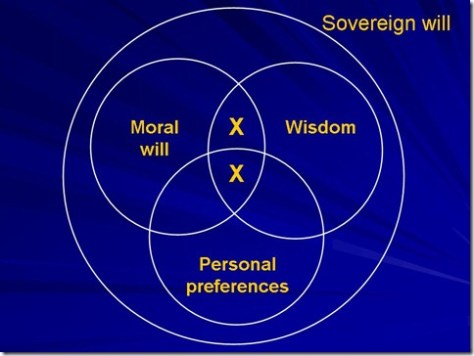
Are Christians responsible for making plans and making good decisions?

Here’s a wonderful post on decision making and the will of God posted on Neil’s blog. Neil links to another post where someone is trying to figure out what God wants him to do.

Excerpt:

Really short version: Aside from direct and clear personal revelation from God, you don’t have access to his sovereign will when making decisions.  Therefore you must look at other factors.  If it isn’t moral, don’t do it.  If it is moral but not wise, don’t do it.  If it is moral and wise, then use your personal preferences.

Using this model you can end up with a wise and biblical decision, but you have avoided the traps of the “God told me to ____” routine.  People who run around saying that God told them this and that convey a super-spirituality that can leave less mature believers wondering if they really have a relationship with God (i.e., “God doesn’t tell me every little thing to do, so maybe I don’t really know him.”).

He has a helpful picture posted as well:

This is actually a very important topic for me, because I like making plans and making good decisions. I like being the quarterback or squad leader of my own life. I like to pick objectives and then make plans to achieve them. (Nothing too exotic, just simple stuff like saving money or reading more books)

Actually, I really oppose the idea that God has a magical fairy tale will for each person that will make them happy and fulfilled. For me, life isn’t like that. I don’t expect God to lead me along like a child at a scavenger hunt. I expect to survey the battlefield where I am and then do something to make a difference. There are lots of things you can do that will please God. Should you focus on your career and sponsor apologetics conferences? Or should you use your spare time preparing Sunday school lessons? There are lots of good things you could do to please God. Your job is to pick the one that will be the most effective. It doesn’t matter if it makes you happy, it only matters if it’s effective and if you are good at it.

Who is Rifleman Dodd?

A while back, I was busily working my way through the U.S. Marine Corps Official Reading List, and I came across a book by C.S. Forester called Rifleman Dodd, or alternatively titled Death to the French. It’s a work of historical fiction that takes place during the Napoleonic wars. The story is about a British marksman named Dodd, who is cut off from his own lines during a withdrawal maneuver. He is subsequently left to fend for himself behind enemy lines. An ordinary man might be full of despair and forget about his mission entirely. But Dodd is no ordinary man. Not only does he find a way to survive by finding food to eat, water to drink and places to sleep, but he also tries to remember his orders and to think about what he can do to advance the cause of his General, the Duke of Wellington.

Here’s an excerpt from a gritty book review:

It’s about a green-coated British infantry rifleman in the Napoleonic Wars, an age when rifles were a novelty and most of the army was red-coated and carried muskets. Private Matthew Dodd gets separated from his regiment during a retreat and finds himself stranded behind enemy (French) lines in Portugal. With the occasional aid of some natives, but mostly on his own, he harasses the French with his rifle and tries to prevent them from building a bridge across the Tagus River. It’s a remarkable tale of survival and solitary achievement, of a rank-and-file soldier who lives by his wits and slowly learns to make plans without orders, and shows leadership qualities and a knowledge of warfare.

I think we’re in the same situation as Dodd.

There is no point in us looking for breadcrumb trails to happiness at this point. That’s not the point of Christianity. The point of Christianity is friendship with God, imitation of Christ, honoring moral obligations, self-sacrificial love for your neighbor (and even your enemies!), and dedication to the truth – whether anyone else likes you or not. It’s not supposed to make you happy, and it’s not necessarily going to be a normal life like everyone else has. Things may not work out the way you’d like them to.

We seem to be making such a big deal about compassion and forgiveness in the Christian life these days – such a big emphasis on our feelings. Almost like we have forgotten that we have obligations to our friend – and his objectives. A relationship doesn’t mean that one person completely disregards the character and goals of the other person and then is automatically granted forgiveness whenever they want it. That’s not a friendship – that’s using someone else for your own ends. Maybe it’s time to remember what this is all about.

Do people go to Hell just because they don’t accept Jesus?

From J. Warner Wallace at Please Convince Me. (Link is now down, I can’t find it anywhere else)

Excerpt:

A “just” God does justice, which means to punish or reward appropriately. In the Western tradition, we punish people for the actions they commit, but the extent of punishment is dependent also on the person’s mental state, and a person’s mental state is reflective of his or her beliefs. Premeditated murder is worse than manslaughter, and is punished more severely, and a hate crime is a sentencing enhancement that adds more punishment to the underlying crime. In both examples, a person’s beliefs are at play: the premeditated murderer has reflected on his choices and wants the victim dead; a hate crime reflects a belief that the rights of a member of the protected group are especially unworthy of respect. So, considering a person’s beliefs may well be relevant, especially if those beliefs have motivated the criminal behavior.

But the challenger’s mistake is even more fundamental. He is wrong to assert that people are condemned for not accepting the gospel. Christians believe that people are condemned for their sinful behavior – the “wages of sin is death” – not for what they fail to do. The quoted challenge is like saying that the sick man died of “not going to the doctor.” No, the person died of a specific condition – perhaps cancer or a heart attack – which a doctor might have been able to cure. So too with eternal punishment. No one is condemned for refusing to believe in Jesus. While Jesus can – and does – provide salvation for those who seek it, there is nothing unjust about not providing salvation to those who refuse to seek it. After all, we don’t normally feel obliged to help someone who has not asked for, and does not want, our assistance. So too the Creator has the right to withhold a gift – i.e. eternity spent in His presence – from those who would trample on the gift, and on the gift-giver.

The quoted assertion also demonstrates an unspoken belief that we can impress God with our “kind” or “generous” behavior. This fails to grasp what God is – a perfect being. We cannot impress Him. What we do right we should do. We don’t drag people into court and reward them for not committing crimes. This is expected of them. They can’t commit a murder and then claim that punishment is unfair, because they had been kind and generous in the past. When a person gets his mind around the idea of what perfection entails, trying to impress a perfect Creator with our “basic goodness” no longer seems like such a good option.

Here’s a related answer from CARM. This one answers the question about degrees of punishment in Hell.

Excerpt:

Yes, there are different degrees of punishment in hell.

[…]But, not all people are equally bad.  Though all deserve damnation because all are sinners, different people have committed different degrees of sin.

  • Mt. 11:20-22, “Then He began to reproach the cities in which most of His miracles were done, because they did not repent. 21 “Woe to you, Chorazin! Woe to you, Bethsaida! For if the miracles had occurred in Tyre and Sidon which occurred in you, they would have repented long ago in sackcloth and ashes. 22 “Nevertheless I say to you, it shall be more tolerable for Tyre and Sidon in the day of judgment, than for you…I say to you that it shall be more tolerable for the land of Sodom in the day of judgment, than for you.”
  • Luke 12:47-48, “And that slave who knew his master’s will and did not get ready or act in accord with his will, shall receive many lashes, 48 but the one who did not know it, and committed deeds worthy of a flogging, will receive but few. And from everyone who has been given much shall much be required; and to whom they entrusted much, of him they will ask all the more.”
  • John 19:11, “Jesus answered [Pilate], ‘You would have no authority over Me, unless it had been given you from above; for this reason he who delivered Me up to you has the greater sin.’ ”
  • Heb. 10:29, “How much severer punishment do you think he will deserve who has trampled under foot the Son of God, and has regarded as unclean the blood of the covenant by which he was sanctified, and has insulted the Spirit of grace?”

So, if Jesus speaks of greater condemnation for Chorazin and Bethsaida than Tyre and Sidon (Matt. 11:21-22), one slave received more punishment than another (Luke 12:47-48), the one who delivered Jesus to Pilate has the greater sin (John 19:11), and a more severe punishment is reserved for those who trample underfoot the Son of God, then does not greater sin mean that greater punishment will also happen in hell?  Yes it does.

Not only are there degrees of punishment in Hell, but there are degrees of reward in Heaven, based on what you do on Earth and what strengths you start out with.

Philippians 4:10-18:

10 I rejoiced greatly in the Lord that at last you renewed your concern for me. Indeed, you were concerned, but you had no opportunity to show it.

11 I am not saying this because I am in need, for I have learned to be content whatever the circumstances.

12 I know what it is to be in need, and I know what it is to have plenty. I have learned the secret of being content in any and every situation, whether well fed or hungry, whether living in plenty or in want.

13 I can do all this through him who gives me strength.

14 Yet it was good of you to share in my troubles.

15 Moreover, as you Philippians know, in the early days of your acquaintance with the gospel, when I set out from Macedonia, not one church shared with me in the matter of giving and receiving, except you only;

16 for even when I was in Thessalonica, you sent me aid more than once when I was in need.

17 Not that I desire your gifts; what I desire is that more be credited to your account.

18 I have received full payment and have more than enough. I am amply supplied, now that I have received from Epaphroditus the gifts you sent. They are a fragrant offering, an acceptable sacrifice, pleasing to God.

Everyone who believes in Jesus gets salvation, but your experience in Heaven will be different based on what you do while you are alive. And that’s also the answer to another common question – about deathbed conversions. Both deathbed converts and William Lane Craig will get the same experience of being in the presence of God, but there are completely different levels of reward. One person has an empty account, and the other person has huge massive amounts of virtuous action on deposit. But I think the real reason that Christians are trying to do good things here on Earth is that they like God, and they want to be his friend. They want to work on the relationship, even if it means a little self-denial, and a little sacrifice. We all have things that we would rather be doing for ourselves, but sometimes we have to things that work – things that are effective – for someone else. My values are not his values. Sometimes it is good to do something based on what He values. I don’t always have to get my way, because then it wouldn’t be a real relationship.

I enjoy thinking about Bible puzzles like this… so often in church we just make Christianity a checklist of things that we are supposed to believe somehow, by brute force willpower. I think reflecting on these problems, asking questions, and making sense of them on our own, is a much better approach.