Tag Archives: China

What should we do about the Wuhan coronavirus?

The economic cost of making workers stay home

I think by now most people have realized that there is an economic cost to shutting Americans of all ages into their homes. If people can’t work, then businesses can’t make money, and they have to furlough or lay off workers. We can’t keep up this policy of making everyone stay home forever – it would lead to another Great Depression. Is there a way to get people back to work?

This article from The Federalist explains, and comes up with a different solution. The author argues that the Wuhan virus is most dangerous to the elderly, and people with pre-existing conditions. And therefore they should shelter in place securely, while the rest of us who are under age 50 keep the economy from sliding into a depression by going back to work as soon as possible.

It says:

Richard Epstein at the Hoover Institution… points out that South Korean data, which is more complete than most other countries’ data, shows huge disparities in risks between old and unhealthy and young and healthy. “Clearly, the impact on elderly and immunocompromised individuals is severe, with nearly 90% of total deaths coming from individuals 60 and over. But these data do not call for shutting down all public and private facilities given the extraordinarily low rates of death in the population under 50,” Epstein writes.

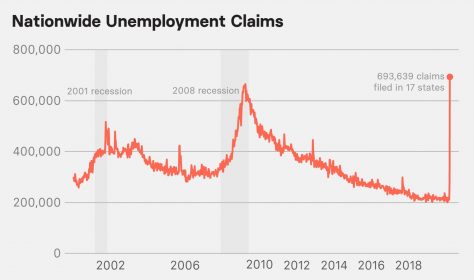
[…]The costs Americans are being forced to bear may be more than is rational to impose. Already one-fifth of working Americans are being laid off and having work hours cut due to not even one week of suspensions.

“[T]he massive curtailments of the U.S. economy can have as many health consequences as the virus itself—if millions lose income and jobs, become depressed in self-isolation, increase smoking, and drug and alcohol use, and postpone out of fear necessary buying and visits to doctors and hospitals for chronic and serious medical conditions unrelated to the virus,” writes Victor Davis Hanson.

What if the real scenario is one of these: 1) We plunge the nation into a depression that kills many businesses and addicts millions to welfare, in a nation that has already pledged more welfare than it can afford for at least the next three generations. Because of this depression, many people die due to poverty, lack of medical care, and despair. Millions more transform from workers to takers, causing a faster implosion of our already mathematically impossible welfare state.

2) The nation quarantines only at-risk populations and those with symptoms, like South Korea has, and ensures targeted and temporary taxpayer support to those groups, goes nuts cranking out ventilators and other crisis equipment such as temporary hospitals using emergency response crews, while the rest of us keep calm, wash our hands, take extreme care with the at-risk groups, and carry on.

Why would the entire nation grind to a halt when the entire nation is not at a severe risk? I would rather have a flu I am 99.8 percent likely to survive than the nation plunged into chaos indefinitely because we pulled the plug on our economy during a stampede.

At the very least, Congress should wait a week or two, while half the nation or more is home, to see how the infection rates look as millions of test kits go out. The worst-case scenario they are predicating their actions on may not be the one we’re facing. Prudence suggests a measured, wait and see approach to policy until we have better information, not chucking trillions of my kids’ dollars out the window “just in case.”

Right now, I think we should expand testing so we understand the problem better, fast-track whatever drugs are known to work, expand hospital capacity, build more N95 masks, build more ventilators, and get people under 50 back to work. This is in addition to proper hand-washing, social distancing and working from home where possible.

The cost of a depression seems to me to be much higher than what is happening to South Korea right now. They have massive testing effort and they are only quarantining people who are at high risk or who show symptoms. That makes more sense to me than shutting the economy down, or pass massive spending bills with bailouts for businesses that should not be shut down more than a month.
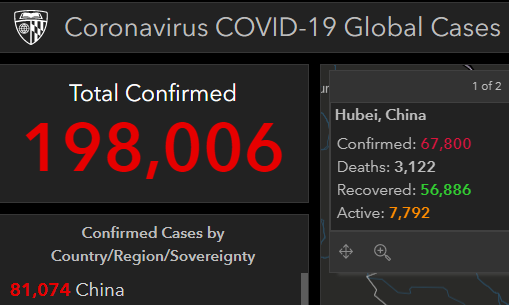
Wuhan virus: communist China destroyed samples, silenced doctors, and disappeared critics

The Wuhan Virus started in China

I’m not a big fan of National Review these days, but I wanted to link to this article because it quoted a bunch of pay-walled articles to make some good points about how we got the Wuhan virus. Not only is China to blame for the Wuhan virus, but they are actually trying to cover it up now, and shift the blame to the countries that they are damaging.

Here are the main points of the article:

  • China destroyed samples and suppressed information about the Wuhan Virus since December 2019, leaving other nations in the dark and unprepared
  • Chinese doctors who warned about patients with the Wuhan virus were silenced by the communist regime in China
  • In January, Chinese authorities denied that the Wuhan virus could be spread between people, and allowed huge gatherings of people in Wuhan
  • The President of China knew about the Wuhan virus for weeks but refused to tell anyone about it
  • The communist China government let 5 million people leave Wuhan without screening them
  • Critics of China’s handling of the Wuhan virus – even rich businessmen – are disappearing

I love the article, because it links to articles behind paywalls from the UK Times, the Wall Street Journal, the Washington Post, the New York Times, etc.

Here’s the UK Times:

Chinese laboratories identified a mystery virus as a highly infectious new pathogen by late December last year, but they were ordered to stop tests, destroy samples and suppress the news, a Chinese media outlet has revealed.

A regional health official in Wuhan, centre of the outbreak, demanded the destruction of the lab samples that established the cause of unexplained viral pneumonia on January 1. China did not acknowledge there was human-to-human transmission until more than three weeks later.

The detailed revelations by Caixin Global, a respected independent publication, provide the clearest evidence yet of the scale of the cover-up in the crucial early weeks when the opportunity was lost to control the outbreak.

And here’s the Washington Post:

As word of a mysterious virus mounted, Li Wenliang shared suspicions in a private chat with his fellow medical school graduates.

The doctor said that seven people seemed to have contracted SARS — the respiratory illness that spread from China to more than two dozen countries and left hundreds dead in the early 2000s. One patient was quarantined at his hospital in Wuhan, China, Li said. He urged people to be careful.

Li and seven other doctors were quickly summoned by Chinese authorities for propagating “rumors” about SARS-like cases in the area — but their warnings were prescient. Soon, health officials worldwide would be scrambling to combat a novel virus with a striking genetic resemblance to SARS.

Here is something else I found on the Daily Wire – the response of the atheistic communist Chinese regime to being caught:

The National Security Council blasted the Chinese Communist Party on Tuesday for expelling journalists from the country and spreading false information about the origin of the virus instead of focusing on stopping the virus, which originated in China.

“The Chinese Communist Party’s decision to expel journalists from China and Hong Kong is yet another step toward depriving the Chinese people and the world of access to true information about China,” the NSC said in a statement. “The United States calls on China’s leaders to refocus their efforts from expelling journalists and spreading disinformation to joining all nations in stopping the Wuhan coronavirus.”

The statement from the NSC comes after China announced it would expel American journalists working for The New York Times, The Washington Post, and The Wall Street Journal.

“It also demanded that those outlets, as well as the Voice of America and Time magazine, provide the Chinese government with detailed information about their operations,” The New York Times reported. “The announcement went on to say that the American journalists now working in mainland China ‘will not be allowed to continue working as journalists in the People’s Republic of China, including its Hong Kong and Macao Special Administrative Regions.’ The two territories are semiautonomous and in theory have greater press freedoms than the mainland.”

Rather than admit responsibility, apologize and make restitution, they are responding by throwing out the journalists who criticize them. And you can bet those journalists would be murdered in secret if they were not American citizens. After all, the communist Chinese regime has been credibly accused of a massive organ harvesting operation – including harvesting the organs of living victims as they are being killed:

Last week, the Independent Tribunal into Forced Organ Harvesting from Prisoners of Conscience in China issued its final report concluding that China engages in the systematic human-rights atrocity of killing political and other prisoners and harvesting their organs.

[…]The Judgment convincingly concludes that China is guilty as charged. According to the report, beginning at page 415, there are four methods by which China kills prisoners and harvests their organs.

  1. Organ harvesting from prisoners incompletely executed by shooting;

  2. Organ harvesting from prisoners after lethal injection;

  3. Execution by organ explanation (killing by organ harvesting);

  4. Organ harvesting under the pretext of brain death (taking organs from people not really dead).

The United States is not alone in suffering major economic and public safety consequences because of the decisions of the communist Chinese government. There is even talk of demanding reparations. We are already in a bear market, and there is likely to be a recession because of their suppression of the evidence. And I also think that there is a lesson there for our election in November – this is what people on the secular left always do when they fail to deliver on their promises. They deny responsibility and silence or destroy those who warned them. It’s standard operating procedure for communists. Communism requires atheism. And without God, any immorality you can imagine is possible.

Marine Captain earned Medal of Honor fighting communists in North Korea

First, let’s go from the top down to set the context for the profile of William E. Barber.

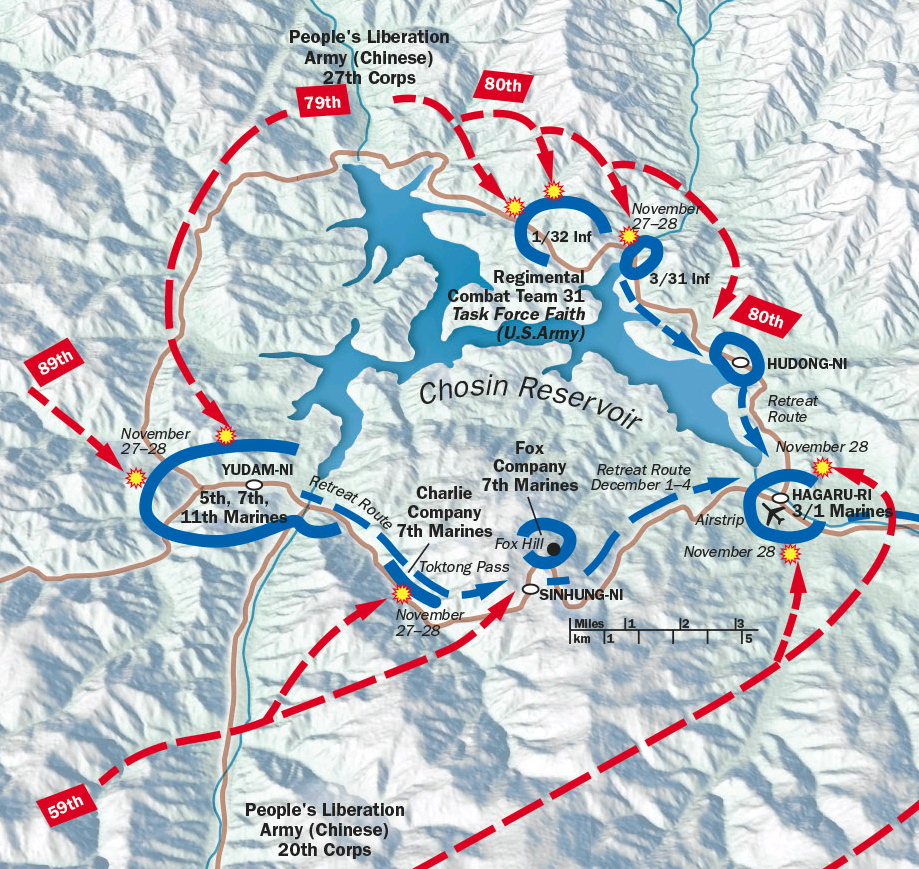
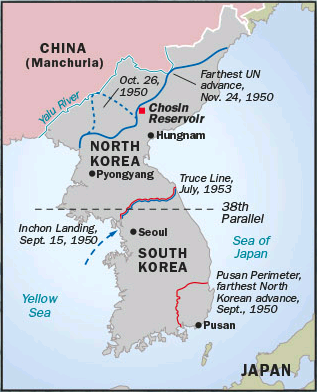
Map of the Korean War

In the summer of 1950, North Korean communists launch a completely unprovoked attack across the 38th parallel against their peaceful, democratic neighbors, the South Koreans. The Americans immediately sent an invasion force by sea to drive them out. The North Koreans easily manage to take over the capital Seoul, and the allies are left with only one port in the southeast – Pusan. In September of 1950, American forces land an invasion force at Inchon, cutting off the North Korean invasion force surrounding Pusan. The North Koreans retreat, and there is hope that American forces will be home by Christmas. But then, unbeknownst to the Americans, the Chines communists  invade North Korea from the north and surround the American forces near the Chosin reservoir, threatening to annihilate an entire Marine division.

The Marines at Yudam-Ni are surrounded and must retreat to Hagaru-Ri

As you can see from the map, there are a whole bunch of American troops fighting to the north/east and south/west of the Chosin Reservoir. The marines near Yudam-Ni need to retreat along a road called the MSR (main supply road) back to Hagaru-Ri. But in order to conduct that retreat, they have to hold onto the vital Toktong pass, which is overwatched by Fox company from their position on Fox Hill. Can Charlie company and Fox company hold off the entire Chinese 59th division (10,000 men) with only two companies (about 250 men each)?

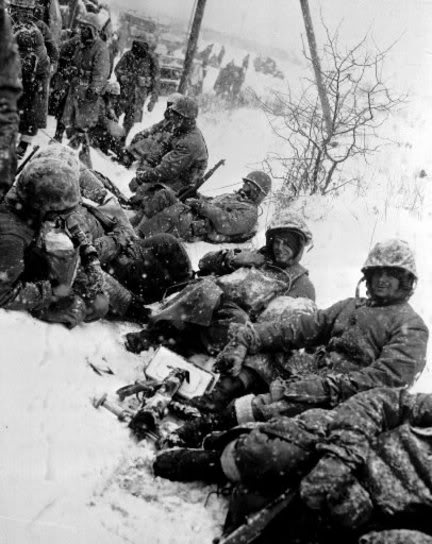
U.S. Marines "The Chosin Few", December 1950
U.S. Marines “The Chosin Few”, December 1950

Well, the book I read (which Dina gave me for Christmas), was about Fox company and their defense of the Toktong pass. This is what the leftist New York Times had to say about the man in charge of Fox company (“F company”) in a 2002 article:

Col. William E. Barber, who won the Medal of Honor for his leadership of a vastly outnumbered company under siege on a snowy hilltop in one of the worst defeats in Marine history, the Battle of the Chosin Reservoir in 1950, died on April 19 at his home in Irvine, Calif. He was 82.

The cause was bone-marrow cancer, said Jerry Courtier, a friend who hopes to write Colonel Barber’s biography.

The reservoir is south of the Yalu River, which separates North Korea from China. After the Americans had pushed the North Koreans almost to the Yalu, 150,000 Chinese troops unexpectedly crossed the river into North Korea. Colonel Barber’s unit, Company F of the Second Battalion of the Seventh Marines, First Marine Division, was on a hill that commanded the Toktong Pass, a vital gap between Yudam Ni and Hagaru Ri, two towns separated by 78 miles.

The stakes were huge. If F Company yielded its position, 8,000 marines at Yudam Ni would be cut off from the 3,000 at Haguru Ri by tens of thousands of Chinese troops.

Through five days and six nights in subzero weather and often swirling snow, Colonel Barber, then a captain, inspired his men, outnumbered more than five to one, to cling to their tenuous positions. He was shot in a bone near his groin on the second day but continued to make the rounds of the hill. He likened the wound to a bee sting.

When the unit was ordered to withdraw and fight its way to safety, Captain Barber refused. Three times, the enemy broke through the line, only to be repulsed.

”I knew that we could probably hold, and I knew that if we didn’t hold we could exact a very heavy toll,” he said in an interview in 1976 with The Los Angeles Times.

His citation for the nation’s top medal said that he commanded his men from a stretcher. But Hector A. Cafferata Jr., who as a rifleman won the Medal of Honor in the same battle, insisted that Captain Barber refused the stretcher.

”He walked the line, he kept us together,” said Mr. Cafferata, who was beside Captain Barber when he was shot.

In the mayhem, the Chinese blew whistles, beat cymbals and tooted bugles as they repeatedly attacked. Coffee froze before men could drink it, and some of the wounded died because plasma froze with no way to thaw it.

When the battle was over, more than 1,000 enemy soldiers were dead. Of Captain Barber’s original 240 men, 82 were able to walk away.

Gen. Raymond G. Davis, who was a lieutenant colonel in the Marines, received a Medal of Honor for leading the unit that rescued F Company.

William Earl Barber was born on Nov. 30, 1919, in Dehart, Ky. He attended what is now Morehead State University in Morehead, Ky., for two years and enlisted in the Marines, at the age of 21, in 1940.

He was so good at shooting a rifle that he was made a weapons instructor. After volunteering for parachute training, he demonstrated such proficiency that he became a parachute instructor.

In World War II, he was promoted to sergeant in 1942 and commissioned a second lieutenant in 1943. He was a rifle platoon commander at Camp Pendleton, Calif., when his unit was shipped to the Pacific.

Colonel Barber was in the first wave to hit Iwo Jima, where he was wounded twice. He received the Silver Star for bravery in addition to two Purple Hearts. At a ceremony on the 50th anniversary of the battle in 1995, he said:

”I am older now, as you are, but I can still see the colors of that February morning. The sky. The island. And sometimes I think I can hear the noise of battle.”

He was treated in Japan for his wounds and returned to the United States, where he worked as a recruiter, among other positions. He was promoted to captain in 1949 and was in the force that occupied Japan.

When he joined F Company in Korea, he saw a raggedy unshaven bunch and immediately ordered the the troops to shave, shine their shoes and look like marines. He suggested that his new charges resembled Pancho Villa’s bandits.

”He was one tough guy,” Mr. Cafferata said. ”He was by the book.”

He was by the book. He enlisted in the Marines because he was grateful to his country for allowing him to escape poverty and go into college, and he wanted to give something back.

You can read a review of the book I read about Fox company, and read about some of the details of what it was like for those men. You’ll never look at your own troubles the same way again. You can also read about Barber’s Medal of Honor citation here.

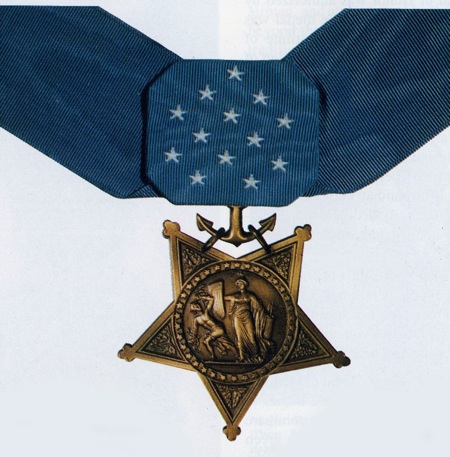
The Medal of Honor, Navy and Marines variant

So, now that I am done with that book, I have moved on to another Korean War book that Dina gave me, this one about George company. The Korean War might have been our most just war – defending a peaceful democratic ally from a totalitarian communist regime. You just have to compare North Korea and South Korea today to understand the stakes. North Korea is basically a godless concentration camp that tortures and murders its people if they so much as think the wrong thoughts about the atheist state. South Korea is free and prosperous, where the people have human rights, like the right to free speech and freedom of religion.

It’s important for me to read about the hardships that real heroes face, so that I don’t complain too much about my own tiny struggles. When you read about the struggles of great American soldiers, so many good things happen to you. Your own problems get smaller, your humility and gratitude get bigger. And you are reminded about why America is a great country, and what American character is really like. These things are not taught by leftists in the public schools. They are not talked about by leftists in the mainstream media. They are not presented by leftists in the Hollywood film industry. If you want to know the real America, you have to find it yourself.