Tag Archives: CBO

Let the grown-ups lead: Paul Ryan describes his proposal to balance the budget

Paul Ryan's Balanced Budget Proposal
Paul Ryan’s Balanced Budget Proposal

In the Wall Street Journal.

Excerpt:

America’s national debt is over $16 trillion. Yet Washington can’t figure out how to cut $85 billion—or just 2% of the federal budget—without resorting to arbitrary, across-the-board cuts. Clearly, the budget process is broken. In four of the past five years, the president has missed his budget deadline. Senate Democrats haven’t passed a budget in over 1,400 days. By refusing to tackle the drivers of the nation’s debt—or simply to write a budget—Washington lurches from crisis to crisis.

House Republicans have a plan to change course. On Tuesday, we’re introducing a budget that balances in 10 years—without raising taxes. How do we do it? We stop spending money the government doesn’t have. Historically, Americans have paid a little less than one-fifth of their income in taxes to the federal government each year. But the government has spent more.

So our budget matches spending with income. Under our proposal, the government spends no more than it collects in revenue—or 19.1% of gross domestic product each year. As a result, we’ll spend $4.6 trillion less over the next decade.

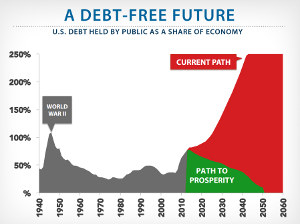
Our opponents will shout austerity, but let’s put this in perspective. On the current path, we’ll spend $46 trillion over the next 10 years. Under our proposal, we’ll spend $41 trillion. On the current path, spending will increase by 5% each year. Under our proposal, it will increase by 3.4%. Because the U.S. economy will grow faster than spending, the budget will balance by 2023, and debt held by the public will drop to just over half the size of the economy.

Yet the most important question isn’t how we balance the budget. It’s why. A budget is a means to an end, and the end isn’t a neat and tidy spreadsheet. It’s the well-being of all Americans. By giving families stability and protecting them from tax hikes, our budget will promote a healthier economy and help create jobs. Most important, our budget will reignite the American Dream, the idea that anyone can make it in this country.

The truth is, the nation’s debt is a sign of overreach. Government is trying to do too much, and when government does too much, it doesn’t do anything well. So a balanced budget is a reasonable goal, because it returns government to its proper limits and focus. By curbing government’s overreach, our budget will give families the space they need to thrive.

Since Obama was elected, he’s added over $5.5 trillion to the national debt. This is not sustainable. We cannot continue to pass on enormous levels of debt to our children so that 30-year-old students can have free condoms bought for them. It is immoral to spend trillions of dollars and then pass the bill to the next generation. Democrats like to talk about helping the children, but really they just want to force them to pay for their wasteful spending. It’s got to stop.

Fiscal cliff deal raises taxes by $600 billion, increases spending $330 billion

The Heritage Foundation explains.

Excerpt:

The Congressional Budget Office (CBO) just now released its score of the bill the Senate passed early this morning while everyone was celebrating the beginning of the New Year. Despite knowing for a long time that taxes would go up on all Americans today, the Senate waited until we technically went over the cliff to act. Washington’s dysfunction was even fodder for New Year’s revelers in Times Square.

Going over the cliff allows Congress to technically say that it isn’t raising taxes, but is cutting them instead. CBO’s score backs them up on this by scoring the Senate bill as a $3.6 trillion tax cut. No one should fall for this. The Senate bill is a tax hike because it allows taxes to go up from 2012 to 2013. The tax increases in the bill will reportedly raise about $600 billion over the next 10 years.

Also of note in the CBO score is that the Senate bill increases spending by around $330 billion by extending expanded unemployment benefits, a temporary “doc fix” patch to prevent cuts to Medicare, and extension of the agriculture programs.

There was some good in the Senate bill — the harmful defense sequester cuts were postponed and most tax hikes were avoided. But there was bad — tax hikes that will hurt the economy and do little to tame the deficit, especially factoring in the spending in the bill.

As I noted before, the CBO has predicted that the bill will add $4 trillion to the national debt, taking us over the $20 trillion mark.

Bloomberg:

The budget deal passed by the U.S. Senate today would raise taxes on 77.1 percent of U.S. households, mostly because of the expiration of a payroll tax cut, according to preliminary estimates from the nonpartisan Tax Policy Center in Washington.

More than 80 percent of households with incomes between $50,000 and $200,000 would pay higher taxes. Among the households facing higher taxes, the average increase would be $1,635, the policy center said. A 2 percent payroll tax cut, enacted during the economic slowdown, is being allowed to expire as of yesterday.

According to the CBO, the deal would raise taxes by $41 for every $1 cut from the budget. Have we really dodged a fiscal cliff?


Obama’s fiscal cliff plan would increase debt to $20 trillion by 2016

Forbes magazine explains why Obama’s plan doesn’t solve our long-term spending problem.

Excerpt:

The President, while not presenting concrete proposals, has been quite clear on what he wants: to raise taxes on the top two percent, keep the Bush tax cuts for everyone else, offer only vague promises of future spending cuts, and gain the unprecedented authority to raise the debt limit without Congressional approval. He does not plan to reform the entitlements so dear to his heart and his base’s. Instead of less spending, he would like to spend more on “stimulus” and “investments.” Obama knows that physicians will desert Medicare if he cuts their compensation by the scheduled 26.5 percent. That is simply not going to happen.

Here are Obama’s desired alternative fiscal policies to avoid the fiscal cliff in order of their effect on the five-year budget as estimated by the CBO:

1. Preserve Bush tax cuts and other tax provisions for everyone except the top 2 percent: Raises the five-year deficit by $2.0 trillion.

2. Drop the fiscal-cliff sequestration of spending and expand discretionary spending by the rate of inflation: Raises the five-year deficit by another trillion dollars.

3. Raise the tax rate on the top 2 percent:  Lowers the five-year deficit by $300 billion.

4. Extend enhanced unemployment benefits: Raises the five-year deficit by $200 billion.

5. Do not cut Medicare payment rates to physicians: Raises the five-year deficit by some $100.

Four of the five fiscal policies on Obama’s wish list raise the deficit. Only one – the vaunted tax on the rich on which he based his campaign – lowers the deficit, but only by a miniscule $300 billion ($60 billion per year). If Obama gets the tax and spending changes he wants, his 2017 successor will inherit a national debt in excess of  $20 trillion.

A warning: The 2013-2017 budget deficits could be much higher. No one knows what the costs of Obama Care will be. By 2017, the federal government will be spending more on health care than on social security. The CBO projection assumes that the costs of Obama Care come in on target. If Obama Care cannot contain health care costs, we could easily see a five-year deficit well in excess of $5 trillion, for an annual deficit of more than a trillion dollars. The CBO also uses a historically low rate of increase of discretionary non-defense spending equal to the rate of inflation. If we return to “business as usual” in Washington, the discretionary spending figure could also be blasted out of the water.

Obama based his re-election campaign on “the rich should pay their fair share” and “I killed Osama.” Well before the election, it was clear from the government’s own figures that taxing the top two percent would make only a tiny contribution to solving our deficit problems.

Why was this not pointed out by the media, who played along with the “tax the rich” fairy tale?  Why was this not the central theme of the Republican campaign?

I think that point I highlighted in bold deserves emphasis. Obama ran up over $6 trillion in new debt – pushing us to a $16.5 trillion dollar debt. His “balanced approach” will generate a measly $60 billion a year in “new revenues”, assuming that “the rich” don’t just curtail their productive activities and shift their operations elsewhere (Canada). If you generate $60 billion in revenues, there is NO WAY that this is going to pay for a trillion dollars a year in new debt. So we are on track to hit over $20 trillion in national debt in Obama’s second term, taking us into Greece-like territory.

And that is according to the official CBO numbers.