
Tag Archives: Career

Why do men prefer to marry younger women instead of older women?

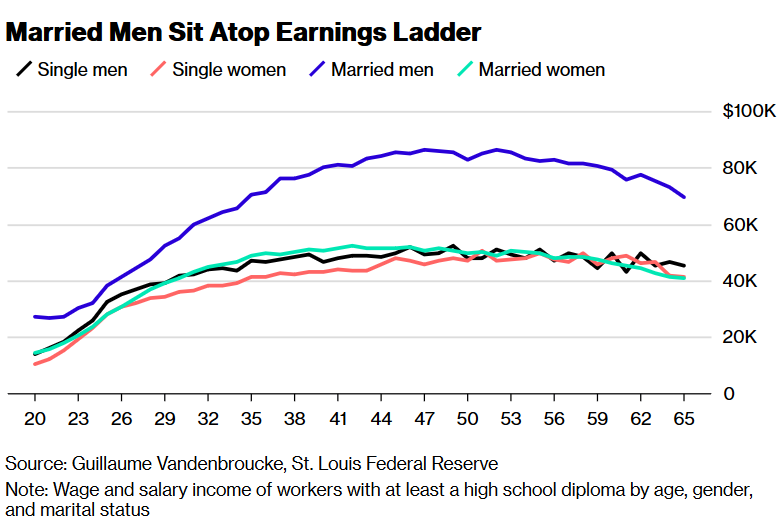
Married men seem to enjoy a boost in earnings from age 23-43
Married men seem to enjoy a boost in earnings between age 22-45

I saw a bunch of pro-marriage friends were tweeting about this article from the St. Louis Federal Reserve which talks about how well married men do financially compared to single men, and using it as a reason to argue that men should get married. The article from the St. Louis Reserve doesn’t have much commentary, but this article from the far-left Washington Post by Brad Wilcox has a lot to say.

Excerpt:

Marriage has a transformative effect on adult behavior, emotional health, and financial well-being—particularly for men.

[…]Men who get married work harder and more strategically, and earn more money than their single peers from similar backgrounds. Marriage also transforms men’s social worlds; they spend less time with friends and more time with family; they also go to bars less and to church more.

[…]Our research, featured in a recent report, “For Richer, For Poorer: How Family Structures Economic Success in America,” indicates that men who are married work about 400 hours more per year than their single peers with equivalent backgrounds. They also work more strategically: one Harvard study found that married men were much less likely than their single peers to quit their current job unless they had lined up another job.

This translates into a substantial marriage premium for men. On average, young married men, aged 28-30, make $15,900 more than their single peers, and married men aged 44-46 make $18,800 more than their single peers.

That’s even after controlling for differences in education, race, ethnicity, regional unemployment, and scores on a test of general knowledge. What’s more: the marriage premium operates for black, Hispanic, and less-educated men in much the same way as it does for men in general.

For instance, men with a high-school degree or less make at least $17,000 more than their single peers.

So, what about these differences between married men and single men? Are men able to earn more if they have a wife to support them and care for their needs? Or is it just that women prefer men who are already able to take care of themselves?

Well, in most cases, it’s the former:

2. Married men are motivated to maximize their income. For many men, this responsibility ethic translates into a different orientation toward work, more hours, and more strategic work choices. Sociologist Elizabeth Gorman finds that married men are more likely to value higher-paying jobs than their single peers.

This is partly why studies find that men increase their work hours after marrying and reduce their hours after divorcing. It’s also why married men are less likely to quit a current job without finding a new job. Indeed, they are also less likely to be fired than their single peers.

3. Married men benefit from the advice and encouragement of their wives. Although there is less research on this, we suspect that men also work harder and more strategically because they are encouraged to do so by their wives, who have an obvious interest in their success. One study appears to buttress this point, finding that men with better-educated wives earn more, even after controlling for their own education.

4. Employers like married men with children. There is evidence that employers prefer and promote men who are married with children, especially compared to their childless male peers and to mothers. Married men are often seen as more responsible and dedicated workers and are rewarded with more opportunities by employers. While illegal bias and long-held stereotypes appear to play a role in this historic preference, it nonetheless helps explain why married family men get paid more.

Now what’s the purpose of me writing this? Well, I’m actually NOT writing this to pressure men to get married. Why not? Because although marriage was a pretty good deal 100 years ago, it’s not as good of a deal under the current laws and policies, e.g. – no-fault divorce, the threats of false accusations, the Sexual Revolution, etc. The institutions of society are not doing as good of a job to prepare women for wife and mother roles as they used to do. Men have a much harder time finding someone who is prepared for marriage today. Men have to choose women more carefully.

But I am writing this to women who are being told by the culture to delay marriage, and especially to delay marriage to use your youth and beauty to “have fun” with boys who won’t commit to marriage. If a woman loves a marriage-focused man and really wants to take care of him and support him, then early marriage is one of the very best ways to really help him during the years (22-45) when it really makes a difference. Marrying a man who wants marriage when you’re still young means that he will have many, many measurable benefits. It’s hard to attract a man who is already rich, because so many women are competing for him. It’s much easier to marry a young man and build him up into a rich man, by supporting him.

Men know that a woman’s support has value. It’s important for women to marry when the marriage has the potential to do the most good for a man in areas like health, career, finances and children. Men typically don’t want to marry women who are older, because those women tend to have more sexual experience. They get used to giving a man sex in order to get him to do what she wants. They get used to breaking up instead of making things work. Once a woman gets used to doing this, it becomes much harder to trust a good man to lead, and to give a man respect as a leader.

So, what I would like to see is women understand that part of loving a man is committing to him early, and staying with him to build him up. Instead of trying to wasting your youth on hot bad boys, why not build up a good man into the fit, wealthy husband you want? It seems to me that building up a man into what you want is a lot easier than wasting your youth on bad boys, then trying to attract a good man when your attractive years are already behind you.
What the nomination of Amy Coney Barrett communicates to secular left feminists

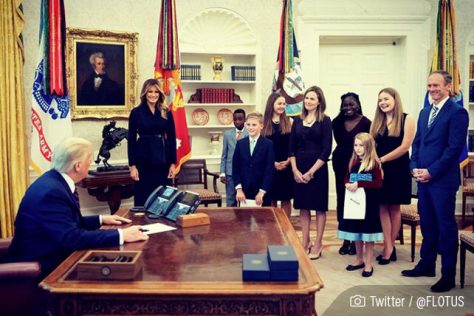
Amy Coney Barrett, her husband and her 7 children
Amy Coney Barrett, her husband and her 7 children in the Oval Office

Here’s an article from The Federalist by my favorite Federalist writer, Joy Pullmann, where she lists 9 feminist lies that were smashed by the nomination of Amy Coney Barrett:

  • Women Need Abortion to Succeed
  • Children Make You Unhappy
  • Women Must Repress Their Fertility to Succeed
  • Religious People and Conservatives Are Anti-Sex
  • Women Don’t Need Men
  • Christianity Oppresses Women
  • Conservatives Hate Women
  • Women Should Prioritize Career Over Family
  • Women Are Oppressed

The article is excellent. I will just focus on the one part that I thought was the most interesting:

Marriage is the epitome of the cooperation of the sexes, yet the left treats it as unnecessary at best and harmful at worst. The Black Lives Matter organization, for example, which has been supported by millions in donations and thousands of endorsements from CEOs and Democrat politicians, in its policy platform openly attacked “heteronormative” “nuclear families.”

Gloria Steinem, the apostle of feminism, popularized the phrase “A woman needs a man like a fish needs a bicycle.” Leftism and feminism pit the sexes against each other, while conservatism and Christianity recognize that the sexes are interdependent. This recognition brings humankind joy instead of hatred.

Fathers are crucial to the happiness and well-being of every child, a need that only intensifies with the addition of each child. Barrett’s husband Jesse is a full partner in their marriage with his own significant career. Barrett recognized her husband’s major contributions to their family and her happiness in her nomination acceptance speech Saturday night.

I couldn’t manage this very full life without the unwavering support of my husband Jesse. At the start of our marriage, I imagined that we would run our household as partners. As it has turned out, Jesse does far more than his share of the work. To my chagrin, I learned at dinner recently that my children consider him to be the better cook. For 21 years, Jesse has asked me every single morning what he can do for me that day. And though I almost always say ‘Nothing,’ he still finds ways to take things off my plate. And that’s not because he has a lot of free time—he has a busy law practice. It’s because he has a superb and generous husband, and I am very fortunate.

Given her description, I think it’s accurate to guess Barrett and her husband’s interdependence is a source of strength and joy to them both, as well as to their children and community. They have undoubtedly achieved much more together than they could have separately, as many highly successful women will also tell you of their marriages. Our husbands are our sometimes-secret weapon.

Feminists don’t like any of Joy’s 9 points, though.

Feminism is what a woman believes after she has smashed herself up by having sex with bad boys. Bad boy failures makes her think that all men are unreliable. She likes abortion because it allows her to chase the bad boys she is attracted to. When she learns how bad boys are unreliable, she intentionally delays marriage to focus on her career and pay off all her student loans. But, if a woman avoids bad boys, and instead chooses a good husband who supports her, she can have 5 kids and adopt 2 more and not have all that bitterness. With a good husband, and a network of supportive relatives, she can even get on the Supreme Court.

I prefer that young women study for a STEM degree, and try to avoid student loans with community college, scholarships, living at home, summer jobs, etc. I recommend they work until their first child arrives. After that, they should stay home with the children, at least for the first 3 years of each child’s life. And obviously, having more children leads to a bigger legacy than fewer children. I’m also a strong supporter of homeschooling. I don’t have much confidence in Christian schools, private schools and especially public schools.

However, in the special case of women like Amy Coney Barrett, who can make a huge difference in the world for the good of conservatives and Christians, then it may be possible, with an excellent husband and many willing relatives, to have a safety net for the children that allows her to do something that will protect us all from the secular left. This is not the ordinary case, of course. This is 1% of the 1% of the 1%. There is no doubt that her children will suffer from her decision to have a career. But if she makes a Supreme Court decision that protects the unborn, or safeguards self-defense rights, or preserves religious liberty, it will be worth it. I don’t think this is the ordinary case. I don’t support mothers of young children having ordinary careers just to make money, because usually the young children have to be placed with strangers.

My goal for my wife was that she be a stay at home wife and mother, at least while we have any children under 3, and preferably under 5. I wouldn’t have liked to have a wife who served on the Supreme Court. I wouldn’t want to share my wife with co-workers, because of the way I was raised. But I can understand why it is a good thing for me (and for conservatives and Christians) that she is the nominee.

Why should a woman marry a man while she’s still under 25?

Married men seem to enjoy a boost in earnings from age 23-43
Married men seem to enjoy a boost in earnings between age 22-45

I saw a bunch of pro-marriage friends were tweeting about this article from the St. Louis Federal Reserve which talks about how well married men do financially compared to single men, and using it as a reason to argue that men should get married. The article from the St. Louis Reserve doesn’t have much commentary, but this article from the far-left Washington Post by Brad Wilcox has a lot to say.

Excerpt:

Marriage has a transformative effect on adult behavior, emotional health, and financial well-being—particularly for men.

[…]Men who get married work harder and more strategically, and earn more money than their single peers from similar backgrounds. Marriage also transforms men’s social worlds; they spend less time with friends and more time with family; they also go to bars less and to church more.

[…]Our research, featured in a recent report, “For Richer, For Poorer: How Family Structures Economic Success in America,” indicates that men who are married work about 400 hours more per year  than their single peers with equivalent backgrounds. They also work more strategically: one Harvard study found that married men were much less likely than their single peers to quit their current job unless they had lined up another job.

This translates into a substantial marriage premium for men. On average, young married men, aged 28-30, make $15,900 more than their single peers, and married men aged 44-46 make $18,800 more than their single peers.

That’s even after controlling for differences in education, race, ethnicity, regional unemployment, and scores on a test of general knowledge. What’s more: the marriage premium operates for black, Hispanic, and less-educated men in much the same way as it does for men in general.

For instance, men with a high-school degree or less make at least $17,000 more than their single peers.

So, what about these differences between married men and single men? Are men able to earn more if they have a wife to support them and care for their needs? Or is it just that women prefer men who are already able to take care of themselves?

Well, in most cases, it’s the former:

2. Married men are motivated to maximize their income. For many men, this responsibility ethic translates into a different orientation toward work, more hours, and more strategic work choices. Sociologist Elizabeth Gorman finds that married men are more likely to value higher-paying jobs than their single peers.

This is partly why studies find that men increase their work hours after marrying and reduce their hours after divorcing. It’s also why married men are less likely to quit a current job without finding a new job. Indeed, they are also less likely to be fired than their single peers.

3. Married men benefit from the advice and encouragement of their wives. Although there is less research on this, we suspect that men also work harder and more strategically because they are encouraged to do so by their wives, who have an obvious interest in their success. One study appears to buttress this point, finding that men with better-educated wives earn more, even after controlling for their own education.

4. Employers like married men with children.  There is evidence that employers  prefer and promote men who are married with children, especially compared to their childless male peers and to mothers. Married men are often seen as more responsible and dedicated workers and are rewarded with more opportunities by employers. While illegal bias and long-held stereotypes appear to play a role in this historic preference, it nonetheless helps explain why married family men get paid more.

Now what’s the purpose of me writing this? Well, I’m actually NOT writing this to pressure men to get married. Why not? Because although marriage was a pretty good deal 100 years ago, it’s not as good of a deal under the current laws and policies, e.g. – no-fault divorce, the threats of false accusations, the Sexual Revolution, etc. So I wouldn’t advise a man to rush into marriage to just anybody in order to get the financial (and health) benefits of having a wife. Marriage is only safe when you choose a woman carefully.

But I am writing this to women who are being told by the culture to delay marriage, and especially to delay marriage to use your youth and beauty to “have fun” with boys who won’t commit to marriage. If a woman loves a marriage-focused man and really wants to take care of him and support him, then early marriage is one of the very best ways to really help him during the years (22-45) when it really makes a difference. Marrying a man who wants marriage when you’re still young means that he will have many, many measurable benefits.

It’s important to marry a man when the marriage has the potential to do the most good for him in areas like health, career, finances and children. Men typically don’t want to marry women who are older, because they have more sexual experience and because they get used to giving a man sex in order to get him to do what she wants. Once a woman gets used to doing this, it becomes much harder to trust a good man to lead, and to give a man respect as a leader.

In addition, men know that women never change who they are really attracted to. If a woman chooses superficially attractive men who won’t commit over and over, then even if she “settles” for a man later on, she probably won’t be able to be attracted him. Men know not to choose women who won’t value them for their traditional moral values, conservative politics and ability to perform traditional male roles like providing. Men know that a woman who feels that she is “settling” for less than she deserves is more likely to disrespect him, and to withhold sex from him.

Now pro-marriage parents and pro-marriage pastors will typically tell you that they want to let their daughters decide when to marry, so that they will be happy having “fun” before marriage, and happy being provided for after marriage. But when those women are done playing the field and in their mid-thirties, their relatives and pastors are not thinking about what men’s interests are. They’re thinking about how to get this woman married, regardless of the man’s interests. And men know that. So they aren’t going to be bullied or shamed into a marriage after the window when it benefits them has closed. If parents and pastors want their daughters married AT ALL, then they need to encourage women to be self-controlled and marriage-focused EARLY.