
Tag Archives: Capitalism

Could Obama have done better? He could learn from Canada’s success

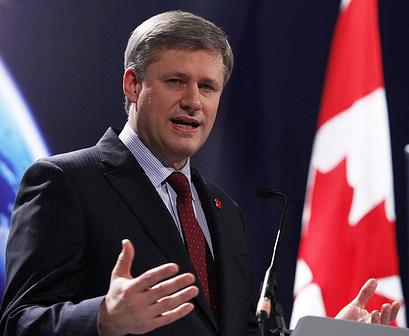
Prime Minister Stephen Harper

Here’s an editorial from Investors Business Daily.

Excerpt:

Away from the low growth and high regulation of an America under Washington’s thumb, our northern neighbor is economically strong. As 2011 ends, Canada has announced yet another tax cut — and will soar even more.

The Obama administration and its economic czars have flailed about for years, baffled about how to get the U.S. economy growing.

In reality, the president need look no further than our neighbor, Canada, whose solid growth is the product of tax cuts, fiscal discipline, free trade, and energy development. That’s made Canada a roaring puma nation, while its supposedly more powerful southern neighbor stands on the outside looking in.

On Thursday, Canadian Prime Minister Stephen Harper announced that he will slash corporate taxes again on Jan. 1 in the final stage of his Economic Action Plan, dropping the federal business tax burden to just 15%.

Along with fresh tax cuts in provinces such as Alberta, total taxes for businesses in Canada will drop to 25%, one of the lowest in the G7, and below the Organization of Economic Cooperation and Development average.

“Creating jobs and growth is our top priority,” said Minister Jim Flaherty. “Through our government low-tax plan … we are continuing to send the message that Canada is open for business and the best place to invest.”

It’s not just that Canada’s conservative government favors makers over takers. Harper’s also wildly popular for shrinking government. “The Harper government has pursued a strategic objective to disembed the federal state from the lives of citizens,” wrote University of Calgary Professor Barry Cooper, in the Calgary Herald.

Harper also has made signing free trade treaties his priority. Canada now has 11 free trade pacts in force, and 14 under active negotiation — including pacts with the European Union and India, among others.

“We believe in free trade in Canada, we’re a free-trading nation. That’s the source of our strength, our quality of life, our economic strength,” Flaherty said last month.

Lastly, Canada has pursued its competitive advantage — oil. And it did so not through top-down “industrial policy,” but by getting government out of the way.

Harper has enacted market-friendly regulations to accomplish big things like the Keystone Pipeline — and urged President Obama to move forward on it or else Canada would sell its oil to China.

These policies have been well-known since the Reagan era. But in a country that’s been institutionally socialist since the 1950s, Harper’s moves represent a dramatic affirmation for free market economics.

For Canada, they’ve had big benefits.

Canada’s incomes are rising, its unemployment is two percentage points below the U.S. rate, its currency is strengthening and it boasts Triple-A or equivalent sovereign ratings across the board from the five top international ratings agencies, lowering its cost of credit.

Is it too much to ask Washington to start paying attention to the Canadian success story?

These sound principles work every time they are tried, and they have led to a transformation in Canada.

Although this article doesn’t mention it, Stephen Harper is also the most solid statesman on foreign policy issues as well.

And here’s a view from up north from Canadian journalist Brian Lilley.

Excerpt:

Prime Minister Stephen Harper has put out his own list of accomplishments for the year that just ended but here are a few of the key conservative minded actions that spring to mind for me.

  • Ending political welfare. The per-vote subsidy that made political parties lazy and unresponsive to the voters of this country and insulated them from angering their core supporters will be gone by 2015-2016. Legislation ending the subsidy has already passed but the parties are slowly being weaned off the money and will get smaller amounts each year until the subsidy is gone.
  • They saw the light of common sense and released the names of those on their wanted list of suspected foreign war criminals. These were people that officials admitted should not be in the country, had been ordered out but that were still in Canada. At first officials would only admit there was a list of suspected war criminals but not say who they were. After much pressure, common sense won the day.
  • Ending the insane rules that would see farmers from certain provinces jailed for daring to sell their wheat to the customer of their choice. The Canadian Wheat Board still exists for those that want to use its centralized system. For those that want freedom, they now have that choice.
  • While much attention has been paid to Bill C-10, the omnibus crime bill, the government has passed C-2 (the mega-trials bill), this bill will make it easier to conduct the mega-trials now associated with organized crime without infringing on the right to a fair trial.
  • While the bill to end the gun registry has not been passed yet, it has been introduced and will pass early this year.
  • Immigration. On this file the Conservatives continue to push for ever higher numbers of newcomers while keeping those skeptical of high immigration onside by cracking down on fraud, cleaning up the system and putting Canada first.

Another thought for those, often myself included, that like to say this government is not conservative enough.

Lilley also notes that electing Harper presented a national day care program (which punishes families with stay-at-home), increasing unemployment benefits (which encourages people not to work), etc.


Obama says that limited government and capitalism have never worked

Obama Economic Record November 2011

Investors Business Daily explains the latest speech on economics from the man who has doubled Bush’s 2007 unemployment rate, and increased Bush’s 2007 budget deficits tenfold.

Excerpt:

One thing is certainly true about President Obama — no matter how many times people point out the falsehoods in his speeches, he just keeps making them. Case in point: his latest “economic fairness” address.

In that speech Tuesday, Obama once again tried to build a case for his liberal, big-spending, tax-hiking, regulatory agenda. But as with so many of his past appeals, Obama’s argument rests on a pile of untruths. Among the most glaring:

• Tax cuts and deregulation have “never worked” to grow the economy. There’s so much evidence to disprove this claim, it’s hard to know where to start. But let’s begin with the fact that countries with greater economic freedom — lower taxes, less government, sound money, free trade — consistently produce greater overall prosperity.

Here at home, President Reagan’s program of lower taxes and deregulation led to an historic two-decade economic boom. Plus, states with lower taxes and less regulation do better than those that follow Obama’s prescription.

Obama also claimed the economic booms in the ’50s and ’60s somehow support his argument. This is utter nonsense. Taxes at the time averaged just 17% of the economy. And there was no Medicare, no Medicaid, no Departments of Transportation, Energy or Education, and no EPA. Had Obama been around then, he would have decried it all as un-American.

• Bush’s tax cuts on the rich only managed to produced “massive deficits” and the “slowest job growth in half a century.” Budget data make clear that Obama’s spending hikes, not Bush’s tax cuts, produced today’s massive deficits.

And Obama only gets his “slowest job growth” number by including huge job losses during his own term in office. Also, monthly pre-recession job growth under Bush was about 40% higher than post-recession growth has been under Obama.

• During the Bush years, “we had weak regulation, we had little oversight.” This is patently false. Regulatory staffing climbed 42% under Bush, and regulatory spending shot up 50%, according to a Washington University in St. Louis/George Washington University study. And the number of Federal Register pages — a proxy for regulatory activity — was far higher under Bush than any previous president.

• The “wealthiest Americans are paying the lowest taxes in over half a century.” Fact: the federal income tax code is now more progressive than it was in 1979, according to the Congressional Budget Office. IRS data show the richest 1% paid almost 40% of federal income taxes in 2009, up from 18% back in 1980.

• We can keep tax breaks for the rich in place, or make needed investments, “but we can’t do both.” Not true. Repealing the Bush tax cuts on the “rich” would raise only about $70 billion a year, a tiny fraction of projected deficits. With or without the Bush tax cuts, the country can’t afford Obama’s agenda.

The Heritage Foundation describes the effects of the Bush tax cuts.

Excerpt:

President Bush signed the first wave of tax cuts in 2001, cutting rates and providing tax relief for families by, for example, doubling of the child tax credit to $1,000.

At Congress’ insistence, the tax relief was initially phased in over many years, so the economy continued to lose jobs. In 2003, realizing its error, Congress made the earlier tax relief effective immediately. Congress also lowered tax rates on capital gains and dividends to encourage business investment, which had been lagging.

It was the then that the economy turned around. Within months of enactment, job growth shot up, eventually creating 8.1 million jobs through 2007. Tax revenues also increased after the Bush tax cuts, due to economic growth.

In 2003, capital gains tax rates were reduced. Rather than expand by 36% as the Congressional Budget Office projected before the tax cut, capital gains revenues more than doubled to $103 billion.

The CBO incorrectly calculated that the post-March 2003 tax cuts would lower 2006 revenues by $75 billion. Revenues for 2006 came in $47 billion above the pre-tax cut baseline.

Here’s what else happened after the 2003 tax cuts lowered the rates on income, capital gains and dividend taxes:

  • GDP grew at an annual rate of just 1.7% in the six quarters before the 2003 tax cuts. In the six quarters following the tax cuts, the growth rate was 4.1%.
  • The S&P 500 dropped 18% in the six quarters before the 2003 tax cuts but increased by 32% over the next six quarters.
  • The economy lost 267,000 jobs in the six quarters before the 2003 tax cuts. In the next six quarters, it added 307,000 jobs, followed by 5 million jobs in the next seven quarters.

The timing of the lower tax rates coincides almost exactly with the stark acceleration in the economy. Nor was this experience unique. The famous Clinton economic boom began when Congress passed legislation cutting spending and cutting the capital gains tax rate.

If, in the 2012 election, half the country decides to vote for the person who gives the best speeches and who is cheered on the Comedy Channel, then we are going to have four more years of 9% unemployment and 1.4 trillion dollar deficits. Barack Obama knows nothing whatsoever about economics.

UPDATE: Obama says that small business owners didn’t build their own businesses

Richard Epstein explains why economic inequality is required in order to promote innovation

My friend Matt, who blogs at The Conscience of  a Young Conservative, posted this on Facebook.

Epstein explains how the profit motive creates economic value that raises the standard of living of all people, who are able to exchange their money for valuable products and services that they did not create. He explains how wealth redistribution is wasteful and harmful to economic growth.

(Found here)

Now let’s look at some myths that Christians believe about economics.

We need to understand basic economics

Christian philosopher Jay Richards explains basic economics.

Excerpt:

THE ZERO-SUM GAME MYTH.

There are three kinds of games: win-lose, lose-lose, and win-win. Win-lose games, like basketball, are sometimes called “zero-sum games.” When the Celtics and the Bulls compete, if the Celtics are up, then the Bulls are down, and vice versa. The scales balance. It’s a zero-sum.

Besides lose-lose games, which most of us avoid, there are positive-sum, or win-win, games. In these games, some players may end up better off than others, but everyone ends up at least the same if not better off than they were at the beginning.

Millions of people think that the free trade in capitalism is a dog-eat-dog competition, where winners always create losers. This is the zero-sum game myth, which leads many to think that the government should somehow redistribute wealth. While some competition is a part of any economy, of course, an exchange that is free on both sides, in which no one is forced or tricked into participating, is a win-win game. When I pay my barber $18 for a haircut, I value the haircut more than the $18. My barber values the $18 more than the time and effort it took her to cut my hair. We’re both better off. Win-win.

THE MATERIALIST MYTH.

A similar myth leads people to think of the economy as some fixed amount of material stuff—money in safes or gold bars in a vault. Since two firms competing for one customer can’t both get the customer’s money, we might think the whole economy looks that way: wealth itself isn’t created, it’s merely transferred from one party to another.

A common image of this “Materialist Myth” is a pie. If one person gets too big a slice, someone else will get just a sliver. To serve it fairly, you have to slice equal pieces.

This isn’t how a free economy works, however. Over the long run, the total amount of wealth in free economies grows. We can create wealth that wasn’t there before. The “pie” doesn’t stay the same size. Under capitalism, someone can get wealthy not merely by having someone else’s wealth transferred to his account, but by creating new wealth, not only for himself, but for others as well.

THE GREED MYTH.

Friends and foes of capitalism often claim that it is based on greed. Writer Ayn Rand even claimed that selfishness is a virtue (see the accompanying feature article). But greed is one of the seven deadly sins. If capitalism is based on it, then Christians can’t be capitalists.

In truth, Adam Smith and other capitalist thinkers did not believe this “Greed Myth.” Rather, Smith argued that capitalism, unlike static economies, channels even greedy motives into socially beneficial outcomes. “In spite of their natural selfishness and rapacity,” Smith wrote, business people “are led by an invisible hand…and thus without intending it, without knowing it, advance the interest of the society.”3

Rather than inspire miserliness, capitalism encourages enterprise. Entrepreneurs, including greedy ones, succeed by delaying their own gratification, by investing their wealth in creative but risky ventures that may or may not pan out. Before they ever profit, they must first create.

In a fallen world, we should want an economic system that not only channels greed into productive purposes, but unleashes human ingenuity, creativity, and willingness to risk as well.

I think Christians who don’t understand economics really need to make the effort to understand the basics. I recommend Robert Murphy’s “The Politically Incorrect Guide to Capitalism” and Thomas Sowell’s “Basic Economics“. If you want to see how economics works together with Christianity, then you also want Jay Richards “Money, Greed and God” and Wayne Grudem’s “Politics According to the Bible“.