Tag Archives: Capitalism

Arthur Brooks: why is the American public shifting from optimism to envy?

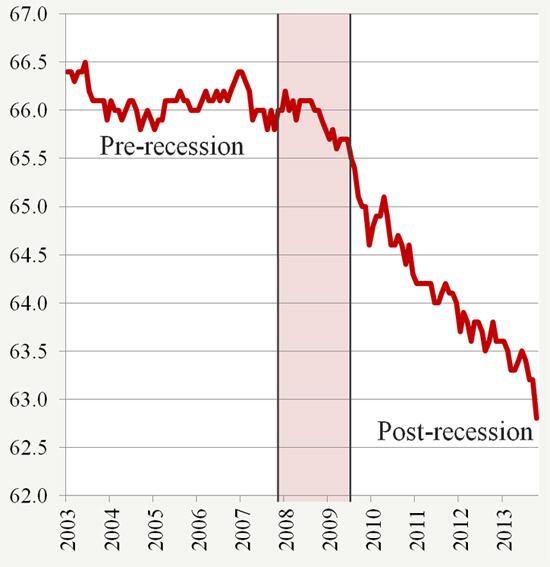
Labor Force Participation down to 62.8%

An editorial by Arthur Brooks appeared today in the leftist New York Times. His topic is the shift from optimism to envy, why it is happening, and whether envy makes us happier than optimism.

Excerpt: (links removed)

The Irish singer Bono once described a difference between America and his native land. “In the United States,” he explained, “you look at the guy that lives in the mansion on the hill, and you think, you know, one day, if I work really hard, I could live in that mansion. In Ireland, people look up at the guy in the mansion on the hill and go, one day, I’m going to get that bastard.”

[…]Unsurprisingly, psychologists have found that envy pushes down life satisfaction and depresses well-being. Envy is positively correlated with depression and neuroticism, and the hostility it breeds may actually make us sick. Recent work suggests that envy can help explain our complicated relationship with social media: it often leads to destructive “social comparison,” which decreases happiness. To understand this, just picture yourself scrolling through your ex’s wedding photos.

My own data analysis confirms a strong link between economic envy and unhappiness. In 2008, Gallup asked a large sample of Americans whether they were “angry that others have more than they deserve.” People who strongly disagreed with that statement — who were not envious, in other words — were almost five times more likely to say they were “very happy” about their lives than people who strongly agreed. Even after I controlled for income, education, age, family status, religion and politics, this pattern persisted.

It’s safe to conclude that a national shift toward envy would be toxic for American culture.

Unfortunately, in the wake of the Great Recession, such a shift may well be underway, given the increasing anxiety about income inequality and rising sympathy for income redistribution. According to data from the General Social Survey, the percentage of Americans who feel strongly that “government ought to reduce the income differences between the rich and the poor” is at its highest since the 1970s. In January, 43 percent of Americans told the Pew Research Center that government should do “a lot” to “reduce the gap between the rich and everyone else.”

Why the shift? The root cause of increasing envy is a belief that opportunity is in decline. According to a 2007 poll on inequality and civic engagement by the Maxwell School of Citizenship and Public Affairs at Syracuse University, just 30 percent of people who believe that everyone has the opportunity to succeed describe income inequality as “a serious problem.” But among people who feel that “only some” Americans have a shot at success, fully 70 percent say inequality is a major concern.

People who believe that hard work brings success do not begrudge others their prosperity. But if the game looks rigged, envy and a desire for redistribution will follow.

This is the direction we’re heading. According to Pew, the percentage of Americans who feel that “most people who want to get ahead” can do so through hard work has dropped by 14 points since about 2000. As recently as 2007, Gallup found that 70 percent were satisfied with their opportunities to get ahead by working hard; only 29 percent were dissatisfied. Today, that gap has shrunk to 54 percent satisfied, and 45 percent dissatisfied. In just a few years, we have gone from seeing our economy as a real meritocracy to viewing it as something closer to a coin flip.

There is a good lesson in this for people who want what is best for the poor. Simply receiving money from others is not going to make poor people happy. What we need to focus on is providing the poorest people with opportunities. For example, we need to reduce barriers that employers face to hire them, and we need to make the school system focus more on skill-building and less on indoctrination in leftist ideology.

Democrats like to give lots of speeches on income inequality, stoking the fires of envy, while doing nothing to help people learn useful skills in school and to help employers hire people more easily, setting them on the path of lifelong independence. For example, Democrats oppose school choice, as when they killed the D.C. voucher program that helped poor black students. Less school choice helps public schools to be insulated from competition, so that they can focus on what they want (bigger government, so they get paid more) rather than what parents want (bad teachers fired, students to learn useful skills, more male teachers in the classroom, a focus on vocational skills rather than ideology). Just this past week, the ultra-leftist mayor of New York city kicked charter schools out of the city. Why? Because if children learn useful skills in better schools, then they will be less dependent on government, and less responsive to “envy rhetoric”.

Democrats also passed Obamacare, which punishes businesses with taxes if they allow part-time workers to work for more than 30 hours a week. Many jobs were lost because of this, and many people are now struggling to pay higher premiums for plans with higher deductibles and co-pays. Now the Democrats are talking about raising the minimum wage, which is going to put even more pressure on employers to lay off workers, because they can’t afford to pay them more for the same work. For Democrats, this is all to the good, though. Because if the poor don’t have jobs, or can’t work enough hours, they start to see the economic game as “rigged” and they are more responsive to “envy rhetoric”.

What we need to see is that it’s not the Democrats’ objective to help people find jobs. They gain when people become more envious, like in European countries, and start to vote to grow the size and power of government to redistribute wealth. Speeches about income inequality never have the goal of giving people jobs. None of Obama’s policies aim to do that. That’s why he won’t build the Keystone XL pipeline, or boost domestic energy development here at home. Instead, they want to extend unemployment benefits and pass the costs on to the next generation. Their goal is to get you unemployed or on disability or on welfare, so that you will vote for the government to continue to take your neighbor’s money. That manufactured envy is what keeps the Democrats in power.

Conservative Party of Canada on track to deliver budget surplus in 2015

Prime Minister Stephen Harper
Prime Minister Stephen Harper (Conservative Party)

Story from Yahoo News about the results delivered by the Conservative Party of Canada.

Note: To understand the numbers in the article, simply multiple the numbers by 10 to compare with American numbers – Canada’s economy is about 1/10 the size of ours. For example, our GDP is $15.7 trillion and theirs is $1.8 trillion. Our national debt is $17 trillion, while their’s is $1.2 trillion.

Excerpt:

Canada’s Conservative government looks set to comfortably balance its books in 2015 or even sooner, its latest budget showed on Tuesday, with cuts in spending on the public service more than offsetting a series of modest new expenditures.

The low-key spending plan leaves Prime Minister Stephen Harper well-positioned to offer tax breaks and other initiatives in the runup to an election scheduled for October next year.

“Some people will say this budget is boring,” Finance Minister Jim Flaherty told reporters ahead of the budget speech. “Boring is good.”

The budget shows a deficit of C$2.9 billion ($2.63 billion)in the 2014-15 fiscal year, up from the previous estimate of C$5.5 billion. That balance includes a C$3 billion contingency fund, which in fact reveals an underlying surplus that year.

Flaherty acknowledged the budget would be narrowly balanced this coming year without the contingency fund, but said he preferred to have a “nice clean surplus next year”.

The government estimates a bigger-than-expected C$6.4 billion surplus in 2015-16. In the year ending March 31 of this year, the deficit is pegged at C$16.6 billion.

[…]Flaherty, who is 64 and battling a rare skin disease, has staked his reputation on eliminating Canada’ small deficit, equivalent to about 1 percent of gross domestic product (GDP), and restoring the reputation the country had before the global financial crisis as having the strongest fiscal record in the Group of Seven major economies.

Germany is currently the only G7 country running a surplus, but Canada’s ratio of debt to GDP is substantially less and it is one of a handful of countries with a triple-A rating from rating agencies.

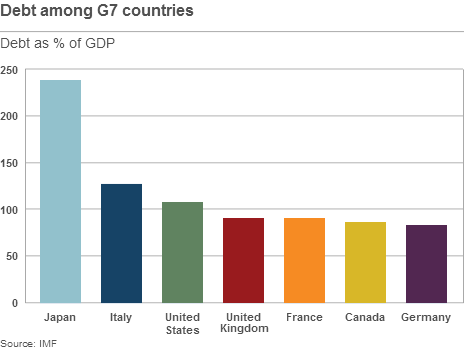
Canada is beating us in debt to GDP:

G7 Debt to GDP as of 2013
G7 % Debt to GDP as of 2012 (lower is better)

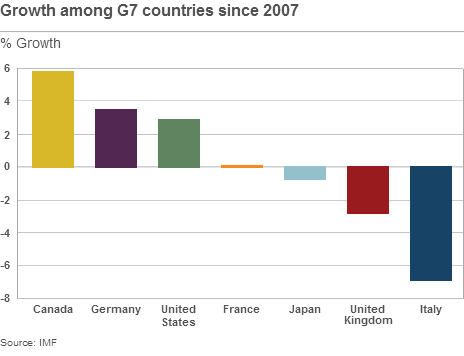
Canada is beating us in economic growth:

G7 GDP growth for 2013
G7 % GDP growth from 2007 to 2012 (higher is better)

Source: BBC Business

The next Canadian election is in 2015. I know that the Liberal Party is currently leading in the polls, but I found some good news. The Canadians just redistricted after their census, and there are 30 new electoral districts. If the same turnout occurs in 2015 which occurred in the 2011 election, then the Conservative Party of Canada would get 22 out of 30 of those new seats. However, I am concerned. I want Harper to keep his majority, as he and Tony Abbott (Australia) are two bright conservative stars who show people what conservatives can do. 

David Brooks on young people’s rejection of American values

He voted for Obamacare, and he got it

I normally don’t read David Brooks anymore since his slide to the left, but Dennis Prager mentioned this article from the radically leftist New York Times, and I thought it was worth a look.

Excerpt:

When foreign visitors used to describe American culture, they generally settled on different versions of one trait: energy. Whether driven by crass motivations or spiritual ones, Americans, visitors agreed, worked more frantically, moved more and switched jobs more than just about anybody else on earth.

That’s changing. In the past 60 years, for example, Americans have become steadily less mobile. In 1950, 20 percent of Americans moved in a given year. Now, it’s around 12 percent. In the 1950s and 1960s, people lived in the same house for an average of five years; now people live in the same house for an average of 8.6 years. When it comes to geographic mobility, we are now at historic lows, no more mobile than people in Denmark or Finland.

Why is that? Here is his hypothesis:

[A] big factor here is a loss in self-confidence. It takes faith to move. You are putting yourself through temporary expense and hardship because you have faith that over the long run you will slingshot forward. Many highly educated people, who are still moving in high numbers, have that long-term faith. Less-educated people often do not.

One of the oddities of the mobility that does exist is that people are not moving to low-unemployment/high-income areas. Instead they are moving to lower-income areas with cheap housing. That is to say, they are less likely to endure temporary housing hardship for the sake of future opportunity. They are more likely to move to places that offer immediate comfort even if the long-term income prospects are lower.

This loss of faith is evident in other areas of life. Fertility rates, a good marker of confidence, are down. Even accounting for cyclical changes, people are less likely to voluntarily vacate a job in search of a better one. Only 46 percent of white Americans believe they have a good chance of improving their standard of living, the lowest levels in the history of the General Social Survey.

[Leftist] Peter Beinart wrote a fascinating piece for [Leftist] National Journal, arguing that Americans used to have much more faith in capitalism, a classless society, America’s role in the world and organized religion than people from Europe. But now American attitudes resemble European attitudes, and when you just look at young people, American exceptionalism is basically gone.

Fifty percent of Americans over 65 believe America stands above all others as the greatest nation on earth. Only 27 percent of Americans ages 18 to 29 believe that. As late as 2003, Americans were more likely than Italians, Brits and Germans to say the “free market economy is the best system on which to base the future of the world.” By 2010, they were slightly less likely than those Europeans to embrace capitalism.

Thirty years ago, a vast majority of Americans identified as members of the middle class. But since 1988, the percentage of Americans who call themselves members of the “have-nots” has doubled. Today’s young people are more likely to believe success is a matter of luck, not effort, than earlier generations.

The funny thing about this story is that the young people themselves are voting for the very things that are destroying their hopes and dreams. They vote for the Democrat Party, the champions of social liberalism and fiscal liberalism.

What do young people need to get ahead? They need a stable family with a mother and father. Young people vote for the pro-no-fault-divorce Democrat Party. They vote for the pro-gay-marriage Democrat Party. They vote to call any family arrangement marriage, and any collection of people with kids a family. They are the ones who are the strongest opponents of the nuclear family that used to be the norm in America. Maybe they are doing it out of ignorance, but they are still responsible – they are voting for it. They are voting for more adult selfishness, and they are the victims of it.

What else to young people need to get ahead? They need a good education and a job. What do they vote for? They vote for the Democrat Party. The party that opposes school choice. The party of teacher unions. They party that undermines free market capitalism with taxes, regulations and nationalization of the private sector. They vote for judicial activism instead of the rule of law. They vote for redistribution of wealth instead of private property. And what’s more they are anti-corporations! Who exactly do they expect to work for? They keep voting for more and more government spending on adults, and they are the ones who are going to be stuck with the bill.

This will go on until the United States ends up like France and Greece, when there is no more money left to borrow, and then it will stop. But one thing is for sure – these young people will never have the standard of living their grandparents had. Either you believe in America, and what America represents, or you devolve into Greece, and live at home, unemployed, with your parents for your whole life.