
Tag Archives: Canada

Conservative MP introduces bill to abolish Section 13 speech code

Here is the description for that video, posted by SDAMatt: (Note: Tory = Conservative)

Tory backbencher Brian Storseth wants to eliminate Section 13 of the Canadian Human Rights Act (CHRA). That is the provision in federal law that gives the Canadian Human Rights Commission authority to hear complaints of hate speech on the Internet. We wish Mr. Storseth, the MP from Westlock-St. Paul in Alberta, well in this campaign. Section 13 is a particularly pernicious infringement on free speech. Originally added to the CHRA in 2001 as a protection for vulnerable groups against racist or violence-promoting websites, the clause has more often been used by minority activists (or those purporting to act on behalf of minorities) to silence those who do not share their opinions.

The biggest problem with Sec. 13 is that its provisions make it far too easy for commissioners to find an alleged offender guilty. Unlike in a court of law – where the presumption of innocence, rules of evidence and bans on hearsay testimony protect defendants from wrongful prosecution – at a human rights tribunal complainants may remain anonymous and complaints may be filed by third parties with no direct interest in the case at hand. (Some folks even make a profitable hobby out of launching these complaints.) Hearsay evidence is perfectly acceptable, the onus to prove one’s innocence often falls on the accused, and tax dollars pay for the plaintiff’s lawyers while the accused is on his or her own to fund a defence.

A further flaw in Sec. 13 is that neither the truth nor the lack of intent to harm is permitted as a defence. It does not matter whether the offending Internet message was truthful or if adjudicators find it “likely to expose an identifiable group to hatred or contempt” (the standard employed under criminal law) – the owner of the website on which it appears and the person who posted it are guilty anyway.

In 2007, Sec. 13 was used against writer Mark Steyn for material he wrote in Maclean’s magazine that four Muslim students claimed had offended them. That same year, a similar provision in Alberta provincial human rights law was used to prosecute Ezra Levant for publishing the infamous Danish cartoons of the Prophet Muhammad in the now-defunct Western Standard magazine. In both cases, the clear intent of the complainants was to limit legitimate debate about religious extremism.

Fears that getting rid of Sec. 13 will lead to a flood of vicious anti-Semitism and the like are unfounded. Sections 318 through 320 of the Criminal Code already prohibit “hate propaganda” – including “any writing, sign or visible representation that advocates or promotes genocide.” And it has been used several times to prosecute true hatemongers, James Keegstra, most famously. Nothing in Mr. Storseth’s proposal would affect those laws.

The Conservatives have a majority in the House of Commons and the Senate, and they have Prime Minister Stephen Harper there to sign the bill. They need to do this right away, and then ban political contributions by large corporations and public sector unions.

But wait! There’s more! (H/T Andrew)

Excerpt:

The Supreme Court of Canada recently laid the smack down on Human Rights Tribunals across the country. In a recent decision, B.C. Workers’ Compensation Board v. Figliola, a five-judge majority dramatically reduced the discretion of human rights tribunals to rehear discrimination complaints already decided by other administrative bodies such as workers’ compensation boards.

According to lawyer Peter Gall, who is also representing Dr. Brian Day in a health care related case that the Canadian Constitution Foundation is also assisting in, “the practice of workers taking a second kick at the can in front of human rights tribunals after their discrimination complaints had already been dismissed by a labour board or other administrative decision-maker ‘was happening often enough that it was a real problem'”.
This Supreme Court decision applies to all human rights tribunals across Canada and is very important to the business community of British Columbia and Canada because it provides for finality and prevents “forum shopping” and the issue of multiple proceedings.

I know that there are  a lot of conservative voters who are disillusioned with the Canadian Tories over the abortion issue and the free speech issue. The Conservatives need to get something done on these issues, immediately.
 

Obama administration blocks oil production in Ohio: 200,000 jobs lost

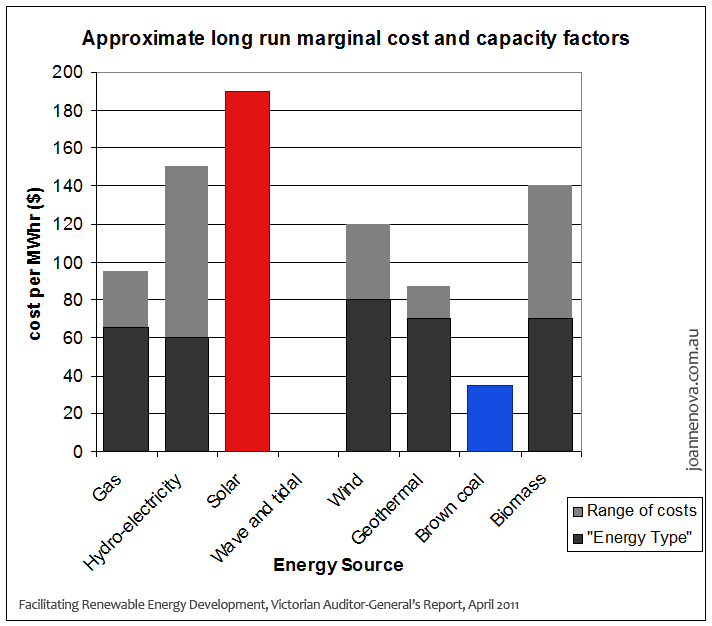
Cost of renewable wind and solar energy

The Heritage Foundation explains Obama’s latest effort to appease the environmentalist cult.

Excerpt:

First, it was 20,000 jobs the Obama Administration delayed by punting a decision to approve the Keystone XL pipeline, which would bring 700,000 barrels of oil per day from Canada into the United States. Multiply that number by 10 and you have the amount of jobs the President is putting on hold by delaying a mineral lease sale in Ohio’s Wayne National Forest for oil and gas drilling. This decision kills jobs and denies Americans access to affordable energy.

The Washington Examiner reports that Wayne National Forest already has 1,300 oil and gas wells in operation, but access to Utica’s shale gas reserves would require hydraulic fracturing. The United States Department of Agriculture announced a six-month delay in the leasing of 3,000 acres in the forest to study the environmental effects of hydraulic fracturing. This decision not only delays access to the jobs and energy that Americans need now, but it blocks an important revenue source for federal and state governments. The Ohio Oil and Gas Energy Education Program estimated that:

Natural gas and crude oil industry could help create and support more than 200,000 Ohio-based jobs from the leasing, royalties, exploration, drilling, production and pipeline construction activities for the Utica shale reserve. The state could experience an overall wage and personal-income boost of $12 billion by 2015 from industry spending.

The study also projects royalty payments to landowners, schools, businesses and communities could increase to as much as $1.6 billion by 2015—a number that exceeds the total amount of royalties distributed by Ohio’s natural gas and crude oil industry in the last decade. Total tax revenue from oil and gas exploration and development in the Utica shale formation from 2011 until 2015, including severance, commercial activity, ad valorem (property), federal, state and local taxes, is projected to be approximately $479 billion. Industry expenditures related to Utica shale development could generate approximately $12.3 billion in gross state product and result in a statewide output or sales of more than $23 billion.

Hydraulic fracturing, known as “fracking,” is a long-proven process by which producers inject a fluid (composed of 99 percent water) and sand into wells to free oil and gas trapped in rock formations. Used in over 1 million wells in the United States over more than six decades, fracking has been successfully used to retrieve over 7 billion barrels of oil and over 600 trillion cubic feet of natural gas.

Spencer Hunt of the Columbus Dispatch reports that “Tom Stewart, vice president of the Ohio Oil and Gas Association, said shale well drilling would be less harmful to the forest than conventional drilling because as many as six shale wells can be drilled on a single pad.”

Fracking is subject to both federal and state regulations, and there have been no instances of contamination to drinking water. Groundwater aquifers sit thousands of feet above where fracking takes place, and studies by the Environmental Protection Agency, the Ground Water Protection Council, and other agencies have found no evidence of groundwater contamination. Where there have been unwanted environmental outcomes—such as gas migration—they were the result of poor well construction or problems with the concrete and steel casings around the well bore. Those instances have been rare, and they were not a result of the fracking process itself.

Hydraulic fracturing will be a critical process in developing energy supplies in the future. The National Petroleum Council estimates that fracking will allow 60–80 percent of all domestically drilled wells in the next 10 years to remain viable.

You can study the effects of hydraulic fracturing for six more months, but the facts are going to remain the same. Fracking is a long-proven process that can help access our nation’s abundant oil and gas reserves. Delaying lease sales is delaying the creation of much-needed jobs.

So let me get this straight. If Obama isn’t handing out $535 million of taxpayer dollars to Solyndra and $1.4 billion of taxpayer dollars to BruightSource, then he’s busy blocking oil drilling in the Gulf and blocking oil drilling in Ohio and blocking the construction of the Keystone XL pipeline. It’s no wonder we have a 9% unemployment rate – this man doesn’t want to create jobs. He wants to reward the people who got him elected by handing out millions and billions of taxpayer dollars to millionaires and billionaires – in effect, transferring wealth from the middle class to rich Democrat fundraisers. I find it very surprising that labor unions back this man in elections. What sense does that make?

Global warming alarmism is nothing but a religion. Why do we have to have so much religion in politics? I understand if environmentalists want to practice their religion in their own homes and in the churches, but why do we have to give them taxpayer money for their environmentalist devotions? And why to we have to put our economy on hold just so that we are compliant with their religious beliefs? Why did we elect a President for believes in forcing a religious ideology onto the rest of us? Why do we have to have our freedom and prosperity – our right to produce goods and our right to purchase goods – limited by a religious ideology?

Related posts

FARC terrorist leader Alfonso Cano killed by Colombian armed forces

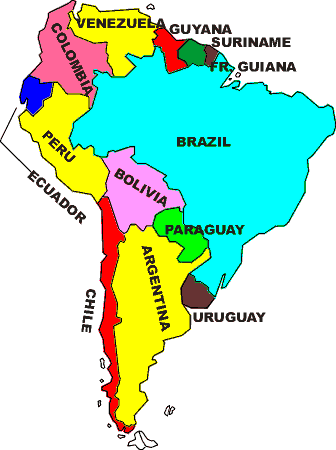
Map of South America

From the Heritage Foundation.

Excerpt:

The armed forces of Colombia have scored a major battlefield victory. They finally hunted down, confronted, and killed the leader of the narco-terrorist Revolutionary Armed Forces of Colombia (FARC), Guillermo Leon Saenz, widely known by his alias Alfonso Cano.

A guerrilla for decades, Cano assumed the top leadership of the FARC following the natural death of founder Manuel Marulanda (2008) and the elimination of senior figures Raul Reyes (2008) and Jorge Briceno (aka Mono Jojoy, 2010).

Seen by some as a modern-day version of the “good revolutionary,” Cano—a life-long advocate of armed violence and terrorism—fell in combat with the Colombian armed forces as they rappelled their way into his secret jungle hideout. Cano was also indicted in a U.S. court for drug trafficking along with dozens of other FARC leaders and had a $5 million price on his head.

FARC is a Marxist terrorist group.

The Economist reports that the Colombian economy is also doing well.

Excerpt:

WHEN the figures are finally tallied, Colombia may prove to have weathered the world recession better than any other of the larger Latin American countries. After a slight contraction at the end of 2008, the economy has been growing modestly this year. This resilience stems from continued foreign investment, an increase in government spending on public works and easier money: since December the central bank has cut interest rates by six percentage points, to 4%, a steeper drop than anywhere in the region outside Chile.

[…]President Álvaro Uribe’s security policies have helped to restore confidence. Investment soared, from 15% of GDP in 2002 to 26% last year, says Mr Zuluaga. Private business has retooled. After many delays, the government has issued licences to expand several ports; this month it hopes to award a contract for the first of four big road schemes, costing a total of $7.5 billion over four years. It hopes for investment of up to $50 billion in mining and oil over the next decade.

And liberal MSNBC has more on the booming Colombian economy.

Excerpt:

…Colombia’s revival is benefiting U.S. economic and political rivals as much as or more than the U.S. itself.

The long delay in signing the treaty allowed Latin America’s fourth-largest economy to strengthen ties with China. It also damaged U.S. credibility in the region, says Eric Farnsworth, vice-president of the Council of the Americas in Washington. “The delay in passing this called into question the United States’ reliability as a partner,” Farnsworth says. “There’s a strategic component to this. It’s not just about economics and trade.”

[…]As talks between the U.S. and Colombia dragged on, Colombia and China forged plans for a rail link between the Pacific and Caribbean that could draw freight away from the Panama Canal. Colombian President Juan Manuel Santos aims for a trade deal with South Korea. To tighten his connections to high-growth Asia, he’s also seeking membership in the Asia-Pacific Economic Cooperation group. “While Washington was debating whether the accord with Colombia was opportune, we advanced in our foreign policy strategy,” says Trade Minister Sergio Diaz-Granados.

Santos has cooperated more with his South American neighbors, organizing a meeting of finance ministers to discuss ways to protect their currencies and economies from the debt crisis in the U.S. and Europe. He supports a stock trading platform with Colombia, Chile, and Peru and wants to bring Mexico and Panama on board. Exports to Brazil have surged tenfold. While the U.S. remains Colombia’s biggest export market, with $16.8 billion in 2010 sales, up 30 percent from a year earlier, sales to China more than doubled last year, to $1.2 billion. Sales to the European Union are also rising, to $5.4 billion this year through August, more than in all of 2010. An EU trade accord could come next year.

The government has reduced cocaine cultivation 37 percent and halved the number of insurgents to about 8,000. Improved security has spurred enough growth to win an investment-grade credit rating from Standard & Poor’s as well as investment from billionaires. Colombia’s victories over the guerrillas opened up swathes of countryside to exploration for oil, gold, and coal. Mexican billionaire Carlos Slim’s push into crude has helped fuel foreign investment that the government says may reach a record $12 billion this year. The economy grew 5.2 percent in the second quarter.

The U.S. faces more competition from Colombia’s neighbors and Canada. In 2010, U.S. agricultural exports to Colombia fell more than 50 percent from 2008, to $827 million, as Argentina’s more than doubled, to $1 billion, according to a report by Senator Richard Lugar’s staff. Diaz-Granados attributes the U.S. setback to the delay in the free-trade agreement.

An August accord reduces or ends Colombian tariffs on Canadian wheat, paper, and machinery. Bank of Nova Scotia, Canada’s third-largest lender, agreed in October to buy 51 percent of Banco Colpatria Red Multibanca Colpatria for about $1 billion—Scotiabank’s largest international takeover. “This is not the Colombia of old,” says Brian J. Porter, group head of international banking for Scotiabank. “The more we looked at Colombia, the more excited we got about the economic potential.”

We really should have signed that trade deal 3 years ago – it would have helped out economy a lot.  But unions got Obama elected, and the unions decided that the trade deal needed to be held up for 3 years. And that’s one of the reasons why we’ve had over 9% unemployment. Our economic policy is being set by unions, not by economists. But in Colombia, economic policy is set by economists, not unions.