Tag Archives: Business

Republicans introduce national right-to-work legislation

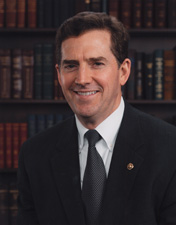
Sen. James Demint

From the Hill.

Excerpt:

Eight Republican Senators introduced a bill Tuesday giving workers a choice as to whether to join labor unions, which they argue will boost the nation’s economy and provide an increase in wages.

Sen. Jim DeMint (R-S.C.), introduced the National Right to Work Act to “reduce workplace discrimination by protecting the free choice of individuals to form, join, or assist labor organizations, or to refrain from such activities,” according to a statement.

Seven other Republicans signed onto the effort: Sens. Tom Coburn (Okla.), Orrin Hatch (Utah), Mike Lee (Utah), Rand Paul (Ky.), James Risch (Idaho), Pat Toomey (Pa.) and David Vitter (La.).

“Facing a steady decline in membership, unions have turned to strong-arm political tactics to make forced unionization the default position of every American worker, even if they don’t want it,” Hatch said. “This is simply unacceptable. At the very least, it should be the policy of the U.S. government to ensure that no employee will be forced to join a union in order to get or keep their job.

“Republicans cited a recent poll they said shows that 80 percent of union members support having their policy and that “Right to Work” states outperform “forced-union” states in factors that affect worker well being.

From 2000 to 2008, about 4.7 million Americans moved from forced-union to right to work states and a recent study found that there is “a very strong and highly statistically significant relationship between right-to-work laws and economic growth,” and that from 1977 to 2007, right-to-work states experienced a 23 percent faster growth in per capita income than states with forced unionization.

“To see the negative impacts of forced unionization, look no further than the struggling businesses in states whose laws allow it,” Vitter said. “It can’t be a coincidence that right-to-work states have on balance grown in population over the last 10 years, arguably at the expense of heavy union-favoring states.”

DeMint blamed the problems faced by U.S. automakers on the unions.

“Forced-unionism helped lead to GM and Chrysler’s near bankruptcy and their requests for government bailouts as they struggled to compete in a global marketplace,” he said. “When American businesses suffer because of these anti-worker laws, jobs and investment are driven overseas.”

If you want to attract businesses, then you need to have pro-business laws. That’s where jobs come from – businesses.

Here’s an article about states who are trying to pass these laws to attract more employers.

Excerpt:

Currently 14 states beyond Indiana and Wisconsin are considering legislation that would limit union benefits and/or collective bargaining power. They are: Alaska, Hawaii, Maine, Michigan, Minnesota, Missouri, Montana, New Hampshire, New Mexico, Ohio, Pennsylvania, Virginia, Washington (state) and West Virginia. In any number of these states, supporters have planned or held rallies against the measures. But public support might be less than deep. According to a Rasmussen Poll conducted late last week and released Monday, 48 percent of likely U.S. voters sided with Wisconsin Governor Walker whereas only 38 percent sided with his union opponents; the other 14 percent were undecided. And 50 percent of the respondents favored reducing their home state’s government payroll by one percent a year for 10 years either by reducing the work force or reducing their pay. Only 28 percent opposed such action.

This is how we are going to turn the recession around. Cut off the spending on left-wing special interests – NPR, PBS, ACORN, Planned Parenthood, Unions. They all will have to pay their own way, just like the grown-ups do.
Stephen Harper’s Conservative Party cuts federal spending by 6.2%

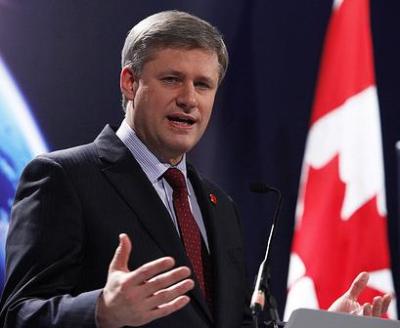
Prime Minister Stephen Harper

More news from up north. (H/T Ben)

Excerpt:

Federal government expenditures are set to fall next fiscal year by $16.5-billion, or 6.2%, with big cuts to regional development and environment programs, according to documents tabled Tuesday.

That would leave total expenditures for the 2011-12 year at $250-billion, with the bulk taken up by transfer payments to individuals and governments, and operating costs. Just over $30-billion of that expense is attributed to refinancing Canada’s debt.

The figures, contained in spending estimates provided by the Treasury Board, sees budget increases for departments entrusted with security and law enforcement – such as a 21% boost to jails — but cuts of roughly 20% to Environment Canada, Natural Resources Canada and Agriculture and Agri-Food Canada.

Government is supposed to be concerned with security and law enforcement, not with environmentalist wastefulness.

Here’s Paul Ryan. He would like to cut our budget by 6.2% – and maybe even more.

If Canada is cutting their government waste, then why can’t we?

There are a lot of programs that we could be cutting.

Excerpt:

The federal government could save billions in taxpayer dollars annually by consolidating duplicative government programs, according to a new report.

The newly-released report from the Government Accountability Office “makes us all look like jackasses,” Sen. Tom Coburn (R-Okla.) told reporters Monday night.

The conservative senator said the report — which identifies redundancies in more than 546 individual programs — reveals why the United States is $14 trillion in debt.

“Anybody who says we don’t look like fools up here hasn’t read the report,” he said.

[…]The GAO reviewed 34 areas (among them agriculture, defense and social services) where agencies, offices or initiatives have similar or overlapping objectives. The report also looked at 47 additional cost-saving opportunities related to more general government efficiency. For instance, the report said, “Improved corrosion prevention and control practices could help [the Defense Department] avoid billions in unnecessary costs over time.”

Addressing duplicative efforts on even a single issue could save billions, the report found. For instance, the GAO says the government could save up to $5.7 billion annually by addressing potentially duplicative policies designed to boost domestic ethanol production. Additionally, the Defense Department could save $460 million annually by making broader changes to the governance of its military health care system.

The report finds that there are 15 agencies involved in food safety, 80 programs involved in economic development and more than 100 involved in surface transportation. There are 10 agencies and 82 programs involved in teacher quality, and more than 20 agencies and about 56 programs involved in financial literacy efforts. There are about 2,300 investments across the Defense Department to modernize its business operations.

House Majority Leader Eric Cantor (R-Va.) said today that in order to foster long term economic growth, “we’re going to deal with the pressing issues of regulatory waste in our agencies, as well as long term issues facing our country with entitlement programs.”

This is why we have to stop giving private sector money to government. They don’t earn any money by making things or helping people – they don’t sell anything useful. They just steal money from the productive workers and businesses and then they waste it and run up trillion dollar deficits. This kind of corruption, fraud and waste would not survive in small businesses, and probably not even in big businesses. Business have to be efficient or they go bankrupt. They have to perform or their competitors will have them for lunch. The consumer is king in the private sector.

Related posts

North Dakota Republican Dan Ruby wants to slash tax rates and ban abortion

Rep. Dan Ruby
Rep. Dan Ruby

Wow, this guy is perfect!

He managed to get this pro-life bill passed in North Dakota.

Excerpt:

A strong majority of lawmakers in the North Dakota House of Representatives on Friday afternoon passed a law that would make it illegal to murder any human being from the moment of their conception.

The Defense of Human Life Act, HB 1450, recognizes every human being at any stage of development as a person under state law with a right to protection.

“The overwhelming community and legislative support for HB 1450 proves that North Dakota could be the first state to recognize the value and dignity of every living human being,” stated Representative Dan Ruby. “The Defense of Human Life Act is just common sense. Of course every human being is a person, and every innocent person should receive legal protection. I am motivated to see women and children protected by HB 1450, and I look forward to its passage in the Senate in the near future.”

While the bill prohibits chemical abortifiacients such as RU-486, it does not apply to emergency contraception, or other “contraception administered before a clinically diagnosable pregnancy.” The bill also exempts legitimate medical procedures that may lead to the death of children in the womb when a woman’s life is in danger. The bill also exempts pregnant women seeking abortions from criminal prosecution.

The bill, supported by ND Right to Life, ND Life League, ND Family Alliance, ND CWFA, and the ND Catholic Conference, passed 68-25 in Friday’s vote.

“HB 1450 simply states that all human beings will be equal under North Dakota state law.  Our law would treat all children as human beings,” said Republican Rep. Gary Paur in an email to supporters.

Daniel Woodard, a legal consultant for North Dakota Right to Life and the North Dakota Life League, told LifeSiteNews.com that the bill would put the one remaining abortion clinic in the state out of business. “This bill should shut down that clinic,” said Woodard.

That’s good, but here is something that is also just as good: not taking money away from families, and not taking money away from the corporations that enable families to have money.

Excerpt:

Under the Republican governor’s proposal, the lowest individual income tax rate would decline from 1.84 percent to 1.63 percent, while the top rate would fall from 4.86 percent to 4.65 percent. The cuts would save North Dakotans about $50 million in income tax payments over two years.

Republican and Democratic lawmakers have offered alternatives. Rep. Jerome Kelsh, D-Fullerton, the House minority leader, has introduced a bill to exempt a person’s first $40,000 of income, and a couple’s first $50,000, from the state income tax entirely.

Kelsh said he wanted to focus the tax break on lower-income North Dakotans.

“I don’t think (state) income tax, to the top level of income earners in North Dakota, is really a problem,” Kelsh said in an interview. “Maybe their federal is different, but North Dakota income tax is not very burdensome to anyone.”

Reps. Dan Ruby, R-Minot, and Jim Kasper, R-Fargo, have proposals that offer larger income tax cuts than the governor’s proposal.

Ruby’s legislation would slash corporate and individual income taxes by 60 percent. The state Tax Department estimates it would reduce income tax collections by $634.7 million over two years. It would also cut taxes on so-called “pass-through” income that individuals receive from partnerships and limited liability companies.

Ruby’s bill would cut the top corporate tax rate from 6.4 percent to 2.56 percent, and reduce all five of North Dakota’s individual income tax rates below 2 percent. The top income tax rate would fall from 4.86 percent to 1.94 percent.

Oh, and I should note that he is NOT a poet. He is a small business owner and a father of 10!