I have been puzzled by the extent of the media coverage of some crank’s prediction that the world would come to an end today. People are always predicting the end of the world. So far they have always been wrong. Was there something about this particular prediction that was newsworthy? Did any significant number of people expect to wake up this morning and see graves opening and people ascending into Heaven? This morning, there were news stories to the effect that the world still exists. Really! Did reporters expect their readers to be surprised? Why, in short, was this silliness a major media event?
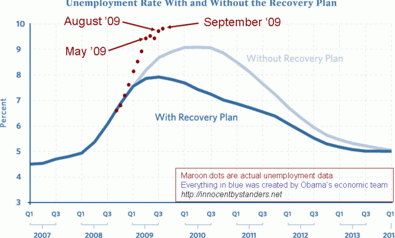
I wish reporters would pay as much attention to a more important failed prediction: the Obama administration’s assurance that its policies, including the “stimulus,” would foster job creation and prevent unemployment from reaching 8 percent.
And here are some charts from John’s post.
Community organizer Obama predicted that his $800 billion dollar stimulus program would keep unemployment below 8%:
Stimulus Job Creation Prediction
Ooops! Never send a community organizer to do an economist’s job.
How about all that spending? Surely ALL the spending must have created more jobs?
This should be the end of the belief that government spending creates jobs, but it won’t be, because the university is not committed to teaching what gets results, but what produces feelings of superiority. The secular elites feel that they should be allowed to redistribute the wealth created by businesses and workers. This feeling of entitlement to control and distribute is best put into practice with large-scale taxation, spending and redistribution of wealth. The professors think that their good feelings (subjective) will somehow, mysteriously, cause good effects in the real world (objective). The chart proves their mysticism wrong, but the university is insulated from feedback from the real world.
That is why we need to elect business owners like Michele Bachmann or Herman Cain.
Fishermen on New Hampshire’s Seacoast are warning that new fishing regulations could destroy their industry and have already caused them severe emotional stress.
[…]”If they don’t do something to modify the fishing regulations, we won’t have a fishing industry on the Seacoast, is what it boils down to,” said Hampton Town Manager Fred Welch.
[…]The new regulations are known as “catch-share.” The team said they are not there to look at possible changes to the rules but rather to see what effects they are having.
[…]”One of the fishermen from Rye had said that there had been three suicide attempts and a half dozen divorces during this first year of catch-shares,” said Bob Campbell of the Yankee Fisherman’s Cooperative. “Commercial fishermen are usually pretty tight-lipped, and for something this serious to come out, I mean, you know that the whole situation is grave.”
Campbell said the cooperative has lost about $750,000 in business since the new regulations went into effect.
“We’re off 1.1 million pounds of fish from last year, and over a million and a half pounds from the year before,” he said.
This is what regulations made in Washington do to a business running in New Hampshire.
As the U.S. languishes, Chile posted a head-turning 15.2% yearly gain in GDP in March, and forecasts for the year are rising. Why can’t we do that here?
A year ago, Chile lay in rubble, victim of the world’s fifth most powerful earthquake. So Chile’s 15.2% growth is a big bounce from a bad setback.
But it shouldn’t be dismissed as an anomaly. It’s a showy number, but not the only one.
The same day Chile released its data, Goldman Sachs raised its 2011 growth forecast for the country to 6.4% from 6%. In its annual regional business index, Latin Business Chronicle ranked Chile as having the best business climate in Latin America in 2011.
Such numbers are so alien to the U.S. in the economically debilitated Obama era, it makes sense to look at what Chile has done.
First, Chile’s policies for long-term growth were put into effect in the 1980s by the group of Milton Friedman-inspired economists known as the Chicago Boys.
Under them, Chile’s pension privatization cost nothing and left the country with no net debt. The private funds now hold assets worth 90% of GNP ($185 billion) — capital used to develop the country. Already, Chile’s education and infrastructure are the best in Latin America as a result.
Second, there’s free trade, of which Chile is a global champion, signing at least 58 treaties to gain access to 2 billion customers.
That’s a big reason Chile is close to full employment and is scrambling to attract growth-hungry U.S. entrepreneurs — and getting them.
[…]Bamrud says Chile has been turning heads with investors the past year and a half because of its emphasis on improving its corporate environment, its tax regime and its economic freedom, all of which rate highly.
“Chile has always been held out as a model for Latin America, but the reality is … it’s now a model for the U.S.,” he said.
Corporate taxes are the second lowest in Latin America at 18%, behind Paraguay’s 10%. The Latin average is 28%.
Meanwhile, Goldman Sachs’ chief economist for Latin America, Alberto Ramos, says Chile has wisely fostered growth by reducing the size of government and not printing too much money.
In 2011, it cut government spending to 5% of GDP, or $700 million, more than its projected 5.5%. So GDP has room to grow 6.4%, rather than 6% as first estimated.
Chile is doing the exact opposite of the socialist Barack Obama. Chile is cutting government spending, removing tariffs, enacting free trade deals, and cutting corporate taxes. Businesses and investors are moving there, and there are not enough people to work at all the jobs that are being created. Meanwhile, in Venezuela, communist dictator Hugo Chavez just reported 0.6% gain in the last quarter of 2010.
May Day — socialists’ paean to class warfare — evokes memories of Soviet tanks in Red Square and leftist radicals rioting. But Chile celebrates the actual empowerment of workers.
May 1 marks the 30 years since Chile became the first nation to privatize its social security system. By turning workers into investors, the move solved an entitlement crisis much like the one America faces today.
“I like symbols, so I chose May Day as the birth date of Chile’s ‘ownership society’ that allowed every worker to become a small capitalist,” wrote Jose Pinera, former secretary of labor and social security and the architect of this pension revolution. He is now a senior fellow at the Cato Institute in Washington, D.C.
What he designed has succeeded beyond all expectations. Yet Congress remains reluctant to adopt anything like it, despite efforts by Presidents Bill Clinton and George W. Bush to partially privatize an American system.
Instead of paying a 12.4% Social Security tax as we do here, Chilean workers must pay in 10% of their wages (they can send up to 20%) to one of several conservatively managed and regulated pension funds. From the accumulated savings, they get a life annuity or make programmed withdrawals (inheriting any funds left over).
Over the last three decades these accounts have averaged annual returns of 9.23% above inflation. By contrast, U.S. Social Security pays a 1% to 2% (theoretical) return, and even less for new workers.
[…]In 2005, New York Times reporter John Tierney worked out his own Social Security contributions on the Chilean model and found that his privatized pension would have been $53,000 a year plus a one-time payout of $223,000. The same contributions paid into Social Security would have paid him $18,000.
The biggest threat to American solvency is the growth in entitlement spending on Medicare, Medicaid and Social Security. The Democrats are stubbornly opposed to reforming these benefits, because they like the idea of transferring wealth from children, who cannot vote, to people who depend on government hand-outs, who can vote. And the best part of their scheme is that young people can be easily indoctrinated by the public schools to believe that have their future mortgaged away to buy votes is a good idea. It’s really very sad and unfair to young people.


 WINTERY KNIGHT