Tag Archives: Business

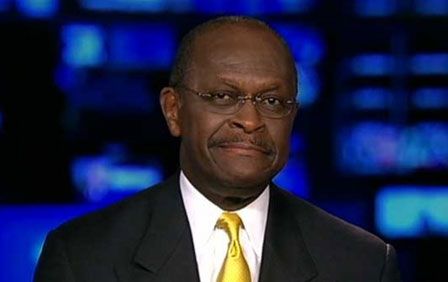
A closer look at Herman Cain’s business experience

From the liberal Minneapolis Star Tribune. (H/T Powerline Blog)

Excerpt:

Herman Cain, the Republican presidential hopeful, says he can turn around the country just as he did Godfather’s Pizza 25 years ago.

Business success has never guaranteed political success. But Cain demonstrated during a tour with Pillsbury Co. in the 1980s that he is a successful, charismatic leader. With flair and hard work, he turned around Pillsbury’s struggling Philadelphia Burger King region and revived a near-dead Godfather’s Pizza.

“My career spans 38 years and I’ve worked for 26 different managers,” said Frank Taylor, a recently retired Burger King financial executive whom Cain hired as his regional controller in 1983. “Herman was far and away the best I’ve worked for in terms of getting a team together, sharing a vision and accomplishing the goals. And nothing diverted him.”

Cain also shared the wealth. When Burger King distributed $50,000 apiece to the regional vice presidents as reward for good performance in 1985, most of the regional bosses spent it on a trip to a posh resort for themselves and other managers and spouses. The enlisted troops got a dinner. Cain took everybody in his office, including administrative staff, on the same three-day reward cruise, Taylor recalled.

Cain, 65, the son of a domestic worker and a chauffeur, earned degrees in math and computer science and worked in computer systems and business analysis during 10 years in the Navy and at Coca-Cola. He moved to Pillsbury as a business analyst in 1977. He managed the move of Pillsbury into its new downtown Minneapolis headquarters in 1982. And, in 1983, Cain got a shot in field management at Pillsbury’s restaurant division.

The Philadelphia region of Burger King ranked near the bottom among Burger King’s 12 groups. Cain brought analytical strengths and energy. He fired and hired. He praised and exhorted the survivors. He turned the region into a top performer within two years.

“I worked with him fairly closely at Burger King,” recalled George Mileusnic, a former Pillsbury executive, now a Twin Cities consultant. “He was good strategically and good with people, including working long hours in Burger King stores to get that bottom-up experience. He had about 500 stores in that Philadelphia region and he did a great job.”

Herman Cain leads Romney by 1 point in the latest Iowa poll and leads Perry by 1 point in the latest Texas poll.
Merril Lynch analyst: U.S. credit rating likely to be downgraded again

From Reuters. (H/T Reason to Stand)

Excerpt:

The United States will likely suffer the loss of its triple-A credit rating from another major rating agency by the end of this year due to concerns over the deficit, Bank of America Merrill Lynch forecasts.

The trigger would be a likely failure by Congress to agree on a credible long-term plan to cut the U.S. deficit, the bank said in a research note published on Friday.

A second downgrade — either from Moody’s or Fitch — would follow Standard & Poor’s downgrade in August on concerns about the government’s budget deficit and rising debt burden. A second loss of the country’s top credit rating would be an additional blow to the sluggish U.S. economy, Merrill said.

“The credit rating agencies have strongly suggested that further rating cuts are likely if Congress does not come up with a credible long-run plan” to cut the deficit, Merrill’s North American economist, Ethan Harris, wrote in the report.

“Hence, we expect at least one credit downgrade in late November or early December when the super committee crashes,” he added.

The bipartisan congressional committee formed to address the deficit — known as the “super committee” — needs to break an impasse between Republicans and Democrats in order to reach a deal to reduce the U.S. deficit by at least $1.2 trillion by November 23.

If a majority of the 12-member committee fails to agree on a plan, $1.2 trillion in automatic spending cuts will be triggered, beginning in 2013.

What I am hearing from my sources is that the debt super-committee is not doing well at all on deciding on the cuts that everyone agreed were needed to raise the debt ceiling. I really do not feel good about the defense cuts, given what I am hearing about new Russian and Chinese 4th generation fighters. This is going to put a lot of pressure on our military if things go badly in Afghanistan and Iraq.

Is Herman Cain’s 9-9-9 plan revenue neutral? Does it tax the poor more?

Presidential candidate Herman Cain

Consider this article by rock-star economist Arthur Laffer.

Excerpt:

In the recent past, federal tax revenues from the personal and business income taxes, all payroll taxes, and the capital gains, gift and estate taxes have averaged $2.3 trillion, while gross domestic product has averaged about $14.5 trillion. The total revenue from these taxes as a share of gross domestic product averages around 16%. Sometimes it’s a good deal higher, as in the boom of the late 1990s, and sometimes its lower, as in today’s “Great Recession.” But a number in the 16%-19% range is as good as you’ll get under our current tax code.

By contrast, the three tax bases for Mr. Cain’s 9-9-9 plan add up to about $33 trillion. But the plan exempts from any tax people below the poverty line. Using poverty tables, this exemption reduces each tax base by roughly $2.5 trillion. Thus, Mr. Cain’s 9-9-9 tax base for his business tax is $9.5 trillion, for his income tax $7.7 trillion, and for his sales tax $8.3 trillion. And there you have it! Three federal taxes at 9% that would raise roughly $2.3 trillion and replace the current income tax, corporate tax, payroll tax (employer and employee), capital gains tax and estate tax.

The whole purpose of a flat tax, à la 9-9-9, is to lower marginal tax rates and simplify the tax code. With lower marginal tax rates (and boy will marginal tax rates be lower with the 9-9-9 plan), both the demand for and the supply of labor and capital will increase. Output will soar, as will jobs. Tax revenues will also increase enormously—not because tax rates have increased, but because marginal tax rates have decreased.

By making the tax codes a lot simpler, we’d allow individuals and businesses to spend a lot less on maintaining tax records; filing taxes; hiring lawyers, accountants and tax-deferral experts; and lobbying Congress. As I wrote on this page earlier this year (“The 30-Cent Tax Premium,” April 18), for every dollar of business and personal income taxes paid, some 30 cents in out-of-pocket expenses also were paid to comply with the tax code. Under 9-9-9, these expenses would plummet without a penny being lost to the U.S. Treasury. It’s a win-win.

I have heard precious few conservative commentators reporting the facts on Herman Cain’s plan, so it’s nice to see Art Laffer looking at the details.

Here are three facts about Cain’s plan:

  • Fact #1: People below the poverty line are exempt from ALL the taxes.
  • Fact #2: It is a stupid objection to say that the tax rate can be raised. ALL taxes can be raised, and Cain has already said that his plan would require a 2/3rds majority to raise the tax rates.
  • Fact #3: This plan has nothing to do with state income taxes or state sales taxes or state corporate taxes – his plan only reforms federal taxes. State tax laws are outside of the jurisdiction of the President.

I was really disappointed to hear some of the people in Tuesday night’s debate disparaging Herman Cain’s plan, especially Michele Bachmann, who ought to know better because this is her strength. When people say that a tax is regressive, that means that it is not progressive. And a progressive tax is communist. It punishes success. What we want to have is a flat tax rate that doesn’t punish success and broadens the tax base so that everyone pays something. What Cain’s plan does is lower the punishment on job creators and workers, and raises the tax on consumers who spend money. And isn’t that a good thing? Aren’t we in this whole mess because we spend too much money? Maybe we should incentivize job creation and work instead of spending. Cain’s plan would be the greatest boon to job creation that this company has ever seen – it’s brilliant precisely because it eliminates the cost of having to comply with an onerous, complicated tax code. We are getting this wealth for free, and the only losers will be the IRS and the Washington lobbyists.