Tag Archives: Bankruptcy

What is the future of the European Union?

From the Wall Street Journal.

Excerpt:

In 1965, government spending as a percentage of GDP averaged 28% in Western Europe. Today it hovers just under 50%. In 1965, the fertility rate in Germany was a healthy 2.5 children per mother. Today it is a catastrophic 1.35. During the postwar years, annual GDP growth in Europe averaged 5.5%. After 1973, it rarely exceeded 2.3%. In 1973, Europeans worked 102 hours for every 100 worked by an American. By 2004 they worked just 82 hours for every 100 American ones.

[…]What is now happening in Europe isn’t so much a crisis as it is an exposure: a Madoff-type event rather than a Lehman one. The shock is that it’s a shock. Greece was never going to be bailed out and will, sooner or later, default. The banks holding Greek debt will, sooner or later, be recapitalized. The recapitalization will be borne by German taxpayers, and it will bring them—sooner rather than later—to the outer limit of their forbearance. The Chinese will not ride to the rescue: They know not to throw good money after bad.

And then Italy will go Greek. Europe’s crisis will lap on U.S. shores, and America’s economic woes will lap on Europe’s—a two-way tsunami.

America will survive this because America is a state. But as Bismarck once remarked, “Whoever speaks of Europe is wrong. Europe is a geographical expression.” The “fiscal union” that’s being mooted will never come to pass: German voters won’t stand for it, and neither will any other country that wants to retain fiscal independence—which is to say, the core attribute of democratic sovereignty.

What comes next is the explosion of the European project. Given what European leaders have made of that project over the past 30-odd years, it’s not an altogether bad thing. But it will come at a massive cost. The riots of Athens will become those of Milan, Madrid and Marseilles. Parties of the fringe will gain greater sway. Border checkpoints will return. Currencies will be resurrected, then devalued. Countries will choose decay over reform. It’s a long, likely parade of horribles.

Wow… things really are bad in Europe. And here, too.

Check out this editorial in the Washington Examiner.

Excerpt:

[A] congressional report released last week added another layer of explanation for the abject failure of Obamanomics since 2009. Along with the explosion of federal spending, Obama directed his appointees at key federal departments and agencies to embark on an unprecedented expansion of bureaucratic regulation. Thousands of new bureaucrats were hired at places like the Department of Heath and Human Services and the U.S. Environmental Protection Agency, and legions of costly new regulations soon poured forth.

The report by the House Oversight and Government Reform Committee headed by Rep. Darrell Issa, R-Calif., took aim at Obama’s “regulatory tsunami” and concluded that the pace and scale of new regulations threatens the ability of the government to fulfill even its most basic regulatory functions. Here’s how the congressional panel summarized its conclusions:

“The Obama Administration has created a regulatory environment that is suffocating America’s entrepreneurs’ ability to create jobs and grow businesses, … This regulatory tsunami has caused job creators to lock down at a time when we need them to expand. The committee has found that the problems created by this regulatory tsunami goes far beyond the cost of the regulations themselves, but also include breakdowns in the regulatory process itself that is having a severe impact on large and small businesses alike.”

Specifically, the panel found at least 219 “economically significant regulations in the pipeline, which if finalized, will impose costs of $100 million or more annually on the economy.” That’s a minimum of $219 billion in added costs to do business in this country over the next decade. Even worse, the panel found the Obama bureaucrats have already imposed 75 major new regulations that are projected to add another $380 billion in costs.

The Issa panel concluded that, as a result of this flood of new rules, “the regulatory process is broken” and that it is “being manipulated and exploited in an effort to reward allies of the Obama administration such as environmental groups, trial lawyers and unions.”

All we have to do to screw up this economy is do what the Europeans are doing – and we are.

Obama administration knew $535 million Solyndra loan was too risky

FBI agents remove evidence from Solyndra Headquarters

Here’s the latest from the radically leftist New York Times.

Excerpt:

Republican lawmakers, escalating the political furor over the collapse of a solar equipment manufacturer that received a $528 million government loan, released excerpts from Obama administration e-mails on Wednesday suggesting that the White House pressed federal officials to wrap up their review of the loan quickly for political purposes.

In the e-mails, officials at the Office of Management and Budget expressed frustration that they were being put under time pressure to sign off on the loan to the company, Solyndra, two years ago so that Vice President Joseph R. Biden Jr. could announce its approval at a groundbreaking for a factory. The White House wanted an announcement that would show progress on job creation.

The disclosure became a focus of a House Energy and Commerce subcommittee hearing on Wednesday about the loan to Solyndra, which has developed into a political headache for the Obama administration. The administration used the company as a prime example of stimulus bill dollars creating “green jobs.” But Solyndra recently filed for bankruptcy protection and closed its factory, and its headquarters was raided by the Federal Bureau of Investigation, apparently in connection with the loan.

The bankruptcy filing and the raid “clearly show that the committee was more than justified in its scrutiny of the deal,” said the panel’s chairman, Representative Fred Upton, Republican of Michigan. “Why did the administration think Solyndra was such a good bet?”

[…]Suspicions that the administration might have pushed the loan for political reasons have centered on the fact that a major investor in the company is a charitable foundation associated with George B. Kaiser, a billionaire from Tulsa, Okla., who raised $50,000 to $100,000 as a “bundler” for President Obama’s 2008 presidential campaign.

Logs show that Mr. Kaiser visited the White House on several occasions during the spring and summer of 2009, while the loan to Solyndra was being considered. Among the officials he met with were the chief of staff, Rahm Emanuel, and Pete Rouse and Valerie Jarrett, both senior advisers to Mr. Obama.

[…]While Mr. Kaiser’s connection to the Obama campaign and to Solyndra, based in Fremont, Calif., have helped draw attention to the loan, he was not a major topic of discussion at the hearing on Wednesday. Republicans did, however, press those testifying on whether the Solyndra bankruptcy offered proof that the government should not be lending to companies that have trouble raising money from private investors.

“In this time of record debt, I question whether the government is qualified to act as a venture capitalist, picking winners and losers in speculative ventures and shelling out billions of taxpayer dollars to keep them afloat,” Mr. Upton said.

ABC News reported on the contents of the e-mails: (H/T Director Blue)

The company’s solar panel factory was heralded as a centerpiece of the president’s green energy plan — billed as a way to jump start a promising new industry. And internal emails uncovered by investigators for the House Energy and Commerce Committee that were shared exclusively with ABC News show the Obama administration was keenly monitoring the progress of the loan, even as analysts were voicing serious concerns about the risk involved. “This deal is NOT ready for prime time,” one White House budget analyst wrote in a March 10, 2009 email, nine days before the administration formally announced the loan.

“If you guys think this is a bad idea, I need to unwind the W[est] W[ing] QUICKLY,” wrote Ronald A. Klain, who was chief of staff to Vice President Joe Biden, in another email sent March 7, 2009. The “West Wing” is the portion of the White House complex that holds the offices of the president and his top staffers. Klain declined comment to ABC News.

I think people need to get very clear on what “stimulus” spending is. Stimulus spending is nothing more and nothing less than taking money from the private sector job creators (“tax the wealthiest Americans”) and giving it to the people who got the socialists elected (“rebuilding our crumbling roads”).

More details from the Daily Caller.

Excerpt:

In light of the Solyndra bankruptcy, terms like “economic stimulus package” and “green jobs” now appear to be Team Obama code words for “kickbacks to political supporters so huge they would make a third-world despot green with envy.”

Solyndra is (or, more accurately, was) a California solar energy company that was the crown jewel of Obama’s first economic stimulus package, which cost $787 billion. Solyndra’s chief investor, George Kaiser, was also a bundler for Obama’s 2008 campaign, gathering over $50,000 in campaign contributions. Kaiser, together with Solyndra executives and board members, donated $87,050 to Obama’s campaign.

As part of the economic stimulus, Obama’s Department of Energy (DOE) fast-tracked a loan of $535 million (at the lowest interest rate granted by the DOE program) to Solyndra in 2009 to create green jobs. All other energy companies that received loans are paying an interest rate three to four times higher, and Solyndra got this amazing deal despite a Dun & Bradstreet credit rating that was only “fair.”

About a year later, Solyndra wasn’t making the payments and needed refinancing. In 2011, Solyndra’s CEO communicated with members of Congress, claiming that the company was on sound financial footing and would be able to repay a refinanced loan. DOE had a man attending Solyndra’s meetings, so they should have known whether the CEO was telling the truth. DOE arranged for refinancing.

Just a few months later, Solyndra laid off nearly all of its 1,100 workers and declared bankruptcy. Just a few days after that, agents of the FBI and the inspector general were raiding Solyndra headquarters and the homes of the CEO and two other executives, with search warrants.

That means that criminal charges are possible. But in the bankruptcy, DOE allowed Kaiser and other investors to recover their investments first, before DOE attempted to recover the $535 million in taxpayers’ money. What a sweetheart deal. America’s taxpayers have been left holding the bag.

Mark Levin took a call from a Solyndra worker who says that “everyone already knew that China had developed a more inexpensive way to manufacture these solar panels. Everyone knew that the plant wouldn’t work. But they still did it. They still built it.”

Obama says that adding 4 trillion to the debt is unpatriotic… then does it

Here’s the speech from July 3, 2008:

Ha! That looks like Obama giving that speech. Oh, it is Obama. Ha ha.

In that clip, Obama says:

The problem is, is that the way Bush has done it over the last eight years is to take out a credit card from the Bank of China in the name of our children, driving up our national debt from $5 trillion for the first 42 presidents – #43 added $4 trillion by his lonesome, so that we now have over $9 trillion of debt that we are going to have to pay back — $30,000 for every man, woman and child. That’s irresponsible. It’s unpatriotic.

Obama liked to talk about the credit card from the bank of China during the campaign. And many people who watch Jon Stewart and Stephen Colbert and Rachel Maddow believed him. They believed him because the comedians told them to believe him. They did not want to stop laughing long enough to look at Obama’s voting record to see that he was consistently getting F ratings on spending and government waste and pork in all of his years as a legislator.

So Obama said that spending 4 trillion is “unpatriotic”. But then Obama did a funny thing. CBS News reports.

The latest posting by the Treasury Department shows the national debt has now increased $4 trillion on President Obama’s watch.

The debt was $10.626 trillion on the day Mr. Obama took office. The latest calculation from Treasury shows the debt has now hit $14.639 trillion.

It’s the most rapid increase in the debt under any U.S. president.

The national debt increased $4.9 trillion during the eight-year presidency of George W. Bush. The debt now is rising at a pace to surpass that amount during Mr. Obama’s four-year term.

Mr. Obama blames policies inherited from his predecessor’s administration for the soaring debt. He singles out:

“two wars we didn’t pay for”
“a prescription drug program for seniors…we didn’t pay for.”
“tax cuts in 2001 and 2003 that were not paid for.”

He goes on to blame the recession, and its resulting decrease in tax revenue on businesses, for making fewer sales, and more employees being laid off. He says the recession also resulted in more government spending due to increased unemployment insurance payments, subsidies to farms and funding of infrastructure programs that were part of his stimulus program.

Obama’s explanation for the deficits doesn’t wash, since the deficit was only $162 billion in 2007, the last year the Republicans had control of the House and Senate.

The Washington Times explains.

Excerpt:

A favorite liberal narrative is that President George W. Bush squan- dered the Clinton-era budget surpluses and piled up deficits with expensive wars and tax cuts for the rich. Candidate Barack Obama used this tale to great effect, and President Obama tells it still. Take his State of the Union address last week, when Mr. Obama attributed the Bush-era deficits to “paying for two wars, two tax cuts, and an expensive prescription drug program.”

The truth is that Mr. Bush’s deficits were the product of spending, not tax cuts. In fact, Mr. Obama could learn an important lesson for his own economic plan by studying Mr. Bush’s two very different attempts at tax-cutting.

As the Wall Street Journal’s Stephen Moore illuminates in his 2008 book “The End of Prosperity” (Threshold Editions), Mr. Bush’s 2001 tax cuts failed to revive an economy still staggering from the bursting of the dot-com bubble. Mr. Bush’s strategy had been to adopt a demand-side, Keynesian stimulus, hoping that putting a few extra dollars in Americans’ pockets would jump-start the economy through increased consumption. This approach faltered, not just because Americans opted to save their rebates, but because it neglected the importance of business investment to overall growth. Predictably, the economy lagged and government revenues stagnated. What the United States needed then (and needs now) was to stimulate investment, not consumption.

By 2003, Mr. Bush grasped this lesson. In that year, he cut the dividend and capital gains rates to 15 percent each, and the economy responded. In two years, stocks rose 20 percent. In three years, $15 trillion of new wealth was created. The U.S. economy added 8 million new jobs from mid-2003 to early 2007, and the median household increased its wealth by $20,000 in real terms.

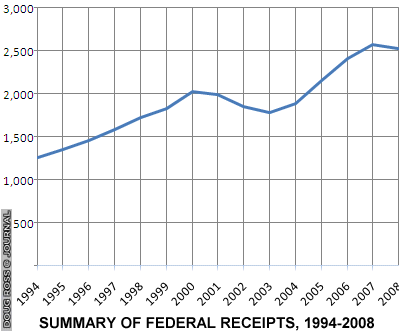
But the real jolt for tax-cutting opponents was that the 03 Bush tax cuts also generated a massive increase in federal tax receipts. From 2004 to 2007, federal tax revenues increased by $785 billion, the largest four-year increase in American history. According to the Treasury Department, individual and corporate income tax receipts were up 40 percent in the three years following the Bush tax cuts. And (bonus) the rich paid an even higher percentage of the total tax burden than they had at any time in at least the previous 40 years. This was news to theNew York Times, whose astonished editorial board could only describe the gains as a “surprise windfall.”

Unfortunately, Mr. Bush allowed Congress to spend away those additional tax revenues. The fact is that the increase in tax revenues that flowed from the ‘03 tax cuts could have paid for the wars in Afghanistan and Iraq and then some but for rampant discretionary domestic spending.

So, Bush passed his tax cuts in 2001 and 2003, but revenue went up:

Federal receipts after Bush tax cuts

And the deficits went down from 2004 to 2007:

Obama Budget Deficit 2011

Bush was on track to balance the budget, then Nancy Pelosi came along and added 5.34 trillion to the debt in her 4 years as Speaker.