
Tag Archives: Atheism

Canadian Liberal Party introduces bill to legalize euthanasia

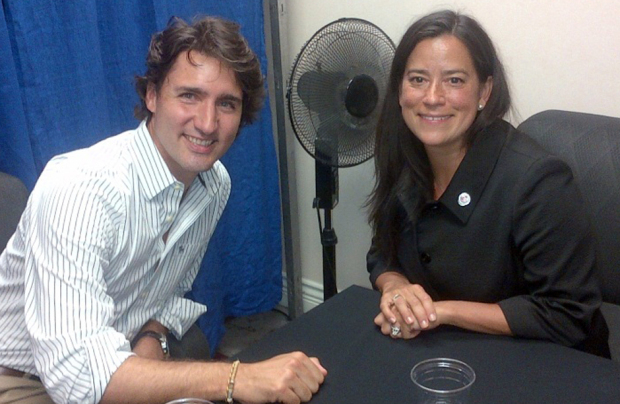
Jody Wilson-Raybould, Minister of Justice and Attorney General of Canada
Jody Wilson-Raybould, Minister of Justice and Attorney General of Canada (right)

Life Site News has a story about Canada’s new assisted suicide bill:

The Liberal government’s euthanasia bill introduced Thursday will not protect vulnerable Canadians or the conscience rights of physicians, say anti-euthanasia activists.

While Justice Minister Jody Wilson-Raybould’s Bill C-14 is more restrictive than the legislative framework the special joint parliamentary committee recommended in its February 2016 report, it essentially provides “a perfect cover for acts of murder, absolutely,” says Alex Schadenberg, executive director of the Euthanasia Prevention Coalition.

The draft legislation restricts eligibility for euthanasia and assisted suicide to competent patients 18 years of age and older who have “an incurable serious and incurable illness, disease or disability” which “causes them enduring physical or psychological suffering that is intolerable to them and that cannot be relieved under conditions,” who are in “an advanced state of decline in capability” and whose “natural death is reasonably foreseeable.”

The legislation mandates that a patient request assisted suicide or voluntary euthanasia in writing, and that this request be approved by two independent medical practitioners, or nurse practitioners.

It mandates a 15-day waiting period after the request is approved, but that period can be waived if the two medical practitioners deem the patient’s condition will deteriorate before that time is up.

[…]Schadenberg says the bill “does not provide effective oversight in the law,” because while it calls for two independent physicians or nurse practitioners to approve a request for euthanasia,  “this is the system where the doctor or nurse practitioner who does the act also does the reporting.”

The legislation also provides “legal immunity for anyone, anyone who does anything at a person’s request, under Sections 241.3, 241.5,” he said.

[…][W]hile the bill acknowledges conscience rights in its preamble, it “provides no protection for conscientious objectors,” according to Albertos Polizogopoulos, a constitutional lawyer for Canadian Physicians for Life.

Canadian doctors are already forced to perform abortions against their conscience, so this last point is no great surprise.

In a country that has single payer health care, all medical care is paid for by the federal government. You pay into the system your whole life (at an average of 42% of your income, in Canada) and then at the end, you get in line and hope that the government will treat you. It is extremely convenient for the government to kill off patients who are elderly. Elderly patients won’t be able to vote in many more elections, but they will want to draw away funds that could be used to buy the votes of young people who want “free” breast enlargements, plastic surgery, sex changes and IVF treatment. So the government has every incentive to cut loose the old people and then buy the votes of young people with the taxpayer money they save. Single payer health care is a scam to help politicians stay in power.

Similar laws in places like Belgium and Netherlands have been used to cut down on the medical bills that the government must pay.

A Parliamentary committee brief that I found on the Canadian government web site says this:

A study published in the NEJM entitled: Recent Trends in Euthanasia and Other End-of-Life Practices in Belgium (March 19, 2015) found that 4.6% of all deaths in the first six months of 2013, in the Flanders region of Belgium, were by assisted death and 1.7% of all deaths were assisted deaths without explicit request representing more than 1000 assisted deaths without explicit request in 2013.

The supplemental appendix in the study informs us how the researchers classified the data.

It states: “If in the latter case the drugs had been administered at the patient’s explicit request, the act was classified as euthanasia or assisted suicide depending on whether the patient self-administered the drugs. If drugs were used with the same explicit intention to hasten death but without the patient’s explicit request, the act was classified as hastening death without explicit patient request. This can include cases where a patient request was not judged as explicit by the physician, where the request came from the family or where the physician acted out of compassion.”

This research study confirms that many intentional hastened deaths are occurring without the explicit request of the patient which contravenes the Belgian assisted death law and medical ethics.

Previously, I blogged about how the UK government provides bonuses to hospitals who put elderly patients on an end-of-life pathway.

Ethicist Wesley J. Smith comments on the Canadian law in National Review.

Excerpt:

The Canadian government has tabled its new euthanasia bill–and as expected, it will be the most radical in the world.

Since the death doctor need not be present at the demise, the bill creates an unprecedented license for family members, friends–heck, a guy down the street–to make people dead.

[…]In short, this provision is the perfect defense for the murder of sick and disabled people who requested lethal drugs.

The George Delury case is an example of what I mean: Delury said he assisted wife, Myrna Lebov’s suicide out of “compassion” and at her request due to MS.

But his real hope was not only to be free from care giving, but become famous writing a book about her death. (He did, What If She Wants to Die?)

It almost worked. But because assisted suicide was a criminal offense, authorities conducted an investigation and discovered his diary.  It showed that contrary to the compassionate face Delury was conjuring, in reality, he emotionally pressured Myrna into wanting to commit suicide, telling her, for example, that she was a burden and ruining his life.

He also withheld full dosage of antidepressants so he could use those drugs to kill her. And, he but put a plastic bag over her head to make sure she died.

If euthanasia Canada’s bill had been the law of New York when Delury killed Myrnov, he might have been able to coerce her into asking for lethal drugs. At that point, he could have killed her any time he wanted and there wouldn’t have been a criminal investigation to find his diary.

Canada has just paved the way for a person, hungry for an inheritance or ideologically predisposed, to get away with the perfect murder.

In the last election, the Liberal Party promised the Canadian voters the moon, in terms of new spending. They said it would only add 10 billion to the deficit this year. But now (after the election) the number has exploded to 30 billion this year and over 100 billion over the next five years. Could this euthanasia plan be the first step in balancing the books, so they can win re-election?

Robin Collins explains two kinds of cosmic fine-tuning

Christianity and the progress of science

I was busy working my way through “Debating Christian Theism“, a book published by Oxford University Press in August 2013. It features about 20 different topics from science, to philosophy, to history. For each topic, there is an essay by a world-class scholar in favor, and one opposed. So you get both sides of many interesting issues, at a very advanced level. The section on cosmic fine-tuning features a chapter written by Dr. Robin Collins.

About Robin Collins:

Robin Collins (PhD, University of Notre Dame, 1993), is professor of philosophy at Messiah College, Grantham, PA specializing in the area of science and religion.  He has written over twenty-five articles and book chapters on a wide range of topics, such as the fine-tuning of the cosmos as evidence for the existence of God, evolution and original sin, the Doctrine of Atonement, Asian religions and Christianity, and Bohm’s theory of quantum mechanics.  Some of his most recent articles/book chapters are “Philosophy of Science and Religion” in The Oxford Handbook of Science and Religion, “Divine Action and Evolution” in The Oxford Handbook of Philosophical Theology (2009)  “The Multiverse Hypothesis: A Theistic Perspective,” in Universe or Multiverse? (Cambridge University Press), and “God and the Laws of Nature,” in Theism or Naturalism: New Philosophical Perspectives (Oxford University Press, forthcoming).  He recently received a grant from the John Templeton Foundation to finish a book that presents the case for design based on physics and cosmology,  tentatively entitled The Well-Tempered Universe: God, Cosmic Fine-tuning, and the Laws of Nature.

The fine-tuning argument

Here’s a short article where Collins gives TWO examples of the fine-tuning. He is very modest in his argument, merely asserting that the fine-tuning is more compatible with theism than it is with atheism.

Excerpt:

Science is commonly thought to have undercut belief in God. As Nobel Prize winning physicist Steven Weinberg famously remarked, “the more we find out about the universe, the more meaningless it all seems.” Yet, the discoveries of modern physics and cosmology in the last 50 years have shown that the structure of the universe is set in an extraordinarily precise way for the existence of life; if its structure were slightly different, even by an extraordinarily small degree, life would not be possible. In many people’s minds, the most straightforward explanation of this remarkable fine-tuning is some sort of divine purpose behind our universe.

This fine-tuning falls into three categories: the fine-tuning of the laws of nature, the fine-tuning of the constants of physics, and the fine-tuning of the initial conditions of the universe. “Fine-tuning of the laws of nature” refers to the fact that if the universe did not have precisely the right combination of laws, complex intelligent life would be impossible. If there were no universal attractive force (law of gravity), for example, matter would be dispersed throughout the universe and the energy sources (such as stars) needed for life would not exist. Without the strong nuclear force that binds protons and neutrons together in the nucleus, there would not be any atoms with an atomic number greater than hydrogen, and hence no complex molecules needed for life. And without the Pauli-exclusion principle, all electrons would fall to the lowest orbital of an atom, undercutting the kind of complex chemistry that life requires.

Some fundamental physical numbers governing the structure of the universe—called the constants of physics—also must fall into an exceedingly narrow range for life to exist. For example, many have estimated that the cosmological constant—a fundamental number that governs the expansion rate of empty space—must be precisely set to one part in 10120 in order for life to occur; if it were too large, the universe would have expanded too rapidly for galaxies and stars to form, and if it were too small, the universe would have collapsed back on itself. As Stephen Hawking wrote in his book A Brief History of Time, “The remarkable fact is that the values of these numbers [i.e. the constants of physics] seem to have been very finely adjusted to make possible the development of life.” Finally, the initial distribution of mass energy at the time of the big bang must have an enormously special configuration for life to occur, which Cambridge University mathematical physicist Roger Penrose has calculated to be on the order of one part in 1010123. This is an unimaginably small number.

I know what you’re thinking: How do we know that non-Christian scientists acknowledge the fine-tuning of gravity in the way that Collins describes?

Well, the New Scientist actually talks about the fine-tuning of the force of gravity. And they’re not Christians.

Excerpt:

The feebleness of gravity is something we should be grateful for. If it were a tiny bit stronger, none of us would be here to scoff at its puny nature.

The moment of the universe‘s birth created both matter and an expanding space-time in which this matter could exist. While gravity pulled the matter together, the expansion of space drew particles of matter apart – and the further apart they drifted, the weaker their mutual attraction became.

It turns out that the struggle between these two was balanced on a knife-edge. If the expansion of space had overwhelmed the pull of gravity in the newborn universe, stars, galaxies and humans would never have been able to form. If, on the other hand, gravity had been much stronger, stars and galaxies might have formed, but they would have quickly collapsed in on themselves and each other. What’s more, the gravitational distortion of space-time would have folded up the universe in a big crunch. Our cosmic history could have been over by now.

Only the middle ground, where the expansion and the gravitational strength balance to within 1 part in 1015 at 1 second after the big bang, allows life to form.

Here’s a very long paper by Collins on the fine-tuning argument, where he answers several objections to the argument, including the multiverse/many-universe hypothesis.

Ryan Bell’s year of atheism testimony shows need for apologetics

The Christian life requires a certain degree of mental toughness and non-conformity

Are you interested in knowing how to avoid losing your Christian faith? Well, an episode of the Unbelievable show featuring well-known apostate Ryan Bell will give you some clues.

But before we go to the podcast, I want to recap some reasons why people think that God exists.

In addition to these arguments for theism, Christians should be able to make a minimal facts case for the resurrection, one that leverages the early creed in 1 Corinthians 15:3-7. And some sort of case for the belief that Jesus was divine using only the earliest sources.

In addition to those positive evidences, there would be informed defenses to other questions like the problem of evilthe problem of sufferingreligious pluralismthe hiddenness of Godmaterialist conceptions of mindconsciousness and neurosciencethe justice of eternal damnation,sovereignty and free will, the doctrine of the Incarnation, the doctrine of the Trinity, and so on.

I listed these out so that you can see how many of these positive arguments and defenses that Ryan Bell wrestles with in his deconversion testimony.

The podcast

Details:

Ryan J Bell is a former pastor who has decided to try being an atheist for a year. He explains why and interacts with New Zealand apologist Matt Flannagan.

The MP3 file is here. (We only care about the first 45 minutes)

Matt Flanagan and Justin Brierley do a great job in this debate getting the real issues on the table, although you have to wait until about 20 minutes in. Quick note about Bell. He has a BA in Pastoral Ministry, an MDiv, and a doctorate in Missional Organization. Now I have a suspicion of people with a background like that – my view is that they are more likely to be impractical and/or insulated from real life.

I also noticed that his politics are liberal, and that he is featured on the web site of GLAAD, a gay rights organization, for supporting gay marriage. Why do people support same-sex marriage? I think the most common reason is because they care more about the needs of adults than they care about the needs of children for a mother and a father. That’s where this guy is coming from – he is a people-pleaser, not someone who promotes the needs of children over the needs of adults.

Summary:

At the start of the podcast, we learn that Bell was in the Seventh Day Adventist church, which is strongly invested in young-Earth creationism. Depending on how strict his young Earth view was, this closes off many of the best arguments for theism from science, such as the cosmological argument, the cosmic fine-tuning argument, the stellar habitability argument, the galactic habitability argument, the Cambrian explosion argument, and even the origin of life argument (to a degree). These are the arguments that make theism non-negotiable.

When he started his journey to atheism, he says that he was reading a book called “Religion Without God” by Ronald Dworkin.I was curious to see what view of faith was embraced by this book. Would it be the Biblical view of faith, trust based on evidence? Or the atheist view of faith, belief without evidence? I found an excerpt from the book in the New York Times, which said this:

In the special case of value, however, faith means something more, because our convictions about value are emotional commitments as well and, whatever tests of coherence and internal support they survive, they must feel right in an emotional way as well. They must have a grip on one’s whole personality. Theologians often say that religious faith is a sui generis experience of conviction. Rudolf Otto, in his markedly influential book, The Idea of the Holy, called the experience “numinous” and said it was a kind of “faith-knowledge.” I mean to suggest that convictions of value are also complex, sui generis, emotional experiences. As we will see… when scientists confront the unimaginable vastness of space and the astounding complexity of atomic particles they have an emotional reaction that matches Otto’s description surprisingly well. Indeed many of them use the very term “numinous” to describe what they feel. They find the universe awe-inspiring and deserving of a kind of emotional response that at least borders on trembling.

The excerpt quotes William James, who reduces religion to non-rational emotional experiences. I don’t know about you, but I don’t think that view of faith is Biblical at all. Biblical faith is rooted in evidence. So clearly, what is important to this Dworkin is not objective evidence, it’s feelings. And this is what Bell was reading. He was not reading academic books like “Debating Christian Theism” to get the best arguments pro-and-con. He was looking for something that “resonated” with his feelings.

His journey was prompted by a female Episcopal priest friend who was asked by an atheist “what difference does religion make in my life?”. So, the framework of his investigation is set by a question that is not focused on truth, but is instead focused on emotions and life enhancement. Now Christianity might be a real stinker of a worldview for life enhancement, and the Bible warns us not to expect a bed of roses in this life. Christianity is not engineered to make you feel good or to make people like you, especially people like female Episcopal priests and GLAAD.

When talking about atheism, he is not concerned with whether atheism is logically consistent or consistent with objective evidence. He is concerned by whether atheists can have the experience of being moral without God. He sees an atheist who has moral preferences and seems like a good person by our arbitrary social standards, and he finds that as “valid” as religion. He is judging worldviews by whether people have their needs met, not by truth.

He says that as a pastor, his method of evangelizing atheists was to encourage them to “try on faith” “go through the motions” “participate in social justice outreach events”, etc. His goal was that they would “step into the stream of the Christian narrative and discover that it held value and meaning to them, and find that they actually believed it”. So his method of recommending Christianity to others has nothing to do with logic, evidence or truth. He is offering Christianity as life enhancement – not knowledge but a “narrative” – a story. If it makes you feel good, and it makes people like you, then you can “believe” it. He says that he was “a Christian by practice, a Christian by tradition”. Not a Christian by truth. Not a Christian by knowledge. He just picked a flavor of ice cream that tasted right to him, one that pleased his parents, friends and community. And now he has new friends and a new community, and he wants to please them and feel good about himself in this new situation.

He says that the Christian worldview is “a way of approaching reality” and “creating meaning” and “identifying meaning in the experiences we have”. And he says that there are “other ways of experiencing meaning”. He talks a lot about his correspondence with people and reading atheists, but nothing about reading Christian scholars who deal with evidence, like William Lane Craig, Stephen C. Meyer or Mike Licona.

Literal, literal quote: (23:35) “Well I think the only access we have to  the question of God’s existence or not is how we feel. I mean there’s no falsifiable data that says God either exists or doesn’t exist. It’s all within the realm of our personal experience”. “If living as though God exists makes you happy and comforts you, then by all means, go for it”. This attitude is so popular in our churches today, and where does it end? In atheism. I had a fundamentalist woman telling me just last night how this feelings mysticism approach was the right approach to faith, and that the head knowledge approach was bad and offensive.

I’m going to cut off my summary there, but the podcast goes on for 45 minutes. Matt Flannagan is brilliant, and went far beyond what I wanted to say to this guy, but in such a winsome way. I recommend listening to the whole thing, and be clear where this fideistic nonsense ends – in atheism.

My thoughts

This podcast is a great warning against two views: 1) faith is belief without evidence and 2) religion not about truth, but about life enhancement. Three other related stories might also help: the story of Dan Barker, the story of Nathan Pratt and the story of Katy Perry. I think the Christian life requires a commitment to truth above all. If you think that you can get by as a Christian relying on hymn singing, church attending, mysticism and emotional experiences, you have another thing coming. This is a different time and a different place than 50 years ago, when that sort of naivete and emotionalism might have been safe. Now we have many challenges – some intellectual and some not. To stand in this environment, it’s going to take a little more than piety and emotions. 

People today are very much looking for religion to meet their needs. And this is not just in terms of internal feelings, but also peer approval and mystical coincidences. They expect God to give them happy feelings. They expect God to give them peer approval. They expect God to make every crazy unBiblical, unwise selfish plan they invent “work out” by miracle. They feel very constrained by planning and moral boundaries, believing in a “God of love” who is primarily concerned with their desires and feelings, not with rules and duties. Nothing in the Bible supports the idea that a relationship with God is for the purpose of making us feel happy and comfortable. When people realize that they will be happier in this life without having to care what God thinks, they will drop their faith, and there are plenty of non-Christians to cheer them on when they do it.

I would say to all of you reading that if the opinions of others causes you to stumble then meditate on the following passage: 1 Cor 4:1-4 too. There is only one person’s opinion that matters, ultimately.