
Tag Archives: Arthur Brooks

Arthur Brooks and the value of earned successs

In the Wall Street Journal.

Excerpt:

Earned success means defining your future as you see fit and achieving that success on the basis of merit and hard work. It allows you to measure your life’s “profit” however you want, be it in money, making beautiful music, or helping people learn English. Earned success is at the root of American exceptionalism.

The link between earned success and life satisfaction is well established by researchers. The University of Chicago’s General Social Survey, for example, reveals that people who say they feel “very successful” or “completely successful” in their work lives are twice as likely to say they are very happy than people who feel “somewhat successful.” It doesn’t matter if they earn more or less income; the differences persist.

The opposite of earned success is “learned helplessness,” a term coined by Martin Seligman, the eminent psychologist at the University of Pennsylvania. It refers to what happens if rewards and punishments are not tied to merit: People simply give up and stop trying to succeed.

During experiments, Mr. Seligman observed that when people realized they were powerless to influence their circumstances, they would become depressed and had difficulty performing even ordinary tasks. In an interview in the New York Times, Mr. Seligman said: “We found that even when good things occurred that weren’t earned, like nickels coming out of slot machines, it did not increase people’s well-being. It produced helplessness. People gave up and became passive.”

Learned helplessness was what my wife and I observed then, and still do today, in social-democratic Spain. The recession, rigid labor markets, and excessive welfare spending have pushed unemployment to 24.4%, with youth joblessness over 50%. Nearly half of adults under 35 live with their parents. Unable to earn their success, Spaniards fight to keep unearned government benefits.

Meanwhile, their collective happiness—already relatively low—has withered. According to the nonprofit World Values Survey, 20% of Spaniards said they were “very happy” about their lives in 1981. This fell to 14% by 2007, even before the economic downturn.

That trajectory should be a cautionary tale to Americans who are watching the U.S. government careen toward a system that is every bit as socially democratic as Spain’s.

Government spending as a percentage of GDP in America is about 36%—roughly the same as in Spain. The Congressional Budget Office tells us it will reach 50% by 2038. The Tax Foundation reports that almost 70% of Americans take more out of the tax system than they pay into it. Meanwhile, politicians foment social division on the basis of income inequality, instead of attempting to improve mobility and opportunity through education reform, pro-growth policies, and an entrepreneur-friendly economy.

These trends do not mean we are doomed to repeat Spain’s unhappy fate. But our system of earned success will not defend itself.

What I find most interesting is that the people who vote for Obama don’t even realize how they are making themselves more and more unhappy by being more and more dependent on government. It’s the bluest states that have seen the lowest income growth, the lowest job growth, lower home prices, and the highest unemployment. All of this talk about taxing the rich and spreading the wealth around through bigger and more intrusive government hasn’t worked. More government means less prosperity, and less prosperity means fewer jobs, and fewer jobs means less happiness. Punishing your successful neighbor and borrowing huge amounts of money from the next generation does not create jobs. And without a job, you’re not going to be happy. Even liberal CNN recognizes that more government intervention during Obama’s first term has caused huge numbers of people to become unemployed.

We need to have a public policy that recognizes that human beings are spiritual creatures, and we aren’t happy unless we chart our own course.
Should government do more to help people achieve prosperity?

From Arthur Brooks at the American Enterprise Institute. (H/T Mary)

Excerpt:

In January, the right-leaning organization Resurgent Republic asked Americans which of the following statements comes closer to their view: (a) “Government should do more to solve problems and help meet the needs of people”; or (b) “Government is trying to do more things than it can do well, things that should be left to the private sector and individuals.” Forty-nine percent of respondents chose (a); 46% chose (b). (The other 5% said they didn’t know.)

[…]The “doing good” philosophy cannot accommodate difficult but necessary budget decisions. It will always devolve into a drunken spending binge largely directed toward rewarding political friends like public-sector unions (witness the current mayhem in Wisconsin), engaging in social engineering (see the new health-care mandates), socializing losses (emergency loans and grants to failing businesses), and doling out pork (look almost anywhere in the stimulus).

[…]So citizens say they want government to help them, politicians oblige, but citizens loathe the result. How do we cut this Gordian Knot? The solution is a real philosophy that outlines what the government should do–and, just as importantly, not do. Our elected officials must then show courage and leadership by governing according to this philosophy.

What is that governing philosophy? Here is an answer from the great economist and Nobel laureate Friedrich Hayek: As regards the economy, the government should provide a minimum basic standard of living for citizens, and address market failures in cases where government action can do so cost effectively. That’s all.

We should acknowledge that markets are not perfect. Market failures can occur when we have monopolies (which eliminate competition), externalities (like pollution), public goods (the military, for example), and information problems (such as when people cheat others in the marketplace). Nearly all economists agree these kinds of failures can justify some degree of state intervention.

Obviously, there is plenty of room for debate in this philosophy. What is a minimum basic standard of living? And are certain services–for example, the Smithsonian Institution–public goods? How much waste can we find in the defense budget? These are the arguments we should be having.

But there are many others we shouldn’t be having, because the answers are clear. Should we bail out car companies? (No: GM would fail precisely because markets are working, not because they are failing.) Should we leave the retirement age at 65 even though people are living much longer than ever before and taking more than they ever paid into the Social Security system? (No: This is middle-class welfare, not a minimum basic standard of living.) Should we continue to prohibit people from buying health insurance from companies across state lines? (No: This induces market failure.) Do we need high-speed trains to take us to St. Louis? (No: This is not a public good.) And so on.

It’s not the government’s job to equalize life outcomes regardless of our own choices. Their job is to referee the game, not to pick winners and losers.

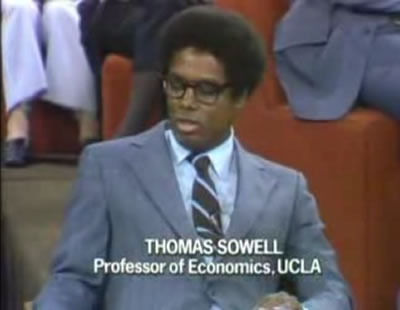
Thomas Sowell explains the concept of “moral hazard”

Young Thomas Sowell

From Real Clear Politics. (H/T Jojo)

Excerpt:

One of the things that makes it tough to figure out how much has to be charged for insurance is that people behave differently when they are insured from the way they behave when they are not insured.

In other words, if one person out of 10,000 has his car set on fire, and it costs an average of $10,000 to restore the car to its previous condition, then it might seem as if charging one dollar to all 10,000 people would be enough to cover the cost of paying $10,000 to the one person whose car that will need to be repaired. But the joker in this deal is that people whose cars are insured may not be as cautious as other people are about what kinds of neighborhoods they park their car in.

[…]Although “moral hazard” is an insurance term, it applies to other government policies besides insurance. International studies show that people in countries with more generous and long-lasting unemployment compensation spend less time looking for jobs. In the United States, where unemployment compensation is less generous than in Western Europe, unemployed Americans spend more hours looking for work than do unemployed Europeans in countries with more generous unemployment compensation.

People change their behavior in other ways when the government pays with the taxpayers’ money. After welfare became more readily available in the 1960s, unwed motherhood skyrocketed. The country is still paying the price for that– of which the money is the least of it. Children raised by single mothers on welfare have far higher rates of crime, welfare and other social pathology.

San Francisco has been one of the most generous cities in the country when it comes to subsidizing the homeless. Should we be surprised that homelessness is a big problem in San Francisco?

[…]We also hear a lot of talk about “the uninsured,” for whose benefit we are to drastically change the whole medical-care system. But income data show that many of those uninsured people have incomes from which they could easily afford insurance. But they can live it up instead, because the government has mandated that hospital emergency rooms treat everyone.

And here’s another Tom Sowell column making a related point.

Excerpt:

Much has been made of the fact that families making less than $250,000 a year will not see their taxes raised. Of course they won’t see it, because what they see could affect how they vote.

But when huge tax increases are put on electric utility companies, the public will see their electricity bills go up. When huge taxes are put on other businesses as well, they will see the prices of the things those businesses sell go up.

If you are not in that “rich” category, you will not see your own taxes go up. But you will be paying someone else’s higher taxes, unless of course you can do without electricity and other products of heavily taxed businesses. If you don’t see this, so much the better for the Obama administration politically.

This country has been changed in a more profound way by corrupting its fundamental values. The Obama administration has begun bribing people with the promise of getting their medical care and other benefits paid for by other people, so long as those other people can be called “the rich.” Incidentally, most of those who are called “the rich” are nowhere close to being rich.

[…]There was a time when most Americans would have resented the suggestion that they wanted someone else to pay their bills. But now, envy and resentment have been cultivated to the point where even people who contribute nothing to society feel that they have a right to a “fair share” of what others have produced.

The most dangerous corruption is a corruption of a nation’s soul. That is what this administration is doing.

Republicans prefer private voluntary charity as the best way to provide a safety net. Just because people on the left give less to charity than people on the right, it doesn’t mean that no one one gives to charity. Europe has the highest taxes, and they give the least in charity. Why not LOWER taxes for people who want to give MORE in charity? When government hands out money, it encourages people to be more dependent. But when a person in trouble has to go to a neighbor or a charity in their own community, it sends the right message – “this should be temporary – don’t let this become a habit”. It’s not GOOD for someone to depend on the government. People need to work in order to be happy.

Having the government take over the role of provider in the home is an insult to men. It’s not government’s job to replace men. They ought to stay right out of it. Leave money in the pockets of the working man so he can save for a rainy day himself. If you subsidize a behavior, you get more of it. If you tax a behavior, you get less of it. It makes no sense to subsidize irresponsible lifestyle choices and tax productive and moral lifestyle choices. You don’t want to make the rescue from bad decisions an anonymous and automatic affair. You want people to worry, so that they won’t want to make risky and irresponsible choices. Everybody goes through though times, but we shouldn’t make it normal. People ought to know that it’s not normal.

You may want to read about how government dependence makes people less happy than having a job. Don’t make people depend on government by taxing businesses and investment. We need more companies hiring – not less. And that means letting the profit motive provide an incentive for entrepreneurs to engage in more risk-taking and enterprise.