Tag Archives: Apologetics

Bible study: the importance of truth in religion

Bible study that hits the spot

Here’s an interesting passage of the Bible. What do you all think the practical value of this passage is?

1 In the second year of his reign, Nebuchadnezzar had dreams; his mind was troubled and he could not sleep.

2 So the king summoned the magicians, enchanters, sorcerers and astrologers to tell him what he had dreamed. When they came in and stood before the king,

3 he said to them, “I have had a dream that troubles me and I want to know what it means.”

4 Then the astrologers answered the king, “May the king live forever! Tell your servants the dream, and we will interpret it.”

5 The king replied to the astrologers, “This is what I have firmly decided: If you do not tell me what my dream was and interpret it, I will have you cut into pieces and your houses turned into piles of rubble.

6 But if you tell me the dream and explain it, you will receive from me gifts and rewards and great honor. So tell me the dream and interpret it for me.”

7 Once more they replied, “Let the king tell his servants the dream, and we will interpret it.”

8 Then the king answered, “I am certain that you are trying to gain time, because you realize that this is what I have firmly decided:

9 If you do not tell me the dream, there is only one penalty for you. You have conspired to tell me misleading and wicked things, hoping the situation will change. So then, tell me the dream, and I will know that you can interpret it for me.”

10 The astrologers answered the king, “There is no one on earth who can do what the king asks! No king, however great and mighty, has ever asked such a thing of any magician or enchanter or astrologer.

11 What the king asks is too difficult. No one can reveal it to the king except the gods, and they do not live among humans.”

12 This made the king so angry and furious that he ordered the execution of all the wise men of Babylon.

13 So the decree was issued to put the wise men to death, and men were sent to look for Daniel and his friends to put them to death.

14 When Arioch, the commander of the king’s guard, had gone out to put to death the wise men of Babylon, Daniel spoke to him with wisdom and tact.

15 He asked the king’s officer, “Why did the king issue such a harsh decree?” Arioch then explained the matter to Daniel.

16 At this, Daniel went in to the king and asked for time, so that he might interpret the dream for him.

17 Then Daniel returned to his house and explained the matter to his friends Hananiah, Mishael and Azariah.

18 He urged them to plead for mercy from the God of heaven concerning this mystery, so that he and his friends might not be executed with the rest of the wise men of Babylon.

19 During the night the mystery was revealed to Daniel in a vision. Then Daniel praised the God of heaven

20 and said:

“Praise be to the name of God for ever and ever;
wisdom and power are his.

21 He changes times and seasons;
he deposes kings and raises up others.
He gives wisdom to the wise
and knowledge to the discerning.

22 He reveals deep and hidden things;
he knows what lies in darkness,
and light dwells with him.

23 I thank and praise you, God of my ancestors:
You have given me wisdom and power,
you have made known to me what we asked of you,
you have made known to us the dream of the king.”

24Then Daniel went to Arioch, whom the king had appointed to execute the wise men of Babylon, and said to him, “Do not execute the wise men of Babylon. Take me to the king, and I will interpret his dream for him.”

25 Arioch took Daniel to the king at once and said, “I have found a man among the exiles from Judah who can tell the king what his dream means.”

26 The king asked Daniel (also called Belteshazzar), “Are you able to tell me what I saw in my dream and interpret it?”

27 Daniel replied, “No wise man, enchanter, magician or diviner can explain to the king the mystery he has asked about,

28 but there is a God in heaven who reveals mysteries. He has shown King Nebuchadnezzar what will happen in days to come. Your dream and the visions that passed through your mind as you were lying in bed are these:

29 “As Your Majesty was lying there, your mind turned to things to come, and the revealer of mysteries showed you what is going to happen.

30 As for me, this mystery has been revealed to me, not because I have greater wisdom than anyone else alive, but so that Your Majesty may know the interpretation and that you may understand what went through your mind.

This passage is interesting to me because it shows the kind of attitude that God answers. The King in this passage was tired of hearing man-made stories from his servants – stories that were undoubtedly influenced by the servants desire to survive the King’s wrath. The servants would only have told the King things that were vague and happy, so that they could never be proved wrong or found to be judgmental or offensive. But the King was tired of that. He wanted someone with authority to tell him the truth about the way the world was.

In the rest of the chapter, Daniel interprets the dream, and concludes by saying this: “The great God has shown the king what will take place in the future. The dream is true and its interpretation is trustworthy.”. The King replies: “Surely your God is the God of gods and the Lord of kings and a revealer of mysteries, for you were able to reveal this mystery.”

I think it is is going to be difficult for Christians living today to be able to tell people their dreams like that. But what we can do is talk about God’s miracles as revealed by science and history. We can study astrophysics, biochemistry and history and we can explain what God did in creating and fine-tuning the universe for life, in sequencing amino acids into functioning proteins, in creating brand new body plans in the Cambrian explosion, in raising Jesus from the dead as a matter of historical record, and so on. We have to show how great God is to people who do not even think he exists, and without assuming that they believe in the Bible.

There are still people out there like the King who are looking for someone who can speak to them with authority. All it takes from us is a little studying, and we can be like Daniel, too. But we have to know what God has done from science and history, and speak with authority about how we can know that God has acted supernaturally. Authority to speak comes from having knowledge about what we are talking about, and knowledge comes from studying and debating with people we disagree with. Nebuchadnezzar  was not a believer in the God of Israel, but he was still interested in truth. That won’t always be the case, but it is the case for some people.

Does archaeological evidence confirm names, dates and places in the Bible?

Sherlock Holmes and John Watson: let's take a look at the facts
Sherlock Holmes and John Watson: let’s take a look at the facts

I spotted this post on Be Thinking by UK apologist Peter S. Williams. (H/T Eric Chabot at Think Apologetics)

So let me pick the ones I liked most for this post.

Here’s a good one:

Jerusalem and The Pool of Bethesda

John 5:1-15 describes a pool in Jerusalem, near the Sheep Gate, called Bethesda, surrounded by five covered colonnades. Until the 19th century, there was no evidence outside of John for the existence of this pool and John’s unusual description “caused bible scholars to doubt the reliability of John’s account, but the pool was duly uncovered in the 1930s – with four colonnades around its edges and one across its middle.”[38] Ian Wilson reports: “Exhaustive excavations by Israeli archaeologist Professor Joachim Jeremias have brought to light precisely such a building, still including two huge, deep-cut cisterns, in the environs of Jerusalem’s Crusader Church of St Anne.”[39]

And this one:

Jerusalem and The Pool of Siloam

In the 400s AD, a church was built above a pool attached to Hezekiah’s water tunnel to commemorate the healing of a blind man reported in John 9:1-7. Until recently, this was considered to be the Pool of Siloam from the time of Christ. However, during sewerage works in June 2004 engineers stumbled upon a 1stcentury ritual pool when they uncovered some ancient steps during pipe maintenance near the mouth of Hezekiah’s tunnel. By the summer of 2005, archaeologists had revealed what was “without doubt the missing pool of Siloam.”[40] Mark D. Roberts reports that: “In the plaster of this pool were found coins that establish the date of the pool to the years before and after Jesus. There is little question that this is in fact the pool of Siloam, to which Jesus sent the blind man in John 9.”[41]

I just read this one because I am working my way through John. In case you haven’t read John, you really should it’s my favorite gospel.

Here’s another one:

Herod the Great

We have a bronze coin minted by Herod the Great. On the obverse side (i.e. the bottom) is a tripod and ceremonial bowl with the inscription ‘Herod king’ and the year the coin was struck, ‘year 3’ (of Herod’s reign), or 37 BC.

In 1996 Israeli Professor of Archaeology Ehud Netzer discovered in Masada a piece of broken pottery with an inscription, called an ostracon. This piece had Herod’s name on it and was part of an amphora used for transportation (probably wine), dated to c. 19 BC. The inscription is in Latin and reads, “Herod the Great King of the Jews (or Judea)”, the first such that mentions the full title of King Herod.

Herodium is a man-made mountain in the Judean wilderness rising over 2,475 feet above sea level. In 23 BC Herod the Great built a palace fortress here on top of a natural hill. Seven stories of living rooms, storage areas, cisterns, a bathhouse, and a courtyard filled with bushes and flowering plants were constructed. The whole complex was surrounded and partly buried by a sloping fill of earth and gravel. Herod’s tomb and sarcophagus were discovered at the base of Herodium by archaeologist Ehud Netzer in 2007.

And one more:

The ‘James, son of Joseph, brother of Jesus’ Ossuary

James, the brother of Jesus, was martyred in AD 62. A mid-1st century AD chalk ossuary discovered in 2002 bears the inscription “James, son of Joseph, brother of Jesus” ( ‘Ya’akov bar Yosef akhui di Yeshua’). Historian Paul L. Maier states thatthere is strong (though not absolutely conclusive) evidence that, yes, the ossuary and its inscription are not only authentic, but that the inscribed names are the New Testament personalities.[68] New Testament scholar Ben Witherington states that:“If, as seems probable, the ossuary found in the vicinity of Jerusalem and dated to about AD 63 is indeed the burial box of James, the brother of Jesus, this inscription is the most important extra-biblical evidence of its kind.”[69] According to Hershel Shanks, editor in chief of the Biblical Archaeological Review: “this box is [more] likely the ossuary of James, the brother of Jesus of Nazareth, than not. In my opinion … it is likely that this inscription does mention the James and Joseph and Jesus of the New Testament.”

And finally one short one:

Tiberius Caesar

The Denarius coin, 14-37 AD, is commonly referred to as the ‘Tribute Penny’ from the Bible. The coin shows a portrait of Tiberius Caesar. Craig L. Blomberg comments: “Jesus’ famous saying about giving to Caesar what was his and to God what his (Mark 12:17 and parallels) makes even more sense when one discovers that most of the Roman coins in use at the time had images of Caesar on them.”[48]

This is a good article to bookmark in case you are ever looking for a quick, searchable reference on archaeology and the Bible. There are many more examples in that post.

Now some people might be wondering why archaeology doesn’t confirm every detail in the New Testament. And here’s what J. Warner Wallace has to say about that:

But what are we to say to those who argue the Biblical archeological record is incomplete? The answer is best delivered by another expert witness in the field, Dr. Edwin Yamauchi, historian and Professor Emeritus at Miami University. Yamauchi wrote a book entitled, The Stones and the Scripture, where he rightly noted that archaeological evidence is a matter of “fractions”:

Only a fraction of the world’s archaeological evidence still survives in the ground.

Only a fraction of the possible archaeological sites have been discovered.

Only a fraction have been excavated, and those only partially.

Only a fraction of those partial excavations have been thoroughly examined and published.

Only a fraction of what has been examined and published has anything to do with the claims of the Bible!

See the problem? In spite of these limits, we still have a robust collection of archaeological evidences confirming the narratives of the New Testament (both in the gospel accounts and in the Book of Acts). We shouldn’t hesitate to use what we do know archaeologically in combination with other lines of evidence. Archaeology may not be able to tell us everything, but it can help us fill in the circumstantial case as we corroborate the gospel record.

I think you can form an opinion about the whole New Testament based on the record of confirmations. The verdict is in: the New Testament should be presumed trustworthy.

Four ways the Earth is fine-tuned for life, and one more

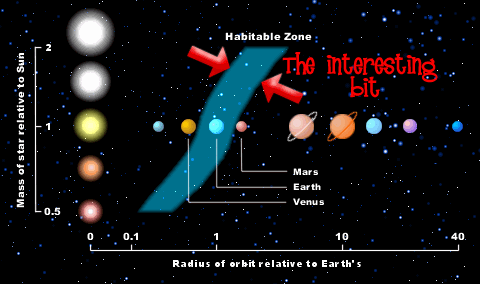
Circumstellar Habitable Zone

This is a post from J. Warner Wallace, over at Cold Case Christianity.

Let’s see his four ways first, then I’ll add one that I know.

He writes:

  1. The Earth’s Relationship to the Sun Is Favorable to Life
  2. The Earth’s Atmospheric Conditions Are Favorable to Life
  3. The Earth’s Terrestrial Nature Is Favorable to Life
  4. The Earth’s Relationship to the Moon Is Favorable to Life

I’ve blogged about the moon and plate tectonics before, so we won’t pick #3 and #4 to look at. And I blogged about the stellar habitable zone before, so we won’t pick #1, either.

Let’s look at #2:

The Earth’s Atmospheric Conditions Are Favorable to Life:
The surface gravity of Earth is critical to its ability to retain an atmosphere friendly to life. If Earth’s gravity were stronger, our atmosphere would contain too much methane and ammonia. If our planet’s gravity were weaker, Earth wouldn’t be able to retain enough water. As it is, Earth’s atmosphere has a finely calibrated ratio of oxygen to nitrogen—just enough carbon dioxide and adequate water vapor levels to promote advanced life, allow photosynthesis (without an excessive greenhouse effect), and to allow for sufficient rainfall.

Ok, that’s very good.

Now here is one from me… well, it’s from Science Daily, but I found it. Actually, ECM found it. But he told me.

Excerpt:

They suggest that the size and location of an asteroid belt, shaped by the evolution of the Sun’s protoplanetary disk and by the gravitational influence of a nearby giant Jupiter-like planet, may determine whether complex life will evolve on an Earth-like planet.

This might sound surprising because asteroids are considered a nuisance due to their potential to impact Earth and trigger mass extinctions. But an emerging view proposes that asteroid collisions with planets may provide a boost to the birth and evolution of complex life.

Asteroids may have delivered water and organic compounds to the early Earth. According to the theory of punctuated equilibrium, occasional asteroid impacts might accelerate the rate of biological evolution by disrupting a planet’s environment to the point where species must try new adaptation strategies.

The astronomers based their conclusion on an analysis of theoretical models and archival observations of extrasolar Jupiter-sized planets and debris disks around young stars. “Our study shows that only a tiny fraction of planetary systems observed to date seem to have giant planets in the right location to produce an asteroid belt of the appropriate size, offering the potential for life on a nearby rocky planet,” said Martin, the study’s lead author. “Our study suggests that our solar system may be rather special.”

So, that’s 5 ways that the Earth and our solar system are fine-tuned to be habitable for complex, embodied minds. Somebody is looking out for you, so be thankful and recognize.