
Tag Archives: Alvin Plantinga

Why does God let people suffer? Why is there so much evil in the world?

I just wanted to draw your attention to this 4 page essay by Joe Manzari, which is the best darn summary of the state of the art on the problems of evil and suffering I have seen. The problem of evil is an objection to the existence of God based on the presence of evil or suffering in the world. The arguments basically infer that if God is all-good and all-powerful, then there should not be any evil or suffering.

There are two kinds of problem of evil.

The Logical/Deductive Problem of Evil:

The first kind is called “the deductive problem of evil” or “the logical problem of evil”. An exampel of evil would be Saddam Hussein murdering some journalist who told the truth about him. This version of the problem of evil tries to introduce a logical contradiction between the attributes of God and the presence of evil, like this:

(1) God exists.
(2) God is omnipotent.
(3) God is omniscient.
(4) God is omni-benevolent.
(5) Evil exists.
(6) A good being always eliminates evil as far as it can.
(7) There are no limits to what an omnipotent being can do.

In order to avoid a contradiction, we need to explain how there could still be evil, since the conclusion of this argument is that there should not be any evil!So how are we going to get out of this mess? The solution is to attack premises 6 and 7.

Premise 6 is false because in order to eliminate human evil, you would have to eliminate free will. But eliminating free will is worse than allowing it, because good things like love are impossible without free will.

It is in response to this proposition that the Free Will Theodicy of G. W. Leibniz applies. God, valuing man’s freedom, decided to provide him with a will that was free to choose good over evil, rather than constraining his will, allowing him to choose only good.

Premise 7 is false because there are limits on what an omnipotent being can do. God cannot perform contradictory things, because contradictory things are impossible. God cannot make a married bachelor. Similarly, God cannot force free creatures to do his will.

In the same manner that God cannot create a square circle, he cannot make someone freely choose to do something. Thus, if God grants people genuine freedom, then it is impossible for him to determine what they will do. All that God can do is create the circumstances in which a person can make free choices and then stand back and let them make the choices.

One last point. In order to solve the problem of natural evil for this argument, you can point out that free will requires predictable and regular natural laws in order to make free will meaningful. Natural laws mean that individuals can predict what will happen when they act, allowing for moral responsibility. More on that next time.

Inductive/Probabilistic Problem of Evil

There is a second version of the problem of evil, though, which is more dangerous than the first. This is the one you see being argued in debates, whereas the first version is not used because it has been defused as seen above. Here is the second one:

(1) If God exists, gratuitous evil does not exist.
(2) Gratuitous evil exists.
(3) Therefore, God does not exist.

This argument tries to argue that while God may have some reason for allowing free will, there are other evils in the world that are not the result of human action that God has no reason for permitting. Theists usually like to argue that God has morally-sufficient reasons for allowing some evil in the world, in order for the character of humans to develop through suffering and endurance. But what about gratuitous evil, which doesn’t have any point?

Consider the case of a fawn running in the forest, who falls and breaks his leg. Ouch! Then a forest fire starts and the poor fawn suffocates to death in the smoke. Why would God allow this poor small animal suffer like that? And notice that there is no morally sufficient reason for allowing it, because no human knows about this and so no human’s character or relationship with God is impacted by it.

The solution to this problem is to deny premise 2. (You can also deny 1 if you want). The problem with premise 2 is that the atheist is claiming to know that some instance of evil really is gratuitous. But since they are making the claim to know, they have to be able to show that God’s permission of that evil achieves nothing. But how do they know 2 is true?

The problem with 2 is that the atheist is not in a position to know that the permission of some evil X really doesn’t achieve anything. This is because the atheist cannot look forward into the future, or see into other places, in order to know for certain that there is no morally sufficient reason for allowing God’s allowing evil X to occur. But since the atheist argues based on premise 2, he must be able to show that premise 2 is more probable than not.

Manzari’s article also argues why apparently gratuitous evil is less problematic for Christians in particular, because of certain Christian doctrines. He lists four doctrines that make the apparently gratuitous evil that we observe more compatible with an all-good, all-powerful God.

  1. The chief purpose of life is not happiness, but the knowledge of God.
    Some of the things that we experience may wreck our feelings of contentment, but we need to remember that God may be permitting those troubles in order to remind us not to get too comfortable with life on earth, and to think ahead to the after-life. And remember, even Jesus learned endurance through suffering. His suffering was not pointless and neither is ours.
  2. Mankind is in a state of rebellion against God and God’s purposes.
    We humans seem to be on a dead run away from God, trying to keep our autonomy by knowing as little about him as possible. Part of knowing God is knowing what he designed us to do – to love him and to love others. And so, the less we know about God, the more we stray from his design for our lives.
  3. God’s purpose is not restricted to this life but spills over beyond the grave into eternity.
    Sometimes it seems as if our sufferings really are catastrophic, but when you realize that you are offered eternal life without any suffering after you die, the sufferings of this life are a lot less upsetting than they would be if this life was all we had.
  4. The knowledge of God is an incommensurable good.
    This one is the biggest for me. Knowing God and knowing his actual character by studying the historical Jesus is a wonderful counterbalance for all the problems and sufferings of this life. A little bit of historical study reveals that Jesus was not spared the worst kind of suffering in his life, making it is a lot easier for us to bear with whatever God allows us to face.

In section 3, Manzari shows how you can also argue against this version of the problem by supplying evidence for God, such as from the big bang, the fine-tuning, the origin of life, the origin of free will, the origin of the first living organism, the origin of the mind, the sudden emergence of phyla in the fossil record, molecular machines, irreducible complexity, the resurrection miracle, and the objective morality argument.

The argument goes like this:

(1) If God exists, gratuitous evil does not exist.
(2) God exists.
(3) Therefore, gratuitous evil does not exist.

Just support 2 with some evidence, and you win, especially when they can’t support their claim to know that gratuitous evil exists.

The Argument for God from Evil

In the paper, Manzari actually makes an argument for God from evil. That’s right. Far from disproving God, the presence of evil (a departure from the way things out to be), actually affirms God’s existence. How?

(1) If God does not exist, then objective moral values do not exist.
(2) Evil exists.
(3) Therefore, objective moral values do exist.
(4) Therefore, God exists.

That’s right. If evil exists in any sense such that it is not a personal or cultural preference, then objective morality exists. If objective morality exists, then there is an objective moral lawgiver. Game over. If the atheist backtracks and says that the existence of evil is just his opinion or his cultural preference, then this standard does not apply to God, and you win again. Game over again. More on this argument for God’s existence from evil here.

So, although the problems of evil look pretty tough, they are actually easy. The toughest part of evil and suffering is the emotional problem. I could tell you stories about what I’ve been through… but then, that’s why the arguments matter. You can hold your position under tremendous fire when you have the arguments and evidence to ground you.

For more on the problem of evil, listen to this lecture by Douglas Geivett, professor of philosophy at Biola University. Then you must listen to this debate between William Lane Craig and Walter Sinnott-Armstrong (with summary by me). Another debate transcript is here, with William Lane Craig and Kai Nielsen. Here’s a book debate between William Lane Craig and Walter Sinnott-Armstrong, published by Oxford University Press, 2004.

If God has a reason for allowing evil and suffering, should we know what it is?

This tiny little thing is a No-See-Um

Have you heard about the terrible noseeums? Then read on, for Steven Cowan will tell you about them.

Intro:

The problem of evil is no doubt the most serious challenge to belief in God. Even religious believers find it troubling that evil exists in the world—and so much evil! It is puzzling, to say the least, that an all-powerful, absolutely good being would allow evil to exist in his creation. And yet it does. Evil and suffering exist and they are often overwhelming in their magnitude. Consider the recent Tsunami in the Indian Ocean that took the lives of almost 200,000 people. Consider as well the infamous Nazi Holocaust in which millions of Jews and others were mercilessly slaughtered. Moreover, we can watch the evening news on almost any day and hear of people in our neighborhoods being robbed, beaten, and murdered. How and why could God allow such things?

Excerpt:

However, perhaps God’s existence is incompatible with a certain kind of evil that exists. For example, the atheist William Rowe has argued that God’s existence is inconsistent with pointless or gratuitous evil. By “pointless evil,” Rowe means evil that does not and cannot serve a greater good. And Rowe believes that there is such pointless evil in the world. He thus concludes that God does not exist. Rowe’s argument may be simply stated as follows:

  1. If God exists, there would be no pointless evil.
  2. There is pointless evil.
  3. Therefore, God does not exist.

[…]But, is there pointless evil in the world? Rowe thinks there is. To show that there is pointless evil, Rowe introduces what he calls the “noseeum inference.” Like the pesty little bugs that some readers may be familiar with, a “noseeum” is something that you cannot see—it is a “no-see-um.” And a noseeum inference is a conclusion drawn on the basis of what one does not see. The basic structure of all noseeum inferences looks like this:

  1. I cannot see an x.
  2. Therefore, there probably is no x.

We all make noseeum inferences everyday of our lives. Every time I go to cross a street, I look both ways and I step out into the street only after I “no-see-um” a car coming.

[…]Rowe applies this kind of noseeum reasoning to God and evil. Rowe suggests that if we cannot see a reason for a particular instance of evil, then there is probably not a reason. Suppose we hear about a very young child who is tortured to death to amuse some psychotic person. We think about this event and we examine all the circumstances surrounding it. No matter how hard we try, we cannot see any good reason why this child had to suffer the way she did. Since we cannot see a reason why God would allow this child to suffer, there probably is not a good reason—the child’s suffering was pointless. Of course, Rowe would be quick to point out that he is not speaking merely hypothetically. There are cases like this in the news every day—real-life cases in which we shake our heads in frustration, wondering why God would allow such a thing.

Is Rowe correct in his conclusion? Do such examples prove that there is pointless evil in the world? I don’t think so. To see why, we must recognize that noseeum inferences are not all created equal. Some noseeum inferences, as we have seen, are reasonable and appropriate. But, many are not. Suppose I look up at the night sky at the star Deneb and I do not see a planet orbiting that star. Would it be reasonable for me to conclude that there is no planet orbiting Deneb? Of course not. Suppose that using the best telescopes and other imaging equipment presently available, I still cannot see a planet around Deneb. I would still be unjustified in concluding that there was no such planet.

To know that any given instance of evil or suffering is gratuitous/pointless requires a high level of knowledge. How much knowledge? Well, consider this paper by the late William Alston of Syracuse University, who lists six problems with the idea that humans can know that any particular instance of evil and suffering is gratuitous. Humans just do not have the capability to know for certain that God has NO morally sufficient reason for allowing any particular instance of evil and/or suffering. God’s morally sufficient reason is a noseeum. Just because we don’t see it doesn’t mean it isn’t there, and the burden of proof is on the person who says there is NO morally sufficient reason. They’re making the claim, they have to shoulder the burden of proof.

By the way, I HAVE the PDF of the William Alston paper. But I can’t post it publicly because it’s copyrighted.

However, here is a summary of his argument: (it’s unnecessarily wordy – this is not Thomas Sowell or Theodore Dalrymple writing this)

The recent outpouring of literature on the problem of evil has materially advanced the subject in several ways. In particular, a clear distinction has been made between the “logical” argument against the existence of God (“atheological argument”) from evil, which attempts to show that evil is logically incompatible with the existence of God, and the “inductive” (“empirical”, “probabilistic”) argument, which contents itself with the claim that evil constitutes (sufficient) empirical evidence against the existence of God. It is now acknowledged on (almost) all sides that the logical argument is bankrupt, but the inductive argument is still very much alive and kicking.

In this paper I will be concerned with the inductive argument. More specifically, I shall be contributing to a certain criticism of that argument, one based on a low estimate of human cognitive capacities in a certain application. To indicate the point at which this criticism engages the argument, I shall use one of the most careful and perspicuous formulations of the argument in a recent essay by William Rowe (1979).

  1. There exist instances of intense suffering which an omnipotent, omniscient being could have prevented without thereby losing some greater good or permitting some evil equally bad or worse. ,
  2. An omniscient, wholly good being would prevent the occurrence of any intense suffering it could, unless it could not do so without thereby losing some greater good or permitting some evil equally bad or worse.
  3. There does not exist an omnipotent, omniscient, wholly good being (p. 336).

Let’s use the term ‘gratuitous suffering’ for any case of intense suffering, E, that satisfies premise 1, that is, which is such that an omnipotent, omniscient being could have prevented it without thereby losing some greater good or permitting some evil equally bad or worse.’

[…]The criticism I shall be supporting attacks the claim that we are rationally justified in accepting 1, and it does so on the grounds that our epistemic situation is such that we are unable to make a sufficiently well grounded determination that 1 is the case. I will call this, faute de mieux, the agnostic thesis, or simply agnosticism. The criticism claims that the magnitude or complexity of the question is such that our powers, access to data, and so on are radically insufficient to provide sufficient warrant for accepting 1.And if that is so, the inductive argument collapses.

What the atheist has to show is that God could have prevented some instance of evil that appears to be pointless without losing any overall goodness. I.e. – suppose someone gets sick and has to stay home instead of going to a party. The person is suffering, but how do we know that God isn’t justified in allowing this suffering? What if, by allowing this suffering, God protects the person from being killed by a drunk driver? If the atheist says that there cannot be ANY moral justification for allowing the suffering, he has to be able to know what would happen in the future to know that nothing good would never come out of it. That’s the burden of proof on the atheist, and Alston claims that the atheist is not in a position to know that.

Also, remember that on the Christian view, the good aim that God has is NOT to make humans have happy feelings in this life, regardless of their knowledge, wisdom and character. That’s what atheists think, though. They think that God, if he exists, is obligated to make them feel happy all the time. They don’t think that God’s goal is being actively involved in forming their knowledge, wisdom and character. God has a purpose – to work in the world so that everyone who can freely respond to him will respond to him. The Bible says that allowing pain and suffering is one of the ways that he gets that group of people who are willing to respond to respond to him – FREELY. To be able to claim that evil is gratuitous, the atheist has to show that God can achieve his goal of saving all the people he wants to save while permitting less suffering in the world. And that is a very difficult thing for an atheist to show, given our human cognitive limitations.

But as I said before, atheist confuse the purpose of life. They think that the purpose of life is to have happy feelings, and they wonder “how could allowing me to suffer create MORE happy feelings?” And that’s where the problem arises. They can’t accept the idea that God has a right to form their character, to put them through certain experiences, and to place humans in times and places where he can orchestrate a world that meets his needs, not our needs.

I also found this opening speech from a debate that Steven Cowan did on the problem of evil, which may also be useful to you.

The best place to learn about no-see-ums is in this excellent lecture by Biola University professor Doug Geivett.

New York Times profiles philosopher Alvin Plantinga and discusses his new book

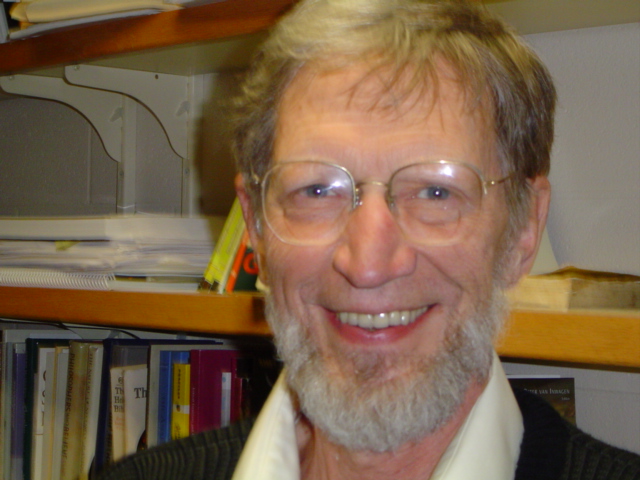
Christian philosopher Alvin Plantinga

Alvin Plantinga is widely regarded as the top Christian philosopher in the world, and a former head of the largest professional association of philosophers – the American Philosophical Association (APA).

 Mary sent me this article from the New York Times about Alvin Plantinga and his new book, published by Oxford University Press – the top academic press in the world.

Excerpt:

From Calvin [College], and later from the University of Notre Dame, Mr. Plantinga has led a movement of unapologetically Christian philosophers who, if they haven’t succeeded in persuading their still overwhelmingly unbelieving colleagues, have at least made theism philosophically respectable.

“There are vastly more Christian philosophers and vastly more visible or assertive Christian philosophy now than when I left graduate school,” Mr. Plantinga said in a recent telephone interview from his home in Grand Rapids, adding, with characteristic modesty, “I have no idea how it happened.”

Mr. Plantinga retired from full-time teaching last year, with more than a dozen books and a past presidency of the American Philosophical Association to his name. But he’s hardly resting on those laurels. Having made philosophy safe for theism, he’s now turning to a harder task: making theism safe for science.

For too long, Mr. Plantinga contends in a new book, theists have been on the defensive, merely rebutting the charge that their beliefs are irrational. It’s time for believers in the old-fashioned creator God of the Bible to go on the offensive, he argues, and he has some sports metaphors at the ready. (Not for nothing did he spend two decades at Notre Dame.)

In “Where the Conflict Really Lies: Science, Religion and Naturalism,” published last week by Oxford University Press, he unleashes a blitz of densely reasoned argument against “the touchdown twins of current academic atheism,” the zoologist Richard Dawkins and the philosopher Daniel C. Dennett, spiced up with some trash talk of his own.

[…] Longtime readers of Mr. Plantinga, who was raised as a Presbyterian and who embraced the Calvinism of the Christian Reformed Church as a young man, are used to such invocations of theological concepts. And even philosophers who reject his theism say his arguments for the basic rationality of belief, laid out in books like “Warranted Christian Belief” and “God and Other Minds,” constitute an important contribution that every student of epistemology would be expected to know.

But Mr. Plantinga’s steadfast defense of the biochemist and intelligent-design advocate Michael Behe, the subject of a long chapter in the new book, is apparently another matter.

“I think deep down inside he really isn’t a friend of science,” Michael Ruse, a philosopher of science at Florida State University, said of Mr. Plantinga. “I’m not objecting to him wanting to defend theism. But I think he gets his victory at the level of gelding or significantly altering modern science in unacceptable ways.”

Mr. Dennett was even harsher, calling Mr. Plantinga “Exhibit A of how religious beliefs can damage or hinder or disable a philosopher,” not to mention a poor student of biology. Evolution is a random, unguided process, he said, and Mr. Plantinga’s effort to leave room for divine intervention is simply wishful thinking.

“It’s just become more and more transparent that he’s an apologist more than a serious, straight-ahead philosopher,” Mr. Dennett said.

When Mr. Plantinga and Mr. Dennett (who said he has not read Mr. Plantinga’s new book) faced off over these questions before a standing-room-only crowd at a 2009 meeting of the American Philosophical Association, the event prompted ardent online debate over who had landed better punches, or simply been more condescending. (A transcript of the proceedings was published last year as “Science and Religion: Are They Compatible?”)

Mr. Plantinga, who recalled the event as “polite but not cordial,” allowed that he didn’t think much of Mr. Dennett’s line of reasoning. “He didn’t want to argue,” Mr. Plantinga said. “It was more like he wanted to make assertions and tell stories.”

Would you like to know how well Daniel Dennett can debate the naturalism/theism dispute? First of all, Plantinga has debated Dennett, and you can find the audio for it at Apologetics 315.

William Lane Craig also presented several arguments against naturalism to Daniel Dennett in 2007, and Dennett responded by calling it a “first-rate piece of philosophical reasoning”. I link to the exchange and complain about Dennett’s weak response to Craig’s arguments in a previous post.

You may also find this recent interview with Alvin Plantinga, conducted by Brian Auten, informative.

The resurgence of Christian theism in analytical philosophy

Now let’s move from the specific to the aggregate. What is going on with these Christian philosophers?

Well, you can read an excellent article about the resurgence of Christian theism in philosophy departments in the peer-reviewed philosophy journal Philo, which, in my opinion, is the best journal for atheists and agnostic philosophers. The article is authored by the well-known atheist Quentin Smith.

He writes:

THE DESECULARIZATION OF ACADEMIA THAT EVOLVED IN PHILOSOPHY DEPARTMENTS SINCE THE LATE 1960s

By the second half of the twentieth century, universities and colleges had been become in the main secularized. The standard (if not exceptionless) position in each field, from physics to psychology, assumed or involved arguments for a naturalist world-view; departments of theology or religion aimed to understand the meaning and origins of religious writings, not to develop arguments against naturalism. Analytic philosophers (in the mainstream of analytic philosophy) treated theism as an antirealist or non-cognitivist world-view, requiring the reality, not of a deity, but merely of emotive expressions or certain “forms of life” (of course there were a few exceptions, e.g., Ewing, Ross, Hartshorne, etc., but I am discussing the mainstream view).

[…]The secularization of mainstream academia began to quickly unravel upon the publication of Plantinga’s influential book on realist theism, God and Other Minds, in 1967. It became apparent to the philosophical profession that this book displayed that realist theists were not outmatched by naturalists in terms of the most valued standards of analytic philosophy: conceptual precision, rigor of argumentation, technical erudition, and an in-depth defense of an original world-view. This book, followed seven years later by Plantinga’s even more impressive book, The Nature of Necessity, made it manifest that a realist theist was writing at the highest qualitative level of analytic philosophy, on the same playing field as Carnap, Russell, Moore, Grünbaum, and other naturalists. Realist theists, whom hitherto had segregated their academic lives from their private lives, increasingly came to believe (and came to be increasingly accepted or respected for believing) that arguing for realist theism in scholarly publications could no longer be justifiably regarded as engaging in an “academically unrespectable” scholarly pursuit.

Naturalists passively watched as realist versions of theism, most influenced by Plantinga’s writings, began to sweep through the philosophical community, until today perhaps one-quarter or one-third of philosophy professors are theists, with most being orthodox Christians. Although many theists do not work in the area of the philosophy of religion, so many of them do work in this area that there are now over five philosophy journals devoted to theism or the philosophy of religion, such as Faith and Philosophy, Religious Studies, International Journal of the Philosophy of Religion, Sophia, Philosophia Christi, etc. Philosophia Christi began in the late 1990s and already is overflowing with submissions from leading philosophers. Can you imagine a sizeable portion of the articles in contemporary physics journals suddenly presenting arguments that space and time are God’s sensorium (Newton’s view) or biology journals becoming filled with theories defending élan vital or a guiding intelligence? Of course, some professors in these other, non-philosophical, fields are theists; for example, a recent study indicated that seven percent of the top scientists are theists.1 However, theists in other fields tend to compartmentalize their theistic beliefs from their scholarly work; they rarely assume and never argue for theism in their scholarly work. If they did, they would be committing academic suicide or, more exactly, their articles would quickly be rejected, requiring them to write secular articles if they wanted to be published. If a scientist did argue for theism in professional academic journals, such as Michael Behe in biology, the arguments are not published in scholarly journals in his field (e.g., biology), but in philosophy journals (e.g., Philosophy of Science and Philo, in Behe’s case). But in philosophy, it became, almost overnight, “academically respectable” to argue for theism, making philosophy a favored field of entry for the most intelligent and talented theists entering academia today. A count would show that in Oxford University Press’ 2000–2001 catalogue, there are 96 recently published books on the philosophy of religion (94 advancing theism and 2 presenting “both sides”). By contrast, there are 28 books in this catalogue on the philosophy of language, 23 on epistemology (including religious epistemology, such as Plantinga’s Warranted Christian Belief), 14 on metaphysics, 61 books on the philosophy of mind, and 51 books on the philosophy of science.

And how have naturalist philosophers reacted to what some committed naturalists might consider as “the embarrassment” of belonging to the only academic field that has allowed itself to lose the secularization it once had? Some naturalists wish to leave the field, considering themselves as no longer doing “philosophy of mind,” for example, but instead “cognitive science.” But the great majority of naturalist philosophers react by publicly ignoring the increasing desecularizing of philosophy (while privately disparaging theism, without really knowing anything about contemporary analytic philosophy of religion) and proceeding to work in their own area of specialization as if theism, the view of approximately one-quarter or one-third of their field, did not exist. (The numbers “one-quarter” and “one-third” are not the result of any poll, but rather are the exceptionless, educated guesses of every atheist and theist philosophy professor I have asked [the answers varied between “one-quarter” and “one-third”]). Quickly, naturalists found themselves a mere bare majority, with many of the leading thinkers in the various disciplines of philosophy, ranging from philosophy of science (e.g., Van Fraassen) to epistemology (e.g., Moser), being theists. The predicament of naturalist philosophers is not just due to the influx of talented theists, but is due to the lack of counter-activity of naturalist philosophers themselves. God is not “dead” in academia; he returned to life in the late 1960s and is now alive and well in his last academic stronghold, philosophy departments.

Quentin Smith is a good friend of William Lane Craig, who is a philosopher/theologian and the top Christian defender in the world, and probably of all time. Smith is the co-author, with William Lane Craig, of the book “Theism, Atheism, and Big Bang Cosmology“, also published by Oxford University Press. Craig and Smith debated at Harvard University in 2003, and I transcribed the debate for posterity. If some of you are looking for a way to help promote Christian apologetics, you should pick a debate that hasn’t been transcribed and transcribe it. A lot of people read these debate transcripts. I had them printed out in my binder when I was an undergraduate student, in case my professors got boring! I like a good fight.

On a lighter note, my office plant is named Alvin Plantinga. It was grown in water and then given to me by an atheist with whom I work. We discuss these interesting topics over lunch every few months. And so should you. Why not send the New York Times article and the Philo article to an atheist in your office and get the conversation started? There’s enough in this post alone to help you sound like Alvin Plantinga!