Tag Archives: 2012

A closer look at Michele Bachmann’s record on fiscal policy

Michele Bachmann: On the Issues

An analysis of Michele Bachmann’s record on economic policy, courtesy of the Club for Growth.

Summary:

Congresswoman Michele Bachmann was first elected to Congress in 2006 after serving in the Minnesota State Senate from 2001 to 2006. If elected President, she would be the first woman President and the second person elected directly from the U.S. House of Representatives since James Garfield. Congresswoman Bachmann received a 100% score in the Club for Growth’s 2010 scorecard and has a lifetime score of 94%. The average house Republican score from 2007-2010 was 78%. Congresswoman Bachmann also has a lifetime score of 94% from the Minnesota Taxpayers League during the time she served in the State Senate. The average score for Republican State Senators during that time was 76%.

These guys do the most thorough job of anyone vetting the candidates – they go over every bill, every speech, every vote, every editorial – even campaign advertisements.

The report covers the following areas:

  • TAXES
  • SPENDING
  • ENTITLEMENT REFORM
  • REGULATION
  • FREE TRADE
  • SCHOOL CHOICE
  • TORT REFORM
  • POLITICAL FREE SPEECH
  • POLITICAL ACTIVITY & ENDORSEMENTS

Excerpt:

SCHOOL CHOICE
The Club for Growth supports broad school choice, including charter schools and voucher programs that create a competitive education market including public, private, religious, and non-religious schools.  More competition in education will lead to higher quality and lower costs.
Congresswoman Bachmann not only has a strong record on school choice, she is the first major presidential candidate to actually found a charter school. In fact, Congresswoman Bachmann co-founded the first K-12 charter school in the nation, New Heights Charter School back in 1993.  Her record on school choice has, predictably, been flawless since then.
In 2011, Bachmann voted to re-establish the DC school voucher program.  As a member of the State Senate, Bachmann voted to prohibit teacher strikes during the school year.  She also voted to allow parents to use education tax credits for tuition at private schools.  She’s introduced legislation to make foster children eligible for education vouchers.
As far back as 2003, Bachmann was fighting the No Child Left Behind Act, filing a bill in the Minnesota legislature that would have prohibited the Dept. of Children, Families and Learning or any other state agency “from entering into a contract or other agreement under the provisions of the No Child Left Behind Act of 2001, unless the financial consequences to the state and each school district have been identified.”  Another bill, S.F. 1921, “requires all state plans, agreements and contracts associated with NCLB compliance to be nullified and revoked on June 1, 2004, unless the Legislature specifically affirms implementation of the federal law by that date.”

Conclusion:

With very few exceptions, Congresswoman Bachmann has supported pro-growth policies throughout her career. She especially deserves praise for her consistent defense of school choice. After reviewing her record, we are confident that Congresswoman Bachmann would be a pro-growth President.

For my social conservative friends: please print out the paper and read it. These guys are not indifferent to your concerns at all.

Pat Toomey and the Club for Growth

The past director of the Club for Growth is current Pennsylvania senator Pat Toomey.

Here’s a blurb from his web site:

Pat is pro-life and believes that children should be welcomed into the world and protected by its laws.

While reasonable people may differ on the question of abortion rights, we should all be able to agree on policies that encourage adoption over abortion, that avoid taxpayer funding of abortions, and that allow parental involvement in decisions that involve minors. As a senator, Pat will support policies that further these important goals.

Pat also believes the tradition of marriage is sacred and is best defined as between a man and a woman. As a congressman, Pat voted to protect the institution of marriage in many ways. For example, Pat voted to reduce the tax penalty on married couples and will support similar policies as a U.S. senator. Throughout his time in Congress, Pat voted for legislation to protect innocent life, strengthen marriage, and protect the traditional values upon which this country was founded.

His voting record on abortion:

  • Voted YES on making it a crime to harm a fetus during another crime. (Feb 2004)
  • Voted YES on banning partial-birth abortion except to save mother’s life. (Oct 2003)
  • Voted YES on forbidding human cloning for reproduction & medical research. (Feb 2003)
  • Voted YES on funding for health providers who don’t provide abortion info. (Sep 2002)
  • Voted YES on banning human cloning, including medical research. (Jul 2001)
  • Voted YES on banning Family Planning funding in US aid abroad. (May 2001)
  • Voted YES on federal crime to harm fetus while committing other crimes. (Apr 2001)
  • Voted YES on banning partial-birth abortions. (Apr 2000)
  • Voted YES on barring transporting minors to get an abortion. (Jun 1999)
  • Rated 0% by NARAL, indicating a pro-life voting record. (Dec 2003)

And on marriage:

  • Voted YES on establishing nationwide AMBER alert system for missing kids. (Apr 2003)
  • Voted YES on reducing Marriage Tax by $399B over 10 years. (Mar 2001)
  • Rated 100% by the Christian Coalition: a pro-family voting record. (Dec 2003)

This is the record of the former leader of the most fiscally conservative PAC. The most pro-business group. The most anti-spending group.

Fiscal conservatives are more socially conservative than you think. If you are a social conservative, but not a fiscal conservative, then you should print out the paper on Michele Bachmann, a radical social conservative, and see how these fiscal conservatives at the Club for Growth judge what counts as fiscally conservative. It might be the case that fiscally conservative positions actually dovetail nicely with socially conservative positions. I think they do.

Campaign speeches, interviews and debates

Speeches:

Reactions from her recent debate performance:

Profiles of Michele Bachmann:

Michele Bachmann on television news

Let Americans spend their own money

Time to prioritize spending

Obama’s plan is to raise your taxes

Michele Bachmann in the legislature

Against socialism:

For economic growth:

Against ACORN funding:
Where does Republican candidate Rick Perry stand on social issues?

Texas Governor Rick Perry

The first post from Life News.

Excerpt:

Upon entering politics, Perry has maintained a record of defending religious expression in the public sphere.

He supported and signed a Texas bill in 2007, the “Religious Viewpoint Anti-Discrimination Act,” clarifying that students and school employees alike had the right to express religious views in public, and that religious groups had the same right of access to public facilities as secular groups.

[…]But one thing that distinguishes Perry from the typical right-wing politician is his unabashedly public prayer life: the governor has called on Texans to pray and even fast in response to state crises or disasters.When wildfires were raging during a drought in Texas this spring, Perry released an official proclamation over the Easter weekend asking people of all faiths to pray for rain for three days, and to pray for firemen and other officials in danger.

And:

Perry is increasingly famous for championing the 10th Amendment of the US Constitution, by which states are granted whatever powers are not explicitly reserved to the federal government.

Despite a conservative record on marriage – Perry supported Texas’s 2005 amendment defining marriage as the union of a man and a woman – his 10th Amendment loyalties led to some confusion among pro-family advocates when he indicated that New York’s decision to legalize same-sex “marriage” in June was “their business, and that’s fine with me.”

Perry later clarified that he was not defending same-sex “marriage,” but the principle allowing states to decide without intrusion by the federal government. He added that he supported a federal marriage amendment, which would mean an agreement by 3/4 of the states, to define marriage as the union of a man and a woman nationwide.

The Texas governor also defended Texas’s sodomy law, which the US Supreme Court struck down in 2002 in Lawrence v. Texas

I still think Bachmann is better, but Perry has socially conservative accomplishments. In my opinion, this makes him better than Romney, who has nothing to show that he is a social conservative, and much to show that he is a social liberal.

Here’s more about Perry in a second post from Life News.

Excerpt:

As governor, Rick Perry signed Texas’s informed consent law, the Woman’s Right to Know Act in 2003, and legislation giving unborn children at any point in gestation separate victim status in a crime (the Prenatal Protection Act 2003). He also signed a parental consent law in 2005, and made Texas the 10th U.S. state to fund abortion alternatives beginning in 2005.

Perry also signed into law a 2005 measure banning abortion after 26 weeks gestation. The law allows exceptions in the cases where the mother faces substantial risk of death, “imminent, severe, irreversible brain damage or paralysis,” or if her unborn child has “severe, irreversible brain impairment.”

During the most recent legislative session, Perry declared a new sonogram bill an “emergency” priority, allowing the legislature to swiftly enact the law that requires abortionists to provide women an ultrasound of their unborn child and an opportunity to hear the fetal heartbeat before making a decision on abortion.

[…]Perry adheres to a strong 10th amendment, or states rights philosophy, especially on abortion. The 10th amendment to the U.S. Constitution iterates that either the states or the people retain governmental powers not explicitly given to the federal government in the Constitution.

Perry has made the case that the states would be in a better position to defend the unborn than the federal government, which has been a prime donor to the abortion industry at home, through subsidizing Planned Parenthood, or funding abortion groups overseas.

The U.S. Supreme Court curtailed the power of the states to restrict or regulate abortion with the Roe v. Wade decision in 1973, making abortion a constitutional right, and therefore a federal issue. This has prevented states from passing pro-life laws that would greatly restrict or ban abortion.

Perry, however, has said that while he believes abortion is a matter for the states, he would support a Human Life Amendment to the U.S. Constitution. Such an amendment would be consistent with his states-based approach, because it would require the common consent of three-quarters of the States and supermajorities in both chambers of Congress.

There’s more in those two articles.

Again, he’s more moderate than I would like, but also more electable. He sounds like he would strike a middle ground between my views and Mitt Romney’s views. He’ll have more broad appeal with Democrats and independents. He’s not conservative enough for me on social issues, but he’s conservative enough to move the ball forward on social issues from where things stand today. I still prefer Michele Bachmann to anyone else by far, but a Perry/Bachmann or Perry/Pawlenty ticket makes sense to me, if it comes to that, with the remaining Minnesota candidate running for the Senate seat in 2012 against that miserable Amy Klobuchar.

I notice that the Club for Growth has a white paper on Michele Bachmann’s record views, but none for Rick Perry, yet. Bachmann gets an excellent review from Club for Growth, naturally. And she’s tied for first place on social issues with Rick Santorum, in my opinion.

Tea party voters are pleased with John Boehner’s deal

Boehner's deal pleases the Tea Party

From the liberal Washington Post.

Excerpt:

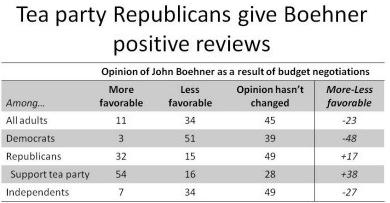
A majority of Republicans who agree with the tea party movement give House Speaker John A. Boehner (R-Ohio) positive reviews for his role in debt negotiations in a new Washington Post-Pew Research Center poll. The speaker’s high marks represent a crucial link between the highly energized political movement and the Republican establishment as attention pivots back to the 2012 election cycle.

[…]After Republicans cut a deal on Sunday reducing the deficit with spending cuts alone – a key GOP and tea party priority – there is little doubt that the tea party movement has emerged as a powerful and sustained force in national politics.

[…]Tea party Republicans are significantly more tuned in than others to the 2012 presidential contest, according to another survey. Overall, more than eight in 10 are closely following the campaign, said the latest Washington Post-ABC News poll. Some 42 percent of Republicans who strongly support the tea party said they’re following it “very closely,” roughly twice the number of Democrats (17 percent), independents (19 percent) and Republicans overall (21 percent) who say so.

Tea party Republicans make up nearly one-quarter of registered voters in swing states. While tea party Republicans make up 17 percent of registered voters in states that favored Obama by 10 points or more according to June and July Post-ABC polls, they make up 23 percent of voters in states decided by single digit margins. That’s identical to the 23 percent of voters in heavily McCain states who identify as tea party Republicans.

Elections matter. Make sure you start engaging your friends now.