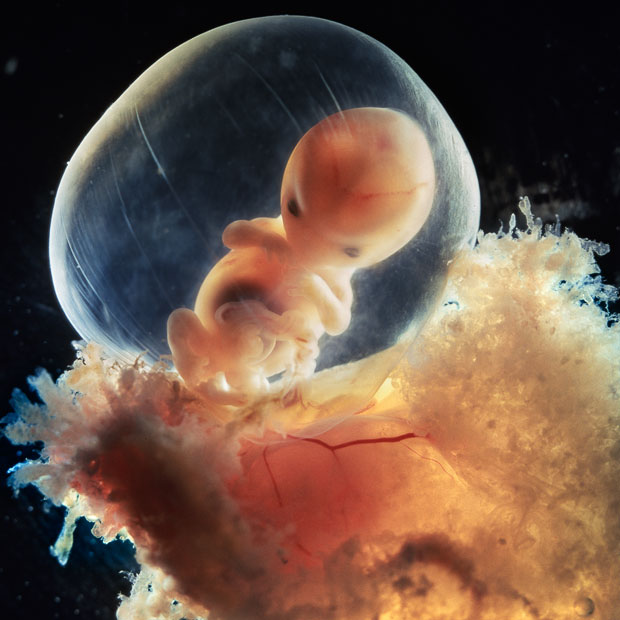
Here is the report from the Oxford University website:
When does our heart first start to beat? Until now, researchers thought that the first time our heart muscle contracted to beat was at eight days after conception in mice, which equates to around day 21 of a human pregnancy.
Now, a team funded by the British Heart Foundation (BHF) at the University of Oxford has demonstrated earlier beating of the heart in mouse embryos which, if extrapolated to the human heart, suggests beating as early as 16 days after conception.
In the study, published in the journal eLife, researchers looked at the developing mouse heart and found that the muscle started to contract as soon as it formed the cardiac crescent – an early stage in heart development. In mice, this crescent forms 7.5 days after conception, which is equivalent to day 16 in the human embryo. Previously, it was thought that the heart started to contract a stage later, when the heart appears as a linear tube.
Here’s how they did it:
By adding fluorescent markers to calcium molecules within the mouse embryo, the team was able to see at exactly which point in time the calcium tells our heart muscle cells to contract and then become coordinated enough to produce a heartbeat.
The team also found that this initiation of beating was essential for the heart to develop properly at an early stage and that a protein called NCX1 plays a key role in the generation of the calcium signals needed to produce the beating action of the heart.
The heart is the first organ to form during pregnancy and is critical in providing oxygen and nutrients to the developing embryo. The process of heart development is highly conserved between mammalian species, meaning that these findings may add considerably to our understanding of how the human heart develops.
Abortion is another one of those issues where conservatives are determined to abide by what the progress of science reveals, while liberals are determined to block out what science reveals.
Here is a nice video that shows how unborn children develop in the womb:
From the moment of conception, a new set of human DNA is formed, different from the mother, different from the father. And already the little unborn child is in relationship with his or her mother. He or she is depending on her to honor her obligation to him or her, because it was she who chose to have sex, and who chose the man to have sex with, and who chose when in the relationship to have sex with him.
Those of us who are Christians have always believed that abortion was morally wrong, going write back to the beginning of the Christian faith.
Recently I came across a reading of the Didache. “The what?” you may ask. The Didache is a book written somewhere in the first or second century. For a long time it was up for consideration as Scripture. It was believed to be the Teaching of the Twelve Apostles. Eventually it was agreed that the book was an excellent book, but not inspired Scripture. So I was pleased to be able to download this admirable book containing good teachings from the early Church fathers.
The book seemed to be largely a lot of quotes from Scripture. You’ll learn the basic rules of Christianity — “First, you shall love God who made you; second, love your neighbor as yourself.” You’ll learn that “grave sins” are forbidden, like adultery, murder, fornication, and so on. (They specifically include pederasty in the list.) There are instructions regarding teachers, prophets, Christian assembly, and so on. Lots of the normal, good stuff. But, since this was written sometime prior to 200 AD, I was somewhat surprised at this instruction: “You shall not murder a child by abortion” (Didache, Ch 2).
Christians really would benefit from looking at the moral values of the early church. These days, we tend to decide what is right and wrong based on our feelings, including the feelings we have when other people like us or don’t like us. But deciding things based on your feelings was not real popular with the earliest Christians. They decided what to do based on what was morally right, and they always protected the weak rather than favoring the selfishness and hedonism of the strong.
Two widely recognized trends in American society might have something to do with each other.
Divorce rates climbed to the highest levels ever in the 1980s, when about half of all marriages ended in divorce.
And in the present day, Americans are rapidly becoming less religious. Since 1972, the share of Americans who say they do not adhere to any particular religion has increased from 5 percent of the population to 25 percent.
Could those two trends be related? A new study from the Public Religion Research Institute says yes. The children of divorced parents have grown up to be adults of no religion.
People whose parents divorced when they were children are significantly more likely to grow up not to be religious as adults, the study found. Thirty-five percent of the children of divorced parents told pollsters they are now nonreligious, compared with 23 percent of people whose parents were married when they were children.
[…]Cox said his team found that even children of divorced parents who are religious are less religious than their peers. Thirty-one percent of them go to services every week, compared with 43 percent of religious people whose parents were married when they were growing up.
This part about Protestant pastors wimping out of thorny issues is very interesting:
Andrew Root, a professor at Luther Seminary who has written a book about the spiritual consequences of divorce for children, was not surprised to hear about the study’s findings.
“Everything in a divorce gets divided. Literally everything. Parents’ friends get divided. Relatives get divided. Everyone takes sides,” Root said. “Even religion takes sides. The church gets divided. Dad leaves Mom’s faith, or vice versa. Negotiating those worlds becomes difficult.”
Root said churches are not doing enough to speak directly to the concerns of children in those situations, so the kids lose faith in the ability of the church to help them. He said that when the divorce rate climbed in the 1980s, many members of the clergy, especially mainline Protestant pastors, stopped speaking out against divorce so as not to alienate struggling congregants. But by going silent on the subject, they didn’t offer any comfort to the kids.
As adults, Root said, those same people do not believe the church will respond to their adult problems. “They’re now thinking, ‘I’m dealing with depression.’ Or, ‘I’m dealing with my own marital troubles.’ The church must not have anything to say to me, because when I was 8 and dealing with divorce, my Sunday-school teacher didn’t even say, ‘Man, Amanda, that must be really complicated for you’,” Root said.
I get e-mails all the time from people who are suffering from the effects of the Sexual Revolution, which was put in place by selfish adults so they could do whatever they wanted. Children suffered a lot from this. Obviously, the painful of experience of their parents divorcing hurt their view of God. But divorce also hurts a child’s ability to know what a man loving a woman in a stable commitment looks like, and what a woman loving a man in a stable commitment looks like. I mean – what does love between sexes look like when the “in love” feeling has worn off, and all that remains is the commitment to build something together? I think that a lot is riding on the stability of the relationship between the child’s mother and father.
The video of the debate was posted by ReasonableFaith.org – Dr. Craig’s organization. This debate occurred in March 2017 at the University of Dublin, in Ireland.
The video: (91 minutes)
My non-snarky summary is below.
Dr. Craig’s opening speech
Two claims:
1. There are good reasons to think that theism is true.
2. There are not comparably good reasons to think that atheism is true.
Five reasons for God’s existence:
1. The beginning of the universe
– actual infinite past is mathematically impossible
– BGV theorem: any universe that is on balance expanding in its history (like ours) cannot be past eternal
2. Fine-tuning of cosmic quantities and constants
– slight changes to quantities and constants prevent a universe from supporting complex embodied life
– the multiverse response of atheists conflicts with observations, e.g. the Boltzmann Brains problem
3. Objective moral values
– God’s existence is required to ground objective moral values and duties
4. Minimal facts case for the resurrection of Jesus
– there are good reasons to accept the most widely accepted facts about the historical Jesus (empty tomb, appearances, early widespread belief in the resurrection)
– the best explanation of these minimal facts is that God raised Jesus from the dead
5. Experience God directly
– in the absence of any defeaters to belief in God, a person can experience God directly
Dr. Daniel Came’s opening speech
1. The hiddenness of God
– if God wants a personal relationship with us, and a relationship with God would be the greatest good for us
– God ought to reveal himself to us, but he does not reveal himself to many people, the “non-resistant non-believers”
2. The inductive problem of evil
– many evil events occur that are pointless – there is no morally sufficient reason why God would allow them to occur
– examples: animal suffering, children born with disease, tsunamis
– the theistic response to this is that humans are not in a position to know whether there are morally sufficient reasons, due to our limitations of knowing the consequences
– but this ripple effect defense has 4 possible outcomes, 3 of which don’t do the job of justifying
Dr. Craig’s first rebuttal
1. The hiddenness of God
– God’s goal is not to make his existence known, but to draw them into a love relationship
– it’s speculative that overt displays of God’s existence would draw people to him in a love relationship, they might resent his bullying
– atheist would have to prove that God could draw more people into a love relationship with him by revealing himself more overtly
2. The inductive problem of evil
– as humans, we are not in a position to know for certain that any apparently pointless evil really is pointless
– William Alston article: 6 limitations of human knowing make it impossible to judge that an evil is actually “pointless”
– Dr. Came says that there are 4 possibilities for the ripple effects, and since 3 are bad, it’s likely that there are not morally sufficient reasons for a apparently pointless evil
– it is logically fallacious to assert probability conclusions without knowing the probabilities of those 4 options
– there is actually an argument from evil: since the problem of evil requires an objective standard of good and evil by which to measure, and God is the only possible ground of objective morality, then pressing the problem of evil actually requires the atheist to assume God, in order to ground this objective moral standard
Dr. Came’s first rebuttal
3. Objective moral values
– there are naturalistic theories of moral realism where objective moral duties and objective moral values exist in a naturalistic universe
– I’m not saying that any of them are correct, but there are many theories about object morality in a naturalistic universe
There are naturalistic theories for all of the 5 arguments that Dr. Craig presented. It is Dr. Craig’s responsibility to present those naturalistic theories and prove that they are not as good as his explanations. I’m not going to defend (or even name!) a single naturalistic theory for any of these 5 arguments by Dr. Craig.
Dr. Craig’s explanations for the 5 evidences he gave can’t be admitted, because we have to know how God did something in naturalistic terms before we can know that God did it supernaturally. Explanations are only valid if they are naturalistic.
1. The beginning of the universe
– naturalism explains how the universe expands after it came into being, so that explains how it came into being
– the God explanation, that God created the universe out of nothing, is not admissible, because it is not naturalistic
– how does God, as an unembodied mind interact with the physical world?
– the only agency that we know about is human agents, and we have bodies, so how could God perform actions without having a body?
The theistic hypothesis does not make any predictions, but naturalism makes lots of testable predictions. God could do anything, so he is not constrained and is therefore untestable. We can’t infer God as an explanation in principle because we can’t predict what is more probable if God exists than if he does not.
2. Fine-tuning of cosmic quantities and constants
– the university was not set up to make embodied intelligence plausible, because the vast majority of the universe is hostile to life
– there are models of the multiverse that escape the Boltzmann Brains problem that Dr. Craig raised
Dr. Craig’s second rebuttal
Some of Dr. Craig’s arguments are deductive (e.g. – the beginning of the universe, objective moral values), so that the conclusion follows from the premises if the premises are true. The resurrection passes the standard tests for historical explanations.
1. The beginning of the universe
– the whole point of the argument is that there is no naturalistic explanation for an ultimate beginning of the universe
2. Fine-tuning of cosmic quantities and constants
– the whole point of the argument is that there is no naturalistic explanation for a design of the universe to support life
– he has to prove that intelligences has to be attached to bodies
– human beings are non-physical minds united to physical bodies
– naturalistic attempts to explain mental operations fail
– the arguments prove that unembodied minds exist
– the vast expanse of the universe is required in order to form the galaxies, stars and heavy elements needed for complex life
– why expect that the entire universe should be small, or that life would be everywhere?
– a non-fine-tuned world is more likely in the multiverse, and in a multiverse, we are more likely to have a Boltzmann brain world than a world with complex, embodied life
– Dr. Came has not advanced any naturalistic explanation for the fine-tuning
3. Objective moral values
– non-theistic ethical theories cannot account for the ontological foundations of objective moral values and duties
– atheistic theories of moral realism simply assume objective moral values out of thin air
– it is especially hard to find any basis for objective moral duties in the absence of God
Dr. Came’s second rebuttal
5. Religious experience
– Dr. Craig should not bring up religious experience in a debate where arguments and evidence are central
– people who have dreams, hallucinations and psychotic delusions could appeal to religious experience
– religious experience is by no means universal, and it is possible to doubt it
3. Objective moral values
– there are lots of atheists who hold to objective moral values
– Dr. Craig has to explain how God grounds objective moral values and duties
– Dr. Craig has to explain why atheist moral realist theories don’t work to ground objective moral values and duties
1. The beginning of the universe
– Dr. Craig claims that something can’t come from nothing, that’s not an argument
– there are numerous models that don’t require an absolute beginning of the universe
– Dr. Craig cites the BGV theorem, but Guth (one of the authors) says that only the inflation has a beginning, not the whole universe
Dr. Craig’s conclusion
1. The beginning of the universe
– on theism, there is an efficient cause, but no material cause, for the origin of the universe
– on atheism, there is neither an efficient cause nor a material cause, for the origin of the universe: that’s worse!
– if he thinks that there are models of the universe that don’t require a beginning, then let him name a viable eternal model of the universe
– he never refuted the mathematical argues against an infinite past
2. Fine-tuning of cosmic quantities and constants
– nothing to refute
3. Objective moral values
– God is a better ground for morality than humans, because he is ultimate, and not contingent and arbitrary
– God is a being who is worthy of worship, and therefore command his creatures with moral duties
4. Minimal facts case for the resurrection of Jesus
– nothing to refute
5. Religious experience
– only justified because there are no defeaters to it
1. The hiddenness of God
– atheist has to show that if God’s existence were more obvious, that it would result in more people being drawn to him
2. The inductive problem of evil
– Dr. Came’s argument was logically fallacious, and makes errors in probability theory
Dr. Came’s conclusion
Sometimes, people can’t prove something, but lack of evidence is a justification for doubting it, e.g. – werewolves.
If none of Craig’s arguments work, then it follows that it is not rational to believe that God exists, and it is rational to believe that God does not exist.
Atheists shouldn’t have a burden of proof for what they know, only theists have a burden of proof for what they know.
My thoughts
One quick point. If life were common everywhere then atheists would infer that God wasn’t involved in it. Period. “Life is everywhere, so it’s common, why do we need a designer?” they’d say. I agree with Dr. Came about denouncing religious experience in a formal debate. I don’t like when Dr. Craig brings this up, but I see why he does it – he’s an evangelist, and that’s a good thing, too. I just worry about how it looks to atheists, although it’s good for sincere seekers. I’m not the one on the stage, though, Dr. Craig is.
I think the point about more overt revealing by God would annoy people and make them turn away. Think of how gay people respond to the suggestion that there is anything wrong with them, with rage, vandalism, threats, coercion, attempts to get you to lose your job and business, and using government as a weapon to fine and imprison you. It’s really obvious to me that more God does not mean more love of God. For those who don’t want God, the hiddenness is respect for their choice to put pleasure above the search for truth. (I mean the gay activists – I have great sympathy for people who struggle with same-sex unwanted attractions because they were impacted by a failed bond with their parent of the same sex as they are).
Whenever I meet people like Dr. Came, I always urge them to keep investigating and pursuing truth, because they will find it if they are sincerely seeking after God. Some atheists do sincerely seek God, but I don’t know any who haven’t found him. I’m not sure if that’s because those atheists who claim to be non-resistant and rational are in fact resistant and non-rational, or what the real reason is. If you believe the Bible, all unbelief is non-rational and resistant (see Romans 1). Regarding the werewolves, we don’t have any good arguments for werewolves, we do have good arguments for God. Dr. Came didn’t refute the arguments that Craig raised, nor did his own arguments for atheism work. And there are many, many more arguments (origin of life, Cambrian explosion, habitability-discoverability, molecular machines) that Craig did not raise, too.