How the presence and quality of fathers affects belief in God

Does government provide incentives for people to get married?
A father in the home helps children to reconcile love and moral boundaries

Here’s an article by Paul Copan which points out how father presence/absence and father quality affects belief and disbelief in God.

Excerpt:

Seventh, the attempt to psychologize believers applies more readily to the hardened atheist.It is interesting that while atheists and skeptics often psychoanalyze the religious believer, they regularly fail to psychoanalyze their ownrejection of God. Why are believers subject to such scrutiny and not atheists? Remember another feature of Freud’s psychoanalysis — namely, an underlying resentment that desires to kill the father figure.

Why presume atheism is the rational, psychologically sound, and default position while theism is somehow psychologically deficient? New York University psychology professor Paul Vitz turns the tables on such thinking. He essentially says, “Let’s look into the lives of leading atheists and skeptics in the past. What do they have in common?” The result is interesting: virtually all of these leading figures lacked a positive fatherly role model — or had no father at all.11

Let’s look at some of them.

  • Voltaire(1694–1778): This biting critic of religion, though not an atheist, strongly rejected his father and rejected his birth name of François-Marie Arouet.
  • David Hume(1711–76): The father of this Scottish skeptic died when Hume was only 2 years old. Hume’s biographers mention no relatives or family friends who could have served as father figures.
  • Baron d’Holbach(1723–89): This French atheist became an orphan at age 13 and lived with his uncle.
  • Ludwig Feuerbach (1804–72): At age 13, his father left his family and took up living with another woman in a different town.
  • Karl Marx(1818–83): Marx’s father, a Jew, converted to being a Lutheran under pressure — not out of any religious conviction. Marx, therefore, did not respect his father.
  • Friedrich Nietzsche(1844–1900): He was 4 when he lost his father.
  • Sigmund Freud(1856–1939): His father, Jacob, was a great disappointment to him; his father was passive and weak. Freud also mentioned that his father was a sexual pervert and that his children suffered for it.
  • Bertrand Russell(1872–1970): His father died when he was 4.
  • Albert Camus(1913–60): His father died when he was 1 year old, and in his autobiographical novel The First Man, his father is the central figure preoccupation of his work.
  • Jean-Paul Sartre(1905–80): The famous existentialist’s father died before he was born.12
  • Madeleine Murray-O’Hair (1919–95): She hated her father and even tried to kill him with a butcher knife.
  • We could throw in a few more prominent contemporary atheists not mentioned by Vitz with similar childhood challenges:
  • Daniel Dennett (1942–): His father died when he was 5 years of age and had little influence on Dennett.13
  • Christopher Hitchens (1949–): His father (“the Commander”) was a good man, according to Hitchens, but he and Hitchens “didn’t hold much converse.” Once having “a respectful distance,” their relationship took on a “definite coolness” with an “occasional thaw.” Hitchens adds: “I am rather barren of paternal recollections.”14
  • Richard Dawkins (1941–): Though encouraged by his parents to study science, he mentions being molested as a child — no insignificant event, though Dawkins dismisses it as merely embarrassing.15

Moreover, Vitz’s study notes how many prominent theists in the past — such as Blaise Pascal, G.K. Chesterton, Karl Barth, and Dietrich Bonhoeffer — have had in common a loving, caring father in their lives.16

Not only is there that anecdotal evidence, but there is also statistical evidence.

Excerpt:

In 1994 the Swiss carried out an extra survey that the researchers for our masters in Europe (I write from England) were happy to record. The question was asked to determine whether a person’s religion carried through to the next generation, and if so, why, or if not, why not. The result is dynamite. There is one critical factor. It is overwhelming, and it is this: It is the religious practice of the father of the family that, above all, determines the future attendance at or absence from church of the children.

If both father and mother attend regularly, 33 percent of their children will end up as regular churchgoers, and 41 percent will end up attending irregularly. Only a quarter of their children will end up not practicing at all. If the father is irregular and mother regular, only 3 percent of the children will subsequently become regulars themselves, while a further 59 percent will become irregulars. Thirty-eight percent will be lost.

If the father is non-practicing and mother regular, only 2 percent of children will become regular worshippers, and 37 percent will attend irregularly. Over 60 percent of their children will be lost completely to the church.

Let us look at the figures the other way round. What happens if the father is regular but the mother irregular or non-practicing? Extraordinarily, the percentage of children becoming regular goesupfrom 33 percent to 38 percent with the irregular mother and to 44 percent with the non-practicing, as if loyalty to father’s commitment grows in proportion to mother’s laxity, indifference, or hostility.

[…]In short, if a father does not go to church, no matter how faithful his wife’s devotions, only one child in 50 will become a regular worshipper. If a father does go regularly, regardless of the practice of the mother, between two-thirds and three-quarters of their children will become churchgoers (regular and irregular). If a father goes but irregularly to church, regardless of his wife’s devotion, between a half and two-thirds of their offspring will find themselves coming to church regularly or occasionally.

A non-practicing mother with a regular father will see a minimum of two-thirds of her children ending up at church. In contrast, a non-practicing father with a regular mother will see two-thirds of his children never darken the church door. If his wife is similarly negligent that figure rises to 80 percent!

The results are shocking, but they should not be surprising. They are about as politically incorrect as it is possible to be; but they simply confirm what psychologists, criminologists, educationalists, and traditional Christians know. You cannot buck the biology of the created order. Father’s influence, from the determination of a child’s sex by the implantation of his seed to the funerary rites surrounding his passing, is out of all proportion to his allotted, and severely diminished role, in Western liberal society.

Basically, anyone who doesn’t have a benevolent, involved father is going to have an more difficult time believing that moral boundaries set by an authority are for the benefit of the person who is being bounded. The best way to make moral boundaries stick is to see that they apply to the person making the boundaries as well – and that these moral boundaries are rational, evidentially-grounded and not arbitrary. It is therefore very important to children to be shepherded by a man who studied moral issues (including evidence from outside the Bible) in order to know how to be persuasive to others. If you want your child to be religious and moral, you have to pick a man who is religious and moral. And it can’t just be a faith commitment that he makes, he can just lie about that. Women ought to check whether men are bound to what they believe by checking what they’ve read. A man usually acts consistently with what he believes, and beliefs only get formed when a man informs himself through things like reading.

My advice to Christian women is this. When you are picking a man, be sure and choose one who is already invested in Christian things and producing results. It’s very unlikely that he’s going to start from nothing after you marry him. If you value your kids, make a man’s interest in developing and acting on a Christian worldview the main thing you are looking for.

Ohio parents denied custody of their daughter for not supporting transgenderism

Gay activist vandalizes pro-marriage sign

A long, long time ago, I wrote a very long post detailing a secular case against same-sex marriage. One of the reasons was that promoting gay rights would infringe on other basic rights, like the right to free speech and freedom of association. Same-sex marriage denies that that the two genders are different. Those who disagree with this are now being punished for their disagreement, e.g. – Christian business owners. It isn’t difficult to predict that transgender activism will cause the same sorts of problems.

Here’s an example reported at the Daily Wire:

On Friday, Ohio parents were denied custody of their daughter for not being supportive enough of her alleged transgenderism.

The 17-year-old biologically female child identifies as a boy and claims she has suicidal thoughts over her parents’ lack of support for her transgenderism (they won’t, for example, call her by her new chosen male name). The parents were fighting for custody of their daughter back from the state in an effort to stop potential transgender hormone treatment.

An attorney representing the parents, whose names have not been disclosed because of privacy concerns, argued that the girl was not “even close to being able to make such a life-altering decision at this time.” Representatives of the girl argued that a “medical team” claimed that the treatment was a matter of life and death.

Hamilton County Judge Sylvia Sieve Hendon granted custody to the girl’s maternal grandparents, who are open to transgender hormone therapy. The teenager has been living with them since 2016.

According to CNN, Hendon also granted the grandparents the option to petition to change the teen’s name to her new male name in probate court. The girl is now covered by their insurance.

“The grandparents, rather than parents, will be the ones to help make medical decisions for the child going forward. But before any hormone treatment is allowed, the court ordered, the teen should be evaluated by a psychologist who is not affiliated with the current facility where he is receiving treatment, on ‘the issue of consistency in the child’s gender presentation, and feelings of non-conformity,'” notes CNN.

I thought this part was very interesting:

The parents’ Christian faith was used against them in the case by Donald Clancy of the Hamilton County Prosecutor’s Office.

“Father testified that any kind of transition at all would go against his core beliefs and allowing the child to transition would be akin to him taking his heart out of his chest and placing it on the table,” argued Clancy.

Brinkman denied the allegations and argued that the parents believed hormone therapy was “unnecessary” and “would do more harm than good.”

In cases like this, I always like to remind Christians to remember how they vote. Many Christians think that a big secular government should be empowered to hand out welfare, stop global warming, provide free sex changes, free abortions and free contraceptives, etc. But they don’t understand that a big secular government does not care about religious liberty, parental autonomy, or conscience rights. They care about redistributing taxpayer money to buy the votes of people who depend on government.

Legislators and judges are paid by taxpayers, through the collection of mandatory taxes. This means that the victims of Judge Sylvia Sieve Hendon are paying her salary. They are paying her to overrule their decision-making. Think about that. And think about that again when you decide whether to vote for smaller or bigger government.

Divorce is horribly painful for boys

About a month ago, one of my friends ECM committed suicide. He used to send me a lot of stories for this blog. Whenever we talked about his background, he would always point to his parents’ divorce as something that really hurt him badly, and caused him to abandon the faith of his childhood for drinking and promiscuity in college. I found an editorial on Fox News that talks about some of the things that he told me he had experienced.

Suzanne Venker writes:

Broken homes, or homes without a physically and emotionally present mother and father, are the cause of most of society’s ills. “Unstable homes produce unstable children,” writes Peter Hasson at The Federalist.

He adds, “On CNN’s list of the “27 Deadliest Mass Shootings In U.S. History,” seven of those shootings were committed by young males since 2005. Of the seven, only one—Virginia Tech shooter Seung-Hui Cho—was raised by his biological father throughout childhood.”

Life for Nikolas Cruz was no different. His adoptive father died when Cruz was very young, and his adoptive mother had a difficult time raising him.

America’s boys are in serious trouble. As Warren Farrell’s new book, The Boy Crisis, explains, boys are experiencing a crisis of education, a crisis of mental health (as in the case of Nikolas Cruz), a crisis of purpose. And at the root of it all is fatherlessness.

Indeed, there is a direct correlation between boys who grow up with absent fathers and boys who drop out of school, who drink, who do drugs, who become delinquent and who wind up in prison.

And who kill their classmates.

The reason why so many people on the left want to ban guns as the solution to violent crime they don’t like is because they don’t want to address the root cause of the problem: fatherlessness. And why don’t they want to address it? In a second editorial, Suzanne Venker explains why not.

Excerpt:

To point out that boys need their fathers is to shine a spotlight on divorce and single mothers; and that is, admittedly, uncomfortable. But there’s no way to address fatherlessness comfortably.

The fact is, divorce and family breakdown—which, to answer my emailer’s question, is the root of fatherlessness—is catastrophic for children. There’s more than one reason why, but an obvious one is that in the majority of cases, divorce separates children from their fathers.

This is destructive to both boys and girls, but each sex suffers differently. Girls who grow up deprived of their father are more likely to become depressed, more likely to self-harm, and more likely to be promiscuous. But they still have their mothers, with whom they clearly identify. Boys do not have a comparable identification and thus suffer more from father absence. They also tend to act out in a manner that’s harmful to others, which girls typically do not.

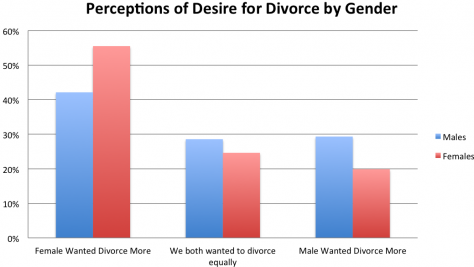
[…]More often than not, children lose contact with their fathers—for two reasons. One, mothers remain the default custodial parent in the average American divorce and thus retain most of the control. Second, it is usually women who consider themselves the aggrieved party, as evidenced by the fact that wives initiate 70 percent of divorces.

The unfortunate result is that some divorced mothers use any opportunity to undermine their children’s relationship with their father or, if not that, dismiss the significance of a father’s role.

[…]And the saddest part is most absent fathers aren’t absent by choice. The “deadbeat dad” exists, but not in spades. In many instances, women are divorcing perfectly good husbands in their search for what they believe will be a better match—which is a natural outgrowth of no-fault divorce. Certainly, women who are married to abusive or dangerous men must file for divorce. But such husbands and fathers cannot account for the 70 percent female-led divorce rate.

Seventy percent of divorces are initiated by women, and most of those are for flimsy reasons like unhappiness. As if marriage is about feeling good, and it’s the other person’s job to make you feel good. And if they don’t make you feel good, then you can nuke the relationship. It can be very difficult for men to make women feel anything. Most men do the normal male roles in marriage: protect, provide, lead on moral and spiritual issues. But it’s becoming very common for women today to not be “happy” with the normal male roles.

Differing attitudes on divorce

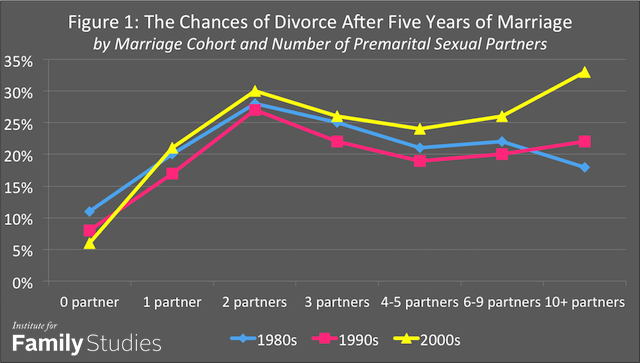
Personally, I think it’s because of the pattern of hedonism that they build up with alcohol and promiscuity in college. The more men that women have sex with before marrying, the higher their likelihood of dissolving their marriage.

Even one non-husband premarital sex partner raises risk of divorce

Previously, I blogged about a Swiss study that showed that children tend to rebel against the religion of their parents if the father is not actively promoting it to them. Studies of prominent atheists find that their fathers are defective in some way – absent, immoral, unfaithful, weak, etc. It’s not use crying about crime later if we as a society have decided to stay silent when women choose men poorly, and choose the timing of sex in relationships poorly. If women chase bad boys and make babies with bad boys, then we should be asking them why. This is a community, and poor decisions about who to make babies with costs us all in the long run.