I stopped reading The Economist when they endorsed the socialist failure Barack Obama, who doubled the national debt to $20 trillion in only 8 years. However, even a stopped clock is right twice a day. And here is one of those times.
Excerpt:
However, there is one big reason to worry about the quality and longevity of people’s intimate bonds. It is that relationships often produce children, and children are profoundly affected by how their parents get on.
You could make enough confetti for a summer of weddings with all the academic papers that show how much children gain from being brought up in stable, loving families, and how much they suffer when those families break down. Culture and customs make little difference. In Japan, four-fifths of single-parent households emerge when couples divorce—a much higher share than in the West, where people usually slip into single parenthood without marrying. Japanese children living with only one parent nonetheless perform significantly worse in school tests, just as children from single-parent families do in Europe and America. In poorer countries, family breakdown can kill. According to one recent estimate, the chance that an African child will die before turning five is about 25-30 per 1,000 for those born into stable families, but 35-40 per 1,000 for the children of single, divorced or widowed parents.
Marriage is not always good for children. They do not benefit when a parent marries somebody who is not their mother or father, and seem to suffer if the parent they live with cycles through several relationships. What they seem to need most is for their biological parents to stick together. And one strong claim that can be made for marriage is that it appears to glue parents together more tightly than any other arrangement.
This part is key, especially for those millennials who think that cohabitating before marrying makes the marriage more secure:
Analysis of one large American data set by Kathryn Edin and Laura Tach, two sociologists, shows that 27% of marriages broke down within nine years of a child being born. By contrast, among couples who were merely cohabiting when a child appeared, 53% separated within nine years—and most of the remaining 47% were married by that point. Among couples who were dating but not living together when the child was born, 81% had split up.
Again, this pattern runs across national and cultural borders. Cohabiting couples behave a bit more like married couples in countries where giving birth outside marriage is very common, such as Estonia and Norway. But they seldom attain the same level of stickiness as married couples, even after controlling for the mother’s level of education.
Cohabitation doesn’t work, because it’s basically saying that I’m going to try the other person and see if I like the other person, and that sex is required to know if I like the other person. It doesn’t really matter that you know the other person really well, because you can always get out of cohabitation just by leaving. Marriage says that I’m going to commit to the other person for life, through thick and thin. Here, both people tend to do a more thorough job of selecting their partner, perhaps even consulting fathers for advice. Why? Because getting out of a marriage is a lot harder to do, and more expensive.
In the past, I’ve blogged about some factors that can make your marriage pretty much divorce proof: things like chastity, not spending too much on the wedding, age of the man and woman at marriage, education levels of each spouse, number of people attending the wedding ceremony, isolation from other divorced people, church attendance, and so on. The truth is that you can engineer a marriage that’s practically divorce proof. But if you insist on spontaneity and following your heart, then you aren’t going to care what studies say works best. A stable marriage takes preparation, and that means making pro-marriage choices all throughout your life before your marriage, instead of doing what feels right to you in the moment. What feels good in the moment is almost never the right choice if your goal is a stable marriage.
Prior to certain scientific discoveries, most people thought that the universe had always been here, and no need to ask who or what may have caused it. But today, that’s all changed. Today, the standard model of the origin of the universe is that all the matter and energy in the universe came into being in an event scientists call “The Big Bang”. At the creation event, space and time themselves began to exist, and there is no material reality that preceded them.
So a couple of quotes to show that.
An initial cosmological singularity… forms a past temporal extremity to the universe. We cannot continue physical reasoning, or even the concept of spacetime, through such an extremity… On this view the big bang represents the creation event; the creation not only of all the matter and energy in the universe, but also of spacetime itself.
Source: P. C. W. Davies, “Spacetime Singularities in Cosmology,” in The Study of Time III, ed. J. T. Fraser (Berlin: Springer Verlag ).
And another quote:
[A]lmost everyone now believes that the universe, and time itself, had a beginning at the big bang.
Source: Stephen Hawking and Roger Penrose, The Nature of Space and Time, The Isaac Newton Institute Series of Lectures (Princeton, N. J.: Princeton University Press, 1996), p. 20.
So, there are several scientific discoveries that led scientists to accept the creation event, and one of the most interesting and famous is the discovery of how elements heavier than hydrogen were formed.
Nucleosynthesis: forming heavier elements by fusion
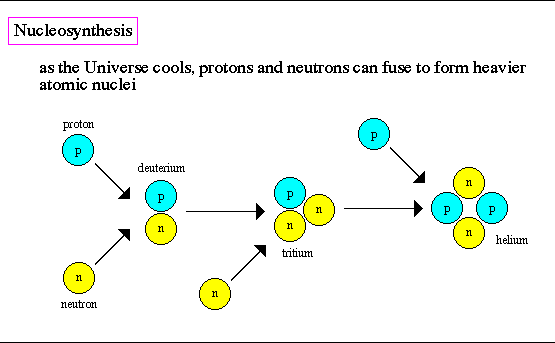
The term nucleosynthesis refers to the formation of heavier elements, atomic nuclei with many protons and neutrons, from the fusion of lighter elements. The Big Bang theory predicts that the early universe was a very hot place. One second after the Big Bang, the temperature of the universe was roughly 10 billion degrees and was filled with a sea of neutrons, protons, electrons, anti-electrons (positrons), photons and neutrinos. As the universe cooled, the neutrons either decayed into protons and electrons or combined with protons to make deuterium (an isotope of hydrogen). During the first three minutes of the universe, most of the deuterium combined to make helium. Trace amounts of lithium were also produced at this time. This process of light element formation in the early universe is called “Big Bang nucleosynthesis” (BBN).
The creation hypothesis predicts that there will be specific amounts of these light elements formed as the universe cools down. Do the predictions match with observations?
Yes they do:
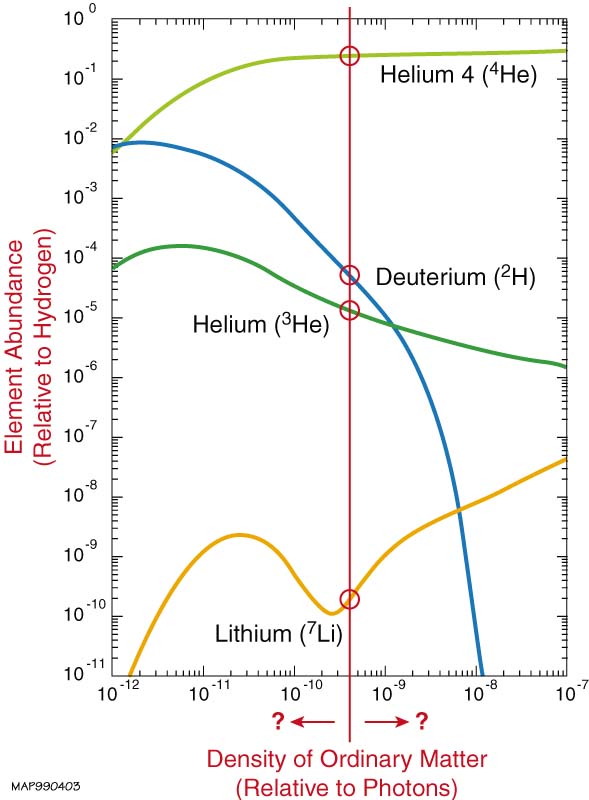
The predicted abundance of deuterium, helium and lithium depends on the density of ordinary matter in the early universe, as shown in the figure at left. These results indicate that the yield of helium is relatively insensitive to the abundance of ordinary matter, above a certain threshold. We generically expect about 24% of the ordinary matter in the universe to be helium produced in the Big Bang. This is in very good agreement with observations and is another major triumph for the Big Bang theory.
Moreover, WMAP satellite measurements of mass density agree with our observations of these light element abundances.
Here are the observations from the WMAP satellite:
Scientific observations match predictions
And here is how those WMAP measurements confirm the Big Bang creation event:
However, the Big Bang model can be tested further. Given a precise measurement of the abundance of ordinary matter, the predicted abundances of the other light elements becomes highly constrained. The WMAP satellite is able to directly measure the ordinary matter density and finds a value of 4.6% (±0.2%), indicated by the vertical red line in the graph. This leads to predicted abundances shown by the circles in the graph, which are in good agreement with observed abundances. This is an important and detailed test of nucleosynthesis and is further evidence in support of the Big Bang theory.
“An important and detailed test”.
For completeness, we should learn how elements heavier than these light elements are formed:
Elements heavier than lithium are all synthesized in stars. During the late stages of stellar evolution, massive stars burn helium to carbon, oxygen, silicon, sulfur, and iron. Elements heavier than iron are produced in two ways: in the outer envelopes of super-giant stars and in the explosion of a supernovae. All carbon-based life on Earth is literally composed of stardust.
That’s a wonderful thing to tell a young lady when you are on a date: “your body is made of stardust”. In fact, as I have argued before, this star formation, which creates the elements necessary for intelligent life, can only be built if the fundamental constants and quantities in the universe are finely-tuned.
Now, you would think that atheists would be happy to find observations that confirm the origin of the universe out of nothing, but they are not. Actually, they are in denial.
Here’s a statement from the Secular Humanist Manifesto, which explains what atheists believe about the universe:
Religious humanists regard the universe as self-existing and not created.
For a couple of examples of how atheistic scientists respond to the evidence for a cosmic beginning, you can check out this post, where we get responses from cosmologist Lawrence Krauss, and physical chemist Peter Atkins.
You cannot have the creation of the universe be true AND a self-existing, eternal universe ALSO be true. Someone has to be wrong. Either the science is wrong, or the atheist manifesto is wrong. I know where I stand.
First, the creed – which is found in 1 Corinthians 15:3-8:
3For what I received I passed on to you as of first importance: that Christ died for our sins according to the Scriptures,
4that he was buried, that he was raised on the third day according to the Scriptures,
5and that he appeared to Peter, and then to the Twelve.
6After that, he appeared to more than five hundred of the brothers at the same time, most of whom are still living, though some have fallen asleep.
7Then he appeared to James, then to all the apostles,
8and last of all he appeared to me also, as to one abnormally born.
Almost all historians accept this creed as dating back to within 5 years of the death of Jesus. But why?
Here’s a great article from Eric Chabot, director of Ratio Christi Apologetics Alliance, The Ohio State University to explain why.
Excerpt:
The late Orthodox Jewish scholar Pinchas Lapide was so impressed by the creed of 1 Cor. 15, that he concluded that this “formula of faith may be considered as a statement of eyewitnesses.” (5)
Paul’s usage of the rabbinic terminology “passed on” and “received” is seen in the creed of 1 Cor. 15:3-8:
“For what I received I passed on to you as of first importance: that Christ died for our sins according to the Scriptures, that he was buried, that he was raised on the third day according to the Scriptures, and that he appeared to Peter, and then to the Twelve. After that, he appeared to more than five hundred of the brothers at the same time, most of whom are still living, though some have fallen asleep. Then he appeared to James, then to all the apostles, and last of all he appeared to me also, as to one abnormally born.”
[…]While the word “received” (a rabbinical term) can also be used in the New Testament of receiving a message or body of instruction or doctrine (1 Cor.11:23; 15:1, 3; Gal. 1:9, 12 [2x], Col 2:6; 1 Thess 2:13; 4:1; 2 Thess 3:6), it also means means “to receive from another.” This entails that Paul received this information from someone else at an even earlier date. 1 Corinthians is dated 50-55 A.D. Since Jesus was crucified in 30-33 A.D. the letter is only 20-25 years after the death of Jesus. But the actual creed here in 1 Cor. 15 was received by Paul much earlier than 55 A.D.
[…]Even the co-founder Jesus Seminar member John Dominic Crossan, writes:
“Paul wrote to the Corinthians from Ephesus in the early 50s C.E. But he says in 1 Corinthians 15:3 that “I handed on to you as of first importance which I in turn received.” The most likely source and time for his reception of that tradition would have been Jerusalem in the early 30s when, according to Galatians 1:18, he “went up to Jerusalem to visit Cephas [Peter] and stayed with him fifteen days” (11).
This comment by Crossan makes sense because within the creed Paul calls Peter by his Aramic name, Cephas. Hence, if this tradition originated in the Aramaic language, the two locations that people spoke Aramaic were Galilee and Judea. (12) The Greek term “historeo” is translated as “to visit” or “to interview.” (13) Hence, Paul’s purpose of the trip was probably designed to affirm the resurrection story with Peter who had been an actual eyewitness to the resurrected Christ (1 Cor. 15:5).
I know what you’re thinking. You’re thinking “Hey WK, isn’t John Dominic Crossan that wacky liberal atheist who is on the far-left fringe of historical Jesus scholarship? So wacky, that he actually thought that Secret Gospel of Mark was real, instead of just being a hoax?” Yes, that’s the nutty John Dominic Crossan I mean. The very one.
Here’s a bit more about this early creed from Gary Habermas.
Quote:
Paul is clear that this material was not his own but that he had passed on to others what he had received earlier, as the center of his message (15:3). There are many textual indications that the material pre-dates Paul. Most directly, the apostle employs paredoka and parelabon, the equivalent Greek terms for delivering and receiving rabbinic tradition (cf. 1 Cor. 11:23). Indirect indications of a traditional text(s) include the sentence structure and verbal parallelism, diction, and the triple sequence of kai hoti Further, several non-Pauline words, the proper names of Cephas (cf. Lk. 24:34) and James, and the possibility of an Aramaic original are all significant. Fuller attests to the unanimity of scholarship here: “It is almost universally agreed today that Paul is here citing tradition.”[4] Critical scholars agree that Paul received the material well before this book was written.[5]
The most popular view is that Paul received this material during his trip to Jerusalem just three years after his conversion, to visit Peter and James, the brother of Jesus (Gal. 1:18-19), both of whose names appear in the appearance list (1 Cor. 15:5; 7). An important hint here is Paul’s use of the verb historesai (1:18), a term that indicates the investigation of a topic.[6] The immediate context both before and after reveals this subject matter: Paul was inquiring concerning the nature of the Gospel proclamation (Gal. 1:11-2:10), of which Jesus’ resurrection was the center (1 Cor. 15:3-4, 14, 17; Gal. 1:11, 16).
Critical scholars generally agree that this pre-Pauline creed(s) may be the earliest in the New Testament. Ulrich Wilckens asserts that it “indubitably goes back to the oldest phase of all in the history of primitive Christianity.”[7] Joachim Jeremias agrees that it is, “the earliest tradition of all.”[8] Perhaps a bit too optimistically, Walter Kasper even thinks that it was possibly even “in use by the end of 30 AD . . . .”[9]
Indicating the wide approval on this subject, even more skeptical scholars frequently agree. Gerd Ludemann maintains that “the elements in the tradition are to be dated to the first two years after the crucifixion of Jesus. . . . not later than three years. . . . the formation of the appearance traditions mentioned in I Cor.15.3-8 falls into the time between 30 and 33 CE. . . .”[10] Similarly, Michael Goulder thinks that it “goes back at least to what Paul was taught when he was converted, a couple of years after the crucifixion.”[11] Thomas Sheehan agrees that this tradition “probably goes back to at least 32-34 C.E., that is, to within two to four years of the crucifixion.”[12] Others clearly consent.[13]
Overall, my recent overview of critical sources mentioned above indicates that those who provide a date generally opt for Paul’s reception of this report relatively soon after Jesus’ death, by the early to mid-30s A.D.[14] This provides an additional source that appears just a half step removed from eyewitness testimony.
(3) Paul was so careful to assure the content of his Gospel message, that he made a second trip to Jerusalem (Gal. 2:1-10) specifically to be absolutely sure that he had not been mistaken (2:2). The first time he met with Peter and James (Gal. 1:18-20). On this occasion, the same two men were there, plus the apostle John (2:9). Paul was clearly doing his research by seeking out the chief apostles. As Martin Hengel notes, “Evidently the tradition of I Cor. 15.3 had been subjected to many tests” by Paul.[15]
These four apostles were the chief authorities in the early church, and each is represented in the list of those who had seen the resurrected Jesus (1 Cor. 15:5-7). So their confirmation of Paul’s Gospel preaching (Gal. 2:9), especially given the apostolic concern to insure doctrinal truth in the early church, is certainly significant. On Paul’s word, we are again just a short distance from a firsthand report.
(4) Not only do we have Paul’s account that the other major apostles confirmed his Gospel message, but he provides the reverse testimony, too. After listing Jesus’ resurrection appearances, Paul tells us he also knew what the other apostles were preaching regarding Jesus’ appearances, and it was the same as his own teaching on this subject (1 Cor. 15:11). As one, they proclaimed that Jesus was raised from the dead (15:12, 15). So Paul narrates both the more indirect confirmation of his Gospel message by the apostolic leaders, plus his firsthand, direct approval of their resurrection message.
That’s how solid this early creed is – even atheists like Crossan and Ludemann accept it as historically reliable. It’s historical bedrock, as Michael Licona likes to say. This is the stuff that everyone accepts – across the ideological spectrum. How do you account for this evidence in your worldview, especially given that Paul never recanted his preaching about Jesus?