
How to avoid being the victim of toxic masculinity

Telling a woman how to make wise decisions protects her

I see that Gillette has come out with a male-bashing ad that blames all men for the sins of a few very bad men. I thought it might be a good idea for me to write something to women to help them to avoid being the victim of toxic masculinity. My post will have two parts: 1) choosing good men and 2) policies that produce good men.

Preparing to evaluate a man

If you don’t want toxic masculinity, then you have to choose a man who is not toxic. Men must be evaluated, and the toxic ones must be rejected – even if they are attractive and produce feelings of desire and excitement. How do you learn how to evaluate men? Well, you have to know how to talk to them about the things that are relevant to their roles as husbands and fathers. It’s not enough to ask a man “how did your day go?” Shallow questions don’t protect you from toxic masculinity. You need to ask questions that actually surface the true character of the man, and whether he has done anything verifiable to prepare himself to lead a family. The only way to evaluate HIM is to have prepared YOURSELF in advance. You prepare yourself by reading serious papers and books about men and marriage and parenting. Only then will you be able to judge how much he knows, and how good he is at doing what a man does in a committed relationship. It’s just like a job interview.

For example, men should be pro-life, because they should care about protecting the weak from the strong. If you – as a woman – do not understand how to make a case for the right to life of unborn children YOURSELF, then how will you be able to evaluate men to determine whether THEY take seriously the obligation to protect the weak from the strong?  If you don’t know anything about pro-life legislation and Supreme Court cases, then how will you evaluate a man’s knowledge of those areas? You have to do YOUR homework first, so that you are able to evaluate the character of a man.

Which policies create men who are toxic?

Fatherlessness creates toxic masculinity.

If a man is growing up without a father, then he will never see a man treating a woman well, even after she has lost her youth and beauty. The first thing that children notice about their fathers is that he lives at home. But they also know that he gets up early each day to go to work for the family. And they know that if there is anything scary, like a spider or a noise, then father is the one who protects the mother. Father is the one who teaches a child that authority (and punishment) is not done out of anger, but out of love. Father is the one who sets moral boundaries, lives out moral rules, and reads the Bible to the children. Fathers demonstrate how to control superior strength, because can never act towards his wife in a way that could destroy the marriage.

Boys learn the complexity of women by watching their fathers interact with their mothers. Growing up with a father and a mother is the complete opposite of pornography. In porn, boys see only the woman’s outward appearance with no context of a commitment, and no long-term plan where husband and wife are partners. Porn reduces her to an object designed only to please his needs. Marriage shows cooperation between man and woman in order to make the relationship stable and productive. Boys in father-present homes have a much broader and deeper database of interactions to draw on when dealing with women. In particular, boys learn what skills and abilities a man demonstrates to a woman in order to signal to her that he is interested in marrying her.

So, if you oppose toxic masculinity, then you have to be against fatherlessness. You have to be for marriage as the best place for children to grow up. And to be for marriage, is to be against every policy that threatens marriage. You must be against no-fault divorce. Against single-mother welfare. Against the Sexual Revolution. Against recreational premarital sex. Against delaying marriage for fun and careers. And against feminism – which teaches women that evaluating a man for traditional marriage roles is “sexist”.

People on the secular left complain the most about toxic masculinity but they are the ones doing the most to promote policies that create it. Secular leftists can’t tear down the theism that rationally grounds morality, and then complain when institutions like marriage – which are built on objective moral values and duties – are destroyed. It doesn’t matter if a secular leftist wishes for toxic masculinity to disappear. If they say nothing about women choosing hot bad boys for relationships, then they are in favor of toxic masculinity. If they say nothing about the destruction of marriage and fatherless children, then they are in favor of toxic masculinity. You can’t kill the engine that produces good men, and then complain that the bad men who are left don’t treat you well.

Conclusion

To review: to avoid toxic masculinity, you should 1) prepare yourself (by studying) so you can evaluate men for their ability to perform distinct male marriage roles, and 2) promote policies in which boys are raised in homes with a father loving their mother in a lifelong commitment. If you deny either of these things, then you’re not opposed to toxic masculinity at all. You might say you don’t like it, but you’re not doing anything to avoid choosing it, and you’re not doing anything to produce young men who avoid it.

I think that women today are complaining about “toxic masculinity” precisely because they feel entitled to choose men based on outward appearance, give them recreational premarital sex, and then expect that those men will treat them with respect and care. It doesn’t work that way. Hot bad boys don’t respond to recreational premarital sex by transforming themselves into faithful husbands with impeccable moral character. If you want good character, then evaluate men to find it and then choose it. Period.

Cosmologist Luke Barnes answers 11 objections to the fine-tuning argument

Christianity and the progress of science

This is from the blog Common Sense Atheism.

Atheist Luke Muehlhauser interviews well-respect cosmologist Luke Barnes about the fine-tuning argument, and the naturalistic response to it.

Luke M. did a good job explaining the outline of the podcast.

Details:

In one of my funniest and most useful episodes yet, I interview astronomer Luke Barnes about the plausibility of 11 responses to the fine-tuning of the universe. Frankly, once you listen to this episode you will be better equipped to discuss fine-tuning than 90% of the people who discuss it on the internet. This episode will help clarify the thinking of anyone – including and perhaps especially professional philosophers – about the fine-tuning of the universe.

The 11 responses to fine-tuning we discuss are:

  1. “It’s just a coincidence.”
  2. “We’ve only observed one universe, and it’s got life. So as far as we know, the probability that a universe will support life is one out of one!”
  3. “However the universe was configured, evolution would have eventually found a way.”
  4. “There could be other forms of life.”
  5. “It’s impossible for life to observe a universe not fine-tuned for life.”
  6. “Maybe there are deeper laws; the universe must be this way, even though it looks like it could be other ways.”
  7. “Maybe there are bajillions of universes, and we happen to be in one of the few that supports life.”
  8. “Maybe a physics student in another universe created our universe in an attempt to design a universe that would evolve intelligent life.”
  9. “This universe with intelligent life is just as unlikely as any other universe, so what’s the big deal?”
  10. “The universe doesn’t look like it was designed for life, but rather for empty space or maybe black holes.”
  11. “Fine-tuning shows there must be an intelligent designer beyond physical reality that tuned the universe so it would produce intelligent life.”

Download CPBD episode 040 with Luke Barnes. Total time is 1:16:31.

There is a very good explanation of some of the cases of fine-tuning that I talk about most on this blog – the force of gravity, the strong force, etc. as well as many other examples. Dr. Barnes is an expert, but he is also very very easy to listen to even when talking about difficult issues. Luke M. is very likeable as the interviewer.

New survey of 20 studies about breast cancer – abortion link

I’ve blogged about a half-dozen studies from different countries on the link between abortion and breast cancer. It’s always interesting to keep up with the research, so we know what to tell young people about the likely consequences of their choices with sex and abortion. The survey was reported by Life News.

Excerpt:

In 2018, the Breast Cancer Prevention Institute funded and published “Induced Abortion as an Independent Risk Factor for Breast Cancer: A Systematic Review and Meta-analysis of Studies on South Asian Women” in Issues in Law and Medicine. (A meta-analysis looks at separate but similar studies in order to use the pooled data for statistical significance. It is regarded by scientists as very strong evidence.)

Of the 20 studies analyzed, 16 were done on Indian women. The meta-analysis found a 151% increased risk of breast cancer after an induced abortion.

In 2014, “Breast Cancer and Induced Abortion,” an analysis also published in Issues in Law and Medicine, revealed that the incidence of breast cancers increased 10-14 years after an abortion. This analysis was consistent with the known biology of breast cancer. There was no statistically significant increase in breast cancer risk before 10 years and after 14 years of an abortion.

Induced abortion in India, referred to as “Medical Termination of Pregnancy,” was legalized in 1971. Sons are most highly prized and sex selection abortions, although illegal, are not uncommon.

A study published in the Lancet 2006 and based on conservative assumptions, reported that the practice of sex-selection accounts for about a half million missing female births yearly. Over the past two decades this translates into the abortion of some 10 million female fetuses.

Abortion is especially a problem for Indian women, because – as in China – India is very pro-abortion. Both India and China have a very pro-abortion culture, and sex-selection abortion is seen as normal.

Here are a couple of studies that focused on China and Chinese women who choose abortion.

Study 1: (September 2010)

Based on the expression of estrogen receptor (ER), progesterone receptor (PR) and HER2/neu (HER2), breast cancer is classified into several subtypes: luminal A (ER+ and/or PR+, HER2-), luminal B (ER+ and/or PR+, HER2+), HER2-overexpressing (ER-, PR-, and HER2+) and triple-negative (ER-, PR-, and HER2-). The aim of this case-control study is to determine reproductive factors associated with breast cancer subtypes in Chinese women. A total of 1,417 patients diagnosed with breast cancer in the First Affiliated Hospital, China Medical University, Shenyang, China between 2001 and 2009 and 1,587 matched controls without a prior breast cancer were enrolled.

[…]Postmenopause and spontaneous abortion were inversely associated with the risk of luminal tumors. By contrast, multiparity, family history of breast cancer and induced abortion increased the risk of breast cancer.

Study 2: (March 2010)

OBJECTIVE: To explore the risk factors of breast cancer for better control and prevention of the malignancy.

METHODS: The clinical data of 232 patients with pathologically established breast cancer were investigated in this 1:1 case-control study to identify the risk factors of breast cancer.

RESULTS: The history of benign breast diseases, family history of carcinoma andmultiple abortions were the statistically significant risk factors of breast cancer, while breast feeding was the protective factor.

CONCLUSION: A history of benign breast diseases, family history of carcinoma and multiple abortions are all risk factors of breast cancer.

Those are both about abortion and breast cancer in China.

And more recently, I blogged about a very recent study from China which concluded thus:

IA is significantly associated with an increased risk of breast cancer among Chinese females, and the risk of breast cancer increases as the number of IA increases. If IA were to be confirmed as a risk factor for breast cancer, high rates of IA in China may contribute to increasing breast cancer rates.

The effect seems to be most observable for women who have induced abortions before ever completing a pregnancy.

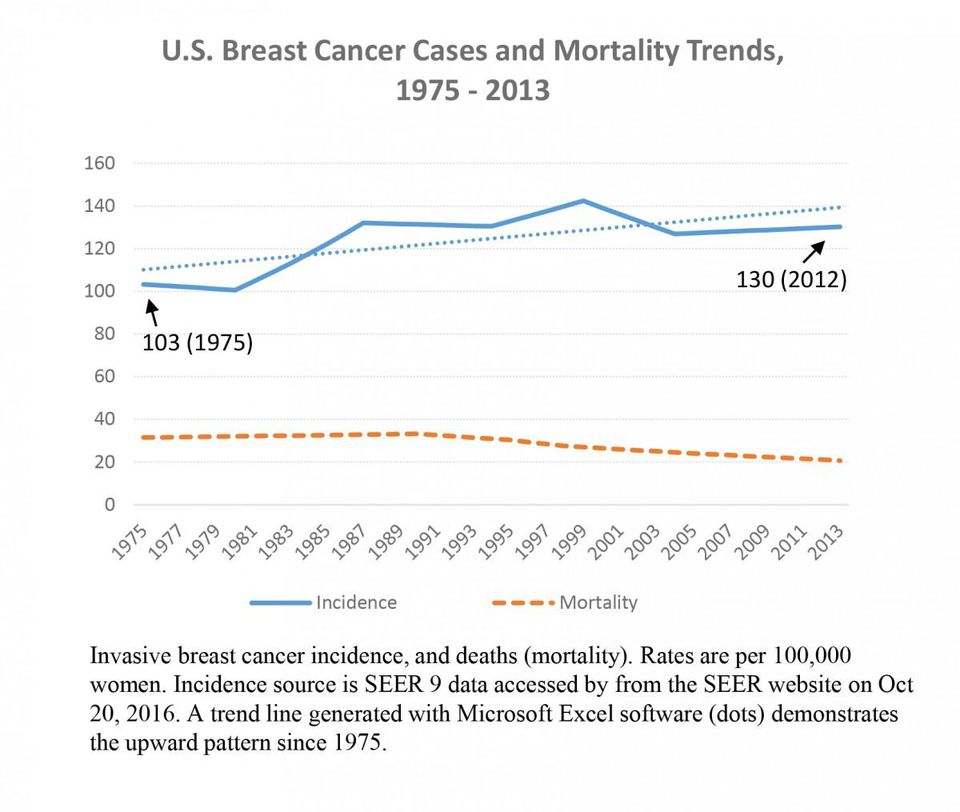
Even though the United States has massively focused on breast cancer screening and treatment, (in contrast to other cancers, such as prostate cancer), the rate of breast cancer has not declined:

Despite much attention and funding, breast cancer rates rising
Breast cancer rates have been rising since abortion was legalized

(Source)

We have so much attention on breast cancer in the West. Many charities raising money for it. Policy changes to promote early testing. Taxpayer money being spent to stop it. And yet the rate has not gone down. It started going up right around the time abortion became legal.

Stopping abortion

So, what about legislative solutions to this problem? I noticed that the new Senator from Tennessee Marsha Blackburn has already introduced a new piece of legislation designed to stop taxpayer-funding of abortion.

Newly elected Sen. Marsha Blackburn announced Thursday that she has introduced her first bill in the Senate, one that would end federal funding to all abortion providers, including Planned Parenthood.

“Tennesseans and the American people do not want their tax dollars funding abortions,” Blackburn, R-Tenn., said in a statement posted on her Twitter page Friday.

Blackburn, 66, was elected to the Senate on Nov. 6, beating Democrat Phil Bredesen, a former governor. She had previously represented Tennessee in the U.S. House since 2003, and before that, served in the state Senate.

Republicans have introduced similar bills in the House and Senate, but they usually get defeated by Democrats, who are in favor of taxpayer-funding for abortion through all nine months of pregnancy.