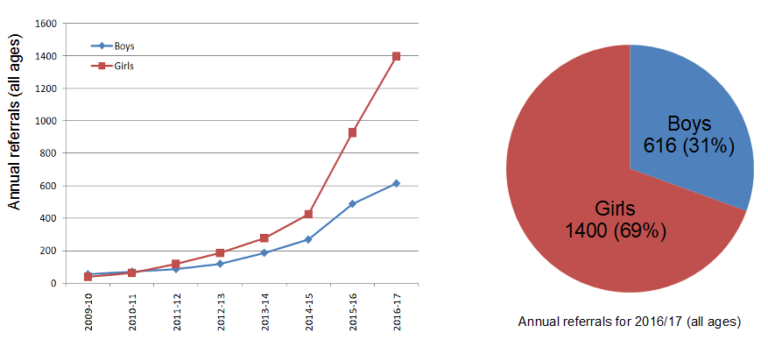
Controversial study on Rapid Onset Gender Dysphoria and transgenderism re-published

What's the best explanation of this data? Genetics or cultural pressure?
What’s the best explanation of this transgenderism data? Genetics or cultural pressure?

I blogged before about a study out of Brown University, which concluded that transgender behavior in children developed rapidly as a result of factors like peer pressures, social media, mental disorders, trauma, etc. I.e. – it’s not genetic. Brown University retracted it because some people complained. Well, it’s now been republished. Let’s see if there were any mistakes found.

Here’s how the study was first reported by Science Daily:

This month, a Brown University researcher published the first study to empirically describe teens and young adults who did not have symptoms of gender dysphoria during childhood but who were observed by their parents to rapidly develop gender dysphoria symptoms over days, weeks or months during or after puberty.

[…]The study was published on Aug. 16 in PLOS ONE.

Peer pressure / The Internet:

The pattern of clusters of teens in friend groups becoming transgender-identified, the group dynamics of these friend groups and the types of advice viewed online led her to the hypothesis that friends and online sources could spread certain beliefs.

[….]”Of the parents who provided information about their child’s friendship group, about a third responded that more than half of the kids in the friendship group became transgender-identified,” Littman said. “A group with 50 percent of its members becoming transgender-identified represents a rate that is more 70 times the expected prevalence for young adults.”

Mental disorders / traumatic events:

Additionally, 62 percent of parents reported their teen or young adult had one or more diagnoses of a psychiatric disorder or neurodevelopmental disability before the onset of gender dysphoria. Forty-eight percent reported that their child had experienced a traumatic or stressful event prior to the onset of their gender dysphoria, including being bullied, sexually assaulted or having their parents get divorced.

This article at The Federalist had a few examples to illustrate the conclusion of the study. I’ll pick two.

The study includes other eye-opening information, such as case studies of several children’s stories.

  • “A 14-year-old natal female and three of her natal female friends were taking group lessons together with a very popular coach. The coach came out as transgender, and, within one year, all four students announced they were also transgender.”

  • “A 14-year-old natal female and three of her natal female friends are part of a larger friend group that spends much of their time talking about gender and sexuality. The three natal female friends all announced they were trans boys and chose similar masculine names. After spending time with these three friends, the 14-year-old natal female announced that she was also a trans boy.”

I thought this quote from that article was interesting as well, given the culture’s obsession with “bullying”, which is a nebulous term that can mean actual bullying, or mere disagreement.

The study also may indicate that school “anti-bullying” programs typically created by LGBT activist organizations such as the Human Rights Campaign may help accelerate children identifying as transgender by pushing peers and authority figures to profusely express their support.

Coming out as transgender means instant fame and popularity, because you’re a victim, and everyone has to be nice to you… or else:

“Great increase in popularity among the student body at large. Being trans is a gold star in the eyes of other teens,” wrote one parent on the study response form. Another wrote, “not so much ‘popularity’ increasing as ‘status’ … also she became untouchable in terms of bullying in school as teachers who ignored homophobic bullying …are now all at pains to be hot on the heels of any trans bullying.”

Well, we’ve had a delay of 6 months for Littman to answer her critics and submit her work to even more extensive peer-review. And now the study has been re-published in PLOS One. So were there any mistakes in it? Does it still reach the same conclusions?

The College Fix reports:

Here’s what actually changed, according to PLOS One:

Other than the addition of a few missing values in Table 13, the Results section is unchanged in the updated version of the article.

So, the results didn’t change, and that means that the conclusions stand. So what was the problem originally? The problem originally was that the research didn’t confirm the biased politically correct views of the secular leftists.

She lost her consulting job anyway

However, that’s not the whole story. I looked up her interview from this week on Quillette, and she got to tell her side of the story.

Two parts stood out to me.

This part, where she contrasted the favoral response of research scientists and clinical scientists with the angry outbursts of a social worker:

The third presentation was the smallest and least research-oriented audience of the three. In contrast to the other presentations, the vast majority of the comments were made by one person who I later learned was a social worker. Again, I tried to answer politely with comments such as “Actually, the scientific literature says the following…”; “Actually, social media can be both a positive and a negative influence, not just positive…”; “Actually, this method of data collection has been used in many studies…” But because her interruptions were so frequent and argumentative in nature, it quickly created a tense and adversarial tone in the room.

This part, where she explains the mob that contacted her employers and got her fired:

The worst outcome for me personally was losing my consulting job over this issue. Shortly after my paper came out, some local clinicians who are opposed to my research wrote a letter of complaint about the work and demanded that I be fired immediately. It was an interesting demand, as my consulting work was unrelated to gender dysphoria. Nonetheless, I was called in to several meetings to answer questions about my research… After the meetings, the leadership explained to me that their decision not to renew my contract was not related to the quality of my work but rather that they, as an agency, needed to remain neutral and not take sides regarding the issues raised in the letter.

Do you know what this whole episode reminded me of? It reminded me of the stories of scientists who publish work critical of Darwinian evolution, and work critical of the man-made catastophic global warming hypothesis. It seems as if the viewpoints of secular leftists are decide by emotions, and then defended with rage, coercion and harassment. What does it say about secular leftism that they respond to scientific progress with rage and censorship?

A woman asked me whether Hell and God’s harshness caused me to doubt Christianity

A long journey through the night

I was having a chat on Friday with a brilliant agnostic young lady who knew as much about Christian apologetics as I did. It was very strange because she was only in her mid-20s, but she was talking about the Cambrian explosion, the resurrection scholarship of Dale Allison and Bart Ehrman, and so on. She had seen a lot of debates, and even knew about intelligent design. Anyway, she asked me two questions that I wanted to write about. The first was whether I thought that Hell was unfair, especially because it’s determined by having correct beliefs, and the second was whether I thought that God was kind or harsh.

Regarding, I do hold to a traditional view of Hell being eternal separation from God. I don’t think that God will be actively torturing people in Hell. I’m not sure if the flames are literal or figurative. But I do know that the severity of the punishment will be proportional to the amount of sinning, in the same way that the rewards in Heaven will be proportional to good actions here on Earth. The duration is the same, but the rewards and punishments fit our actions.

I don’t have a problem with Hell because I’ve spent most of my life trying to talk to people about spiritual things. Although this young lady was very open-minded and honest and spiritual, more than most people in the church, even, I don’t think that this is normal for non-Christians. Growing up around Muslims and Hindus, and having spoken to Jews, I know that there just isn’t much curiosity about God and Jesus in these other religions. Believe me, I’ve tried to discuss spiritual things with people of all different religions, and the idea that religious beliefs should be bounded by logic and evidence is almost nowhere to be found. It’s not even to be found among most Christians, but at least we have scholars who you can find if you dig hard enough.

So, when people ask me about Hell, the first thing that comes into my mind is my experiences trying to get non-Christians to line up their beliefs about God and Jesus with logic and evidence. Although it may seem harsh to shut the door on people who don’t want to put in the work, it doesn’t seem harsh to me. I’ve had it with people who make everything except an investigation into God’s existence a priority. I have no patience for people who think they are very intelligent in their thoughts about God, but then when they get into a discussion, it is obvious they haven’t put in any effort.

Do you know what they do put a lot of effort into, though? Entertainment, fun and thrills. I can’t tell you how many times I’ve tried to give books or debates to culturally Jewish atheists and Muslim-raised atheists and Hindus (because of family and community) in my previous jobs, and got no interest in truth whatsoever. They were too busy watching the Comedy Channel Democrats, and trying to get their kids into Ivy league schools, etc. to care about God or Jesus. And God is not going to force them into eternal life with him, they don’t want it, and they’re not going to get it. It’s important to note that to not prioritize God is a choice. We in the West all have leisure time, and to be ignorant about God after 40 years of leisure time when you have put the time in elsewhere is unacceptable. God expects us to be curious about him and to do our due diligence in investigating him using as much intellect and effort as we put into our educations, careers, marriages, etc.

Regarding her other question about whether I think God is kind or harsh, I just decided to tell her that I didn’t think that God was the kind of God who had to be nice to me so that I would like him. I explained to her that I had wanted marriage from an early age, and had prepared very hard for it, but that it had never happened. I’m not sure that God is able to cause women to freely desire the things I did to prepare for marriage, like chastity, STEM degrees, gap-less resume and savings. I’m not the smartest person in the world, and I did not have family or friends helping me to get ahead most of the time. It was very hard to get ready for marriage. But I realized very late in life that young, unmarried women tend to be interested in a man’s appearance and in having fun – not marriage-ready preparation. They do not want a man who is serious about marriage and children until their mid-30s, which is far too old for my marriage plan to work. So, there’s no point in me marrying now. So does this lack of marriage make me think that God is unkind? Not at all.

I do think that God has been kind to me with respect to health, education, career and finances. Also, I can understand from the Bible (2 Tim 2:3-4) why God might need an unmarried soldier to work for him. And this doesn’t bother me, because I’ve read the Bible, and I didn’t get the impression from it that God was my cosmic butler. Although many Western Christians think that God’s sole purpose is to make them happy, there is no way to actually get that meaning out of the text. God’s own Son has to suffer in order to love his Father self-sacrificially. So it’s clear that God is not “kind” to those who love him in the sense that most people would like him to be. In fact, I would believe in God and serve him, even if he were “harsher” with me than he is now.

So, why would I want to be a Christian, rather than just accept the scientific arguments for theism, and then just say that the New Testament is just not good enough historical evidence to warrant moving from theism to Christianity? Well, I did explain to her the minimal facts argument, and the historical criteria used to obtain them. And I also said that we all need to have some sort of historical explanation for the early belief in Jesus being God stepping into history, and for his rising from the dead.

But I think the real reason why I am a Christian, beyond the evidence, is just this daily experience of dealing with the lack of curiosity about God and Jesus (and sometimes outright self-delusion) that I see in so many people. I see it in uneducated people, unintelligent people, educated people, intelligent people. The willful ignorance about facts that matter, like the origin of the universe, the fine-tuning, the origin of life, the Cambrian explosion, etc. It’s not even opposition to Christian specifics, it’s opposition to plain, well-supported scientific facts. I’ve just seen this in action so much with atheists and people of other religions that I have lost all sympathy for non-Christians with respect to what God decides to do with them.

It’s not that I am concerned by their immorality, or their hedonism, primarily. It’s that I am concerned with their lack of interest in puzzling out the big questions of life in a truth-centered way. The only people I really feel comfortable with are Christians who have been serious about proportioning belief to evidence, denying themselves fun and thrills if they have to, and putting their money and time into learning how to defend God’s honor when it’s called into question. A task that simply gets you nothing good from anyone in this world. I find it amazing that there are any of us, but that’s where I want to be – in a room with people like that who put God’s goals above their own desires and needs.

All of my close male friends are either virgins or married as virgins, and they’re all into apologetics. If you understood what it means to be in a room with people who have carefully chosen to live their lives in a quiet, humble way that’s respectful to God and self-sacrificial, then you would understand why there is no substitute for Christianity. In my case, I simply do not want God to lump me in with the people I talk to who have no curiosity about truth in religion. I am not going to be like them, grabbing for happiness, while deliberately shutting their eyes to anything that might cause them to have to take God seriously in a self-sacrificial, two-way relationship. I have more sympathy for God and his reputation and honor than I do for the majority of people who I have seen deliberately keeping him at arm’s length. They want the blessings he provides, but while avoiding the demands of a relationship with him. I’m just not going to be one of them, and I don’t care what people think.

Why are so many educated, successful women struggling to find a husband?

Do young women understand how to get to a stable marriage?

The New York Times says that more and more women are having to freeze their eggs because they can’t find good men to marry. The NYT doesn’t think that women are doing anything wrong. They blame the men for refusing to commit. According to feminism, women who value careers, abortion rights, no-fault divorce, big government, high taxes, etc. are doing everything right. But does it work?

I thought it might be a good idea to help Western women to make better decisions with men and marriage. Although setting out boundaries seems harsh and restrictive, it’s actually protective and loving. If we want women to get to a stable marriage and children, (what they really need long term, after they lose their looks and youth), then we should be bold about leading them.

The first thing to point out is that the women celebrated by the New  York Times are intentionally delaying marriage for their education and careers.

Another New York Times article explains:

It could be that the new generation of millennial women is delaying having children even longer than the women who came before them, as prime childbearing years are also critical years for advancing in a career. A recent study shows that the marital pay gap that springs up after a first child is born typically does not close if the birth happens between age 25 and 35.

Shannon Hettinger, a 32-year-old from Washington, D.C., said she definitely wanted children. She grew up in a large family in a small town in Pennsylvania and almost all her high school friends are married with children. But she moved to Washington, and spent her 20s deciding on a career. Now that she has one she loves — she works in residential real estate sales — she is not going to stop until she gets established. That means not having children for a while.

“I just want to build my book of business and see where I can go from here,” she said. “My whole focus is career growth. That’s my No. 1 priority.”

“Once I achieve a certain level of success,” she added, “then I’ll start thinking about a family.”

Ivy Gray-Klein, 26, who lives in Philadelphia and works at the University of Pennsylvania School of Design, said she was open to having children but cannot imagine doing so until she is 30 or 35. She wants to feel settled in her own life first. Now she has three roommates, is paying down her student loans and is working to build a little bit of savings.

“I’m just really trying to get myself to a place that is solid,” she said by phone. “Having a child right now would be so destabilizing. Children just seem like such an enormous financial undertaking.”

The thing about women wanting to pursue their careers in their 20s is that this is the time when they have the most attractiveness to a man as a wife and mother. The woman’s 20s are the perfect time for her to be searching through the men in her life, looking for the ones who are serious about marriage, while rejecting the ones who just want sex before marriage, cohabitation, and other irresponsible “fun”. Most women who are focusing on their careers will still be in relationships during their 20s, but since they can’t afford to be “encumbered” by marriage, they’ll be spending time with guys who don’t want to commit. This is NOT a good way for a woman to prepare her character for marriage. Flings and break-ups with bad boys do not cause a woman to be trusting with a good man later on.

However, are women ever really attracted to good men? Suppose a woman chased bad boys in her 20s, while focusing on her career, then got serious at 30 and started looking for marriage-read men. Would she really be attracted to those marriage-ready men, after all that time spent choosing the bad boys who would not commit?I think many marriage-ready men know that most women who are 30 or over have kept busy in relationships with bad boys. And they don’t want to be married to a woman who finds them unattractive. So the real problem with men not marrying women who are over 30 is the that many women are not trained to be attracted to good men in their 20s.

Here’s an LA Times editorial about women and domestic terrorist Dzhokar Tsarnaev, one of the Boston marathon bombers.

Excerpt:

Mostly, though, they think Dzhokhar is cute. The Bambi eyes (looking right out of his Instagram-doctored photos at you!), the hipster facial stubble, the masses of wine-dark tousled hair — adorable! Impassioned believers have written “Dzhokhar is innocent” on their hands and plastered “Innocent until proven guilty!!!!” posters around their towns. An 18-year-old waitress interviewed by the New York Post vowed to have Dzhokhar’s last tweet before the bombing tattooed onto her arm: “If you have the knowledge and the inspiration all that’s left is to take action.”

[…]But the real cause of the Jahar craze more likely lies in something more primal and less pretty in the female psyche. I’m betting that women, young and old, are drawn to Dzhokhar not because he is a good-looking late adolescent but because he is a good-looking accused killer. He’s a classic “bad boy” of the sort to whom women are chronically attracted because they want to reform them, or minister to their wounds, or be the healing presence they’ve never had — but mostly because they find them sexy.

That article also noted:

It’s not surprising, then, that every homicide perp on death row who is reasonably attractive has groupies. Consider the handsome (and widely philandering) Scott Peterson, sentenced in 2005 for killing his wife and unborn son and throwing their remains into San Francisco Bay. The day he checked into San Quentin, he received three dozen phone calls from smitten women, including an 18-year-old who wanted to become the second Mrs. Peterson.

Some of the tweets and other fangirl comments about Tsarnaev were collected in this New York Post article.

Lots of Western women from the UK, France, Russia, etc. all picked up and moved to the Middle East to become ISIS jihadi brides.

Excerpt:

Western women joining Islamic State are increasingly from comfortable backgrounds and often well educated with romantic notions of adventure often quickly dispelled by the harshness of life as a “Jihadi bride”, according to a British research report.

Some 550 women from Western countries have left their homelands to join Islamic State, which has captured swathes of Syria and Iraq, said the report by the Institute for Strategic Dialogue and the International Centre for the Study of Radicalisation at King’s College, London.

[…]It said female recruits were increasingly younger, some from comfortable backgrounds and often well-educated, and were playing “crucial” propaganda and recruitment roles.

That article is three years old, the numbers have more than doubled since then. The most common reasons cited for leaving are romance and adventure.

Psychology Today has some comments about why some women do this:

In her post, “Women Who Love Serial Killers,” PT blogger, Katherine Ramsland, offers some suggestions about why some women can be so attracted to, or hopelessly beguiled by, the most terrifying of human predators. At first, she provides explanations from the women themselves, women who actually married these dangerously unhinged criminals. Their reasons (somewhat elaborated here) include the assumptions that:

  • their love can transform the convict: from cunning and cruel, to caring, concerned, and compassionate.

  • there’s a wounded child nested somewhere inside the killer that can be healed through a devoted nurturance that only they can provide.

  • they might share the killer’s media spotlight, and so triumphantly emerge from their anonymity, and maybe in the process even land a book or movie deal (an aspiration about as cynical as it is narcissisticand self-serving).

And this is even more interesting:

To simplify this work’s findings for my present purpose, however, let me begin by emphasizing that Ogas and Gaddam find substantial evidence from Web searches, posts, and many 1,000s of romance novels that women demonstrate a strong erotic preference for dominant men. Or toward what’s now commonly referred to as alpha males—in the authors’ words, men who are “strong, confident, [and] swaggering [as in “cocky,” and the pun is intended].” Unfortunately, what these descriptors often imply is behavior sufficiently bearish, self-centered, and insensitive as to often cross the line into a physical, mental, and emotional abuse that can be downright brutal.

[…]Moreover, in responding to the question as to whether some men, such as “serial killers, violent offenders, and rapists,” might be too dominant for women to accept, Ogas and Gaddam note: “It turns out that killing people is an effective way to elicit the attention of many women: virtually every serial killer, including Ted Bundy, Charles Manson, and David Berkowitz, have received love letters from large numbers of female fans” (p. 98).

Women choose good-looking bad boys, because they think that they can change them:

The fantasy that seems to be operating in such devotees, and that constitutes the plot of virtually all erotic/romantic novels written with women in mind, is that the “misogyny and jerkdom” they might have to battle with in such super-dominant males is only temporary. That it doesn’t really represent the man’s innermost reality. That his violence and lack of tender feelings is only the beginning of the story, and that their unsparing love, affection, and dedication can ultimately transform his character by helping him get in touch with his, well, “inner goo.”

I don’t think it’s wrong for women to do STEM degrees, and even go to graduate school, and work a couple of years in the private sector. The problems occur when they want to have relationships during those years, but not with men who want to commit. The experiences they have with the hot bad boys in that time cause them to be disatisfied with marriage-minded men (self-control, frugality, provider ability, chastity, loyalty, mentoring, etc.) later on when they do want to marry. And marriage-minded men KNOW THAT. We aren’t going to be tricked into marriage to someone who finds the shallow characteristics of irresponsible bad boys more attractive than men who have demonstrated ability at the husband and father roles.