Before socialists in Venezuela could run over protesters, they had to ban gun ownership

Three socialist fools: Barack Obama, Nicolas Maduro, Hugo Chavez

I watched a very sad video from Venezuela, where the socialists who ran the country into the ground are trying to hold onto power by using violence against the people. I feel that it is important for people who were cheering for socialism in Venezuela to see for themselves what happens after socialists take power.

Here is the video:

How can the government have such little respect for the people that they were elected to serve? Answer: they can do that because they don’t think that the people can do anything about it.

Fox News explains:

As Venezuela continues to crumble under the socialist dictatorship of President Nicolas Maduro, some are expressing words of warning – and resentment – against a six-year-old gun control bill that stripped citizens of their weapons.

“Guns would have served as a vital pillar to remaining a free people, or at least able to put up a fight,” Javier Vanegas, 28, a Venezuelan teacher of English now exiled in Ecuador, told Fox News. “The government security forces, at the beginning of this debacle, knew they had no real opposition to their force. Once things were this bad, it was a clear declaration of war against an unarmed population.”

Under the direction of then-President Hugo Chavez, the Venezuelan National Assembly in 2012 enacted the “Control of Arms, Munitions and Disarmament Law,” with the explicit aim to “disarm all citizens.” The law took effect in 2013, with only minimal pushback from some pro-democracy opposition figures, banned the legal commercial sale of guns and munitions to all – except government entities.

Chavez initially ran a months-long amnesty program encouraging Venezuelans to trade their arms for electrical goods. That year, there were only 37 recorded voluntary gun surrenders, while the majority of seizures – more than 12,500 – were by force.

In 2014, with Nicolás Maduro at the helm following Chavez’s death but carrying through his socialist “Chavista” policies, the government invested more than $47 million enforcing the gun ban – which has since included grandiose displays of public weapons demolitions in the town square.

[…]The punishment for illicit carrying or selling a weapon now is 20 years behind bars.

I have this big quote there so that people can sort of get the picture of how socialists work. The socialists never come right out and say that they’re going to confiscate all the guns so they can run you over with an armored vehicle. They start with “gun surrender” programs, where people turn in their guns for nothing. Then they do “gun buyback” programs, where they give you back some of the money that you paid them in taxes in order to get your guns. It’s only later when they feel safe that they go door to door with armed men and confiscare the rest of the guns. At that point, there is nothing that you can do to them when they seize all the water, food, electricity, etc. for themselves. And that’s what happened in Venezuela: the rich socialist politicians have everything, the people who voted for them have nothing.

Ben Shapiro wrote about the how the socialists destroyed the Venezuelan economy in The Daily Wire from 2017.

Excerpt:

On Tuesday, Maduro dragged opposition leaders Leopoldo Lopez and Antonio Ledezma off to prison; on Sunday, the dictatorship killed some ten people during election riots.

[…]Maduro is, of course, the successor to thug dictator Hugo Chavez, who seized power in January 1999 through election, and then proceeded to nationalize foreign oil projects, socialize virtually every other industry, institute price and wage controls, ratchet up tariffs, and entirely destroy the economy of one of the most natural-resources-blessed countries on the planet. Chavez took office with promises to end income inequality in the country. Instead, his brutish regime exacerbated poverty to the point of crisis – but at least they minimized income inequality! Just for good measure, Chavez also essentially destroyed the free press and made employment in key industries contingent on loyalty to his regime.

The consequences: no bread, no sugar, no toilet paper, ordinary citizens hunting dogs in the streets and waiting in line outside bakers not for bread, but for the ability to comb through the garbage for crumbs. Hyperinflation has set in: according to CNBC, “On Friday, $1 equaled 10,389 bolivars. Earlier this week, on Monday, it was worth 8,820 bolivars. At the start of this year, $1 equaled 3,164 bolivars, according to the unofficial exchange rate calculated by dolartoday.com, which millions of Venezuelans use.” Venezuelan hospitals lack gloves, soap, water, paper. Electrical blackouts aren’t infrequent. Caracas has become the most violent city in the Western hemisphere.

And what did all this nationalizing of industry and redistribution of wealth from productive people to non-productive people achieve?

The Daily Wire reports:

A Fox News report from journalist Hollie McKay exposed the socialism-induced horror show on the trail from Venezuela to neighboring Colombia. “Thousands upon thousands of Venezuelans pour into Colombia over the crowd cross-country bridge, their faces gaunt, carrying little more than a backpack. Rail-thin women cradle their tiny babies, and beg along the trash-strewn gutters. Teens hawk everything from cigarettes to sweets and water for small change,” McKay reports.

Malnourished girls and women are selling anything they can, including their bodies, breast milk, and hair, to survive, reports McKay. Females as young as 14 are receiving a reported seven dollars on average “per service”; a woman’s hair might be sold in exchange for a measly $10-30.

And as desperate Venezuelans hand over their papers and identification to “pimp types,” sex trafficking has become the norm. Men are selling themselves, too: straight men, some being trafficked, are performing gay sex acts in exchange for money.

[…]Last year, The Daily Beast reported that starving Venezuelans had resorted to killing pets and zoo animals for food while dictator Nicolas Maduro and his fellow chubby elites maintained access to everything they need. 

[…]Back in Venezuela, suicide is up, particularly with children and teens, health care is basically nonexistent since an estimated 55% of the nation’s medical professionals have fled the country, and at least 70% of the population are estimated to be suffering from acute malnutrition and starvation.

Venezuela elected a socialist who had zero achievements at pleasing customers. He had no experience helping people to get jobs. He had no demonstrated ability at producing more doctors, more nurses, etc. All he had was the promise that he would take from the wealthy, and give to the poor.  And now we know the result of that rhetoric for the stupid, economically-illiterate people who voted for appearances, words and feelings, instead of concrete achievements.

If you vote because someone makes you feel that your own problems are someone else’s fault, you will lose.

Related posts

Study: couples that delay sexual activity experience higher quality relationships

Relationship stability, quality, communication, satisfaction

From Family Studies, news about TWO new studies.

Excerpt: (links removed)

[T]wo recently published studies call into question the validity of testing sexual chemistry early in dating.

My colleagues and I published the first study a few years ago in the American Psychological Association’s Journal of Family Psychology. This study involved a national sample of 2,035 married individuals who participated in the popular online couple assessment survey called “RELATE.” We found that the longer a dating couple waits to have sex, the better their relationship is after marriage. In fact, couples who wait until marriage to have sex report higher relationship satisfaction (20% higher), better communication patterns (12% better), less consideration of divorce (22% lower), and better sexual quality (15% better) than those who started having sex early in their dating (see Figure 2). For couples in between—those that became sexually involved later in their dating, but prior to marriage—the benefits were about half as strong.

[…]These patterns were statistically significant even when controlling for a variety of other variables such as respondents’ number of prior sexual partners, education levels, religiosity, and relationship length.

The second study, by Sharon Sassler and her colleagues at Cornell University, also found that rapid sexual involvement has adverse long-term implications for relationship quality. Using data from the Marital and Relationship Survey, which provides information on nearly 600 low- to moderate-income couples living with minor children, their study examined the tempo of sexual intimacy and subsequent relationship quality in a sample of married and cohabiting men and women. Their analyses also suggest that delaying sexual involvement is associated with higher relationship quality across several dimensions.

They discovered that the negative association between sexual timing and relationship quality is largely driven by a link between early sex and cohabitation. Specifically, sexual involvement early in a romantic relationship is associated with an increased likelihood of moving more quickly into living together, which in turn is associated with lower relationship quality. This finding supports Norval Glenn’s hypothesis that sexual involvement may lead to unhealthy emotional entanglements that make ending a bad relationship difficult. As Sassler and her colleagues concluded, “Adequate time is required for romantic relationships to develop in a healthy way. In contrast, relationships that move too quickly, without adequate discussion of the goals and long-term desires of each partner, may be insufficiently committed and therefore result in relationship distress, especially if one partner is more committed than the other” (p. 710).

The rest of the post talks about two reasons why this works: improved partner selection and prioritizing communication and commitment. Improved partner selection occurs because you haven’t committed too much too soon (sexually) and you have time to let things play out to see if you really fit with the other person. And if you take sex off the table, then you have to use other means in order to build emotional intimacy – communication, service, support, etc.

That’s two studies, and there’s a third. Dina sent me this article from the UK Daily Mail about a new study showing the importance of chastity for relationship quality and stability.

Excerpt:

New couples who jump into bed together on the first date do not last as long in relationships as those who wait a new study has revealed.

Using a sample of almost 11,000 unmarried people, Brigham Young University discovered a direct correlation between the length and strength of a partnership and the amount of time they took to have first have sex.

The study showed that those who waited to initiate sexual intimacy were found to have longer and more positive outcomes in their relationships while those who couldn’t help themselves reported that their dalliances struggled to last more than two years.

‘Results suggested that waiting to initiate sexual intimacy in unmarried relationships was generally associated with positive outcomes,’ said the report authored published by the U.S. National Library of Medicine National Institutes of Health.

‘This effect was strongly moderated by relationship length, with individuals who reported early sexual initiation reporting increasingly lower outcomes in relationships of longer than two years.’

The study examined four sexual-timing patterns: Having sex prior to dating, initiating sex on the first date or shortly after, having sex after a few weeks of dating, and sexual abstinence.

Each one of these fields yielded different results in relationship satisfaction, stability and communication in dating situations.

Here’s another recent study that shows that if a woman has more than her husband as a premarital sex partner, her risk of divorce increases.

His findings:

Using nationally representative data from the 1995 National Survey of Family Growth, I estimate the association between intimate premarital relationships (premarital sex and premarital cohabitation) and subsequent marital dissolution. I extend previous research by considering relationship histories pertaining to both premarital sex and premarital cohabitation. I find that premarital sex or premarital cohabitation that is limited to a woman’s husband is not associated with an elevated risk of marital disruption.However, women who have more than one intimate premarital relationship have an increased risk of marital dissolution.

Here’s another study that makes it even more clear.

Findings:

Data from the 1988 US National Survey of Family Growth (NSFG) were utilized to assess the impact of premarital sexual activity on subsequent marital stability. Among white NSFG subjects first married in 1965-85, virgin brides were significantly less to have become separated or divorced (25%) than women who had not been virgins at marriage (35%).

[…]The lower risk of divorce on the part of white women with no premarital sexual experience persisted even after numerous intervening and background variables were controlled.

If you’re going to talk to a young person about sex, it’s a good idea to use these studies to explain what you lose by having sex too early in the relationship. Although they may respond with anecdotes to refute studies, studies are important because they represent LOTS of data points, not just one or two cherry-picked cases. My view on all this is the Bible’s view – no sex before marriage. But when talking to people about this issue, I find it useful to have evidence ready in order to be convincing in every way possible.

Previously, I blogged on studies that showed that the number of premarital sex partners increases unhappiness in the marriage, which raises the risk of divorce. Read and be wise about sexuality!

How long do people wait to be treated in a single-payer health care system?

Instead of talking about single payer health care in the abstract (“wouldn’t it be nice if health care were free?”), let’s discuss a concrete case of a single payer health care system. Canada’s health care system is a pure government-funded system.  Canadian residents pay money into the system via taxation. And when they get sick, they go into a government-run hospital and ask for government-run health care. The idea of single payer health care makes a lot of politicians feel good, and it draws applause when they talk about it in the abstract. But forget the abstract. How well does it work in reality?

Here’s an article from a Canadian health care policy expert, Sally C. Pipes.

She writes:

The Canadian single-payer regime subjects thousands of patients to life-threatening delays for treatment.

Our northern neighbors’ wait times grow longer with each passing year. According to the Fraser Institute, a Canadian think tank, the typical patient in need of specialist treatment last year waited 21.2 weeks after referral from a general practitioner — a record high. In 1993, the median wait time was less than half that figure — 9.3 weeks.

In British Columbia, the median wait is even longer — a grand total of 26.5 weeks from referral from a general practitioner to receipt of treatment from a specialist.  That’s more than half a year.

Lengthy delays are a hallmark of single-payer. Demand for care is essentially limitless when someone else is paying the bill.

But the provincial and federal governments in Canada don’t have limitless resources. So they typically set a global budget for care.  Doctors and hospitals can only provide so much care before their costs exceed their revenue from the government. And they can only afford to keep a limited amount of equipment operational, such as MRI machines or CT scanners.

Demand for care inevitably outstrips supply. So the government has to establish wait lists.

Long waits aren’t merely inconvenient; they’re dangerous. Consider the case of Walid Khalfallah, a British Columbian boy with severe scoliosis profiled by the Vancouver Sun in 2012. The Sun reported that he faced a three-year wait for spinal surgery, even though medical guidelines recommended a maximum wait of three months.

Delays can even prove fatal. Long waits have contributed to the deaths of more than 44,000 Canadian women in the past two decades, according to a Fraser Institute study.

Many patients would gladly pay extra to receive care more quickly. But British Columbian law makes it effectively impossible to do so.

You can read more about wait times in Canada in this report:

The total wait time that patients face can be examined in two consecutive segments.

From referral by a general practitioner to consultation with a specialist. The waiting time in this segment increased from 8.5 weeks in 2015 to 9.4 weeks this year. This wait time is 155% longer than in 1993, when it was 3.7 weeks. The shortest waits for specialist consultations are in Ontario (7.2 weeks) while the longest occur in New Brunswick (21.5 weeks).

From the consultation with a specialist to the point at which the patient receives treatment. The waiting time in this segment increased from 9.8 weeks in 2015 to 10.6 weeks this year. This wait time is 88% longer than in 1993 when it was 5.6 weeks, and more than three weeks longer than what physicians consider to be clinically “reasonable”. The shortest specialist-to-treatment waits are found in Saskatchewan (7.9 weeks), while the longest are in Nova Scotia (17.7 weeks).

You can read more about the cost of Canadian health care in this report. The average cost is about $13,000 per household per year.

The hardest thing to explain to Americans who are only familiar with private insurance is that if the government tells you no in a single-payer system, your only option is to take whatever money you have left (after being taxed for the single-payer system) and go outside the country. A lot of Canadian socialist politicians do exactly that, when they need reliable health care. Like Bernie Sanders, they say one thing to their naive followers, and do something else in their private lives.

So how good is American health care? Maybe Canadians are waiting in line because their health care is so much better than ours.

American health care

One of the best health care policy experts writing today is Avik Roy, who writes for Forbes magazine.

Here is a recent column, which I think is useful for helping us all get better at debating health care policy.

Excerpt:

It’s one of the most oft-repeated justifications for socialized medicine: Americans spend more money than other developed countries on health care, but don’t live as long. If we would just hop on the European health-care bandwagon, we’d live longer and healthier lives. The only problem is it’s not true.

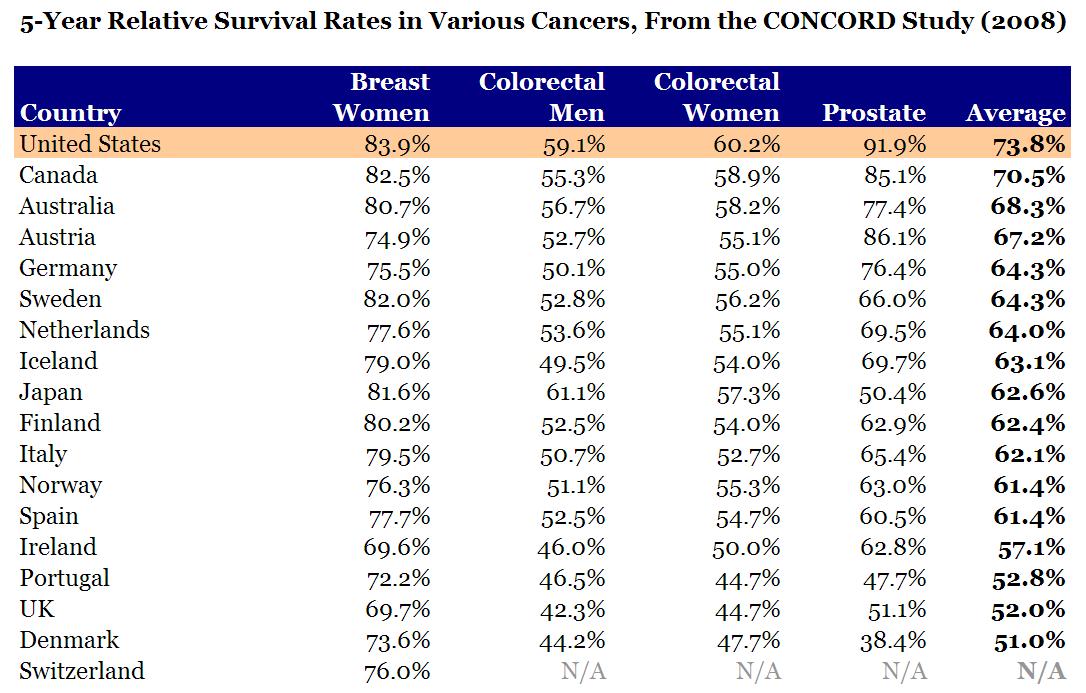
[…]If you really want to measure health outcomes, the best way to do it is at the point of medical intervention. If you have a heart attack, how long do you live in the U.S. vs. another country? If you’re diagnosed with breast cancer? In 2008, a group of investigators conducted a worldwide study of cancer survival rates, called CONCORD. They looked at 5-year survival rates for breast cancer, colon and rectal cancer, and prostate cancer. I compiled their data for the U.S., Canada, Australia, Japan, and western Europe. Guess who came out number one?

Here is the raw data:

Health care outcomes
Health care outcomes by country and type of treatment

Click here to see the larger graph.

So, what explains this?

The article continues:

Another point worth making is that people die for other reasons than health. For example, people die because of car accidents and violent crime. A few years back, Robert Ohsfeldt of Texas A&M and John Schneider of the University of Iowa asked the obvious question: what happens if you remove deaths from fatal injuries from the life expectancy tables? Among the 29 members of the OECD, the U.S. vaults from 19th place to…you guessed it…first. Japan, on the same adjustment, drops from first to ninth.

It’s great that the Japanese eat more sushi than we do, and that they settle their arguments more peaceably. But these things don’t have anything to do with socialized medicine.

Finally, U.S. life-expectancy statistics are skewed by the fact that the U.S. doesn’t have one health-care system, but three: Medicaid, Medicare, and private insurance. (A fourth, the Obamacare exchanges, is supposed to go into effect in 2014.) As I have noted in the past, health outcomes for those on government-sponsored insurance are worse than for those on private insurance.

To my knowledge, no one has attempted to segregate U.S. life-expectancy figures by insurance status. But based on the data we have, it’s highly likely that those on private insurance have the best life expectancy, with Medicare patients in the middle, and the uninsured and Medicaid at the bottom.

If we’re going to discuss health care, then let’s discuss facts. We shouldn’t be picking a health care system from the campaign speeches of politicians who tell us that we can keep our doctor, and keep our health plan, and our premiums will go down. We tried electing a charismatic deceiver in 2008, and it didn’t work out. We lost our doctors, lost our health plans, and our premiums went up enormously. We can do better than single-payer health care. We can do better than socialism.