Does abortion reduce violent crime? Does abortion reduce child abuse?

If abortion reduces crime, why does the evidence show that it doesn't?
If abortion reduces crime, why does the evidence show that it doesn’t?

Grr, my annoying co-workers are at it again this morning. This time, it’s the man who annoyed me about overpopulation fears, which I responded to earlier this week. He says to me this morning that Alabama is going to have a big problem with violent crime because they’ve stopped abortions. These sorts of views are common among TV-watchers, but not among those study-readers.

Life Site News reports on a Yale Law & Economics Research Paper.

First, let’s see the abstract:

Abortion may prevent the birth of “unwanted” children, who would have relatively small investments in human capital and a higher probability of crime. On the other hand, some research suggests that legalizing abortion increases out-of-wedlock births and single parent families, which implies the opposite impact on investments in human capital and thus crime. The question is: what is the net impact? We find evidence that legalizing abortion increased murder rates by around about 0.5 to 7 percent. Previous estimates are shown to suffer from not directly linking the cohorts who are committing crime with whether they had been born before or after abortion was legal.

And now, let’s see the Life Site News article:

Law professors John R. Lott, Jr. of Yale Law School and John E. Whitley of the University of Adelaide found that legalizing abortion increased murder rates by up to seven percent. They concluded that legalizing abortion is a contributing factor to the great increase in out‑of‑wedlock births and single parent families, which in turn contribute to increased crime rates. Since 1970, the percentage of single‑parent households in the United States has nearly tripled, from 11 percent to 32 percent, and the percentage of out‑of‑wedlock births has nearly quadrupled, from 11 percent to 43 percent of all children.7 Children born out-of-wedlock and raised by only one parent have a significantly higher incidence of crime.

There are many other fundamental problems with the conclusion that legalized abortion leads to a decrease in crime.

Statistician David Murray confirmed that young males between the ages of 17 and 25 commit the majority of crimes. However, if abortion had reduced crime, the crime rates in the United States would have dropped first among young people. They did not. Instead, the number of crimes committed by older people dropped first. Nearly 60% of the decline in murder since 1990 involved killers aged 25 and older — who were born before Roe v. Wade.8

Murray also found that other nations with high abortion rates showed a large increase in crime about eighteen years after they legalized abortion. For example, in Great Britain, which legalized abortion in 1968, violent crime has been rising steeply since about 1985 ― exactly when it should have been declining, according to the Donohue‑Levitt thesis. Additionally, Russia, with the highest abortion rate on earth, has experienced a tidal wave of every kind of violent crime following the breakup of the Soviet Union.9

FBI statistics showed that the murder rate in 1993 for 14‑ to 17‑year‑olds in the USA (born in the years 1975‑1979, which had very high abortion rates) was 3.6 times higher than that of kids who were the same age in 1984 (who were born in the pre‑legalization years of 1966‑1970). Additionally, since Black women were having abortions at a much higher rate than White women, we should have expected the murder rate among Black youth to have declined beginning in about 1991. Instead, it increased more than five hundred percent from 1984 to 1993.10

Finally, the huge increase in violent crime that peaked in 1991 and then began to decline is more closely related to the crack epidemic, not abortion. The Donohue‑Levitt study confirms that the crime rate rose and fell exactly where crack cocaine was most easily available ― in the large cities and among young Black males.11 This is also confirmed by the rise in crime during the time period 1984 to 1991, after a decline from 1980 to 1984. If abortion were the primary cause of a decline in violent crime, the crime rate would have been relatively stable during the time period 1980 to 1991.

By the way, a good book to buy on this is John Lott’s “Freedomnomics: Why the Free Market Works and Other Half-Baked Theories Don’t“. One third of the book covers this topic.

And if you’re wondering what caused the decline in violent crime rates in the 1990s, the answer to that is that it was multiple factors. Better policing, mandatory sentencing laws, legalized concealed carry laws, and other factors were responsible.

Abortion and child abuse

Sometimes, pro-abortion people put forward a similar argument about abortion preventing child abuse. This argument seems intuitive, but from an evidence point of view, it’s false.

Here’s a report from Life News about a study out of Bowling Green State University.

Excerpt:

For decades, evidence has existed showing abortion contributes to a rise in child abuse. Now a new study by a post-abortion research institute and Bowling Green State University professors finds that women who have abortions are more likely to abuse their children.

Published in the medical journal Acta Paediatrica, the study found that women who have had abortions are 2.4 times more likely to physically abuse their children. Pro-life advocates say it proves the need for providing women with post-abortion counseling to help deal with the emotional trauma of the abortion.

[…]The authors suggested that “emotional difficulties and unresolved grief responses” from pregnancy loss, whether voluntary or involuntary, could have a negative impact on women’s mental health and lead to unhealthy parenting responses.

According to the Illinois-based Elliot Institute, which released information about the study’s findings, prior surveys “have linked pregnancy loss to an increase in grief reactions, anxiety, depression, sleep disturbances, and symptoms of post-traumatic stress disorder, all of which can have a negative impact on parent/child relationships.”

The post-abortion research group also points to a 2002 study published in the Journal of Child Psychiatry and Psychology that found abortion has been linked to an increase in substance abuse and thoughts of suicide, which could also contribute to child abuse.

The new study also found that women who had more than one miscarriage or stillbirth were more likely to engage in child abuse than women who had just one. However, women who had abortions were more likely to abuse their children whether they had one or more than one abortion.

“Regardless of the specific mechanisms at play, maternal history of one induced abortion does appear to be a marker for increased risk of physical abuse,” the authors concluded.

Whenever I read about how studies contradict people’s intuitions about what will and will not work, it makes me sad that so many people who live life on intuitions and feelings are still allowed to vote. If only we had a society where reason and evidence were seen as indispensable for building up your view of the world.

By the way, if you’re looking for a good article for debating other aspects of the Alabama pro-life law, my friend William, who loves to debate everything, and he always wins, just posted this article about 9 myths about the Alabama pro-life law.

General advice on countering your co-workers

I found that if I passed on TV and movies, I could buy pretty much any book I wanted that has research-based responses to these common questions from secular leftists. All it takes is a commitment to dedicate your book-buying budget to the task of responding to challenges, instead of producing feelings.

I notice a lot of Christian women in my office reading fiction books, while the Christian men are always talking about TV and movies. Fiction and entertainment are useless for putting forward Bible-based views and supporting evidence in controversial discussions. Instead of wasting your money on fiction and entertainment, listen closely to what people in your office are saying, and then purchase and train with resources that help you to serve God in these discussions. Bible verses and prayers alone will not equip you to serve in difficult situations.
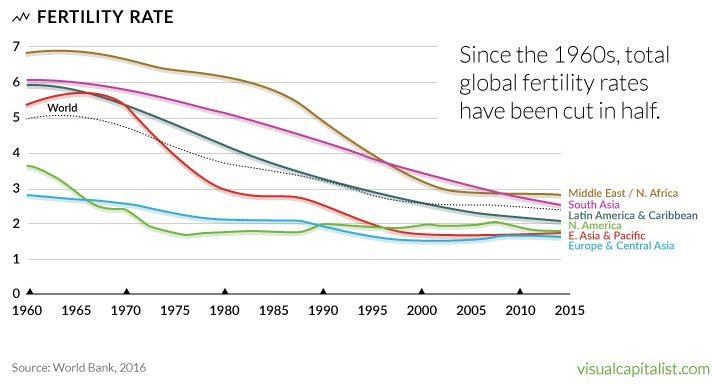
U.S. birth rate hits record low, despite secular left’s obsession with “overpopulation”

Total fertility rates have decreased globally by about half since 1960.

I had lunch with one of my co-workers on the secular left recently. I asked him what his biggest concern with the world. After telling me that he was a “libertarian”, he said that he was alarmed that people were having too many babies. I asked him what he wanted to do about it. He said keep abortion legal, and use the government to stop people from reproducing. Some libertarian!

Anyway, he was just factually wrong about the overpopulation, and I had to launch into a long, detailed explanation of replacement rates, birth rates across the world, and how the prosperity created by capitalism has caused birth rates to decline in even poorer countries. I also explained to him that once a country dips below the replacement fertility rate (2.1 births per woman), it never returns. I concluded my refutation of his assertion by stating that he should be more worried about underpopulation than overpopulation.

Anyway, I had to repeat the same explanation again with another secular leftist that same week. So when I saw this recent Daily Caller article about a new report from the US Centers for Disease Control, I figured I might as well equip you guys to respond to other people with the same wrong view.

It says:

The United States birth rate hit a record low in 2018 with numbers reflecting the lowest birthrates in the past 30 years, reports say.

A new report from the National Center for Health Statistics at the US Centers for Disease Control and Prevention reveals that almost every age group of women under 35 showed birth rate declines in 2018. The provisional number of births in the U.S. in 2018 was 3,788,235, down 2% since 2017. For every 1,000 women, the fertility rate declined 2% from 2017 to 1,728.0 births.

Birth rates had reached a record low in 2017 as well, marking a continuing trend of declining birth rates over the past four years, according to CNN.

[…]These 2018 birth rate numbers are below the necessary threshold needed for population replacement, which is 2,100 births per 1,000 women, CNN reports.

So we’re down to 1.73 births in the USA, which is below the 2.1 rate needed to maintain current population levels.

This new report isn’t an outlier. It confirms what we knew about from previous reports.

Here’s an earlier report from the far-left Pew Research Center, reported by the radically-leftist Slate, of all places.

Excerpt:

A report issued last month by the Pew Research Center found that immigrant births fell from 102 per 1,000 women in 2007 to 87.8 per 1,000 in 2012. That helped bring the overall U.S. birthrate to a mere 64 per 1,000 women—not enough to sustain our current population.

Moreover, the poor, highly fertile countries that once churned out immigrants by the boatload are now experiencing birthrate declines of their own. From 1960 to 2009, Mexico’s fertility rate tumbled from 7.3 live births per woman to 2.4, India’s dropped from six to 2.5, and Brazil’s fell from 6.15 to 1.9. Even in sub-Saharan Africa, where the average birthrate remains a relatively blistering 4.66, fertility is projected to fall below replacement level by the 2070s. This change in developing countries will affect not only the U.S. population, of course, but eventually the world’s.

Now I have a couple tools for you to share to those people who might have irrational views of this issue.

Useful videos

This video explains what’s wrong with overpopulation fears:

And this one explains what the replacement rate number is:

You can share those for people who don’t have time to read. It at least makes the point, even if it doesn’t link to a reputable report.

A useful podcast

This podcast featuring famous economist Dr. Jennifer Roback Morse will be useful for you to understand why the overpopulation myth is something you should be concerned about.

The MP3 file is here. (from 1/22/2010)

Topics:

  • how the transition from country to city discourages child-bearing
  • how religion impacts how many children parents have
  • what is the US birth rate, is it high enough?
  • can we just import immigrants to alleviate the low birth rate?
  • has increased prosperity encouraged people to have more children?
  • how has the purpose of sex changed after the sexual revolution?
  • how does the demographic crisis threaten entitlement programs?
  • what do we learn from the declining birth rate in Japan?
  • how does population growth impact stock market performance?

This podcast explains how some countries aren’t making enough young workers to pay for the social programs needed by a growing number of elderly people wanting to retire.

Please share the post if you found it useful.

The production of carbon from lighter elements is fine-tuned to an amazing degree

Fine-tuning of the strong nuclear force and the fine structure constant

If there is one thing that science fiction is good for, it’s for popularizing the phrase “carbon-based life”. Everyone has heard that carbon is essential for life. But do you know why carbon is so important? And did you know that the reaction that produced the carbon in our universe is actually fine-tuned, and therefore evidence for a Creator and Designer of the universe?

Hugh Ross has a new article up in Salvo magazine, which I found thanks to a post at Uncommon Descent.

Now he starts off with a discussion of how the mass density of the universe needed to be fine-tuned in order to produce elements heavier than hydrogen from the (only) hydrogen that was present at the creation event. I’ve talked about that reaction previously, but I won’t repeat that here. Nucleosynthesis is one of the most important chemical reactions in science, and something every Christian should know and understand well enough to explain it.

You can’t make complex embodied intelligent creatures such as ourselves out of only hydrogen and helium, but you can’t make a life permitting universe without some hydrogen and helium. For one thing, you can’t have liquid water without some hydrogen.

But the element carbon is the center hub of all of the molecules inside of us that allow for the storage and processing of information necessary for life.  And it turns out that the reaction that creates carbon from elements lighter than carbon is fine-tuned to an amazing degree.

Excerpt:

But cosmic mass density is not the only thing that must have been exquisitely fine-tuned for the universe to contain any carbon. The nuclear resonance (or energy) levels for helium, beryllium, carbon, and oxygen also had to be exquisitely fine-tuned for carbon to exist. Here’s how that happens.

Stars fuse carbon and oxygen from helium through a series of reactions known as the triple-alpha process, in which three helium nuclei are combined to make one carbon nucleus. In the first step in this process, two helium nuclei (with 2 protons each) fuse together to make beryllium (which has 4 protons). Next, a helium nucleus fuses with a beryllium nucleus to make carbon (which has 6 protons). Then, some carbon nuclei fuse with helium nuclei to make oxygen (which has 8 protons).

The only reason that the triple-alpha process produces any carbon or oxygen at all is because in the first step, the ground state energy level (i.e., the state of an atom when all of its electrons are at their lowest energy levels) of the beryllium-8 nucleus (containing 4 protons and 4 neutrons) almost exactly equals the ground state energy level of two helium-4 nuclei (2 protons and 2 neutrons each). In the second step, the ground state energy level of a beryllium-8 nucleus plus a helium-4 nucleus almost exactly equals the energy level of an excited state of a carbon-12 nucleus (6 protons and 6 neutrons). In the third step, the ground state energy level of a carbon-12 nucleus at 7.65 million electron volts is just slightly larger than the ground state energy level of an oxygen-16 nucleus (8 protons and 8 neutrons) at 7.12 million electron volts.1

If it were not for the near equivalences or resonances of the nuclear energy levels of two helium nuclei relative to a beryllium nucleus, and of a beryllium nucleus plus a helium nucleus relative to a carbon nucleus, the universe would contain very little or no carbon and very little or no elements heavier than carbon. Life would be impossible.

Furthermore, unless the difference in the nuclear energy levels between a carbon nucleus and an oxygen nucleus were precisely 0.53 million electron volts, the universe would contain either a lot of carbon and no oxygen or a lot of oxygen and no carbon. Either way, physical life would be impossible in the universe.

In the early 1950s, astronomer Fred Hoyle and physicist Willy Fowler were the first to understand how critical the relative nuclear energy levels of helium, beryllium, carbon, and oxygen were for making life possible in the universe. Commenting on the highly fine-tuned nature of these nuclear energy levels, Hoyle wrote in an article he published in Engineering & Science,

A common sense interpretation of the facts suggests that a superintellect has monkeyed with the physics, as well as with chemistry and biology, and that there are no blind forces worth speaking about in nature. The numbers one calculates from the facts seem to me so overwhelming as to put this conclusion beyond question.2

The article continues to explain that there is an additional problem of carbon fine-tuning related to habitability.

The carbon formation problem is one of the best examples of fine-tuning, and as you can see, it’s even admitted by atheists. It’s not the easiest one to explain (because resonance levels are not familiar in every day life), but it’s worth knowing about all three of the fine-tuning topics in the post.

Keep in mind that the more science has made progress, the more fine-tuning problems we have discovered. The trend is very bad if you are a naturalist. But very good if you are a theist. Evidence matters, and scientific evidence is the best kind of evidence.