
Did “thousands of women” die in “back alley abortions” before Roe v. Wade?

I get into debates about abortion, and sometimes my opponent will complain that if Roe v. Wade were overturned, then thousands of women would die in illegal abortions. Well, if that ever happens to you, this post will help you to know how to respond to it.

First of all, if Roe v. Wade were overturned, then each of the 50 states would pass legislation deciding when abortions would be legal.

Here’s a map taken from the Washington Examiner:
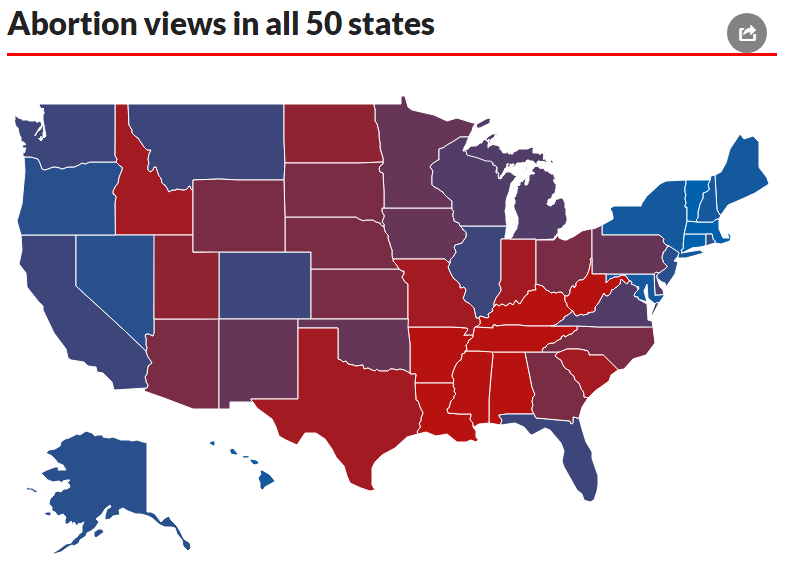
Abortion rights after Roe v. Wade is overturned

Red states are more pro-life than blue states in this map. For example, New York is ranked #6, and Tennessee is ranked #45.

So, if a woman did have irresponsible sex with a hot bad boy, then she easily could terminate her child in one of the blue states.

Second, the number thrown around by abortion advocates is not accurate. It’s simply not true that “thousands of women” were dying from poorly-performed abortions when abortion was still illegal. Actually, abortions were performed by trained medical personnel, but it just wasn’t reported to the police.

Here’s a recent article from the radically leftist Washington Post:

Erica Sackin, a Planned Parenthood spokeswoman, directed us to a 2014 policy statement issued by the American College of Obstetricians and Gynecologists (ACOG): “It is estimated that before 1973, 1.2 million U.S. women resorted to illegal abortion each year and that unsafe abortions caused as many as 5,000 annual deaths.”

There is no citation in the statement for the estimate of “as many as 5,000 annual deaths,” even though many of the other sentences are carefully documented. None of the citations around this sentence supports the figure, and there is no explanation about how it was calculated.

[…]Meanwhile, Sackin also sent a variety of reports, many of which were referenced in a footnote in a document published by NARAL Pro-Choice America. One of the citations especially caught our eye: Frederick Taussig, “Abortion Spontaneous and Induced: Medical and Social Aspects,” (1936).

Why was a study from 1936 being cited? Because in 1936, we didn’t have antibiotics! People were dying all the time from any kind of surgery – not just abortion.

More:

The advent of antibiotics such as penicillin and improved medical procedures suddenly made abortion less risky. Another prominent researcher, Christopher Tietze, argued in a 1948 paper that the number of deaths from abortion was rapidly declining because of three reasons: contraceptive methods had improved so fewer women were getting pregnant, abortion providers were getting better at avoiding infections, and many lives had been saved because of the introduction of sulfa drugs and penicillin.

[…]The data collected by Tietze showed 2,677 deaths from abortion in 1933, compared with 888 in 1945, with much of the decline in septic cases associated with illegal abortions. (The numbers also include deaths from “therapeutic abortions,” permitted by law, and “spontaneous abortions.”)

By 1959, a leading researcher wrote: “Abortion is no longer a dangerous procedure. This applies not just to therapeutic abortions as performed in hospitals but also to so-called illegal abortions as done by physicians. In 1957, there were only 260 deaths in the whole country attributed to abortions of any kind. In New York City in 1921, there were 144 abortion deaths, in 1951 there were only 15.”

The writer was Mary Steichen Calderone, at the time medical director of Planned Parenthood. She attributed the decline in the mortality rate to antibiotics and the fact that 90 percent of illegal abortions were done by trained physicians.

OK, so abortion advocates cite the study from 1936, which already relies on questionable estimates, because they know that the later numbers are far, far lower – thanks to the widespread use of antibiotics. They’re lying, essentially, because lying helps them to persuade people who think with their feelings, and don’t look too closely at facts.

My third point is simple. Even if women hurt themselves during abortions, that wouldn’t be a reason to legalize abortion. Bank robbers hurt themselves during bank robberies, and drug dealers hurt themselves during drug deals. We do not legalize criminal activities just because criminals get hurt during the commission of those activities. So the real question is, what is the unborn? If the unborn is a living human being, then abortion on demand takes the life of an innocent human being without justification, and should therefore be illegal.

UPDATE: My pro-life friend Nathan sent me a fourth response:

There is a difference today that did not exist in 1973. We have a pro-life movement. We have over 2,000 pregnancy care ministries and clinics operating throughout the continental United States. I highly doubt these clinics will just disappear overnight if abortion became illegal nationwide. Women and children will still be in need, and the free market principles that enable charity to flourish will be there to help.

Given this reality, will proponents of abortion now finally step forward to help provide the support to women necessary so they never have to choose a back alley abortion? Given how they have worked themselves into a panic about rusty coat hangers, it seems they would be the most motivated to do so. The fact many don’t seem to want to do so is telling: They just want to justify their own support for abortion, regardless of whether it helps women or not.

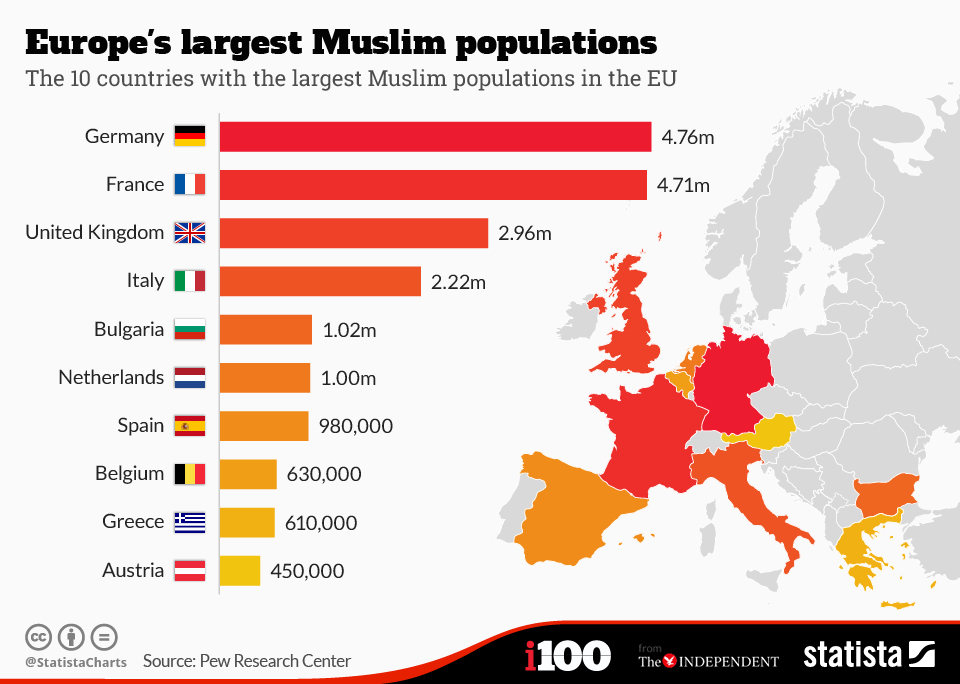
Why did European countries import millions of unskilled Muslim immigrants?

Muslim populations in Europe

I am currently reading a book recommended to me by Dina, my wise advisor. The book is amazing. I want to put it in the hands of all the naive, leftist Christian leaders and Republicans who favor amnesty, and not building a border wall. If I can’t convince you to read the book right now, at least take a look at this review of it in The Federalist.

Excerpt:

“The Strange Death of Europe” is a polemical but perceptive book culled from Murray’s extended sojourns across Europe’s frontiers – from the Italian island of Lampedusa, a flyspeck in the Mediterranean closer to the shores of North Africa than it is to Sicily, and to Greek islands that sit within sight of the Turkish coastline. These places have borne the brunt of the recent exodus from the Middle East and North Africa, but the author has also ventured to the remote suburbs of Scandinavia and Germany and France where many of these ­migrants end up. The resulting portrait is not a happy one.

[…]The distinguishing feature of modern Europe is its persistent ennui, shown in the inability or unwillingness “to reproduce itself, fight for itself or even take its own side in an argument.” What’s more, Europeans seem less stirred to face these unpleasant facts than they are fearful of interpreting them too precisely.

The book analyzes how the secular left “argued” for more immigration of low-skilled Muslims from countries that do not accept Western views on things like the respectful treatment of women.

The never-slacking thirst among Europe’s political class for more immigration has rested on two flawed assumptions, one economic and the other normative (and usually in that order). The economic assumption cites the benefits of immigration without accounting for its costs, and seldom acknowledges that benefits accrue chiefly to the migrants themselves and to highly compensated native inhabitants. Most of the rest of society is left to foot the bill for this immense regressive redistribution of wealth from the poor (who are squeezed out of the labor force) to the rich (who benefit from cheap labor).

Any public concerns about the financial downsides of this immigration – from increased pressure on housing markets to depressed wages – have been swept aside in deference to Europe’s dwindling fertility rates. (In a classic instance of one erroneous public policy begetting another, Murray shrewdly notes that the political left encouraged a “one-child policy” in order to attain an “optimum global population” only later to demand mass immigration in order to lift birthrates back to replacement levels.) The problem of Europe’s birth dearth is very real. The working-age population of Western Europe peaked in 2012 at 308 million – and is set to decline to 265 million by 2060.

So how will immigration schemes alleviate Europe’s fertility-driven strain on the welfare state? It is not clear that they will. Advocates of the rejuvenating effects of immigration are seldom obliged to spell out the wisdom of importing the poor and dispossessed of the world who generally lack the skills required for success in an advanced market economy. Can these migrants reliably be expected to contribute more in taxes than they consume in state aid? (They wouldn’t be alone in their dependence on government largesse: plenty of native workers, too, are struggling mightily to cope with the creative destruction unleashed by the march of globalization and technology.)

When advocates of open borders are pressed on these points, they generally repair to the normative argument. It has been claimed that when a flood of migrants started to pile up at Europe’s frontiers in 2015, the issue ceased to be economic and instead became moral: tending to the needs of beleaguered strangers. Thus Europe’s longstanding debate over immigration suddenly transformed into a contest between head and heart, and in a stampede of sanctimony it was decided that soft-heartedness was better hard-headedness.

What was amazing to me, is that people from these Islamic countries were able to just walk in to Europe and claim asylum. This put them on an immediate path to citizenship. Since there were so many people coming, their claims were not vetted. The immigrants would destroy their own identity documents after arriving in Europe, and then claim to be coming from whatever nation had a war going on, e.g. from Syria. Even if they could not speak any Syrian, they would still be let in and put on a path to citizenship! Incredible.

I have to include this:

After the 7/7 bombings in London, polls revealed that 68 percent of British Muslims believe that British citizens who “insult Islam” should be arrested and prosecuted.

See, no problem at all integrating into Western civilization. It’s not like their just going to start raping and murdering 14-year-old Jewish girls, or start up underage sex-trafficking rings. But the people making the immigration policy don’t care about public safety. They want to appear compassionate. And they do it by spending other people’s money and by risking other people’s safety. There is no concern for the money and safety of taxpayers, the important thing is that the politicians feel good about themselves. They’re better than the people who they stick with the bill. Or the people they stick with the machete. I know that compassionate leftists like Russell Moore want me to think that they are good people, but I don’t. Because I always think of the victims of their compassion. Anyone who votes for more immigration without oversight and accountability is responsible for the harm.

For me, the most interesting part of the book was not about why secular leftist politicians decided to open up the borders, how many Muslim immigrants commit crimes against their welcoming hosts, how European activists subvert the law to welcome in more immigrants (including lying about their own rapes at the hands of Muslim refugees, to cover for the rapist), or how the police cover up crimes committed by Muslim refugees and immigrants. The most interesting part was how anyone who tries to make public safety or fiscal arguments against the mass importation of low-skilled Muslims was vilified. Careers were ended. Reputations were ruined. And then the Muslims themselves would launch lawsuits or take more violent, and even murderous, measures to silence their critics.

Bible study: Esther as an example of bravery and God’s providence

Bible study that hits the spot

I’ve been listening to this FREE two-volume series on the book of Esther featuring pastor Alistair Begg. A whole bunch of interesting things stuck out to me, so I’ll write about one of them today.

First, Esther is a Jewish woman whose father or mother died when she was young. She was adopted by Mordecai, another Jew. She was very beautiful, so she was picked to be part of the Persian King’s harem. In fact, she is so beautiful that the King chooses her to be the Queen.

Now there is an enemy of the Jews in the King’s court named Haman, and he manages to get the King to create an edict that says that all the Jews will be killed. Mordecai calls Esther to tell her that she has to stop the King from ordering this edict.

But Esther is out of favor with the King, and hasn’t been asked to come in to visit him for some time. To go in and see the King without being summoned is a capital offense. Unless the King gives permission, she would be killed for intruding on the King. But in the end, she agrees to speak up and say something.

It all gets resolved in Esther chapter 4.

Esther 4:1-17:

1 When Mordecai learned all that had been done, he tore his clothes, put on sackcloth and ashes, and went out into the midst of the city and wailed loudly and bitterly.

2 He went as far as the king’s gate, for no one was to enter the king’s gate clothed in sackcloth.

3 In each and every province where the command and decree of the king came, there was great mourning among the Jews, with fasting, weeping and wailing; and many lay on sackcloth and ashes.

4 Then Esther’s maidens and her eunuchs came and told her, and the queen writhed in great anguish. And she sent garments to clothe Mordecai that he might remove his sackcloth from him, but he did not accept them.

5 Then Esther summoned Hathach from the king’s eunuchs, whom the king had appointed to attend her, and ordered himto go to Mordecai to learn what this was and why it was.

6 So Hathach went out to Mordecai to the city square in front of the king’s gate.

7 Mordecai told him all that had happened to him, and the exact amount of money that Haman had promised to pay to the king’s treasuries for the destruction of the Jews.

8 He also gave him a copy of the text of the edict which had been issued in Susa for their destruction, that he might show Esther and inform her, and to order her to go in to the king to implore his favor and to plead with him for her people.

9 Hathach came back and related Mordecai’s words to Esther.

10 Then Esther spoke to Hathach and ordered him to reply to Mordecai:

11 “All the king’s servants and the people of the king’s provinces know that for any man or woman who comes to the king to the inner court who is not summoned, he has but one law, that he be put to death, unless the king holds out to him the golden scepter so that he may live. And I have not been summoned to come to the king for these thirty days.”

12 They related Esther’s words to Mordecai.

13 Then Mordecai told them to reply to Esther, “Do not imagine that you in the king’s palace can escape any more than all the Jews.

14 For if you remain silent at this time, relief and deliverance will arise for the Jews from another place and you and your father’s house will perish. And who knows whether you have not attained royalty for such a time as this?”

15 Then Esther told them to reply to Mordecai,

16 “Go, assemble all the Jews who are found in Susa, and fast for me; do not eat or drink for three days, night or day. I and my maidens also will fast in the same way. And thus I will go in to the king, which is not according to the law; and if I perish, I perish.”

17 So Mordecai went away and did just as Esther had commanded him.

What Mordecai is saying here is that God is sovereign over the events that are taking place, and that even if Esther makes a free decision to not intercede to save her people, then God will do something else. Somehow, telling her that makes her agree to take the risk and go in to see the King. Even though it is illegal to go in to see the King, she is going to risk her life and do it. And the message there is that God made her beautiful, and placed her in the palace, for exactly this purpose. Her beauty has a purpose.

Before then, she may not have been the most morally pure Jew, nor the most faithful Jew, nor some great authority on theology or apologetics. She was probably keeping her faith pretty hidden. But in that one moment, she rises above being an orphan, above being a harem girl, and above being just a pretty face. God can use anyone – even a silly girl who spends all day in front of a mirror playing with cosmetics – to achieve his ends. She is not Daniel. But today she is getting the call, anyway. It’s on her.

What is the lesson here? God can use anybody. It doesn’t mean that you shouldn’t be moral, study theology, and study apologetics, and keep your character clean so you have self-control. It means that any believer is just one step away from glory, no matter what they did in the past. That’s how God rolls.

Further study

If you are interested in the story of Esther, then you should listen to the entire series by Alistair Begg.

The point I am making in this post is in this lecture.

Esther is about two themes: 1) how should a believer in God live in a society where believers are a minority? and 2) even when things look really out of control, God is in control, and is never more than one step away from saving his people.

I have a lot of Christian apologist friends who struggle to go to church, and struggle to read the Bible. The links above will take you to some great preaching on one of the most interesting books of the Bible. Go there, grab the MP3s, and listen to them with no distractions.