Chris Sinkinson debates John Hick on religious pluralism and salvation

Two tough rams butt heads, and may the best ram win!

Looks like Justin Brierley on the Unbelievable radio show found a pastor with a Ph.D in philosophy, and he can really whip some ass. And that’s a good thing, because he is taking on one of the two leading proponents of religious pluralism, in my opinion, (the other being Paul Knitter).

The players:

John Hick is a noted philosopher and theologian who is a proponent of a pluralist view of religion – that there is one light (God) but many lampshades (religious expressions).

Chris Sinkinson is a pastor and Bible tutor who has critiqued Hick’s work.  He says that pluralism empties Christianity of any content and in its own way disrespects other religions more than his own exclusivist stance.

The MP3 file is here. (Note: This link works)

Justin does a great job as moderator of this debate. He said what I was thinking of saying a number of times during the debate.

Anyway, here is my snarky summary. I creatively paraphrase some of the things that Hick says to make it more clear. And funny.

—-

Hick:
– had an experience looking at the buildings of other religions
– other religions have buildings, so all religions are equal
– I spent some time in the East, and met nice Eastern people
– since Eastern people are nice that means all religions are equal

Justin:
– isn’t Jesus’ claim to be the exclusive path to salvation offensive?

Sinkinson:
– all religions that are exclusive and have to deal with religious pluralism
– even John Hick writes polemically in favor of his own view
– even John Hick thinks that religions that are exclusive are false

Justin:
– what about the blind man and the elephant?
– the story seems to say that other people have a partial grasp?
– but the story-teller himself has the privileged view
– so isn’t the religious pluralist just as arrogant as exclusivists?

Hick:
– well, it’s not arrogant to claim to have the right answer
– Jesus never made the claim to be God incarnate
– Jesus never made the claim to be the exclusive path to God
– historians don’t think that John’s gospel is reliable because it is late
– the proclamation of exclusivity was added by evangelists much later

Sinkinson:
– the historians who doubt the high Christology are radical skeptics
– the mainstream of historical scholarship accepts a high Christology
– the EARLIEST history about Jesus has the highest Christology

Hick:
– the moderate scholars do think Jesus was divine but that he didn’t think he was divine
– the phrase “Son of God” was used to describe any remarkable person
– only later did the early church turn the generic term into “God the Son”

Sinkinson:
– there is reflection on Jesus’ identity and developments, but not invention
– Jesus and his followers were in trouble precisely for linking him to deity
– why else would Jesus get into trouble and get crucified?

Hick:
– the Romans crucified him because people were saying he was the Messiah
– but the Messiah was not identified as being divine, but political
– and that’s why the Romans crucified him

Justin:
– do you (Sinkinson) think that people in other religions can be saved?

Sinkinson:
– the traditional view is exclusivism
– the other world religions are logically contradictory with Christianity
– you have to respect their differences – they are not the same as Christianity
– exclusivists allow that people can be saved by responding to natural theology
– and there are also other cases where non-Christians are saved, like old testament saints and babies who die in infancy

Hick:
– but people’s religions are based on where they are born
– so it’s not fair for God to expect people to be saved in one religion only

Sinkinson:
– the plurality of religions grouped by location doesn’t make christianity false
– that would be the genetic fallacy – rejecting an idea because of its origin
– the real question to consider is whether it is true
– and even the objection assumes that God is a God of love, who should be fair
– but how do you know that God is loving? that is an exclusive view
– how can the “blob” ultimate of religious pluralism be “loving” and “fair”

Hick:
– the ultimate reality is loving or not loving depending on each person’s religion

Sinkinson:
– but some religions and theistic and some are atheistic
– how can those God exist and not exist?

Hick:
– God is beyond everyone’s understanding, except mine
– God is beyond all definitions, except mine
– God is beyond all human understanding, except mine
– i’m not contradicting myself, it’s a mystery! a mystery!
– as long as you don’t look to closely, they’re all the same!
– allow me to tell you about God, which no one can do but me

Justin:
– doesn’t your religious pluralism mean that Christianity is false?

Hick:
– well, Christianity can’t be true, because it disagrees with other religions
– Christianity can’t falsify other religions, that would be mean to them
– other religions are just as “profound” as Christianity – and that’s what matters – not whether a religion makes true claims
– some religions are older than Christianity, that means they can’t be disagreed with
– we can’t let Christianity be true, because then some people will feel bad
– if people feel bad, then they don’t like me and then I feel bad
– if there’s one thing I know about the unknowable ultimate reality, it’s that it wants me to be liked by lots of people

Sinkinson:
– your view seems to be agnosticism – that nothing can be known about the “ultimate real”
– if we can’t express in words what God is like, then why are you saying what God is like?

Hick:
– the indescribable ultimate is described (falsely, but interestingly) by various tradition

Sinkinson:
– does the “ultimate real” exist?

Hick:
– no

Justin:
– are all the exclusive religions wrong, and only you are right?

Hick:
– all propositions about God in all the religions are false
– the experience of being deluded and having feelings about your delusions is “valid” in all religions
– all religions are equally good ways to believe false things and to have feelings about your false beliefs
– only my propositions about God are true
– everyone who disagrees with me is wrong

Sinkinson:
– so all the propositions of all the religions are wrong
– but all the experiences and feelings are “right”

Hick:
– yes
– all propositions about God are humanly constructed, and so false
– except mine – mine are true!

Sinkinson:
– so everything distinctive about Christianity are literally false?

Hick:
– yes, Christian doctrines are all false
– because if they were true, other religions would be false, and they would feel bad
– and we can’t have that, because everyone has to like me
– only things that don’t offend people in other religions can be true

Sinkinson:
– so do we have to then treat all religions as non-propositional?

Hick:
– well just don’t ask people about the content of their beliefs
– just treat their religion as non-cognitive rituals, feelings and experiences
– don’t inquire too deeply into it, because all religions are all nonsense
– i’m very respectful and tolerant of different religions!

Sinkinson:
– but Muslims, for example, think their religion is making truth claims

Hick:
– but there can be tolerance as long as you treat religions as non-propositional nonsense

Sinkinson:
– um, I have a higher respect for religions than you do
– I actually consider that the claims of other religions could be true
– I think that other religions make truth claims and not nonsense claims

Hick:
– well they are all useful because they are all false
– I don’t emphasize beliefs, I emphasize living, experiences and feelings
– as long as everyone accepts my view and rejects their religion, we’ll all be tolerant

Justin:
– erm, isn’t that an exclusive claim?
– you’re trying to say that your view of what religion is is right, and everyone else is wrong

Hick:
– I’m not arrogant, I just think that all the religions of the worlds are false
– only my statements about religion are true – everyone else is wrong
– I’m tolerant, and Christians are arrogant

Justin:
– but you think Sinkinson’s view is wrong
– why should we accept your view and deny his view?

Hick:
– His view of salvation is false, and mine is true

Sinkinson:
– you use words with set meanings, but you mean completely different things
– when I say salvation, I mean deliverance from sins through Jesus

Hick:
– I get to decide what salvation means for everyone, you intolerant bigot

Sinkinson:
– but that word has a specific meaning that has held true in all of Christian history
– but what you mean by salvation is people having subjective delusions that are not true

Hick:
– I don’t like using the word salvation

Sinkinson:
– but you just used it!
– and you think that it is present in different world religions, but it isn’t

Hick:
– God is unknowable and indescribable
– God isn’t a wrathful God though
– and the Christian description of God is false
– Evangelical Christians are mean
– I had experiences with people of other faiths
– and these experiences taught me that religions that think that the universe is eternal are true
– as long as you reduce religion to behaviors and not truth, then religions are all good at producing behaviors
– if you just treat all religions as clothing fashion and food customs, they are all valid
– the main point of religion is for people to agree on cultural conventions and stick to them
– never mind the propositional statements of religions… who cares about truth? not me!
– but Christianity is definitely false

Sinkinson:
– the Judeo-Christian God is different – he reveals himself to humans
– he is distinct from the other religions
– he is personal, and is loving but also angry at sin

Hick:
– But God isn’t a person, and he isn’t a non-person
– I can’t say what he is – I’ll offend someone if I say anything at all!
– except Christians – I can offend them because they are arrogant bigots
– I’m also very spiritual – I meditate on my breathing

Sinkinson:
– you can’t assess a religion by the experiences that people have
– people who have weird experiences do all kinds of evil things
– so the real question has to be about truth – is the New Testament reliable?, etc.
Trump will cut funding of schools that teach 1619 Project fantasy as history

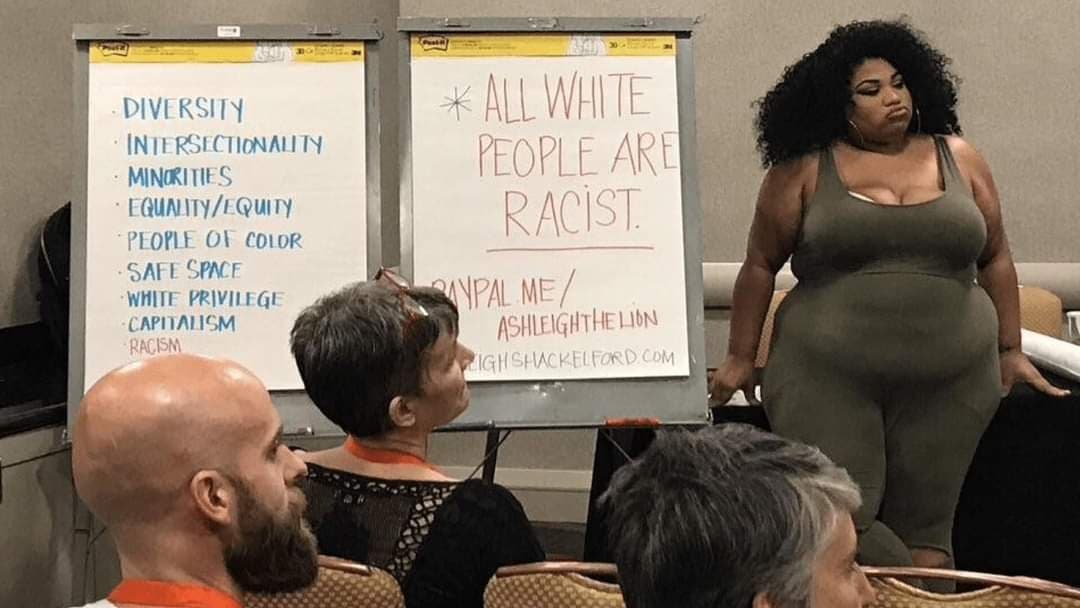
She's saying that her decision to be a whale is your fault, and you must pay her money
The results of her decisions are your fault, so pay her reparations

American schools often teach secular leftist fantasy to young children, in order to undermine their parents’ values. You may remember when teachers presented the oscillating model of the universe to children through atheist Carl Sagan, to get around the need for a Creator. The model was later disproved theoretically and experimentally. Now the schools are trying again with the 1619 Project.

The 1619 Project is a fantasy work, authored by Nicole Hannah-Jones, a person with no training or demonstrated ability in any discipline connected to the real world.

Who says so? The author says so, in this tweet, reported by Red State:

I’ve always said that the 1619 Project is not a history. It is a work of journalism that explicitly seeks to challenge the national narrative and, therefore, the national memory. The project has always been as much about the present as it is the past.

— Ida Bae Wells (@nhannahjones) July 27, 2020

This article from the centrist National Review lists some of most fantastical parts of her work.

Here’s an excerpt:

The most dramatic and controversial assertion in Hannah-Jones’s essay was that, in 1776, “one of the primary reasons the colonists decided to declare their independence from Britain was because they wanted to protect the institution of slavery.” Her essay cited nothing to support this, nor did it show even the slightest awareness of how radical a claim this is. She continued:

By 1776, Britain had grown deeply conflicted over its role in the barbaric institution that had reshaped the Western Hemisphere. In London, there were growing calls to abolish the slave trade. This would have upended the economy of the colonies, in both the North and the South . . . we may never have revolted against Britain if some of the founders had not . . . believed that independence was required in order to ensure that slavery would continue.

So, she’s claiming that the Britain ended slavery at some point prior to 1776, and that this ending of slavery applied to the colonies in America, and that the American Revolution was a response to this ending of slavery being pushed to the colonies. Is that true?

The first real strike against slavery was the 1772 Somerset judicial decision in Britain, which declared that slavery was alien to the English common law and thus could not exist within Britain without a positive act of Parliament. As Princeton University history professor Sean Wilentz has noted, however, the reaction to the Somerset case, which did not apply to British colonies, was relatively muted even in the southern colonies; it provoked nothing even vaguely resembling the furious responses to the Tea Act the following year.

Early anti-slavery movements before 1776 had no effect on the “British colonies”, e.g. – America. But more importantly there was no UK ban on slavery until way after the American Revolution:

Organized, popular movements against slavery, and laws restricting or abolishing slavery and the slave trade, were considerably more advanced in the American colonies in the 1770s than in Britain, where Parliament would not ban slavery in Jamaica and other British colonies until 1833, after many years of failures by William Wilberforce and other anti-slavery leaders. The world’s first organized anti-slavery society was formed in Pennsylvania in 1774, and the first legal ban on slavery anywhere in the world was in Vermont in 1777. Five of the original 13 states followed suit either during or immediately after the Revolution, passing bans on slavery between 1780 and 1784. The first federal ban on slavery, in the Northwest Territory, was drafted in 1784 by Thomas Jefferson and passed by the Confederation Congress in 1787. Its language would later be adopted directly into the 13th Amendment.

If slavery was not banned in the UK and pushed on the colonies prior to the Revolution, then the Revolution cannot have been a reaction to slavery being made illegal. In fact, America was far ahead of the UK at banning slavery. And far, far ahead of the rest of the world.

I just want to emphasize this – this is the problem with so many on the secular left:

[…]Hannah-Jones openly scoffs that there is “no such thing” as objective history…

This is the person the secular left believes and celebrates. A writer of anti-American fantasy. A liar.

Should we teach BLM rioter fantasies in our schools?

Well, I’m not very impressed with her work, and fortunately for us we have a Republican president who won’t bender over backwards to appease shoddy scholarship.

Fox News reports:

President Trump said Sunday that the Department of Education is examining the use of the New York Times Magazine’s 1619 Project in schools, and warned that institutions that teach this alternative narrative of American history could lose federal funding.

The project is based on the premise that American history began in 1619 — cited as the date African slaves arrived in Virginia — and that everything following this should be viewed through that lens.

[…]Trump responded to a tweet stating that California would be using it.

“Department of Education is looking at this,” Trump said. “If so, they will not be funded!”

Trump’s tweet echoes the sentiment of a bill Sen. Tom Cotton, R-Ark., introduced in July. That bill proposed denying funds to any school that uses the 1619 Project in its curriculum. At the time, schools in areas including Chicago and Washington, D.C., had already amended their history curricula to reflect the project’s messages.

This will be the policy for the next 2 months. If Biden wins, that will almost certainly be changed. How would you like to see Nikole Hannah-Jones as Secretary of Education?

What’s really going on here?

Although Hannah-Jones’ work is filled with errors, it’s very appealing to the secular left. It tells them things that they want to hear. Specifically, it makes them feel superior to others, and it excuses their own poor decision-making by shifting the blame to other people. The 1619 Project is similar to Hitler’s Mein Kampf, in that it affirms poorly-educated underachievers who blame their own failures on people of a different race. This is a very attractive message to socialists on the secular left, as it was in 1930s Germany. We should be careful about allowing racist rhetoric into our public schools to influence our children. It’s bad for them, and it’s bad for our nation.

Three cheers for the Janus SCOTUS decision and right-to-work laws in 27 states

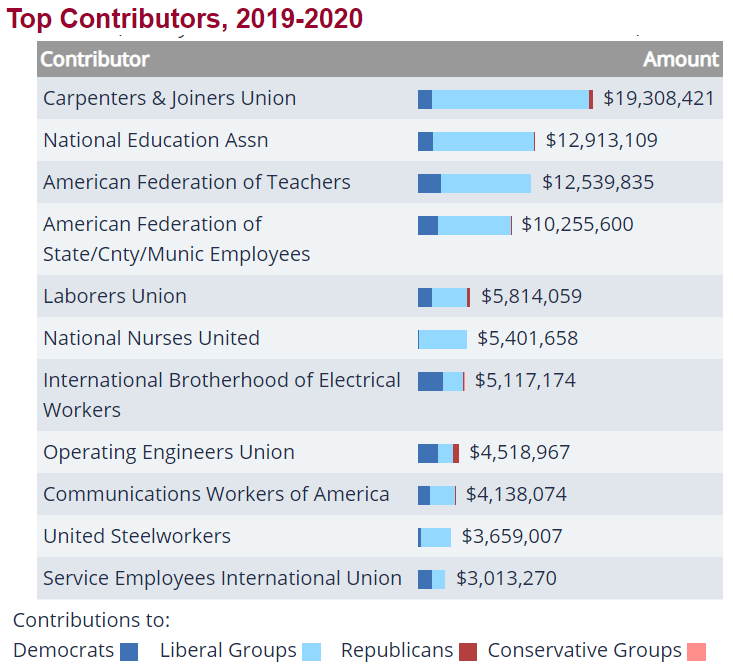
Political contributions from unions are overwhelmingly given to Democrats and leftists
Contributions from unions are mostly given to Democrats and leftists

Some people think of unions as a force for good. Perhaps they were in the past, but a little reading of economics shows how they actually produce very bad results for workers. In addition to that, unions are actively trying to influence the outcome of elections in 2020, using the money collected from their members. Fortunately, there have been two great developments recently that limit their power.

Here’s a recent story from Just the News:

Leaders of several public and private sector unions are threatening to organize walkouts this fall for teachers, truck drivers and service workers in an effort to protest police killings.

“The status quo — of police killing Black people, of armed white nationalists killing demonstrators, of millions sick and increasingly desperate — is clearly unjust, and it cannot continue,” said a statement issued over the weekend by various arms of the American Federation of State, County and Municipal Employees, the Service Employees International Union, and National Education Association.

[…]The union leaders also called for defunding police departments and universal health care.

You can see their progressive convictions coming out in how they distribute the money they collect from their members.

The Washington Examiner reports:

Organized labor has given more than $1.3 billion to Democratic Party organizations and liberal nonprofit and activist groups since 2010, while 1 percent went to conservative groups or causes, according to a survey of federal data.

The giving is starkly different from the beliefs of most rank-and-file union members, many of whom lean Republican.

Having said all of that, there were two pieces of good news about labor unions that I think we should celebrate during Labor Day.

First of all, there was a very good decision to allow teachers to opt out of having to pay union dues in all 50 states. Second, a large number of states have enacted right-to-work laws, which allow employees in union-dominated jobs to be able to work without being forced to join a union.

This article explains both:

While every public sector employee across the country now enjoys right to work protections under the First Amendment as a result of the 2018 National Right to Work Legal Defense Foundation-won Janus v. AFSCME Supreme Court decision, private sector workers in the 23 states that have yet to pass a right to work law can lose their job for refusing to tender dues or fees to a union.

Right to work protects each worker’s freedom of choice, but the advantages of right to work hardly stop there. Enshrining workplace freedom also brings significant economic benefits to the 27 states that have passed right to work laws.

Between 2009 and 2019, right to work states saw the total number of people employed grow by 16.9%. That’s nearly double the 9.6% gain in non-right to work states, according to an analysis of federal government statistics compiled by the National Institute for Labor Relations Research, or NILRR.

The study also found that, after adjusting for the cost of living, the mean after-tax household income in right to work states was about $4,300 higher than for households in forced-unionism states in 2018, the most recent year for which household income data is available.

The connection between right to work laws and better economic performance is not a surprise. Business experts consistently rank the presence of right to work laws as one of the most important factors companies consider when deciding where to expand or relocate their plants and facilities, where they will create new jobs and new opportunities.

Take the manufacturing sector, for example. The NILRR analysis revealed that employment in the manufacturing sector increased by 10% in right to work states from 2009 to 2019, over three times the 2.9% gain forced-unionism states saw over that same period.

Right to work laws clearly make economic sense, but protecting employee freedom has always been their central feature.

I really liked the Janus decision and right-to-work laws, because I don’t think that conservative workers should be forced to join a union in order to earn a living. The unions should not get access to worker money for free – unions should have to earn their worker’s money by providing value. And the worker should decide whether there is value there, or not.

You can see a full breakdown of union contributions by political affiliation for 2019-2020 here at Open Secrets.