Matthew Vines and Michael Brown debate homosexuality and the Bible on Moody radio

Details:

Can you be gay and Christian? Matthew Vines says you can and he’s created a viral video and best-selling book defending his view. This Saturday on Up for Debate, Vines joins host Julie Roys to debate author and leading evangelical apologist, Dr. Michael Brown. Is gay monogamy an option for Christians? Is it unloving to reject gay marriage? Listen and join the discussion this Saturday at 8 a.m. Central Time on Up for Debate!

Audio:

The audio of the Matthew Vines vs Michael Brown debate is streamed here on the Moody site.

Summary key: Julie Roys (JR), Matthew Vines (MV), Michael Brown (MB)

Summary:

Opening speeches:

  • JR: Why should Christians be open to reinterpreting the Bible on homosexuality?
  • MV: Consider the lives and testimonies of gay Christians. Here is my personal story.
  • MV: According to the Bible, a person with same-sex attractions would have to embrace lifelong celibacy. I refuse to do that.
  • MV: There are 6 passages in the Bible that are relevant to the goodness of homosexuality. All are negative.
  • MV: None of these passages address gay relationships that are “long-term” and “faithful” that are based on “commitment” and “love”.
  • JR: You say that it is “damaging” for Christians to disagree with you views, is that true?
  • MV: Yes. One of my friends declared his homosexuality and he did not feel safe to come home. He felt pain because Christians disagreed with him.
  • MV: You cannot ask a person with same-sex attractions to be celibate, it causes too much harm to ask gays to abstain from sexual relationships.
  • JR: Respond to Matthew.
  • MB: The Bible only permits heterosexual sexuality and in every case condemns homosexual acts.
  • MB: Matthew is taking his sexual preferences and activities as given, and reinterpreting the Bible to fit it.
  • MB: Genesis talks about women being made to help men, and to fulfill God’s commandment to procreate and fill the Earth.
  • MB: The Bible speaks about the complementarity of the sexes when talking about how two become one in marriage.
  • MB: I am very sensitive to the stories of people who are gay who experience discrimination as “gay Christians”.
  • MB: You can feel sad for people who have two conflicting commitments, but that doesn’t mean we should redefine what the Bible says.
  • JR: Stop talking, we have a break.

JR takes a caller for the next topic:

  • Caller 1: I had same-sex attractions and I was able to change my sexuality.
  • JR: Matthew, respond to that.
  • MV: Alan Chambers of Exodus International says that 99.9% of people he worked with had not changed their gay orientation.
  • MV: Lifelong celibacy is not acceptable to gays, so the Bible must be reinterpreted to suit gays.
  • MB: Matthew thinks that God himself did not understand the concept of sexual orientation and inadvertently hurt gays because of his lack of knowledge.
  • MB: There is a solution in the Bible for people who cannot be celibate, and that solution is heterosexual marriage
  • MB: If a person is only attracted to pre-teen girls, do we then have to re-write the Bible to affirm that so they won’t be “harmed”?
  • MB: Alan Chambers was speaking for his own group, and his statement does not account for the fact that thousands of people DO change.
  • JR: What about the Jones/Yarhouse study that found that 38% of reparative therapy subjects were successful in changing or chastity?
  • MV: (no response to the question)
  • MV: (to Brown) do you accept that the Bible forces gays to live out lifelong celibacy

Another break, then Brown replies:

  • MB: Yes. But change is possible.
  • MV: Do you know of any Christian who acknowledged that this was the consequence of the Bible’s teaching for gays?
  • MB: Paul’s explanation that the options for ALL Christians are 1) celibacy or 2) heterosexual marriage. For 2000 years.
  • MV: Paul (in Romans 1) is talking about people who are not “long-term”, “faithful” gay relationships.
  • MV: Paul was not aware of “long-term”, “faithful” gay relationships at the time he wrote his prohibitions in Romans 1.
  • JR: How do you know that fixed sexual orientation is true? And that the Biblical authors would written different things if they knew?
  • JR: Are there any references in the first century to “long-term”, “faithful” gay relationships?
  • MB: Yes, in my book I quote prominent historian N. T. Wright who documents that those relationships were known.
  • MB: Matthew’s view requires that God did not know about sexual orientation when ordaining the Bible’s content.
  • MB: Leviticus 18 is for all people, for all time. This was not just for the Jews, this was for everyone.
  • MV: I am not saying that Paul was wrong because he was ignorant.
  • MV: Paul was writing in a context where “long-term”, “faithful” gay relationships were unknown.
  • MV: NT Wright does not cite first century texts, he cites a problematic 4th century text.
  • MV: Absence of 1st-century references to “long-term”, “faithful” gay relationships means that God did not intend to prohibit them.
  • MB: Whenever the Bible speaks about homosexuality, it is opposed to it – Old Testament and New Testament.

Another break, then the conclusion:

  • JR: Respond to the Leviticus prohibition, which prohibits homosexuality for everyone, for all time.
  • MV: It is a universal prohibition on male same-sex intercourse, but it does not apply to Christians.
  • MV: For example, Leviticus prohibits sex during a woman’s menstrual period. And Christians are not bound by that.
  • MV: What is the reason for this prohibition of male-male sex in Leviticus? It’s not affirm the complementarity of the sexual act.
  • MV: The Bible prohibits male-male sex because it is written for a patriarchal culture.
  • MV: In a patriarchal culture, women are viewed as inferior. That’s why the Bible prohibits a man from taking the woman’s role in sex.
  • MB: The prohibition in Leviticus is a universal prohibition against male-male sex, applicable in all times and places.
  • MB: Homosexual sex is a violation of the divine order.
  • MB: We can see already the consequences of normalizing this: gay marriage, and supports for polygamy and polyamory.
  • MV: So the earliest reference there is to a “long-term”, “faithful” gay relationship is a 4th century text.
  • MV: But that gay relationship is not like modern gay relationships.

I have a few comments about Vines’ points below.

My comments:

Even heterosexuals who have not married are called upon to embrace lifelong celibacy. I am in my early 40s and am a virgin because I have not married. I wouldn’t seek to reinrepret the Bible to allow premarital sex just because what I am doing is difficult. I would rather just do what the Bible says than reinterpret it to suit me. And it’s just as hard for me to be chaste as it would be for him to be. In short, it’s a character issue. He takes his right to recreational sex as non-negotiable, and reinterprets the Bible to suit. I take the Bible as non-negotiable, and comply with it regardless of whether it seems to make me less happy. With respect to the purposes of God for me in this world, my happiness is expendable. If I don’t find someone to marry, I’m going to be “afflicted” with the lifelong celibacy that Vines seems to think is torture, but let me tell you – God is happy with the contributions I am making for him, and if I have to be chaste through my whole life, I am 100% fine with that. I serve the King. And not the reverse.

Notice that he talks about “long-term” but not permanent relationships, and “faithful” but not exclusive. This is important because the statistics show that gay relationships (depending on whether it is female-female or male-male) are prone to instability and/or infidelity. I just blogged on that recently, with reference to the published research on the subject. Vines is talking about a situation that does not obtain in the real world – according to the data. Gay relationships do not normally value permanence and exclusivity in the way that opposite-sex marriage relationships do, especially where the couple regularly attends church. The divorce rate and infidelity rate for religious couples is far below the rates for gay couples, depending on the sexes involved. Vines is committed to the idea that marriage is about feelings, e.g. – “love”, but that’s not the public purpose of marriage. Marriage is not about love, it’s about complementarity of the sexes and providing for the needs of children. We have published studies like this one showing that there are negative impacts to children who are raised by gay couples, which dovetails with studies showing that children need a mother and that children need a father. We should not normalize any relationship that exposes children to harm. We should prefer to inconvenience adults than to harm children.

Matthew Vines made an argument that Christians have to stop saying that homosexuality is wrong, because it makes gay people feel excluded. I wrote previously about the argument that gay activists use where they say “if you don’t agree with me and celebrate me and affirm me, then I’ll commit suicide”. In that post, I quoted a prominent gay activist who made exactly that argument. I don’t find the threats to self-destruction to be a convincing argument for the truth of the view that gay marriage being the same as heterosexual marriage. In fact, this is confirmed by a recent study which showed that features of gay relationships themselves, and not social disapproval, is to blame for high rates of suicide in the gay community.

Vines seems to want to argue that the context in which the Bible authors were writing did not allow them to address the problem of gays in “long-term”, “faithful” relationships. Well, we have already seen that statistically speaking, those relationships are in the minority. One British study mentioned in the post I linked to above found that only 25% of gay couples were intact after 8 years. The number is 82% for heterosexual marriages, and that doesn’t filter by couples who abstain from premarital sex and who attend church regularly. If you add those two criteria, the number is going to be well above 82% in my opinion. Studies show that premarital chastity and church attendance vastly improve the stability and quality of marriages.

In addition, Vines is trying to argue that 1) the Bible authors were not aware of “long-term”, “faithful” gay relationships and 2) their failure to explicitly disqualify these “long-term”, “stable” gay sexual relationships means that the Bible actually condones them. A friend of mine pointed out that this is a textbook case of the argument from silence, where someone asserts that because something is not explicitly condemned, then it must be OK. Carried through to its logical end, that would mean that things like identity theft are OK, because they are not mentioned explicitly. Brown asserted that there was a blanket prohibition on homosexual acts. He is arguing from what we know. Vines says that “long-term”, “faithful” homosexual relationships are not mentioned, and are therefore OK. He is arguing from what we don’t know. And he is trying to reverse the burden of proof so that he doesn’t have to show evidence for his view. Brown wouldn’t take the bait. The fact of the matter is that no one for the last 2000 years of church history have taken Vines’ view. Every single Christian before Vines, who were closer to Jesus’ teachings than Vines, understood the verses that Brown cited to be providing a blanket prohibition on homosexual sex acts. If Vines wants to claim that the Bible condones what he wants it to condone, he has to produce some positive evidence from the text or from church history or church fathers. He has nothing to support his case that could convince anyone that this is what Christians have believed, and ought to believe.

Finally, if you are looking for another debate, I blogged about a debate between Michael Brown and Eric Smaw. There’s a video and summaries of the opening speeches in that post.
What’s in an apologetics book?

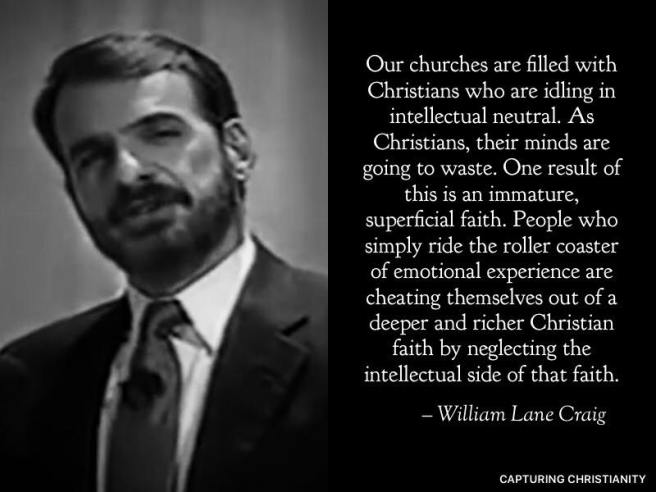
Dr. William Lane Craig says churches aren't preparing Christians to give an answer
Dr. W. L. Craig: churches don’t prepare Christians to answer skeptics

Let’s look at the table of contents of my favorite introduction to Christian apologetics, which is “Is God Just a Human Invention?” written by Sean McDowell and Jonathan Morrow.

In that book, you will find 18 topics.

  1. Is Faith Irrational? (Commentary by: Gregory Koukl)
  2. Are Science and Christianity at Odds? (Commentary by: John Warwick Montgomery)
  3. Are Miracles Possible? (Commentary by: Gary R. Habermas)
  4. Is Darwinian Evolution the Only Game in Town? (Commentary by: William A. Dembski)
  5. How Did the Universe Begin? (Commentary by: R. Douglas Geivett)
  6. How Did Life Begin? (Commentary by: Fazale R. Rana)
  7. Why Is the Universe Just Right for Life? (Commentary by: Jay W. Richards)
  8. Has Science Shown There Is No Soul? (Commentary by: Dale Fincher and Jonalyn Fincher)
  9. Is God Just a Human Invention? (Commentary by: Garry DeWeese)
  10. Is Religion Dangerous? (Commentary by: Douglas Groothuis)
  11. Does God Intend for Us to Keep Slaves? (Commentary by: Paul Copan)
  12. Is Hell a Divine Torture Chamber? (Commentary by: Frank Turek)
  13. Is God a Genocidal Bully? (Commentary by: Clay Jones)
  14. Is Christianity the Cause of Dangerous Sexual Repression? (Commentary by: Kerby Anderson)
  15. Can People Be Good Without God? (Commentary by: Mark D. Linville)
  16. Is Evil Only a Problem for Christians? (Commentary by: Randy Alcorn)
  17. What Good Is Christianity? (Commentary by: Glenn S. Sunshine)
  18. Why Jesus Instead of the Flying Spaghetti Monster? (Commentary by: Darrell L. Bock)

Prominent atheist scholars are quoted in each chapter to introduce the challenges, and then scholarly arguments and evidence are presented to defend the Christian worldview. The language is simple enough, but the material is solid enough to use in a real debate. I would say that introductory books like this one are more than enough to equip you for everyone who will challenge you.

Why are these 18 topics important? Because these are the questions that atheists ask. These are the questions that cause Christians to leave the faith. These are the questions that your children will face in high school and college, which might cause them to leave the faith.

Let’s start with chapter one. One of the most prominent arguments by atheists is that faith is irrational. This chapter allows you to define faith using the Bible’s definition of faith, which relies on logic and evidence.

Atheists also say that Christianity is at war with science. In chapter 2, they discuss the history of science and how Christianity provided the framework that allowed scientific method to take root and flourish.

Atheists like to claim that miracles are impossible. Chapter 3 defends the view that God, if he exists, is capable of interacting with his created world.

Atheists love to put forward Darwinism as means to deny that God is the designer of life. Chapter 4 explains the concept of intelligent design, and why intelligent design is a better explanation for the history of life.

Atheists love to talk about how the universe has always existed, and there’s no need for a Creator. Chapter 5 contains a philosophical argument that is supported by mainstream science to argue that the universe had a beginning, just like the Bible says.

Atheists love to argue that life can emerge from non-life, and the process is simple. Chapter 6 is written by a biochemist, and it takes a look at the real complexity of the simplest living cell.

Atheists like to argue that the universe itself is just an accident, and there is no need for a Designer. Chapter 7 introduces the scientific evidence for fine-tuning and habitability.

Atheists like to say that there is no soul and no afterlife. Chapter 8 gives some arguments for the existence of the soul.

Atheists like to argue that Christians invent God because God makes them feel good. But chapter 9 explains that having an all-powerful God who can hold humans accountable is the last thing any human would want to invent.

Atheists like to talk about how religion, with it’s habit of teaching to believe in things that can’t be tested, causes religious people to do a lot of harm. Chapter 10 takes a look at the real record of Christianity as a force for good in the world.

Atheists like to talk about slavery in the Bible. Chapter 11 talks about what the Bible really says, and provides some rational responses to the accusation.

Atheists like to talk about eternal punishment in Hell isn’t a just punishment for just getting a few questions wrong on a theology exam. Chapter 12 provides an explanation and defense of the concept of Hell.

Atheists love to talk about how God commanded the Israelites to attack their enemies in the Bible. Chapter 13 explains who their enemies really were, and what was really happening in those wars.

Atheists feel that unrestricted sexual activity is very healthy and normal, and that the Biblical prohibitions outside of male-female marriage are repressive and unhealthy.  Chapter 14 explains why God has these rules in place, and supports his rules with evidence.

Atheists love to assert that they don’t need God, because they can behave morally on their own. Chapter 15 explains how to answer this claim by talking about how well atheism grounds objective moral values, objective moral duties, free will and moral accountability: the minimum requirements for objective morality.

Atheists think that the mere existence of natural disasters and human immorality are incompatible with the God of the Bible. Chapter 16 explains why this argument doesn’t work, and why even the concept of evil requires God to exist.

I have an atheist friend in my office who can’t defeat my scientific arguments for the origin of the universe, the fine-tuning and the origin of life. But still, he says to me, even if God exists, why would that matter to my life? Chapter 17 explains what difference Christianity makes in a person’s life.

Atheists think that the life of Jesus has no relevance to their life, and that he has nothing to offer them anyway. Chapter 18 explains the uniqueness of Jesus and explains why his resurrection is relevant to our lives today.

It’s important to understand that this book is not on the level of A. W. Tozer, G.K. Chesterton, Francis Chan, John Piper, etc. Those authors write for a Christian audience and therefore they do not equip you to answer realistic challenges from non-Christians. But the apologetics book we looked at actually equips you to answer challenges from non-Christians using logical arguments and evidence from mainstream history and science. You can use the material in that book in discussions outside the confines of your home and your church.

Thinking practically about the gospel with an illustration from a war movie

The city of Mogadishu, in Somalia, Africa

I decided to re-post one of my favorite posts for Memorial Day.

First, let’s get an overview that helps us understand the context and goals of the mission we are going to discuss.

The scene is set in Somalia, Africa, in 1992. There a civil war between two warlords: Ali Mahdi and Mohammed Farah Aidid. The war has destroyed agricultural operations, and the people are starving. The United Nations are trying to help, but Aidid hijacks the food from UN aircraft so that he can use the food to gain control of the people. Hundreds of thousands of Somalis are dying of starvation. The UN requests American military forces to secure the air-dropped supplies so they can be distributed to the starving people.

In December 1992, President George H.W. Bush answers the call, sending 25,000 troops to Somalia to protect the food from the Somali warlords. However, in 1993, Bill Clinton is elected. He orders that the number of U.S. troops be reduced to 12,000. Following an attack by Aidid on Pakistani peace-keepers, the U.N. issues a resolution to capture those responsible. The U.S. armed forces have the arms and training to battle evil, so they get the call to capture Aidid and his lieutenants.

In late August 1993, Task Force Ranger is deployed to Mogadishu to capture Aidid and his lieutenants at the Olympic Hotel. The U.S. force consists of 440 troops from the Army Rangers and Army Delta Force special forces, commanded by General William Garrison. Garrison requested light armored units (Bradley Infantry Fighting vehicles) that would offer more protection than the unarmored HMMWV Humvees. Garrison was denied the light armor by the Clinton administration. Garrison requested heavier air support (AC-130 Spectre gunships) that would offer better fire support than the UH-60 Blackhawk miniguns. Garrison was denied the air support by the Clinton administration. The Clinton administration did not want the American forces to appear too heavily armed for the peace-keeping role.

The actual mission turned out to be much harder than it needed to be, because of the resources denied by the Clinton administration. Although the Aidid lieutenants were captured, Aidid himself escaped. Eighty-four American soldiers were wounded. Eighteen American soldiers were killed, and their bodies were dragged through the streets of Mogadishu. This was shown over and over by the media, and it undermined American resolve to help the Somali people. As a result, Clinton had the excuse he needed to retreat the American military.

(Source: Nova Online)

Two heroes lost their lives

Today, I want to talk about two of the men who lost their lives in Operation Gothic Serpent. They are Master Sergeant Gary I. Gordon and Sergeant First Class Randall D. Shughart – a Delta Force sniper team.

Here is a clip from the movie Blackhawk Down, which shows what happened to them:

The pilot of the downed Blackhawk was protected by the two men who volunteered to go in after him. They requested that they be inserted at the crash site, even though they knew that reinforcements were likely not going to be there in time to save them. They made the request to go and help the pilot three times before being allowed to go in. Their first two requests were denied by their commanding officer, because the odds against their survival were so overwhelming. The rescued pilot was later released by his captors, and the two heroes were awarded the Medal of Honor for their brave actions.

A Congressional Medal of Honor

Here is a description of the requirements to be awarded a Medal of Honor:

The Medal of Honor is the highest military decoration that may be awarded by the United States government. It is presented by the President of the United States, in the name of Congress, and is conferred only upon members of the United States Armed Forces who distinguish themselves through conspicuous gallantry and intrepidity at the risk of life above and beyond the call of duty:

  • While engaged in action against an enemy of the United States;
  • While engaged in military operations involving conflict with an opposing foreign force; or
  • While serving with friendly foreign forces engaged in an armed conflict against an opposing armed force in which the United States is not a belligerent party.

You can read the official details of their actions.

The point of this post

It is important for Christians to be familiar with real-world examples of people giving their lives in order to save the lives of others. When we see real-world examples of self-sacrifice, it helps us to understand what Jesus really achieved for us, and what he must have felt making that hard choice to volunteer to go in and rescue us. In general, my philosophy when it comes to the Bible is to make every effort to connect what the Bible says to the real world. We must not push Christianity into some far-off world of piety and feelings. We must make connections to real evidence and real life, so that what the Bible says becomes practical, and so that we have a deep friendship with and sympathy for God revealed in Jesus Christ. In real life, being willing to give your life to save someone else is hard. Understanding how that really happens will help us to value what Jesus has done for us.

Bible verses

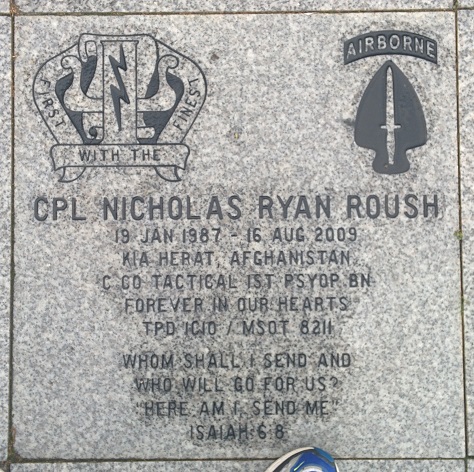
I saw this verse on the ground outside the Airborne & Special Operations Museum in Fayetteville, NC, where I went for my summer vacation in 2015.

Isaiah 6:8:

8 Then I heard the voice of the Lord saying, “Whom shall I send? And who will go for us?”

And I said, “Here am I. Send me!”

Here is the picture I took (yes, that is my running shoe):

“Here am I, send me” Isaiah 6:8

When confronted with an opportunity to imitate Christ in his self-sacrifice, we should think less about ourselves and our own desires, and take the opportunity to serve others effectively. We do not do what makes us happy, and we do not pursue fun and thrills. We do what heals, we do what helps others. We do not push away our responsibility to imitate Christ by caring for those in danger. Christianity is not just about “not doing bad things”. It’s the good things you do because of your relationship with Jesus that show your real allegiance, and give you the experience of being a Christian in deed.

And here is another good verse:

John 15:13:

13 Greater love has no one than this: to lay down one’s life for one’s friends.

If you get a chance to watch the movie Blackhawk Down, then do so. I highly recommend it. You can also read the book that the movie is based on.

I love the Medal of Honor books by Edward F. Murphy. He writes about all the people who have been awarded the Medal of honor in different wars: World War II, the Korean War, and the Vietnam War.

If you check my reading list, you’ll find that I usually read two military books for every one book on another subject.