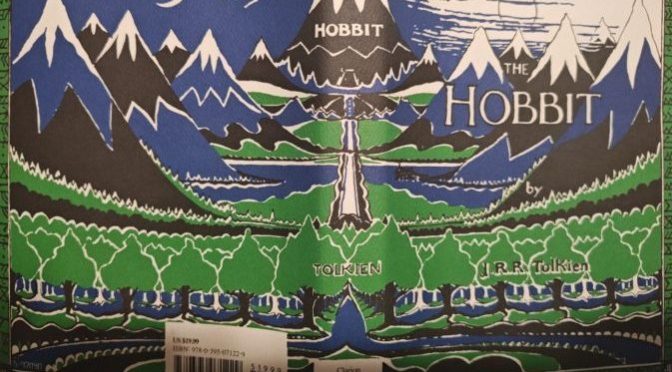
When I was a child, I read J.R.R. Tolkien’s “The Hobbit” and it changed my life

Since I mentioned “The Hobbit” in my biographical page at the top of the blog, I thought it might be worth explaining what I like about it. I still listen to my favorite chapter from it quite often before bed, to put me to sleep. If it doesn’t work, I listen to other chapters. But why choose that book? Well, because The Hobbit had a huge impact on me when I was growing up.

So, the first thing to say is that I didn’t grow up in a home with parents who had any plan for me. They were not involved in engineering me into anything. They just wanted good grades, and their method of getting that was yelling at me on report card day, then forgetting about school entirely, a few days later. As a result, I had to find my own morality and wisdom. The main things I read for that were the Bible, and later on, British literature, like Shakespeare and Spenser. But I’ll always remember the first “big” book that I ever read, and that was the “The Hobbit”.

The Cover

I noticed that there was a new printing of the book with the same cover design as the one that I read when I was small. I managed to get a gift copy of it from Desert Rose for my birthday. What I liked about the cover was the trees. If you look at the cover, there are multiple levels of trees, and you can see that the forest is deep, and you can’t see very far into it. I really liked that as a child. Somehow, that picture on the cover made me think about adventure, and then when I read the book, that really inspired me with the idea of going far away to earn my fortune. I remember that I didn’t read this book for school. I got it from the library.

My favorite chapter

My favorite chapter of “The Hobbit” is “Barrels Out of Bond”. That’s not the most popular chapter. But there is a phrase that appears in that chapter that’s also in the cover blurb from the first edition:

Bilbo Baggins was a hobbit who wanted to be left alone in quiet comfort. But the wizard Gandalf came along with a band of homeless dwarves. Soon Bilbo was drawn into their quest, facing evil orcs, savage wolves, giant spiders, and worse unknown dangers. Finally, it was Bilbo, alone and unaided, who had to confront the great dragon Smaug, the terror of an entire countryside

Did you notice that phrase, “alone and unaided”? I have it on my Twitter profile for my location. It comes from the “Barrels out of Bond” chapter.

So, let’s talk about the overall plot of the book. The plot is that a famous wizard named Gandalf asks Bilbo the hobbit to accompany a group of dwarves on an adventure. His job is to be the burglar, because hobbits are small and sneaky. They travel along until they reach a dark forest called Mirkwood. The dwarves are captured by the inhabitants of the forest – a band of wood elves. Bilbo is able to avoid capture, by slipping on his ring of invisibility that he found earlier. He follows the dwarves into the cave of the wood elves, because he doesn’t want to leave them behind. So, he gets stuck in the cave, wandering around, stealing food, and trying to keep from getting discovered and caught. All while trying to think about how to help the dwarves escape, and get on with their journey.

And then we find this passage:

“I am like a burglar that can’t get away, but must go on miserably burgling the same house day after day,” he thought. “This is the dreariest and dullest part of all this wretched, tiresome, uncomfortable adventure! I wish I was back in my hobbithole by my own warm fireside with the lamp shining!” He often wished, too, that he could get a message for help sent to the wizard, but that of course was quite impossible; and he soon realized that if anything was to be done, it would have to be done by Mr. Baggins, alone and unaided.

You can listen to the whole chapter here.

Bilbo isn’t your typical hero. He isn’t tall. He doesn’t have big muscles. He doesn’t beat up monsters because of his martial training. He doesn’t always know what to do. He sometimes makes mistakes. His strength is his character, especially his humility and selflessness. He isn’t motivated by the same selfish desires as many people are these days. He’s not motivated by greed. He’s not trying to impress anyone.

When I was small, it was important for me to be able to not fall into the traps of my environment. Finding out how to be different was important for me, because I was stuck in a home filled with negative talk and neglect, going to government schools, trapped in an socialist country. So, by reading books like the Hobbit, I was able to find virtues that were nowhere else in my environment.

More than the character was the idea of going on an adventure. That was one of the reasons why I left the country where I was born – so that I could come to America on a work permit, and seek my fortune. And keep seeking it, despite a lot of mistakes and setbacks. And not because outside people were leading me or helping me or engineering me to succeed. No family, no friends, no donations.

So the big lesson from the book  is that an adventurous spirit isn’t free – it has to be put into a boy by what he reads. You should make your children read “The Hobbit”. Put into their minds at a young age the idea that life is an adventure, that dangers and hardships are normal, and that character counts. Put into their minds that all goodness requires sacrifice. And to not worry so much about appearing important to other people.

How to respond to an atheist who complains about slavery in the Bible

I often hear atheists going on and on about how the Bible has this evil and that evil. Their favorite one seems to be slavery. Here are three things I say to atheists when they push this objection.

The Bible and slavery

First, you should explain to them what the Bible actually says about slavery. And then tell them about the person responsible for stopping slavery in the UK: a devout evangelical named William Wilberforce.

Here’s an article that works.

Excerpt:

We should compare Hebrew debt-servanthood (many translations render this “slavery”) more fairly to apprentice-like positions to pay off debts — much like the indentured servitude during America’s founding when people worked for approximately 7 years to pay off the debt for their passage to the New World. Then they became free.

In most cases, servanthood was more like a live-inemployee, temporarily embedded within the employer’s household. Even today, teams trade sports players to another team that has an owner, and these players belong to a franchise. This language hardly suggests slavery, but rather a formal contractual agreement to be fulfilled — like in the Old Testament.3

Atheism and moral judgments

Second, inform them that moral values are not rationally grounded on atheism. In an accidental universe, there is no way we ought to be. There is no design for humans that we have to comply with. There are no objective human rights, like the right to liberty (that would block slavery) or the right to life (that would block abortion). Although you may find that most atheists act nicely, the ones who really understand what atheism means and live it out consistently are not so nice.

Famous atheist Richard Dawkins has previously written this:

The total amount of suffering per year in the natural world is beyond all decent contemplation. During the minute that it takes me to compose this sentence, thousands of animals are being eaten alive, many others are running for their lives, whimpering with fear, others are slowly being devoured from within by rasping parasites, thousands of all kinds are dying of starvation, thirst, and disease. It must be so. If there ever is a time of plenty, this very fact will automatically lead to an increase in the population until the natural state of starvation and misery is restored. In a universe of electrons and selfish genes, blind physical forces and genetic replication, some people are going to get hurt, other people are going to get lucky, and you won’t find any rhyme or reason in it, nor any justice. The universe that we observe has precisely the properties we should expect if there is, at bottom, no design, no purpose, no evil, no good, nothing but pitiless indifference.

(“God’s Utility Function,” Scientific American, November, 1995, p. 85)

When atheists like Dawkins talk about morality, you have to understand that they are pretending. To them, morality is just about personal preferences and cultural conventions. They just think that questions of right and wrong are arbitrary. Things that are wrong in one time and place are right in another. Every view is as right as any other, depending on the time and place. That’s atheist morality.

What’s worse than slavery? Abortion!

Third, you should ask the atheist what he has done to oppose abortion. Abortion is worse than slavery, so if they are sincere in thinking that slavery is wrong, then they ought to think that abortion is wrong even more. So ask them what they’ve done to oppose the practice of abortion. That will tell you how sincere they are about slavery.

Here’s atheist Richard Dawkins explaining what he’s done to stop abortion:

That’s right. The head atheist supports killing born children.

Knight and Rose Show #65: Choices and Character in James, Part 1

Welcome to episode 65 of the Knight and Rose podcast! In this episode, Wintery Knight and Desert Rose begin a two-part series studying the book of James in the New Testament. If you like this episode, please subscribe to the podcast, and subscribe to our YouTube channel. We would appreciate it if you left us a 5-star review on Apple Podcasts or Spotify.

Podcast description:

Christian apologists Wintery Knight and Desert Rose discuss apologetics, policy, culture, relationships, and more. Each episode equips you with evidence you can use to boldly engage anyone, anywhere. We train our listeners to become Christian secret agents. Action and adventure guaranteed. 30-45 minutes per episode. New episode every week.

Episode summary:

Wintery Knight and Desert Rose explore chapters 1 and 2 of the Book of James. They discuss the book’s author, James, the brother of Jesus, and his martyrdom. They examine themes such as endurance through trials, self-control, and faith vs. works. They also critique the prosperity gospel, warn against judging by appearances, and emphasize caring for orphans and widows, offering practical insights for living an authentic Christian life.

Outline and transcript

Here is a transcript of the show provided by TurboScribe AI. TurboScribe AI allows you to translate the transcript into many, many different languages. You can also export the transcript into many different formats, with optional timestamps.

Episode 65:

Speaker biographies

Wintery Knight is a black legal immigrant. He is a senior software engineer by day, and an amateur Christian apologist by night. He has been blogging at winteryknight.com since January of 2009, covering news, policy and Christian worldview issues.

Desert Rose did her undergraduate degree in public policy, and then worked for a conservative Washington lobbyist organization. She also has a graduate degree from a prestigious evangelical seminary. She is active in Christian apologetics as a speaker, author, and teacher.

Podcast RSS feed:

https://feed.podbean.com/knightandrose/feed.xml

You can use this to subscribe to the podcast from your phone or tablet. I use the open-source AntennaPod app on my Android phone.

Podcast channel pages:

Video channel pages:

Music attribution:

Strength Of The Titans by Kevin MacLeod
Link: https://incompetech.filmmusic.io/song/5744-strength-of-the-titans
License: https://filmmusic.io/standard-license