How will you marry and support a family as a conservative Christian?

I sometimes feel that I am very weird compared to other people when it comes to work. I have this terrible fear that the secular left will force me to choose between being a Christian and being able to earn enough money to not starve. In fact, this is one of the reasons why I never married, and never had children. And it’s only going to become more difficult for younger Christian men.

Here’s an interesting article that Randy posted from the Heritage Foundation, a conservative think tank.

It says:

CEOs tripping over themselves to prove how “woke” they are has become de rigueur, but the news that American Express subjected its employees last year to what can only be described as Marxist “re-education” sessions has struck a chord—and rightly so.

[…]It would seem, though, that AmEx doesn’t want to hear any dissent. One ex-employee, Brian Netzel, just filed a lawsuit against the company, alleging that he was fired for voicing his opposition to these sessions.

I’ve been blogging about how people get fired for being conservative and/or Christian from all sorts of big corporations, and not just in Big Tech. Even with good technical skills, it’s challenging to find a job where you can just earn money, and not have to deny your own convictions and worldview. That sort of thing is common in secular left regimes of the past and present, but I’m still getting used to it.

More:

As one of America’s top investigative journalists Christopher Rufo has reported, American Express has demanded that its employees map out their degree of privilege, determine whether they are in an oppressor or marginalized category, and then asks whites to act subordinately to members of minority categories.

AmEx’s workforce has even heard speakers demand that the company discriminate racially by charging black customers lower premiums.

Moreover, the company’s handouts lead employees to the group Critical Resistance, which advocates for the dismantling not just of police but also of the prisons system.

[…]Critical Resistance was founded in 1998 by three committed Marxists: Angela Davis, Ruth Wilson Gilmore and Rose Braz. Davis herself ran twice as Vice President on the Communist Party ticket.

American Express also brought in Khalil Muhammad to harangue its long-suffering employees about how capitalism is racist and steeped in “racist logics and forms of domination.”

I’ve written before about how the problems and solutions of BLM / CRT people are different than the problems and solutions of Christians. No Bible-believing Christian can sign off on BLM / CRT. Destroying the family and implementing Marxism are not the Bible’s solutions to the problems of wealth and poverty.

How are Christian men who reject BLM / CRT problems and solutions for the Bible supposed to survive in corporate America? And if they can’t keep a job, then how can they marry and afford to raise children? It seems like the man would have to compromise.

For example, a Christian man who marries and has children might:

  • mitigate job loss risks by cutting back on charitable giving
  • not have a public ministry under his own name
  • not participate in any serious discussions at work
  • learn to compartmentalize their faith, which can lead to secularism and eventually atheism (I’ve seen this happen)
  • be exposed to harm from leftists in community and schools

What makes this situation even harder is that the Christian man is all alone. Most churches have embraced a new feelings-based version of Christianity that agrees with the priorities of woke corporate America. Christians no longer defend the Bible. Instead, the new feelings-based Christianity says that people can do whatever they want and never be judged. There is a horror of making anyone feel bad by not agreeing with them about following their heart. And if that blows up in their faces, then it’s the fault of other people who made better decisions and got better results. This is the new feelings-based Christianity – moral standards and accountability are out, affirmation and non-judgement are in.

The new Christianity teaches that you determine God’s will for your life through your feelings. If it doesn’t work out, then no one can judge you or teach you to do better – because that might make you feel bad. And if you happen to have some abortions, frivolous divorces or fatherless kids along the way? Well, too bad for them – we wouldn’t want to lose our non-Christian friends by warning them about the likely consequences of their actions. The goal of the new Christianity is to never tell anyone that they should obey God instead of doing what they feel like doing. The goal is to feel good and be liked.

As a Christian man, what I have learned is that if I try to promote a Bible-based moral view in public, that not only will there be trouble from the corporate world, but there will also be trouble from the no-judgment Christians. In the corporate world, telling people that their problems are the result of their own actions will get you fired. In the church world, telling a single mother that her problems are the result of her own choices will get you thrown out of the church. You can’t tell people anything that places the blame for their actions on them, even if the Bible agrees with you.

So, as a Christian man, you have to lie about your convictions at work to keep your job, and you have to lie about your convictions in church to avoid the wrath of the feelings-Christians. You can’t teach any exclusive theological truth claims. That’s intolerant. You can’t teach any exclusive moral truth claims. That’s lacking compassion. Just where are Christian men supposed to go to say what we really think?

The no-judgement Christian crowd needs to understand that in order for Bible-based men to marry, they have to be able to hold down a job. We don’t take on additional responsibilities like marriage and children when it is hard enough already to put food on the table for ourselves and still be faithful to the Bible. If feelings-based people want Christian men to marry, they better dump this new feelings-based version of Christianity, and start doing actions to make it safe for Christian men to earn a living without compromising our convictions. Otherwise, Christian women can marry men who don’t have those convictions. See if that works out.

What criteria do historians use to get to the minimal facts about the historical Jesus?

Have you ever heard Gary Habermas, Michael Licona or William Lane Craig defend the resurrection of Jesus in a debate by saying that the resurrection is the best explanation for the “minimal facts” about Jesus? The lists of minimal facts that they use are typically agreed to by their opponents during the debates. Minimal facts are the parts of the New Testament that meet a set of strict historical criteria. These are the facts that skeptical historians agree with, totally apart from any religious beliefs.

So what are the criteria that skeptical historians use to derive a list of minimal facts about Jesus?

Dr. Craig explains them in this article.

Excerpt:

The other way, more influential in contemporary New Testament scholarship, is to establish specific facts about Jesus without assuming the general reliability of the Gospels. The key here are the so-called “Criteria of Authenticity” which enable us to establish specific sayings or events in Jesus’ life as historical. Scholars involved in the quest of the historical Jesus have enunciated a number of these critieria for detecting historically authentic features of Jesus, such as dissimilarity to Christian teaching, multiple attestation, linguistic semitisms, traces of Palestinian milieu, retention of embarrassing material, coherence with other authentic material, and so forth.

It is somewhat misleading to call these “criteria,” for they aim at stating sufficient, not necessary, conditions of historicity. This is easy to see: suppose a saying is multiply attested and dissimilar but not embarrassing. If embarrassment were a necessary condition of authenticity, then the saying would have to be deemed inauthentic, which is wrong-headed, since its multiple attestation and dissimilarity are sufficient for authenticity. Of course, the criteria are defeasible, meaning that they are not infallible guides to authenticity. They might be better called “Indications of Authenticity” or “Signs of Credibility.”

In point of fact, what the criteria really amount to are statements about the effect of certain types of evidence upon the probability of various sayings or events in Jesus’ life. For some saying or event S and evidence of a certain type E, the criteria would state that, all things being equal, the probability of S given E is greater than the probability of S on our background knowledge alone. So, for example, all else being equal, the probability of some event or saying is greater given its multiple attestation than it would have been without it.

What are some of the factors that might serve the role of E in increasing the probability of some saying or event S? The following are some of the most important:

(1) Historical congruence: S fits in with known historical facts concerning the context in which S is said to have occurred.

(2) Independent, early attestation: S appears in multiple sources which are near to the time at which S is alleged to have occurred and which depend neither upon each other nor a common source.

(3) Embarrassment: S is awkward or counter-productive for the persons who serve as the source of information for S.

(4) Dissimilarity: S is unlike antecedent Jewish thought-forms and/or unlike subsequent Christian thought-forms.

(5) Semitisms: traces in the narrative of Aramaic or Hebrew linguistic forms.

(6) Coherence: S is consistent with already established facts about Jesus.

For a good discussion of these factors see Robert Stein, “The ‘Criteria’ for Authenticity,” in Gospel Perspectives I, ed. R. T. France and David Wenham (Sheffield, England: JSOT Press, 1980), pp. 225-63.

Notice that these “criteria” do not presuppose the general reliability of the Gospels. Rather they focus on a particular saying or event and give evidence for thinking that specific element of Jesus’ life to be historical, regardless of the general reliability of the document in which the particular saying or event is reported. These same “criteria” are thus applicable to reports of Jesus found in the apocryphal Gospels, or rabbinical writings, or even the Qur’an. Of course, if the Gospels can be shown to be generally reliable documents, so much the better! But the “criteria” do not depend on any such presupposition. They serve to help spot historical kernels even in the midst of historical chaff. Thus we need not concern ourselves with defending the Gospels’ every claim attributed to Jesus in the gospels; the question will be whether we can establish enough about Jesus to make faith in him reasonable.

And you can see Dr. Craig using these criteria to defend minimal facts in his debates. For example, in his debate with Ehrman, he alludes to the criteria when making his case for the empty tomb.

Here, he uses multiple attestation and the criteria of embarrassment:

Among the reasons which have led most scholars to this conclusion are the following:

1. The empty tomb is also multiply attested by independent, early sources.

Mark’s source didn’t end with the burial, but with the story of the empty tomb, which is tied to the burial story verbally and grammatically. Moreover, Matthew and John have independent sources about the empty tomb; it’s also mentioned in the sermons in the Acts of the Apostles (2.29; 13.36); and it’s implied by Paul in his first letter to the Corinthian church (I Cor. 15.4). Thus, we have again multiple, early, independent attestation of the fact of the empty tomb.

2. The tomb was discovered empty by women.

In patriarchal Jewish society the testimony of women was not highly regarded. In fact, the Jewish historian Josephus says that women weren’t even permitted to serve as witnesses in a Jewish court of law. Now in light of this fact, how remarkable it is that it is women who are the discoverers of Jesus’ empty tomb. Any later legendary account would certainly have made male disciples like Peter and John discover the empty tomb. The fact that it is women, rather than men, who are the discoverers of the empty tomb is best explained by the fact that they were the chief witnesses to the fact of the empty tomb, and the Gospel writers faithfully record what, for them, was an awkward and embarrassing fact.

There are actually a few more reasons for believing in the empty tomb that he doesn’t go into in the debate, but you can find them in his written work. For example, in his essay on Gerd Ludemann’s “vision” hypothesis. That essay covers the reasons for all four of his minimal facts.

So, if you are going to talk about the resurrection with a skeptic, you don’t want to invoke the Bible as some sort of inerrant/inspired Holy Book. You want to look at it as a historical book, and use historical criteria to get to some facts that critical historians would accept. From that, it’s possible to make a case for the resurrection, which is the guarantee that the words of Jesus are authoritative. Including the words of Jesus where he describes the Bible as a whole as God’s revelation of Himself to his creatures.

Here is the approach I use when talking to non-Christian co-workers:

  1. Explain the criteria that historians use to get their lists of minimal facts
  2. Explain your list of minimal facts
  3. Defend your list of minimal facts using the criteria
  4. Cite skeptics who admit to each of your minimal facts, to show that they are widely accepted
  5. List some parts of the Bible that don’t pass the criteria (e.g. – guard at the tomb, Matthew earthquake)
  6. Explain why those parts don’t pass the criteria, and explain that they are not part of your case
  7. Challenge your opponent to either deny some or all the facts, or propose a naturalistic alternative that explains the facts better than the resurrection
  8. Don’t let your opponent attack any of your minimal facts by attacking other parts of the Bible (e.g. – the number of angels being one or two, etc.)

And remember that there is no good case for the resurrection that does not make heavy use of the early creed in 1 Corinthians 15:3-8. That passages is universally accepted as early, eyewitness testimony from Paul, and represents the core of early Christian beliefs about the death and resurrection of Jesus. Everyone who takes evidence seriously has to account for that early creed, which passes the historical tests I outlined above.

The best essay on the minimal facts criteria that I’ve read is the one by Robert H. Stein in “Contending with Christianity’s Critics“. It’s a good short essay that goes over all the historical criteria that are used to derive the short list of facts from which we infer the conclusion “God raised Jesus from the dead”. That whole book is really very, very good.

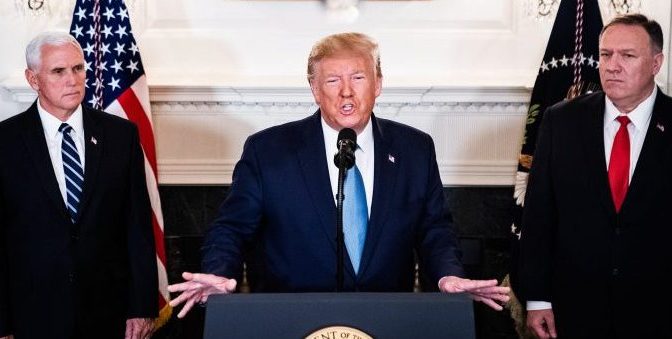
Who has the better record on foreign policy? Donald Trump or Joe Biden?

Originally posted 10/26/2020. Re-posting for 9/11 anniversary. We used to have a president who was good at foreign policy. Now we don’t.

Christians often like to try to make elections about a single issue, typically abortion. I’m pro-life, and opposing abortion is important to me. However, my goal is to get the election result I want in the real world, not just to be right in my own mind. So, I think conservatives should be able to discuss many different issues, like economics, energy, job creation, health care, education, etc. persuasively.

One issue you can use to convince people to vote Republican is foreign policy. Has Trump got a good record on foreign policy? Is it better or worse than Joe Biden’s record? Let’s take a look.

It’s always a good thing when a leader is able to make peace between warring countries. Trump is actually really good at this.

The Federalist explains:

Sudan will be removed from the State Sponsors of Terrorism list and will begin a partnership with the United States and Israel, President Donald Trump announced on Friday.

[…]The agreement comes just weeks after Trump secured two other historic peace deals in the Middle East through the signing of The Abraham Accords with Bahrain and the United Arab Emirates, which established full diplomatic relations of the countries with Israel. These deals facilitated by the Trump Administration are meant to bring “stability, security, and prosperity” in the region.

[…]Trump granted Sudan’s removal from the terrorism list after the nation paid “$335 million to compensate American victims of past terror attacks and their families.”

In addition to those deals, Trump’s diplomatic team just brokered a deal to get Armenia and Azerbaijan to stop shooting at each other.

The Wall Street Journal explains:

Armenia and Azerbaijan, which have spent nearly a month engaged in a violent conflict in the Nagorno-Karabakh region, have agreed to a humanitarian cease-fire, the U.S. and the two Caucasus neighbors said Sunday afternoon.

The cease-fire, based on commitments made in Moscow earlier this month, will take effect at 8 a.m. local time on Monday, according to the joint announcement.

[…]Sunday’s announcement follows a series of meetings in Washington aimed at preventing the long-simmering conflict between the two former Soviet republics from expanding to the wider region.

Trump didn’t start any new wars in his first 4-year term, and kept his promises about bringing troops home. That’s a lot better than Joe Biden, who was VP during THREE failed US interventions in Egypt, Libya and Syria. And the Obama-Biden administration pulled us out of Iraq, which caused the rise of the Islamic State caliphate. Trump actually had to clean up the ISIS mess, and he did: reducing them from a massive area of influence to a tiny area of influence.

Trump also likes to deter Iran, the number one sponsor of terrorism in the world. He pulled out of the Iran deal, which Biden championed. That deal gave Iran pallets of cash, and allowed them to work on developing nuclear weapons. In contrast, Trump has been very tough with Iran.

The Washington Examiner explains:

Qassem Soleimani, the Iranian military general who was killed in a U.S. airstrike in Iraq on Thursday, was responsible for the deaths of over 600 U.S. soldiers in Iraq.

“General Soleimani and his Quds Force were responsible for the deaths of hundreds of American and coalition service members and the wounding of thousands more,” the Pentagon said. “He had orchestrated attacks on coalition bases in Iraq over the last several months — including the attack on December 27th — culminating in the death and wounding of additional American and Iraqi personnel. General Soleimani also approved the attacks on the U.S. Embassy in Baghdad that took place this week.”

The Department of Defense added that the strike against Maj. Gen. Qassim Soleimani, the leader of the Quds Force, the extraterritorial wing of the Islamic Revolutionary Guard Corps, “was aimed at deterring future Iranian attack plans.”

And just this past week, Trump continued to sanction Al Qaeda leaders.

Sky News reports:

The man believed to be al Qaeda’s second-in-command has been killed, Afghan security forces have said.

Abu Muhsin al-Masri was on the FBI’s most wanted list and was charged with conspiracy to kill US nationals.

[…][Al-Masri] had also been charged in America with providing material support and resources to a foreign terrorist organisation.

Very good, and much better than Joe Biden, who seems to be always wrong on foreign policy.

The Washington Examiner again:

In his 2014 memoir, Duty, former Defense Secretary Robert Gates famously shared his view that Biden, then the vice president and previously chairman of the Senate Foreign Relations Committee, had been wrong about “nearly every major foreign policy and national security issue over the past four decades.”

[…]Early on Jan. 7, Biden was savaging Trump as “dangerously incompetent” for the strike that had killed Islamic Revolutionary Guard Corps terrorist leader Gen. Qassem Soleimani a few days earlier. Biden claimed that Trump was close to starting an “endless war in the Middle East” and that “this outcome of strategic setbacks, heightened threats, chants of ‘Death to America’ once more echoing across the Middle East, [and] Iran and its allies vowing revenge — this was avoidable.”

None of Biden’s predictions ever materialized, because he knows less about foreign policy than my keyboard.

Biden is terrible on Osama Bin Laden and the Cold War:

This is the man who once tried to dissuade Obama from his operation against terrorist mastermind Osama bin Laden; who supported the Iraq War and said in 2003, “I voted to go into Iraq, and I’d vote to do it again”; and who vocally opposed President Ronald Reagan’s military buildup and the Strategic Defense Initiative, which helped bring down the Soviet Union.

The Obama/Biden administration created ISIS by retreating from Iraq:

Biden claimed he had atoned for his Iraq War vote by spearheading Obama’s 2011-2012 withdrawal from Iraq. But that withdrawal was a disaster, and it led to the rise of the Islamic State (ISIS).

Joe Biden was also part of the administration that traded FIVE top Taliban commanders for Private Bowe Bergdahl. Bergdahl put his fellow soldiers in danger when they had to go searching for him, after he deserted his post. And then there was the Benghazi scandal, when the Obama-Biden administration abandoned their people when they came under attack by terrorists. Then they blamed the attack on a YouTube video.

We shouldn’t put someone with a bad record on foreign policy – Biden – into the White House, when we can have someone with a good record on foreign policy instead: Trump.