Physicist Michael Strauss discusses Christianity and science at Stanford University

This is one of my favorite lectures.

The lecture:

Dr. Strauss delivered this lecture at Stanford University in 1999. It is fairly easy to understand, and it even includes useful dating tips.

Here is a clip:

The full video can be watched on Vimeo:

Summary:

What does science tell us about God?
– the discoveries of Copernicus made humans less significant in the universe
– the discoveries of Darwin should that humans are an accident
– but this all pre-modern science
– what do the latest findings of science say about God?

Evidence #1: the origin of the universe
– the steady state model supports atheism, but was disproved by the latest discoveries
– the oscillating model supports atheism, but was disproved by the latest discoveries
– the big bang model supports theism, and it is supported by multiple recent discoveries
– the quantum gravity model supports atheism, but it pure theory and has never been tested or confirmed by experiment and observation

Evidence #2: the fine-tuning of physical constants for life
– there are over 100 examples of constants that must be selected within a narrow range in order for the universe to support the minimal requirements for life
– example: mass density
– example: strong nuclear force (what he studies)
– example: carbon formation

Evidence #3: the fine-tuning of our planet for habitability
– the type of galaxy and our location in it
– our solar system and our star
– our planet
– our moon

It’s a good lecture explaining a couple of basic arguments for a cosmic Creator and Designer. If you add the origin of life and the Cambrian explosion (Stephen C. Meyer’s arguments), then you will be solid on the basic scientific arguments for a Creator and Designer of the universe.

Positive arguments for Christian theism

Secular left feminist Sarah Stankorb explains why women leave Christianity

I sometimes read articles from mainstream conservative pastors and theologians. One of these is the famous Doug Wilson who blogs at Blog and Mablog. Well, recently he was attacked by a secular left feminist named Sarah Stankorb. I looked over her recent articles, and a pattern emerged about what she – and the women she writes about – think that Christianity is about.

Here’s an article entitled “These Evangelical Women Are Abandoning Trump and Their Churches”.

She talks about a woman named Katie Loveland, who leaves her church for the following reasons:

  1. If a church allows a man to act like a fool towards women, then Christianity is false.
  2. If a church allows a man who has passed a background check and holds a concealed carry permit to be armed so he can protect church members from attacks like this one, then Christianity is false.
  3. If Christians support a politician who has a pro-life record of demonstrated achievements over a politician who promises to remove all state and local restrictions on abortion from conception to birth, then Christianity is false.

And another woman named Elaina Ramsey, and her reasons for rejecting Christianity:

  1. If Christianity requires you to disagree with your gay and queer friends, then Christianity is false.
  2. If Christians refuse to marry you because you’ve been raped, then Christianity is false.
  3. If the Bible records (and condemns) the rape of Bathsheba by David, then Christianity is false.
  4. If Christianity teaches that murdering humans is wrong, and science says that the unborn are human, then Christianity is false.

And more about another woman named Deirdre Sugiuchi, and her reasons for rejecting Christianity:

  1. If your father claims to be a Christian and spanks you, then Christianity is false.
  2. If you are sent to an abusive Christian reform school for being rebellious, then Christianity is false.
  3. If Christianity feels anti-gay, anti-black or anti-woman, then Christianity is false.
  4. If the United States opposes Al Qaeda for carrying out the 9/11 attack, then Christianity is false.

Are you seeing a pattern here?

It turns out that a lot of emotion-based people claimed to be Christians and were accepted as “Christian”, without any rational basis for believing it. And later on, when Christianity made them feel bad about being reckless and irresponsible, or when it loses them non-Christian friends, then they abandoned it. It’s not that they discovered that Christianity is illogical. It’s not that they discovered evidence to falsify Christian truth claims. Their stated reasons for leaving Christianity are entirely subjective. And none of the reasons do the work of falsifying core Christian truth claims, such as God’s existence, the inspiration of the Bible, or the historicity of the resurrection of Jesus.

Just to review, here are some of the reasons why authentic Christians believe in Christian theism:

  • scientific evidence for the origin of the universe
  • scientific evidence for cosmic fine-tuning
  • scientific evidence for the origin of life
  • scientific evidence for habitability
  • scientific evidence for sudden origin of body plans
  • scientific evidence for molecular machines
  • scientific evidence for irreducible complexity
  • the argument from consciousness
  • the argument from objective morality
  • the historicity of the resurrection of Jesus

These arguments – and many more like them – are defended by scholars in books published by top academic presses. But I see no evidence that emotion-based ex-Christians have ever read such books. Why would they? They aren’t interested in forming their worldview based on objective reality. They aren’t interested in constructing a life plan where their desire for happiness comes second to following Jesus.

People who abandon Christianity because of feelings or experiences have not “left Christianity”. They just stopped faking being Christians. They were never actually Christian in the first place. To be a Christian in the first place, you have to know that Christianity is true. People who accept the arguments for Christianity listed above have just as many disappointments with God, bad experiences with Christians, and bad experiences with churches as people who were guided by their emotions and experiences. 

In fact, I personally know women who grew up fatherless, or had defective parents, or other setbacks. They got themselves into a lot of trouble with churches and immoral men, and yet today, not only are they solid Christians, but they actually take the lead in gospel enterprises, such as apologetics. Why? Because for them, the objective truth of Christianity was more important than their subjective feelings and experiences.

The differences between Christians and non-Christians is that Christians overlook bad feelings, shame and rejection, because we know facts don’t care about our feelings. For real Christians, the normal Christian life requires bad feelings, disappointments, bad experiences and rejection by non-Christians. We actually read the Bible, and so we expect bad things to happen to us.

Note: if you are relying on someone to act in a Christian way – say, as a marriage partner – then you’d better find out what kind of “Christian” they are, by asking them how they arrived at their beliefs. Do not marry a fake Christian who just reads romance novels and fiction. A person can’t determine the truth of Christianity by focusing on career, travel, entertainment, promiscuity, etc.

Controversial study on Rapid Onset Gender Dysphoria and transgenderism re-published

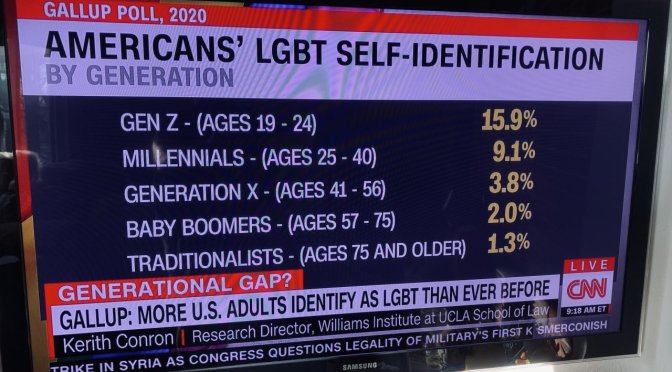
I blogged before about a study out of Brown University, which concluded that transgender behavior in children developed rapidly as a result of factors like peer pressures, social media, mental disorders, trauma, etc. I.e. – it’s not genetic. Brown University retracted it because some people complained. Well, it’s now been republished. Let’s see if there were any mistakes found.

Here’s how the study was first reported by Science Daily:

This month, a Brown University researcher published the first study to empirically describe teens and young adults who did not have symptoms of gender dysphoria during childhood but who were observed by their parents to rapidly develop gender dysphoria symptoms over days, weeks or months during or after puberty.

[…]The study was published on Aug. 16 in PLOS ONE.

Peer pressure / The Internet:

The pattern of clusters of teens in friend groups becoming transgender-identified, the group dynamics of these friend groups and the types of advice viewed online led her to the hypothesis that friends and online sources could spread certain beliefs.

[….]”Of the parents who provided information about their child’s friendship group, about a third responded that more than half of the kids in the friendship group became transgender-identified,” Littman said. “A group with 50 percent of its members becoming transgender-identified represents a rate that is more 70 times the expected prevalence for young adults.”

Mental disorders / traumatic events:

Additionally, 62 percent of parents reported their teen or young adult had one or more diagnoses of a psychiatric disorder or neurodevelopmental disability before the onset of gender dysphoria. Forty-eight percent reported that their child had experienced a traumatic or stressful event prior to the onset of their gender dysphoria, including being bullied, sexually assaulted or having their parents get divorced.

This article at The Federalist had a few examples to illustrate the conclusion of the study. I’ll pick two.

The study includes other eye-opening information, such as case studies of several children’s stories.

  • “A 14-year-old natal female and three of her natal female friends were taking group lessons together with a very popular coach. The coach came out as transgender, and, within one year, all four students announced they were also transgender.”

  • “A 14-year-old natal female and three of her natal female friends are part of a larger friend group that spends much of their time talking about gender and sexuality. The three natal female friends all announced they were trans boys and chose similar masculine names. After spending time with these three friends, the 14-year-old natal female announced that she was also a trans boy.”

I thought this quote from that article was interesting as well, given the culture’s obsession with “bullying”, which is a nebulous term that can mean actual bullying, or mere disagreement.

The study also may indicate that school “anti-bullying” programs typically created by LGBT activist organizations such as the Human Rights Campaign may help accelerate children identifying as transgender by pushing peers and authority figures to profusely express their support.

Coming out as transgender means instant fame and popularity, because you’re a victim, and everyone has to be nice to you… or else:

“Great increase in popularity among the student body at large. Being trans is a gold star in the eyes of other teens,” wrote one parent on the study response form. Another wrote, “not so much ‘popularity’ increasing as ‘status’ … also she became untouchable in terms of bullying in school as teachers who ignored homophobic bullying …are now all at pains to be hot on the heels of any trans bullying.”

Well, we’ve had a delay of 6 months for Littman to answer her critics and submit her work to even more extensive peer-review. And now the study has been re-published in PLOS One. So were there any mistakes in it? Does it still reach the same conclusions?

The College Fix reports:

Here’s what actually changed, according to PLOS One:

Other than the addition of a few missing values in Table 13, the Results section is unchanged in the updated version of the article.

So, the results didn’t change, and that means that the conclusions stand. So what was the problem originally? The problem originally was that the research didn’t confirm the biased politically correct views of the secular leftists.

She lost her consulting job anyway

However, that’s not the whole story. I looked up her interview from this week on Quillette, and she got to tell her side of the story.

Two parts stood out to me.

This part, where she contrasted the favoral response of research scientists and clinical scientists with the angry outbursts of a social worker:

The third presentation was the smallest and least research-oriented audience of the three. In contrast to the other presentations, the vast majority of the comments were made by one person who I later learned was a social worker. Again, I tried to answer politely with comments such as “Actually, the scientific literature says the following…”; “Actually, social media can be both a positive and a negative influence, not just positive…”; “Actually, this method of data collection has been used in many studies…” But because her interruptions were so frequent and argumentative in nature, it quickly created a tense and adversarial tone in the room.

This part, where she explains the mob that contacted her employers and got her fired:

The worst outcome for me personally was losing my consulting job over this issue. Shortly after my paper came out, some local clinicians who are opposed to my research wrote a letter of complaint about the work and demanded that I be fired immediately. It was an interesting demand, as my consulting work was unrelated to gender dysphoria. Nonetheless, I was called in to several meetings to answer questions about my research… After the meetings, the leadership explained to me that their decision not to renew my contract was not related to the quality of my work but rather that they, as an agency, needed to remain neutral and not take sides regarding the issues raised in the letter.

Do you know what this whole episode reminded me of? It reminded me of the stories of scientists who publish work critical of Darwinian evolution, and work critical of the man-made catastophic global warming hypothesis. It seems as if the viewpoints of secular leftists are decide by emotions, and then defended with rage, coercion and harassment. What does it say about secular leftism that they respond to scientific progress with rage and censorship?