How the Biden administration Democrats used woke evangelicals to lie to churches

Megan Basham is an evangelical Christian writer who has gotten my attention by her challenges to anti-conservative evangelicals, such as David French, Russell Moore, Tim Keller, etc. She’s written some amazing articles for the Daily Wire, but her latest is the most important one yet. In it, she talks about how Biden Democrats used woke evangelicals to spread propaganda to conservative churches.

Here’s the article:

In September, Wheaton College dean Ed Stetzer interviewed National Institutes of Health Director Francis Collins on his podcast, “Church Leadership” about why Christians who want to obey Christ’s command to love their neighbors should get the Covid vaccine and avoid indulging in misinformation.

[…] Stetzer is… the executive director of the Billy Graham Center and the editor-in-chief of Outreach media group. He was previously an editor at Christianity Today and an executive director at LifeWay, one of the largest religious publishers in the world. That’s to say nothing of the dozen-plus books on missions and church planting he’s authored.

During their discussion, Collins and Stetzer were hardly shy about the fact that they were asking ministers to act as the administration’s go-between with their congregants. “I want to exhort pastors once again to try to use your credibility with your flock to put forward the public health measures that we know can work,” Collins said. Stetzer replied that he sometimes hears from ministers who don’t feel comfortable preaching about Covid vaccines, and he advises them, in those cases, to simply promote the jab through social media.

“I just tell them, when you get vaccinated, post a picture and say, ‘So thankful I was able to get vaccinated,’” Stetzer said. “People need to see that it is the reasonable view.”

[…]Stetzer… ended the podcast by announcing that the Billy Graham Center would be formally partnering with the Biden administration. Together with the NIH and the CDC it would launch a website, coronavirusandthechurch.com, to provide clergy Covid resources they could then convey to their congregations.

Much earlier in the pandemic, as an editor at evangelicalism’s flagship publication, Christianity Today (CT), Stetzer had also penned essays parroting Collins’ arguments on conspiracy theories. Among those he lambasted other believers for entertaining, the hypothesis that the coronavirus had leaked from a Wuhan lab. In a now deleted essay, preserved by Web Archive, Stetzer chided, “If you want to believe that some secret lab created this as a biological weapon, and now everyone is covering that up, I can’t stop you.”

Only two days before Stetzer published his essay, Collins participated in a livestream event, co-hosted by CT. The outlet introduced him as a “follower of Jesus, who affirms the sanctity of human life” despite the fact that Collins is on record stating he does not definitively believe, as most pro-lifers do, that life begins at conception, and his tenure at NIH has been marked by extreme anti-life, pro-LGBT policies. (More on this later).

Megan has a lot more to say about other pious, charismatic useful idiots in the article.

Joe Carter

Here’s Joe Carter, who writes for the woke evangelical publication “The Gospel Coalition”:

Certainly The Gospel Coalition, a publication largely written for and by pastors, didn’t probe beyond the “facts” Collins’ offered or consider any conflicts of interest the NIH director might have had before publishing several essays that cited him as almost their lone source of information. As with CT, one article by Gospel Coalition editor Joe Carter linked the reasonable hypothesis that the virus might have been human-made with wilder QAnon fantasies. It then lectured readers that spreading such ideas would damage the church’s witness in the world.

Joe Carter has been far-left for some time. Another person who climbed the church hierarchy through piety and charisma, but doesn’t know anything about the real world.

Russell Moore

If you’re looking for the truth about how to handle a virus, you won’t get it from a pious, charismatic pastor:

[T]he Ethics and Religious Liberty Commission (ERLC), an organization funded by churches in the Southern Baptist Convention, the largest Protestant denomination in the U.S.

While a webinar featuring Collins and then-ERLC-head Russell Moore largely centered, again, on the importance of pastors convincing church members to get vaccinated, the discussion also moved on to the topic of masks. With Moore nodding along, Collins held up a basic, over-the-counter cloth square, “This is not a political statement,” he asserted. “This is not an invasion of your personal freedom…This is a life-saving medical device.”

You can read more about this in the latest announcement from the Centers for Disease Control. I’ve talked about Russell Moore often on this blog. I’m not sure how someone this far to the left was able to climb to the top rungs of the Southern Baptist hierarchy.

Tim Keller

Megan writes:

Former megachurch pastor Tim Keller’s joint interview with Collins included a digression where the pair agreed that churches like John MacArthur’s, which continued to meet in-person despite Covid lockdowns, represented the “bad and ugly” of good, bad, and ugly Christian responses to the virus.

Haven’t paid any attention to him recently because of his views on evolution, socialism, and critical race theory.

Hugh Ross

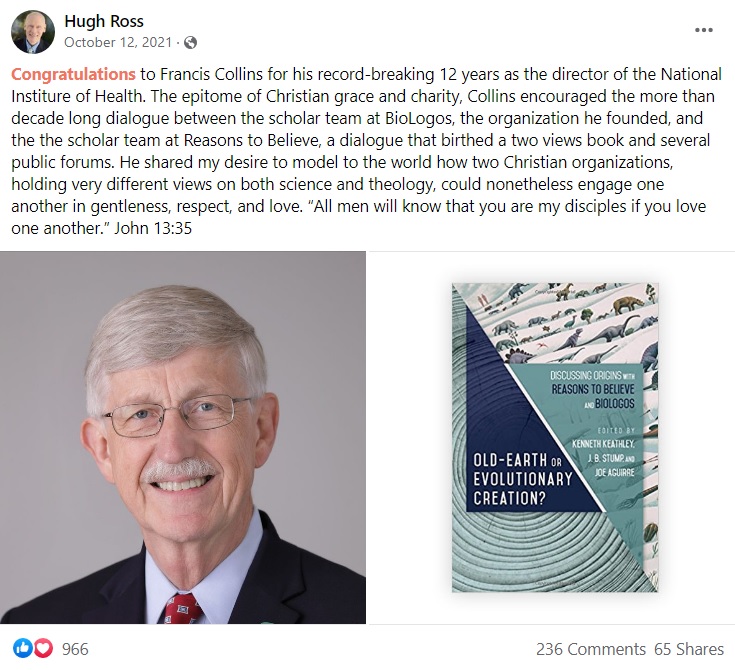
Although I am an old-Earth creationist like Hugh Ross, I was surprised to see him endorse a pro-abortion, pro-LGBT theistic evolutionist like Francis Collins:
Hugh Ross Francis Collins
Hugh Ross loves Francis Collins

I don’t think anyone would call Hugh Ross a very politically-aware person, but this was ridiculous. Francis Collins isn’t automatically a good person just because he has elite degrees and political power. Elite degrees and political power are great, but they don’t automatically make you a good Christian. Hugh Ross has never been very intelligent about policy or politics. He was careless about Collins and it is a huge mistake.

Further reading

If you don’t know much about Francis Collins, you should read this article about him from Evolution News. They go over his record on abortion, experimenting on aborted babies, LGBT activism and theistic evolution.

Oh, and here are some other names Megan names in a tweet:
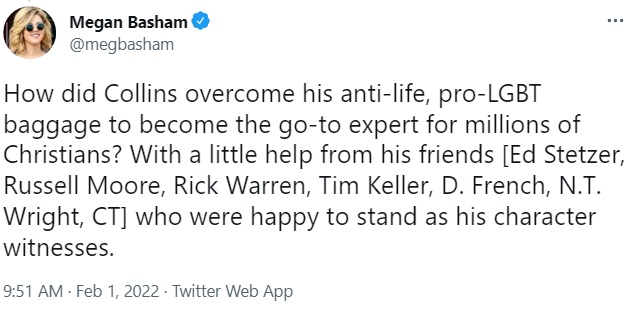
D. French is David French, who used to write for National Review, which has also lurched to the left.

Please don’t listen to these people. They’re wolves.

How the Biden administration raised oil and gas prices, and caused inflation

Before we look at the Biden administration’s actions on oil and gas, let’s review how prices are set in a free market economy. When supply goes down and demand stays the same, then prices rise. That’s because more people want to buy a resource that has become more scare, so sellers can raise the price. Now, has the Biden administration taken action to reduce the supply of oil and gas?

Well, consider what he did right after taking office in January 2021.

CNBC explains:

President Joe Biden on Wednesday signed a series of executive orders that prioritize climate change across all levels of government and put the U.S. on track to curb planet-warming carbon emissions.

Biden’s orders direct the secretary of the Interior Department to halt new oil and natural gas leases on public lands and waters, and begin a thorough review of existing permits for fossil fuel development.

[…]On his first day in office last week, Biden had the United States re-enter the Paris accord. He also cancelled the permit for the construction of the Keystone XL pipeline.

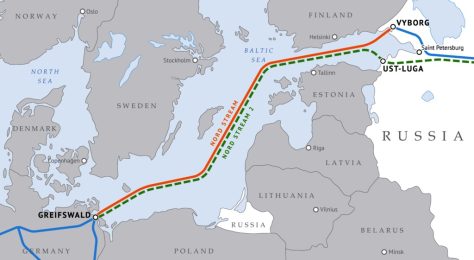
The Keystone XL pipeline would have allowed us to purchase oil and gas from Canada, which is much better than buying it from Russia, the Middle East, etc. Biden loves Russia. One might even say that he colludes with Russia to help them invade Ukraine – by helping them build their military. Biden gave approval for Russia to construct the Nord Stream 2 pipeline from Russia to Germany, so that they could sell all their oil and gas to European countries.

Nord Stream 2
Nord Stream 2

That’s what Democrat voters voted for in 2020: a pipeline for Russia, so they could sell oil and gas and invade Ukraine.

European countries are desperate for oil and gas, after having exchanged their conventional energy sources for green energy sources. Green energy sources produce low amounts of energy, and are inconsistent, while costing more than conventional energy sources. Since the green plan didn’t work out, the Europeans have to enrich Russia now. They make a show of being made at Russia, but they (like Biden) aren’t willing to develop their own energy.

How did American energy producers respond to having their lease applications denied, and their existing leases and pipelines canceled?

Biden’s moratorium on oil and gas leases won’t end fossil fuel extraction since industry leaders currently hold undeveloped leases. Drilling on public lands generates billions of dollars in revenue but comprises roughly a quarter of the country’s greenhouse gas emissions.

Oil and gas producers have strongly opposed Biden’s move and are expected to challenge the order in court.

“Penalizing the oil and gas industry kills good-paying American jobs, hurts our already struggling economy, makes our country more reliant on foreign energy sources, and impacts those who rely on affordable and reliable energy,” Anne Bradbury, president of the American Exploration and Production Council, said in a statement.

Environmental groups, who have long pushed for the changes sought by Biden, praised the orders.

Has Biden learned his lesson from the huge spike in gas prices? Is he concerned about the widespread inflation that is caused by the spike in energy prices?

Nope!

The Federalist notes:

CBS News revealed the Biden administration canceled more oil and gas leases across the country this week as soaring gas prices reached new heights Wednesday.

The Department of Interior canceled plans to drill in more than 1 million acres in Alaska’s Cook Inlet, arguing “lack of industry interest,” on top of canceling a pair of leases in the Gulf of Mexico over “conflicting court rulings.”

[…]The administration’s relentless animosity towards fossil fuels, showcased in its repeated cancelation of oil and gas projects, has chilled investment in the capital- and labor-intensive industry. This keeps production down despite rising demand at home and turmoil in markets abroad.

[…]In Alaska, upon inauguration Biden canceled leases in the Arctic National Wildlife Refuge, which is forecast to hold between 4 to 12 billion barrels of recoverable oil. He closed another 7 million acres from the state’s National Petroleum Reserve off from development last month.

What happens when investors see that the Biden administration is taxing, regulating and blocking oil and gas development? They say “we would do better investing our money elsewhere”. Oil and gas producers get the message very quickly, and they stop creating new energy sources. That’s how supply dries up. And when supply is reduced, prices go up.

Biden tried to fix the rising prices by getting Russia and the Middle East to drill more, and by stealing the strategic oil reserve, which is primarily designed for use during a crisis. But Biden considers his falling poll numbers a crisis. And begging our enemies to produce the oil that we should be producing seems right to him.

The president has turned to the nation’s emergency petroleum reserves for desperate political capital ahead of the November midterms… With no plans announced to restock the emergency supplies, Biden ordered the self-proclaimed “unprecedented” release of 1 million barrels of oil a day onto the market for the next six months beginning Sunday.

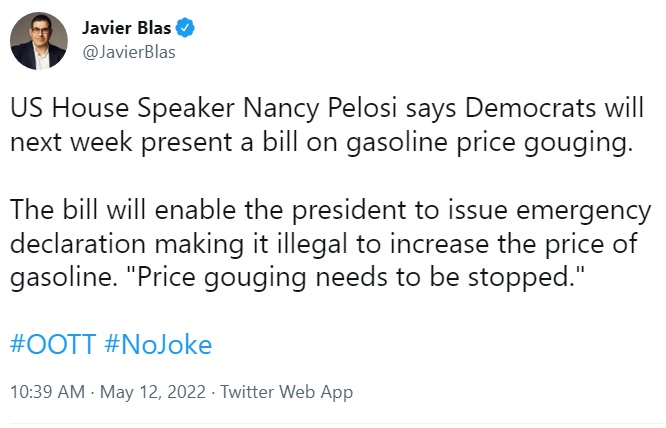
The new Democrat strategy is actually the old Democrat strategy used by Democrat President Jimmy Carter in the 1970s: to impose price controls on oil and gas:

Gas Lines
Gas Lines

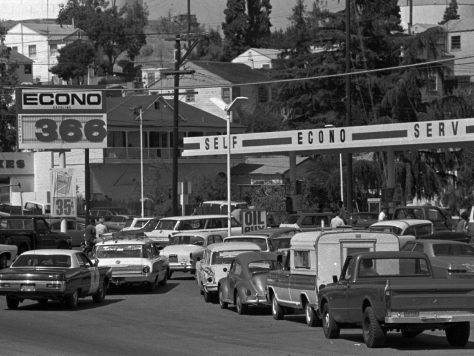
That led to massive gas lines in the 1970s, because suppliers shut down when they realized they couldn’t make enough money to stay in business. There was no money to be made in producing energy, so energy companies just slowed down or stopped producing. Would you go to work if the government took 80% of what you earned?

People in America would line up around the block for gas, and they could only get a certain limited amount. Gas was only sold during certain hours of the day.

Gas Lines
Gas Lines

I’m sure that the young people won’t have heard about the results of setting price controls, but it’s in the first few chapters of Thomas Sowell’s “Basic Economics”. But if their teachers have no ability in economics, then how would the student learn it? They can’t.

Is the definition of atheism “a lack of belief in God”?

First, let’s see check with the Stanford University Encyclopedia of Philosophy:

‘Atheism’ means the negation of theism, the denial of the existence of God.

Stanford University is one of the top 5 universities in the United States, so that’s a solid definition. To be an atheist is to be a person who makes the claim that, as a matter of FACT, there is no intelligent agent who created the universe. Atheists think that there is no God, and theists think that there is a God. Both claims are objective claims about the way the world is out there, and so both sides must furnish forth arguments and evidence as to how they are able to know what they are each claiming.

Philosopher William Lane Craig has some thoughts on atheism, atheists and lacking belief in God in this reply to a questioner.

Question:

In my discussions with atheists, they  are using the term that they “lack belief in God”. They claim that this is different from not believing in God or from saying that God does not exist. I’m not sure how to respond to this. It seems to me that its a silly word-play and is logically the same as saying that you do not believe in God.
What would be a good response to this?
Thank you for your time,

Steven

And here is Dr. Craig’s full response:

Your atheist friends are right that there is an important logical difference between believing that there is no God and not believing that there is a God.  Compare my saying, “I believe that there is no gold on Mars” with my saying “I do not believe that there is gold on Mars.”   If I have no opinion on the matter, then I do not believe that there is gold on Mars, and I do not believe that there is no gold on Mars.  There’s a difference between saying, “I do not believe (p)” and “I believe (not-p).”   Logically where you place the negation makes a world of difference.

But where your atheist friends err is in claiming that atheism involves only not believing that there is a God rather than believing that there is no God.

There’s a history behind this.  Certain atheists in the mid-twentieth century were promoting the so-called “presumption of atheism.” At face value, this would appear to be the claim that in the absence of evidence for the existence of God, we should presume that God does not exist.  Atheism is a sort of default position, and the theist bears a special burden of proof with regard to his belief that God exists.

So understood, such an alleged presumption is clearly mistaken.  For the assertion that “There is no God” is just as much a claim to knowledge as is the assertion that “There is a God.”  Therefore, the former assertion requires justification just as the latter does.  It is the agnostic who makes no knowledge claim at all with respect to God’s existence.  He confesses that he doesn’t know whether there is a God or whether there is no God.

But when you look more closely at how protagonists of the presumption of atheism used the term “atheist,” you discover that they were defining the word in a non-standard way, synonymous with “non-theist.”  So understood the term would encompass agnostics and traditional atheists, along with those who think the question meaningless (verificationists).  As Antony Flew confesses,

the word ‘atheist’ has in the present context to be construed in an unusual way.  Nowadays it is normally taken to mean someone who explicitly denies the existence . . . of God . . . But here it has to be understood not positively but negatively, with the originally Greek prefix ‘a-’ being read in this same way in ‘atheist’ as it customarily is in . . . words as ‘amoral’ . . . . In this interpretation an atheist becomes not someone who positively asserts the non-existence of God, but someone who is simply not a theist. (A Companion to Philosophy of Religion, ed. Philip Quinn and Charles Taliaferro [Oxford:  Blackwell, 1997], s.v. “The Presumption of Atheism,” by Antony Flew)

Such a re-definition of the word “atheist” trivializes the claim of the presumption of atheism, for on this definition, atheism ceases to be a view.  It is merely a psychological state which is shared by people who hold various views or no view at all.  On this re-definition, even babies, who hold no opinion at all on the matter, count as atheists!  In fact, our cat Muff counts as an atheist on this definition, since she has (to my knowledge) no belief in God.

One would still require justification in order to know either that God exists or that He does not exist, which is the question we’re really interested in.

So why, you might wonder, would atheists be anxious to so trivialize their position?  Here I agree with you that a deceptive game is being played by many atheists.  If atheism is taken to be a view, namely the view that there is no God, then atheists must shoulder their share of the burden of proof to support this view.  But many atheists admit freely that they cannot sustain such a burden of proof.  So they try to shirk their epistemic responsibility by re-defining atheism so that it is no longer a view but just a psychological condition which as such makes no assertions.  They are really closet agnostics who want to claim the mantle of atheism without shouldering its responsibilities.

This is disingenuous and still leaves us asking, “So is there a God or not?”

So there you have it. We are interested in what both sides know and what reasons and evidence they have to justify their claim to know. We are interested in talking to people who make claims about objective reality, not about themselves, and who then go on to give reasons and evidence to support their claims about objective reality. There are atheists out there that do make an objective claim that God does not exist, and then support that claim with arguments and evidence. Those are good atheists, and we should engage in rational conversations with them. But clearly there are some atheists who are not like that. How should we deal with these “subjective atheists”?

Dealing with subjective atheists

How should theists respond to people who just want to talk about their psychological state? Well, my advice is to avoid them. They are approaching religion irrationally and non-cognitively – like the person who enters a physics class and says “I lack a belief in the gravitational force!”.  When you engage in serious discussions with people about God’s existence, you only care about what people know and what they can show to be true. We don’t care about a person’s psychology.