Peer-reviewed medical journal blasts Facebook “fact checkers” for censorship

I’ve just about had it with Facebook’s “fact checkers”. In most cases, these are just card carrying Democrats with worthless degrees in grievance studies. They have limited real world experience. Their only credentials are promoting the Democrat party by censoring news and opinions that make the Democrats look bad. Even peer-reviewed medical journals are censored!

Here’s the story from The Federalist:

The editors of a peer-reviewed medical journal penned a scathing letter demanding that Facebook reevaluate its bogus third-party “fact-checking” processes after the journal was censored for publishing information about COVID-19 vaccine trials.

BMJ editors Fiona Godlee and Kamran Abbasi addressed the letter to Facebook creator and CEO Mark Zuckerberg with the intention of raising “serious concerns” about Facebook’s third-party “fact-checking” system.

According to the editors, one of the well-researched articles BMJ published on “a host of poor clinical trial research practices occurring at Ventavia,” one of the companies facilitating trials for Pfizer’s version of the COVID-19 vaccine, was suppressed by Facebook and censored with labels that directed readers to a “fact check” by the obscure website Lead Stories, which routinely issues fake fact-checks.

“Those trying to post the article were informed by Facebook that people who repeatedly share ‘false information’ might have their posts moved lower in Facebook’s News Feed. Group administrators where the article was shared received messages from Facebook informing them that such posts were ‘partly false,’” Godlee and Abbasi wrote.

The editors said that this “fact check,” which Facebook used to justify threats against users who shared the BMJ article, however, was “inaccurate, incompetent and irresponsible.”

[…]Godlee and Abbasi concluded their letter by demanding that Facebook, if it continues its censorship campaign against so-called “misinformation,” choose wiser and more competent organizations for fact-checking such as Cochrane, which reviews medical evidence on a regular basis.

This isn’t the only time that Facebook “fact checkers” have twisted the truth to protect the Democrat party. The most recent example was with the Rittenhouse trial.

Consider this article the New York Post:

Consider how Facebook, in particular, treated the circumstances surrounding Kyle Rittenhouse, the teen acquitted last week of all charges in the self-defense killings of two men and the shooting of another during last summer’s riots in Kenosha, Wis. Immediately after the incident occurred, and despite video evidence which made a self-defense charge instantly plausible, Facebook declared it a “mass murder” and under that justification blocked searches for Rittenhouse’s name and any content in “praise or support” for him on the site — including links to contribute to his legal defense and videos purporting to show Rittenhouse providing aid to protesters.

In other words, Facebook determined that the only speech allowed on its platform was to declare Rittenhouse’s guilt, not his innocence. Perhaps prompted by Facebook’s actions or merely in spite of them, PayPal cut off affiliation with fundraising efforts for Rittenhouse, and so did GoFundMe.

What were the facts in the Rittenhouse case? The jury heard all the facts, and they acquitted Rittenhouse. No “mass murder” there, just self-defense.

Previously, I wrote articles about Facebook’s bias against the Republican party.


Biden continues raising gas prices by canceling more oil and gas leases

I have been reading the Wall Street Journal a lot lately, trying to see when it might be a good time to buy back into the stock market. Normally, I look for a 30% drop before buying, and we are near that now. It’s below when Biden took office. He totally squandered Trump’s bull market. How? By handing out stimulus checks, and attacking the American oil and gas industry. And he’s not done.

Here’s the first article from the Wall Street Journal.

The Biden administration canceled plans to auction drilling rights in three regions off the U.S. coastline later this year, adding more friction to an uneasy relationship with the oil industry during a period of high gasoline prices.

The decision to cancel lease sales for two regions in the Gulf of Mexico and one off the coast of Alaska leaves oil-and-gas companies facing a blackout period of unknown length for access to new drilling spots in valuable offshore acreage.

A five-year schedule for offshore lease sales expires at the end of next month, and the Interior Department has yet to propose a new one. Canceling the pending sales with no new schedule yet proposed could mean the industry now faces years between successful federal offshore auctions.

“The lack of new lease sales will lower future supplies, which will keep energy prices high and drive inflation for years to come,” Marty Durbin, president of the energy arm of the U.S. Chamber of Commerce, said in a statement. “While some in the Administration have called for more domestic production, this action sends exactly the wrong signal to producers and markets.”

Biden has been in an all-out war against domestic energy production since the day he took office, canceling the Keystone XL pipeline and imposing a moratorium on new permits and leases for new drilling.  He’s fine with Russia getting a new pipeline, and he’d like to buy gas from communist Venezuela. But he doesn’t want Americans developing cleaner sources of energy at home. He’s doing everything he can to stop Americans from driving their cars and using heat and air conditioning, all in the name of global warming hysteria, which permeates his Chicken Little administration. This isn’t an accident. Raising prices on energy was done by design.

What can we expect from the party of global warming alarmism?

The Wall Street Journal explains:

From California to Texas to Indiana, electric-grid operators are warning that power-generating capacity is struggling to keep up with demand, a gap that could lead to rolling blackouts during heat waves or other peak periods as soon as this year.

[…]The risk of electricity shortages is rising throughout the U.S. as traditional power plants are being retired more quickly than they can be replaced by renewable energy and battery storage. Power grids are feeling the strain as the U.S. makes a historic transition from conventional power plants fueled by coal and natural gas to cleaner forms of energy such as wind and solar power, and aging nuclear plants are slated for retirement in many parts of the country.

Wind and solar power are not only more expensive than gas and nuclear, but they are also more inconsistent.

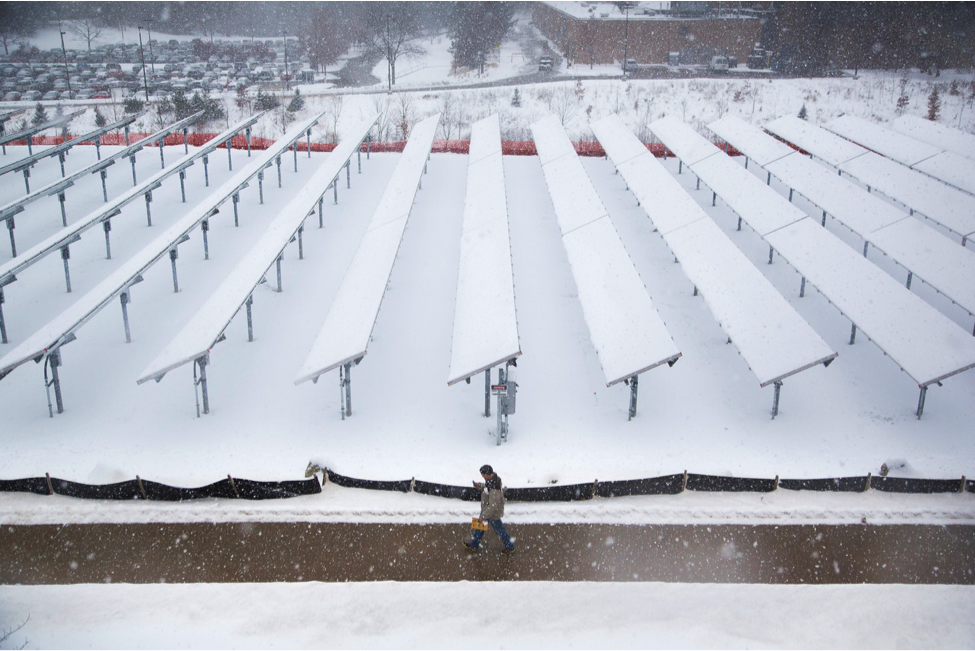
Here’s snow covering solar panels:

Snow on Solar Panels Green Energy

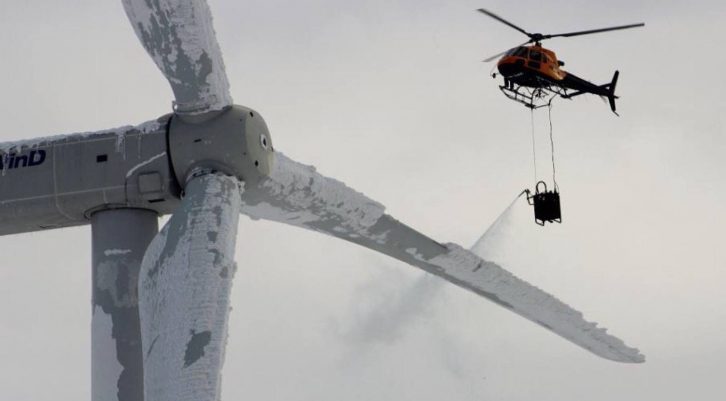
And ice freezing wind farms:

Environmentalists burning helicopter fuel to de-ice wind turbines one at a time

The problem with rising energy prices is that it is a drag on the economy – a separate source of inflation. Everything that is produced for sale to consumers is affected by higher energy costs. Especially things that have to be transported. It would be nice to see inflation addressed by raising interest rates. But because the Biden administration waited too long, that now carries the risk of recession. The next best option would be to lower the cost of energy by return to Trump’s “energy independence” policies. But Biden is totally opposed to that. Even if he changed course now, it would be months until energy prices were lowered.

It all seems as thought the Biden administration is making some sort of play to nationalize the energy industry, like Venezuela did. They’ll say “oh look, the private sector has failed. Now government needs to step in and rescue everyone”. That’s the way it usually plays out in communist countries. Nationalizing energy has caused massive shortages everywhere it’s been tried. Why think our communists are any different than the communists in other countries? They want power, and they don’t care if you have to lose your freedom and prosperity in order for them to get it.

What are undesigned coincidences, and how are they used in apologetics?

When you’re reading the Bible, you may find passages in one book that are mysterious on their own, but then they make sense if you add missing details from a parallel account from a different source inside or even outside the Bible. I think these “undesigned coincidences” are helpful for answering the question of that skeptics often ask: “is the Bible history or myth?” Let’s see some examples.

So, there are two kinds of undersigned coincidences. In the “internal” kind, the clearing up is done by another source in the same book. In the external kind, the clearing up is done by a source outside the same book.

Here’s an article from Apologetics UK with some internal examples:

In John 6:1-7, we are told:

Some time after this, Jesus crossed to the far shore of the Sea of Galilee (that is, the Sea of Tiberias), and a great crowd of people followed him because they saw the signs he had performed by healing the sick. Then Jesus went up on a mountainside and sat down with his disciples. The Jewish Passover Festival was near.When Jesus looked up and saw a great crowd coming toward him, he said to Philip, “Where shall we buy bread for these people to eat?” He asked this only to test him, for he already had in mind what he was going to do.Philip answered him, “It would take more than half a year’s wages to buy enough bread for each one to have a bite!”

Now, Philip is a fairly minor character in the New Testament. And one might, naturally, be inclined to wonder why Jesus hasn’t turned to someone a little higher in the pecking order (such as Peter or John). A partial clue is provided in John 1:44: “Philip, like Andrew and Peter, was from the town of Bethsaida.” Likewise, John 12:21 refers to “Philip, who was from Bethsaida in Galilee”

And what is so significant about Philip being from the town of Bethsaida? We don’t learn this until we read the parallel account in Luke’s gospel (9:10-17). At the opening of the account (verses 10-11) we are told, “When the apostles returned, they reported to Jesus what they had done. Then he took them with him and they withdrew by themselves to a town called Bethsaida, but the crowds learned about it and followed him. He welcomed them and spoke to them about the kingdom of God, and healed those who needed healing.”

And so, we are informed by Luke that the event was actually taking place in Bethsaida — the town from which Philip was from! Jesus thus turns to Philip, whom, he believed, would be familiar with the area. Notice too that Luke does not tell us that Jesus turned to Philip.

But it gets even more interesting still. In Matthew 11, Jesus denounces the unrepentant cities, saying, “Woe to you, Chorazin! Woe to you, Bethsaida! For if the miracles that were performed in you had been performed in Tyre and Sidon, they would have repented long ago in sackcloth and ashes.” The reader is left wondering what miracles were performed in these cities. We are not told in Matthew’s gospel. It is only in light of Luke’s account of the feeding of the five thousand (chapter 9), in which we are told of the event’s occurrence in Bethsaida, that this statement begins to make sense!

This one is pretty clever:

In Matthew 2 6:67-68, we read, “Then they spat in His face and beat Him; and others struck Him with the palms of their hands, saying, “Prophesy to us, Christ! Who is the one who struck You?”” This raises the natural question, why are they asking “Who hit you?” It is not until we read the parallel account in Luke’s gospel (22:64) that we learn that they had blindfolded him, thereby making sense of their taunts “Who hit you?”

Another one:

In Luke 23:1-4, w e read,
Then the whole assembly rose and led him off to Pilate. And they began to accuse him, saying, “We have found this man subverting our nation. He opposes payment of taxes to Caesar and claims to be Messiah, a king.”

So Pilate asked Jesus, “Are you the king of the Jews?”

“You have said so,” Jesus replied.

Then Pilate announced to the chief priests and the crowd, “I find no basis for a charge against this man.”
On the surface, this seems to be a rather strange declaration to make. Jesus has just declared Himself to be a King, and has been charged with subverting the nation and opposing paying taxes to Caesar. Why has Pilate found no basis for a charge against him?

The answer lies in the parallel account in John’s gospel (18:33-38):

Pilate then went back inside the palace, summoned Jesus and asked him, “Are you the king of the Jews?”

“Is that your own idea,” Jesus asked, “or did others talk to you about me?”
“Am I a Jew?” Pilate replied. “Your own people and chief priests handed you over to me. What is it you have done?”

Jesus said, “My kingdom is not of this world. If it were, my servants would fight to prevent my arrest by the Jewish leaders. But now my kingdom is from another place.”

“You are a king, then!” said Pilate.

Jesus answered, “You say that I am a king. In fact, the reason I was born and came into the world is to testify to the truth. Everyone on the side of truth listens to me.”

“What is truth?” retorted Pilate. With this he went out again to the Jews gathered there and said, “I find no basis for a charge against him.

It is only when you read John’s account that you learn that Jesus had told Pilate that “My kingdom is not of this world. If it were, my servants would fight to prevent my arrest by the Jewish leaders. But now my kingdom is from another place.”

And the same article has some external undesigned coincidences:

In Matthew 2:22, we are told:

But when [Joseph] heard that Archelaus was reigning in Judea in place of his father Herod, he was afraid to go there. Then after being waned by God in an dream, he left for the regions of Galilee…

Josephus’ Antiquities 17.3.1 tells us that the domain of Herod the Great was divided among his sons, with Archelaus having authority in Judea but not in Galilee, which was governed by his younger brother, Herod Antipas.

We also know that Archelaus had acquired quite a bloody reputation (e.g. Antiquities 17.13.1-2 and 17.9.3). The latter of these references describes how Archelaus slaughtered 3,000 Jews at Passover. Thus, Joseph decides not to return to Judea and, instead, goes further north to the regions of Galilee, governed by Herod Antipas.

And another one:

In Matthew 2:22, Archeleaus is reigning as king in Judea; in Matthew 27:2, Pilate is governor of Judea; in Acts 12:1, Herod is king of Judea; and in Acts 23:33, Felix is governor of Judea. This becomes extremely confusing.

But here’s the thing: Josephus attests to the accuracy of every one of these titles. Herod the Great was made King of Judea by Mark Anthony. Archelaus was deposed in the year 6 A.D., after only a ten-year reign, and a series of procurators ruled over Judea (of whom Pilate was fifth). The Herod of Acts 12 is Agrippa I. He was made king by Claudius Caesar. After his death, Judea was, once again, placed under the government of procurators (one of them being Felix).

And another one:

When Luke tells us of the riot in Ephesus, he reports that the city clerk tells the crowd that “There are proconsuls”. A proconsul is a Roman authority to whom a complaint may be taken. Normally, there was only one proconsul. Just at that particular time, however, there seems to have been two as a result of the assassination of Silanus (the previous proconsul) by poisoning in the Fall of AD 54, by the two imperial stewards at the urging of Nero’s mother. This event is independently documented by Tacitus in his Annals (13.1). Indeed, Luke’s accuracy has allowed historians to date the event which Luke narrates with incredible precision since we know when Silanus was poisoned.

If you think that these are clever, then share this post, and encourage your non-Christian friends and family to consider one of the many reasons why so many scholars have considered the New Testament books to be so reliable.

I wish that Christian parents and pastors were more thoughtful about how they present the Bible to young people. Instead of just saying “the Bible says” and praising blind faith acceptance of the Bible, why don’t we think a little harder, and look for some confirmation of the Bible from historical methods like undesigned coincidences, and from non-Biblical authors, and from archaeology, etc.? Surely adding more evidence for taking the Bible seriously is the right approach, if the goal is to be persuasive? It’s not like we’re see good results from the current “blind faith” approach to raising Christian children, right?