
Study: galactic habitable zone depends on fine-tuning of cosmological constant

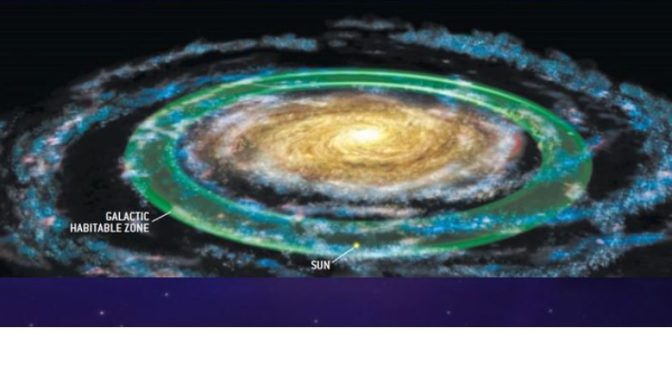
The galactic habitable zone (GHZ) is shown in green against a spiral galaxy
The galactic habitable zone (GHZ) is shown in green superimposed on a spiral galaxy

This is going to be old news to readers of this blog who are familiar with the Michael Strauss, Walter Bradley and Guillermo Gonzalez lectures on habitability and fine-tuning. But, it’s nice to see these ideas show up in one of the most prestigious peer-reviewed science journals in the world (if not the most prestigious).

Here’s the article from Science.

It says:

Scientists have known for several years now that stars, galaxies, and almost everything in the universe is moving away from us (and from everything else) at a faster and faster pace. Now, it turns out that the unknown forces behind the rate of this accelerating expansion—a mathematical value called the cosmological constant—may play a previously unexplored role in creating the right conditions for life.

That’s the conclusion of a group of physicists who studied the effects of massive cosmic explosions, called gamma ray bursts, on planets. They found that when it comes to growing life, it’s better to be far away from your neighbors—and the cosmological constant helps thin out the neighborhood.

“In dense environments, you have many explosions, and you’re too close to them,” says cosmologist and theoretical physicist Raul Jimenez of the University of Barcelona in Spain and an author on the new study. “It’s best to be in the outskirts, or in regions that have not been highly populated by small galaxies—and that’s exactly where the Milky Way is.”

Jimenez and his team had previously shown that gamma ray bursts could cause mass extinctions or make planets inhospitable to life by zapping them with radiation and destroying their ozone layer. The bursts channel the radiation into tight beams so powerful that one of them sweeping through a star system could wipe out planets in another galaxy. For their latest work, published this month in Physical Review Letters, they wanted to apply those findings on a broader scale and determine what type of universe would be most likely to support life.

The research is the latest investigation to touch on the so-called anthropic principle: the idea that in some sense the universe is tuned for the emergence of intelligent life. If the forces of nature were much stronger or weaker than physicists observe, proponents note, crucial building blocks of life—such fundamental particles, atoms, or the long-chain molecules needed for the chemistry of life—might not have formed, resulting in a sterile or even completely chaotic universe.

Basically, the best place for a galaxy that permits complex, embodied life to exist is one where you can pick up enough heavy elements from dying stars nearby, but not be in an area that is so crowded by stars that you will be murdered by intense gamma radiation when they die.

The cosmological constant has to be set just right that we spread out enough to make space between spiral arms for life-permitting solar systems, but no so spread out that we cannot pick up the heavy elements we need for a metal-rich star, a moon, and the bodies of the intelligent agents themselves.

More:

As it turns out, our universe seems to get it just about right. The existing cosmological constant means the rate of expansion is large enough that it minimizes planets’ exposure to gamma ray bursts, but small enough to form lots of hydrogen-burning stars around which life can exist. (A faster expansion rate would make it hard for gas clouds to collapse into stars.)

Jimenez says the expansion of the universe played a bigger role in creating habitable worlds than he expected. “It was surprising to me that you do need the cosmological constant to clear out the region and make it more suburbanlike,” he says.

Remember, this is only one of many characteristics that must obtain in order for a have a location in the universe that can support complex, embodied life of any conceivable kind.

Let’s review the big picture

Time for me to list out some of the things that are required for a galaxy, solar system and planet to support complex embodied life. Not just life as we know it, but life of any conceivable kind given these laws of physics.

  • a solar system with a single massive Sun than can serve as a long-lived, stable source of energy
  • a terrestrial planet (non-gaseous)
  • the planet must be the right distance from the sun in order to preserve liquid water at the surface – if it’s too close, the water is burnt off in a runaway greenhouse effect, if it’s too far, the water is permanently frozen in a runaway glaciation
  • the solar system must be placed at the right place in the galaxy – not too near dangerous radiation, but close enough to other stars to be able to absorb heavy elements after neighboring stars die
  • a moon of sufficient mass to stabilize the tilt of the planet’s rotation
  • plate tectonics
  • an oxygen-rich atmosphere
  • a sweeper planet to deflect comets, etc.
  • planetary neighbors must have non-eccentric orbits

It’s not easy to make a planet that supports life. For those who are interested in reaching out to God, he has left us an abundance of evidence for his existence – and his attention to detail.

Oh, and there’s also a circumstellar habitable zone:
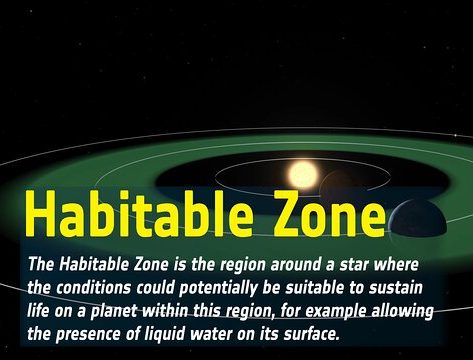
Circumstellar Habitable Zone

And remember, these requirements for a habitable planet are downstream from the cosmic fine-tuning of constants and quantities that occurs at the Big Bang. No point in talking about the need for plate tectonics if you only have hydrogen in your universe. The habitability requirements are a further problem that comes after the fine-tuning problem.

Resources

The best book to read on this topic is “The Privileged Planet“, by Guillermo Gonzalez and Jay W. Richards. The latter is one of my absolute favorite Christian scholars, a real renaissance man. If the book is too much, there is a DVD by the same name that covers everything you need to know at a high level. Just FYI, Gonzalez made the cover of Scientific American in 2001, for his research on habitable zones. This is real evidence you can discuss with anyone, anywhere.

You can also watch the DVD for FREE on YouTube. Not sure how long that will be there. If you like it, buy the DVD, so you can show your friends.

Related posts

What happens to your worldview if you reject a Creator / moral lawgiver?

I noticed that there was a news story about how belief in God is declining even further in America. And it’s happening the most among younger Americans. In this post, I wanted to talk about the common atheist idea that you can just remove God, and life will go on as before, with everything making perfect sense.

I don’t think I’ve ever written a post about ALL the changes that happen when a person ejects a Creator / Moral Lawgiver from their worldview. And now I don’t have to, because this blogger has done the work for us.

He introduces his post like this:

I recently wrote an article targeted at committed atheists who claim that Christians carry all the burden of proof. There, I pointed out that atheism is not a neutral position and is justified only if it, too, can provide answers for the hard questions of science and human experience. In this article, though, I’d like to offer something similar only targeted to the agnostic, who flirts with the idea that this universe may be devoid of a God after all. My intent is to get such persons to consider the impact that true atheism would logically have on their beliefs and values, and to consider whether this package deal sounds more reasonable than theism.

Now, I’ve interacted with the author a little by e-mail, and it turns out that he actually spent a good part of his life living as an atheist. And he’s got a bunch of friends and relatives who don’t exactly fit in with the standard raised-in-a-Christian-home happy path. And best of all, he’s a software engineer, so you know he’s practical and sensible about these topics.

Here are the major areas of worldview that are affected by the rejection of God:

  • Meaning
  • Sovereignty
  • Morality
  • Rights
  • Mind
  • Free Will
  • Science

When I talk about these things, I usually talk about the 3 Ms: Mind, Meaning, Morality. You can see he’s got a lot more there. And he quotes a lot of prominent atheists that you’ve probably heard of: Richard Dawkins, Sam Harris, Sean Carroll, Jerry Coyne, etc.

Here’s the one on Rights:

Universal human rights presuppose that each of us has unique, intrinsic value. The Founding Fathers asserted that our rights were endowed by God, and Scripture claims it is His own image within us that makes us special. If you dispense with this idea, what standard do you use to ground human rights?

We are not equal by any measure one could offer, such as fitness, talent, race, or intelligence. Even grounding it in our mere humanity is arbitrary, since there is no higher standard that would favor humans over the rest of the biological world, and some animals are more fit or intelligent than young, elderly, or disabled humans. Animal rights activists understand this and traffic in this “speciesist” notion. They point out the blight of the human race’s impact on nature, and do not temper that with any belief in the special value of humanity.

The loss of intrinsic human value leads to creative redefinitions for personhood and rights which traffics in things like contribution to society and a life worth living. This road leads to infanticide for the unwanted, eugenics for the unfit, and euthanasia for the elderly. We saw these ideas on display in Nazi Germany as well as, to an extent, the US and other European countries. However, they have been making a comeback in an increasingly secular western culture that has forgotten its dark past. But what principle does atheism offer you to object to any of this beyond your instinctive revulsion?

The conclusion cannot be missed:

Embracing atheism has consequences. Removing God from your life is not like removing a piece of furniture from your house. It’s more like replacing the foundation, which impacts anything that has been built upon it. I’ve discussed several important things that are affected, but many more could be offered, like beauty and the arts, logic, truth, and even the reliability of our senses. In fact, every area of thought and life are affected, or are at least fair game for deconstruction by the universal acid that is atheism.

He also links to a post by James Bishop in the comments, featuring TONS of interesting quotes by famous atheists, about the implications of adopting the worldview of atheism.

Here’s one by former Cornell University paleontologist Will Provine:

Let me summarize my views on what modern evolutionary biology tells us loud and clear … There are no gods, no purposes, no goal-directed forces of any kind. There is no life after death. When I die, I am absolutely certain that I am going to be dead. That’s the end for me. There is no ultimate foundation for ethics, no ultimate meaning to life, and no free will for humans, either.

Is Provine smarter than the average atheist? I think he is, and he’s certainly thought about it more than the average Twitter atheist in his 20s.

I guess what I would say to young atheists is that you probably haven’t 1) evaluated the evidence for a Creator / Designer / Moral Lawgiver at age 14, and 2) you certainly haven’t considered the implications of the decision.

Earlier this week, I wrote a post about an educated 24-year-old feminist woman who was trying to get a man to commit to her. She was choosing men and the timing of sexual activity based on her atheist worldview. As she tells her story, you can clearly see the difference that the worldview makes in the area of relationships. She doesn’t have the resources in her atheism to conduct herself wisely enough to get the results she is looking for.

What kind of “Constitution” can there be for a relationship, if the universe is an accident, human beings are robots made out of meat, and the purpose of life is to be happy here and now? Relationships are stable when each person is able to execute self-sacrificial love. Can you ground a respectful, committed relationship in a worldview of “survival of the fittest”? I think not. And yet this is the approach that most young people take.

Democrat policies raising gas prices, increasing inflation, starting a recession

I’ve been reading some very disturbing things about the energy policies of the Biden administration. The corporate news media is telling everyone that Biden is trying to lower gas prices. How? By threatening producers at home, and begging Venezuela and Saudi Arabia to produce more abroad. None of this will work, and the administration’s other actions are making gas prices rise.

Here is the Wall Street Journal:

President Biden has suddenly discovered that a refinery shortage is driving up fuel prices. Naturally, he’s blaming refiners, even as his Administration doubles down on the policies that created the shortage.

In a remarkable and threatening letter to oil and gas CEOs this week, Mr. Biden seems stunned to learn that prices rise when supply doesn’t meet demand.

[…]A major culprit is U.S. government policy. Some older refineries have closed because companies couldn’t justify spending on upgrades as government forces a shift from fossil fuels. They also have to account for the Environmental Protection Agency’s tighter permitting requirements… and steeper biofuel mandates.

The article notes that our refining capacity is being targeted by the Biden administration’s regulations. Smaller refining companies have to purchase “regulatory credits”, or apply for an exemption, but “the biofuels lobby opposes these exemptions, and the EPA just denied 69 waiver requests”.

And this:

Chevron CEO Mike Wirth said recently that refineries are shutting down or being repurposed for renewable fuels because “the stated policy of the U.S. government is to reduce demand for the products that refiners produce.” When companies are told that demand for their product will become obsolete, it’s no surprise that they don’t invest in supply.

Energy policy expert Michael Shellenberger notes:

Last month, the Biden administration canceled a massive, one-million acre oil and gas lease in Alaska. And earlier this week, Senator Ron Wyden proposed a large new tax on oil industry profits, which Biden officials say the president may support.

A senior executive at a major U.S. bank that finances oil and gas exploration yesterday told me, “If you were an oil company, why would you invest hundreds of millions of dollars into expanding refining capacity if you thought the federal government or investors would shut you down in the next few years? The narrative coming from the administration is absolutely insane. ”

Shellenberger quotes Climate Change Barbie (Energy Secretary Jennifer Granholm) saying that she wants companies to invest in oil refining now, even thought the Democrats intend to shut them down in “five or ten years”. Jennifer Granholm has no earned degrees or work experience in anything remotely related to energy policy.

What’s the effect of attacking oil refining capacity? Higher gas prices, and higher inflation, across the board:

The result of the Biden Administration’s hostility toward the energy industry is skyrocketing inflation. Where energy prices rose 35% over the last year, all prices rose just 8%.

There are certainly other factors causing inflation, including the ramping up of supply chains following the pandemic, the $1.7 trillion stimulus last year, and China’s lockdown in response to the omicron coronavirus variant. But the non-energy factors behind inflation were temporary, and none explain consistently higher energy prices, which are a major factor in the higher prices of everything, from food to consumer products.

And energy’s role could be even larger than economists can detect. “When you strip out of the [Consumer Price Index] all the items that are linked to energy (air fares, moving/freight, rental cars, delivery services, new and used vehicles),” noted economist David Rosenberg, “the core was +0.36% and the [year-over-year] steadied near 4%. ”

Remember, the Biden administration has already cancelled pipelines, leases and drilling permits. They are re-evaluating previously granted leases and drilling permits. There is a real risk of blackouts this summer because we aren’t producing enough energy. Biden can run around ranting and raving about high gas prices, but he’s causing it with his reliance on global warming radicals.

Shellenberger writes about policies that Biden could be implementing to reduce inflation and lower energy prices:

[M]y sources say that Biden could significantly increase oil/gas production within 12 – 18 months. How? First, they say, he should invoke the National Defense Act for Oil and Gas. This will enable the acceleration of required permits for oil and gas projects, they say. Second, he should announce a national commitment to purchase oil to fill the Strategic Petroleum Reserve (SPR) at a floor of $80/barrel. That will, they say, be a powerful incentive for the oil guys. Third, he should announce trade agreements with the international community to supply them with LNG (liquified natural gas) Doing so will incentivize natural gas production and create a surplus of energy for exports with an “American-First asterisk (keep natural gas storage full while exporting).

Biden’s doing none of that. As a result, Biden’s hostility to expanded energy production could result in recession.

Doing things that would actually work would make Biden’s eco-terrorist handlers angry. So, we’ll keep getting policies that raise gas prices and increase inflation. And a lot of ineffectual squealing from an elderly man who should be retired and enjoying his old age.