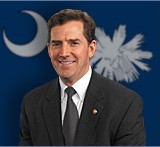
Jim Demint presses Democrats to vote on free speech

Senator Jim Demint
Senator Jim Demint

James “Jim” Demint is my favorite senator, (although he’s nearly tied with James Inhofe). Demint introduced the Broadcaster Freedom Act to protect free political speech in January, and he’s trying to force the Democrats to vote on the so called “Fairness Doctrine” so that their views on free speech over the radio can be made clear. If the Fairness Doctrine passed, free political speech on the radio would be effectively abolished. This is dangerous because talk radio is predominantly conservative just as the news media is predominantly leftist.

This NewsMax.com article notes that Senator Debbie Stabenow, House Speaker Nancy Pelosi and Senator Tom Harkin all support reintroducing the Fairness Doctrine. Their article explains what would likely follow from passing the bill.

Since talk radio is overwhelmingly dominated by conservative hosts, and progressive talk radio draws few listeners, the “equal time” provision would likely force many radio stations to pull popular conservative hosts from the air rather than air low-rated liberal hosts.

If they do go ahead and ban political speech on the radio, I wonder what they will call the bill?

Remember that his Freedom of Choice Act abolishes the right of medical personnel to choose not to performing abortions.

The Family Research Council says:

If FOCA is passed, it would automatically overturn:

  • Forty-six states’ conscience protection laws for individual health care providers
  • Twenty-seven states’ conscience protection laws for institutions

And remember his Employee Free Choice Act abolishes the right of workers to choose not to join a union.

The Heritage Foundation says:

Abolishing elections deprives workers of a fun­damental democratic right. Elections guarantee that all workers can express their views on whether they want to belong to a union. Under card check, how­ever, workers who have not been contacted by union organizers have no say in whether their workplace organizes. If organizers collect cards from a majority of workers, all workers must join the union without a vote.

Maybe the bill to ban free speech on the radio will be called called the Happiness, Ice Cream, Apple Pie, Sunshine and Nothing To See Here Act?

Do free speech and transparency actually make people happier?

I was browsing over at the Anchoress, and I found this fascinating article on free speech, political correctness and self-censorship.This is a huge issue for Christians, especially given what is happening in countries like Canada with these politically correct, multi-cultural censorship tribunals. In the post, the Anchoress urges us to be less worried about offending people.

In our politically correct age, where everyone is afraid of giving offense, being misconstrued-and -then-sued, or simply fearful of falling out-of-step with the trendoids, we almost never hear or read anything that is uncontrolled.

But “free speech” cannot be controlled or it is not “free” at all. And we in America have for too long engaged in self-censorship in favor of “niceness.”

Sometimes, you have to lose control and let the words fly, and if you cannot do that, you are not free.

People in my office know that my favorite way to end a conversation is by apologizing. I probably apologize about 15 times a day. Why do I have to do that? The people I work now with are the most tolerant people I have ever worked with. But I never know if a member of some left-wing special interest victim group is listening, and they may sue me if they don’t like what I say.

And what is the effect of this PC victim mentality? Fewer friendships between people who disagree. Shouldn’t these “victims” get used to the idea that some people disagree with them? People disagree with me all the time. My Christian beliefs were mocked by the media and secular teachers all the way from kindergarden to grad school. I didn’t complain! I wasn’t offended by people who disagreed with me.

The Anchoress also cites a study from Science Daily that argues that self-censorship makes people very unhappy. The study notes:

They figured that well-intentioned people are careful – sometimes hyper-careful – not to say the wrong thing about race in a mixed-race group. Furthermore, they thought that such effortful self-control might actually cause both unease and guarded behavior, which could in turn be misconstrued as racial prejudice.

…independent black observers found that the powerless volunteers were much more direct and authentic in conversation. And perhaps most striking, blacks saw the less inhibited whites as less prejudiced against blacks. In other words, relinquishing power over oneself appears to thwart over-thinking and “liberate” people for more authentic relationships.

As a person of color myself, I would just state that the joy of having authentic relationships with different people is real. I love intimacy. I love being myself. I love opening myself up to people. I love disagreements. If I cannot say what I really think about issues that matter, how am I supposed to be able to form authentic friendships with people with whom I disagree? Enforced segregation by worldview is very bad.

The Anchoress goes on in her post to list how free speech has been curtailed in a number of instances, even in the media, where there is supposed to be freedom of the press.

If we lose our freedom to speak out – to opine loudly, to mock, to question, even to demandthen we have lost everything.

And the truth is, we have already – thanks to political correctness and self-censorship – fallen into the mindset that our speech should be controlled, measured and unfree.

Her post made me recall a podcast that Dennis Prager did a while back on the issue of transparency. For those who don’t know, Prager has a regular “Happiness Hour” every week on his show. Prager makes the point that being transparent with your neighbors, and not censoring yourself, leads to happiness. There is also a partial transcript here. Here’s an excerpt:

You have to let out your secrets. Keeping yourself bottled is a recipe for misery, anger and pathology. I must have hit paydirt here, because all the lines lit up before I even gave the number.

Keeping stuff inside of you, and usually, we do it because we’re embarrassed by it. But you know, everybody has things that they are embarrassed by. The more that you keep hidden, the less chance of happiness you have. Why would one want to go through life hiding? It’s like wearing a veil over your psyche, and over your soul, or even a burka, completely covered. I’ve never followed it, because…I’ve never been hurt by opening up. I mean, it hasn’t always received the response that I wanted. It’s inevitable that it won’t.

The Anchoress ends by mentioning the movie “The Lives of Others“. I just watched it myself yesterday evening, because I saw that it was number ONE on National Review’s list of top conservative movies. And now I am going to make it clear to you. WATCH THIS MOVIE. This is the most amazing movie I have seen in a long time. I give it my highest recommendation!

UPDATE: Welcome visitors from the Anchoress! Thanks so much for the link! New readers may want to take a look around since I cover a lot of different topics here, from free speech to economics to science to public policy!

Split decision on Texas evolution standards favors academic freedom

Over at the Discovery Institute’s Evolution News blog, they recently reported that the Texas State Board of Education reached a split decision on the state standards for teaching evolution.

Evolution News says this in their post:

Kudos to the New York Times for filing a story on the actions of the Texas State Board of Education that actually describes what happened last week. Unlike much of the rest of the newsmedia, the Times doesn’t tell only half of what happened or play up the hysterics. The story’s even-handed title is telling: “Split Outcome in Texas Battle on Teaching of Evolution.”

The NYT article they mentioned explains the compromise reached by the Texas State Board of Education.

First, the bad news:

…the board voted to drop a 20-year-old mandate that science teachers explore with their students the “strengths and weaknesses” of all theories.

But the board also passed some good amendments, among them this one:

…one that would compel science teachers to instruct students about aspects of the fossil record that do not neatly fit with the idea of species’ gradually changing over time, like the relatively sudden appearance of some species and the fact that others seem to remain unchanged for millions of years.

Let me explain why this is a big win for ID. One of my previous employers was a major academic publishing company. By major, I mean my alma mater’s campus library featured academic publication databases that I helped to code. In this company, it was well known that California and Texas were the two most important states, because their textbook standards set the guidelines for the other states.

The NYT article explains:

Whatever the 15-member board decides then will have consequences far beyond Texas, since the state is one of the largest buyers of textbooks in the nation. The new standards will be in place for the next decade, starting in 2010, and will influence the writing of the next generation of biology texts, which the state will order this summer.

John G. West of the Discovery Institute evaluates the board’s decision as positive:

“They did something truly remarkable today,” John G. West of the Discovery Institute, a group that questions Darwinism, said in a statement. “They voted to require students to analyze and evaluate some of the most important and controversial aspects of modern evolutionary theory.”

I actually have podcasts for you of the testimonies of pro-ID scholars given to the Texas Board. If you want to learn how scientists argue for academic freedom on issues of origins, you should listen to these three 15-minute podcasts.

  1. My favorite ID scholar Stepen C. Meyer testified on the Cambrian explosion and the fossil record, (podcast, article). Meyer holds a Ph.D in the Philosophy of Science from Cambridge University. I once saw him explain biological information using colorful lock-blocks, live. (He stole them from his children). I often draw it up for my co-workers on a white board, just like he does!
  2. Microbiologist Ralph Seelke testified about how his lab research that shows clear limits on how far bacteria can evolve, (podcast, article). Seelke holds a Ph.D in Microbiology from the University of Minnesota and the Mayo Graduate School of Medicine. He is a Professor in the Department of Biology and Earth Sciences at the University of Wisconsin-Superior.
  3. Biochemist Charles Garner testified on the chirality problem in chemical evolution, (podcast, article). He also discussed the importance of not glossing over the weaknesses of scientific theories. Garner holds a Ph.D. in Organic Chemistry from University of Colorado, Boulder. Garner is now a Associate Professor in the Department of Chemistry & Biochemistry at Baylor University.

For those looking for a definition of what intelligent design is, look here. I highly recommend the work of Canadian journalist Denyse O’Leary, who is probably the foremost expert on why there is an ID controversy. Her main blog on ID is called Post-Darwinist.

As a supporter of academic freedom, I sent a donation to the Discovery Institute’s Center for Science and Culture yesterday. The CSC is currently offering a free book with donations received before February 28th, 2009. For my annual donation, I chose Stephen C. Meyer’s forthcoming book “Signature in the Cell: DNA and the Evidence for Intelligent Design“.

On another note, I am also excited about Jay Richards’ forthcoming book, “Money, Greed, and God: Why Capitalism Is the Solution and Not the Problem“. Jay did a great lecture on basic economics for Christians and another great lecture on what Christians should think about global warming. Maybe his employer, the Acton Institute, will give me a free book if I send them a donation?

UPDATE: Casey Luskin just posted audio of Stephen C. Meyer responding to questions after is presentation at the hearing.