Book review of Frank Turek’s “Stealing from God”

This book review was posted at Apologetics 315.

It says:

From the very onset of the book, it is clear that Turek has the so-called “new atheists” in his crosshairs and his main contention is that “atheists are using aspects of reality to argue against God that wouldn’t exist if atheism were true. In other words, when atheists give arguments for their atheistic worldview, they are stealing from a theistic worldview to make their case. In effect, they are stealing from God in order to argue against Him.” [p. xviii]

[…]The author explains that since stealing is a crime, and atheists are stealing from God to make their case, the book will use CRIMES [1] as an acrostic to demonstrate the intellectual crimes atheists are committing. Each letter in CRIMES is representative of “one or more aspects of reality that wouldn’t exist if atheism were true.” [xviii]
They are:
C = Causality
R = Reason
I = Information and Intentionality
M= Morality
E = Evil
S = Science

Now look here. I am not one of these weird presuppositionalists who tries to “argue” for God by assuming he’s exists already. I do like to use evidence, so I can convince people who don’t already believe in God. But if an atheist tries to argue back and is basing his arguments on assumptions that are grounded by theism and not by atheism, then I am ready to point that out.

Here is one case:

In Chapter 4, this reviewer was interested to see how the author would handle the issue of morality. After all, arguments such as the cosmological argument and the argument from information are based upon scientific evidence and philosophical argument, but the moral argument gets personal!

Turek begins the chapter by contending that objective moral values indeed exist and that God is necessary to ground them. He then continues by taking Sam Harris and his book The Moral Landscape to task and points out Harris’ key mistake in assessing the objective morality:

Why does a moral law exist at all, and why does it have authority over us…The Moral Landscape give us no answer. It’s a nearly three-hundred-page long example of the most common mistake made by those who think objective morality can exist without God. Harris seems to think that because we can know objective morality (epistemology), that explains why objective morality exists in the first place (ontology). [p. 100]

The author continues by arguing that evolution cannot explain morality, dealing with the infamous “Euthyphro dilemma,” and contending that for atheists to offer a moral objection against God, they need God to do it.

There can be no statements about the supposed “immorality” of God without assuming a standard of objective morality by which you judge God. But then, the very standard you use to judge God could not exist unless God was there to make a standard of right and wrong that was independent of human opinions.

There was a good recent CRI article dealing with atheist attempts to ground morality, where the evolutionary accounts are evaluated.

Here’s a bit:

Paul Copan argues that evolutionary naturalism can describe how people behave, but it cannotprescribe how people should behave.15 In order to say that an action is good or evil, one needs an objective and universal moral standard that transcends individual people and individual societies. It must also be personal in nature. Moral standards deal with right and wrong, whatshould and should not be done. That implies a choice that requires personality and consciousness. A transcendent moral standard would therefore need to be grounded in a conscious, personal, and transcendent reality. Christians find this in God—the only place where such a standard can be found.16

If God does not exist, then as Francis Schaeffer explains, ethics merely explain what is rather than what should be. There is then no objective difference between kindness and cruelty because there is no standard.17 The very terms “kind” and “cruel” would be meaningless. As Norman Geisler and Frank Turek argue, atheists rule out a transcendent Lawgiver in advance:18 This creates a problem: “While they may believe in an objective right and wrong, they have no way to justify such a belief (unless they admit a Moral Law Giver, at which point they cease to be atheists)” (emphasis in original).19

As soon as an atheist says that there is a way that things ought to be objectively rather than just their personal opinion, they have used God to disprove God.
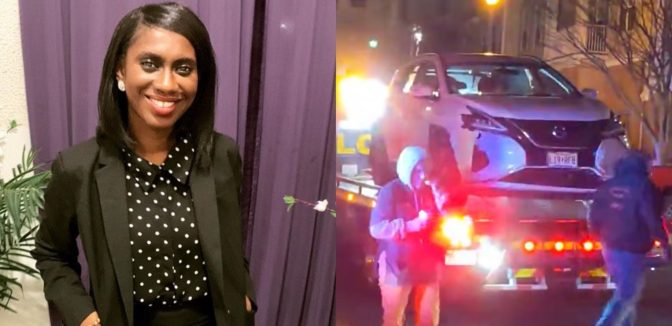
Will the shooting of a black Republican councilwoman be investigated as a hate crime?

Democrats in the corporate media are terrified of Republicans lately. Apparently, those married Presbyterian conservatives with kids are committing all sorts of insurrections, arsons and other violence. In fact, the FBI thinks that parents who are concerned about the coerced transing of their kids are “domestic terrorists”. But if you look at the actual crimes, it’s Democrats committing them.

Here’s the latest from The Post Millennial:

A New Jersey Councilwoman was shot and killed outside of her home on Wednesday evening in what is believed to be a targeted shooting.

Eunice Dwumfour, 30, was found dead in her white Nissan SUV after it crashed near her home in New Jersey.

Dwumfour, a Republican, was shot multiple times and was pronounced dead at the scene by police, the Daily Mail reports.

One witness said that the gunman shot at Dwumfour and drove off quickly from the Camelot at La Mer apartment complex. A call to police was made at 7:22 pm.

[…]No arrests have been made in the case. The Sayreville Police and officials from Middlesex County are investigating the matter.

According to the Daily Mail, close friends posted about Dwumfour’s death, describing her as an “amazing friend” who “loved God.”

The young mother defeated the sitting Democrat in Sayreville in November 2021, and was not up for reelection until 2024.

It’s not unusual for people on the secular left to resort to violence when confronted with ideas they oppose. You might think that there would be some moral restraint on actions like this, but how could there be? You can’t ground notions like “human rights” and “objective moral duties” in an accidental universe, where human beings were just coughed up by an evolutionary process that did not have them in mind.

There are lots of domestic terrorists on the secular left left. Check out this recent article from the Washington Times:

Dozens of pro-life pregnancy centers have been terrorized for months by a radical pro-choice outfit calling itself Jane’s Revenge, but now it looks as if the previously unknown group is entwined with a more significant threat: Antifa.

Antifa trackers and conservative media outlets linked two Miami residents charged with conspiracy in attacks on crisis pregnancy centers in Florida to the shadowy anarchist movement after the Justice Department unsealed the federal indictment last week.

One of the suspects, 23-year-old Amber Smith-Stewart, has made no secret of her Antifa sympathies. She has identified herself as “Antifa, anti-capitalist” on her Facebook page, which includes images of pro-Antifa posters and flags from a screenshot posted on the AntifaWatch website.

The second suspect, 27-year-old Caleb Freestone, is listed on AntifaWatch and has been active with Whatever It Takes, a left-wing pro-choice group with no love for “fascists” that advocates for “sustained civil resistance” and “direct action.”

He was arrested in July at a heated Miami-Dade County school board meeting and charged with disorderly conduct, resisting arrest without violence and trespassing after a warning. A woman at the meeting publicly accused him of being with Antifa, which he appeared to deny.

[…]The two are accused in June attacks on a trio of pregnancy resource centers in Hialeah, Hollywood and Winter Haven. Vandals left behind spray-painted messages such as “Jane,” “Jane was here” and “Jane’s Revenge,” as well as the anarchist “A” symbol favored by Antifa.

That doesn’t mean Antifa and Jane’s Revenge are the same, but they likely share much of the same personnel, said Kyle Shideler, senior analyst for homeland security and counterterrorism for the Center for Security Policy.

I have noticed that people on the secular left are actively supporting infanticide. People on the secular left are actively supporting sex-change surgeries on children. People on the secular left are actively supporting sex-trafficking children. I don’t think that they are as wonderful and compassionate as they want people to believe.

Responding to a pro-abortion argument that concedes the humanity of the unborn

I noticed a new article up at ProLifeTraining.com about a pro-abortion argument that is defended by top pro-abortion scholars. The interesting part about this argument is that they concede the full humanity and personhood of the unborn child.

I’ll let the article explain it:

Spend any amount of time talking about abortion, and you’re likely to hear a variation of the following scenario:

You wake up one morning in bed next to a famous Violinist, who has been connected to you surgically by the Society of Music Lovers. The Violinist has a fatal kidney ailment, and without your bodily support, he will die. The doctor at the hospital informs you that after nine months, the Violinist will have recovered to a point he will no longer need your body for support.

Now, you have a choice to make. You could stay hooked up to this Violinist, and it may very well be good of you to do so, but is it just for the law to compel you to do so? Most people would say no, which raises a further question: What about a woman who becomes pregnant? Is it just for the law to require her to stay attached to a person to sustain their life against her will?

The above scenario is a paraphrase of an argument first made in an essay by philosopher Judith Jarvis Thomson in 1971, titled “A Defense of Abortion”. The argument has gone on to appear in countless forms, and has been updated and defended by philosophers such as Eileen McDonagh and David Boonin.

Thomson’s argument is strong for a couple of reasons. First, she asks the reader to put themselves in the position of a woman facing an unplanned pregnancy, something everyone, pro-life or pro-choice, should be willing to do. It’s easier to see abortion as a sort of abstract topic without actually thinking of how we would feel if we were to find ourselves in the same position.

Second, and perhaps most importantly, Thomson reframes the argument over abortion by conceding a central element of the pro-life argument: The unborn entity in question could very well be a valuable member of the human family, a “person”, as Thomson argues.

And it doesn’t matter. In the view of Thomson(as well as McDonagh and Boonin) just because someone is a human being with intrinsic value in virtue of their humanity, that does not give them the right to use the body(or bodily tissues and organs) of another person to sustain their own life. This line of argument has become very popular in online as well as in-person discussions over the past year, with pro-life arguments dismissed offhand as ultimately irrelevant. A common assertion online goes like this: It doesn’t matter if abortion kills a life, because no one has the right to use your body without your consent.

Thomson’s argument, and others in the same manner, succeed if the analogies employed can demonstrate the moral principles at play in the decision to get an abortion are similar or the same to the other analogous scenarios.

The article lists a whole bunch of problems with the argument. Before you click through to read it, think about what you would say to the argument. How is the position of the violinist different from the position of the unborn child? How is the position of the violinist’s unwilling donor different from the position of the unborn child? Is having a disease the same as being conceived by the decisions of adults? I made a list of problems, but the list of problems in the article was longer than mine!