
Caterpillar and John Deere. (H/T Hot Air via ECM)
Excerpt:
Caterpillar Inc. said Wednesday it will take a $100 million charge to earnings this quarter to reflect additional taxes stemming from newly enacted U.S. health-care legislation.
[…]The charge is expected to be a one-time cost, but Caterpillar has argued that higher taxes and other potential cost increases related to insurance coverage mandates in the legislation will hinder the company’s recovery this year after a 75% plunge in income during 2009.
“From our point of view, a tax increase like this cannot come at a worse time,” said Jim Dugan, a Caterpillar spokesman.
[…]Farm equipment maker Deere expects after-tax expenses to rise by $150 million this year as a result of the health care reform law President Barack Obama signed this week.
Most of the higher expense will come in Deere’s second quarter, the company said on Thursday. The expense was not included in the company’s earlier 2010 forecast, which called for net income of about $1.3 billion.
The law could raise expenses for large U.S. employers. Industrial companies, which typically have large numbers of retirees, may be among those facing the biggest bill. Caterpillar had argued before the legislation passed that health reform would put it at a disadvantage against global competitors.
And National Review reports on Verizon. (H/T ECM)
Excerpt:
Yesterday I posted a memo that Verizon sent to its employees concerning its view that the Democrats’ health-care bill would probably cause its costs to go up. Specifically, the memo keyed in on a change in the tax treatment of the Medicare Part D retiree drug subsidy. This is a subsidy that the government pays to employers that offer prescription-drug coverage to their retirees; it was created as part of the Medicare prescription-drug entitlement to encourage employers not to dump their retirees into the public system. As the Wall Street Journal editorial board reports today, the subsidy costs taxpayers $665 per person, “while the same Medicare coverage would cost $1,209.”
As part of their effort to keep their health-care bill deficit-neutral, the Democrats changed the law and exposed the subsidy to the 35 percent corporate income tax rate, adding $5.4 billion in revenue to the bill. In its memo to employees, Verizon warned that this tax change would make the subsidy “less valuable to employers, like Verizon, and as a result, may have significant implications for both retirees and employers.” This is a clear sign that Verizon and other employers will probably drop their retiree prescription-drug coverage, leaving Medicare Part D to pick up the slack.
UPDATE: More from National Review. (H/T ECM)
Excerpt:
AK Steele Holding Corp., “the third largest U.S. steelmaker by sales, said it will record a non-cash charge of about $31 million resulting from the health-care overhaul signed into law by President Barack Obama. The charge will be recorded in the first quarter of 2010.”
Valero Energy “will take a $15 million to $20 million charge to second-quarter earnings for the same reason.”
Medical-device maker Medtronic “warned that new taxes on its products could force it to lay off a thousand workers.”
And more from National Review. (H/T ECM)
Excerpt:
Wow: “U.S. companies employed 3.9 million fewer workers in January 2010 than they did one year earlier.”
If you will recall, when touting the stimulus, President Obama and his team declared that “a package in the range that the President-Elect has discussed is expected to create between three and four million jobs by the end of 2010 . . . More than 90 percent of the jobs created are likely to be in the private sector.”
90 percent of three million jobs would be 2.7 million jobs. Yet we’re 3.9 million lower than when we started.
To meet the goal by the deadline, the country would have to create 6.6 million jobs in the next nine months. or more than 733,000 jobs per month for three quarters of the year.
UPDATE 2: Now Business Week reports that AT&T is screwed.
Excerpt:
AT&T Inc. will book $1 billion in first-quarter costs related to the health-care law signed this week by President Barack Obama, the most of any U.S. company so far.
A change in the tax treatment of Medicare subsidies triggered the non-cash expense, and the company will consider changes to the benefits it offers current and retired workers, Dallas-based AT&T said today in a regulatory filing.
Hey! Do you know what causes outsourcing of jobs? DEMOCRATS. Democrats cause jobs to be shipped overseas. Democrats hate companies. Companies hire people. Democrats cause American manufacturing jobs to be shipped overseas. Democrats cause unemployment. That’s why the unemployment rate is double what it was under Ronald Reagan and George W. Bush. Democrats cause unemployment.
How do jobs get created, anyway?
Do you know what really works to create jobs?
I mean – do you know what actually has worked in the past to create jobs?
The Heritage Foundation reports:
President Ronald Reagan’s record includes sweeping economic reforms and deep across-the-board tax cuts, market deregulation, and sound monetary policies to contain inflation. His policies resulted in the largest peacetime economic boom in American history and nearly 35 million more jobs.
See:
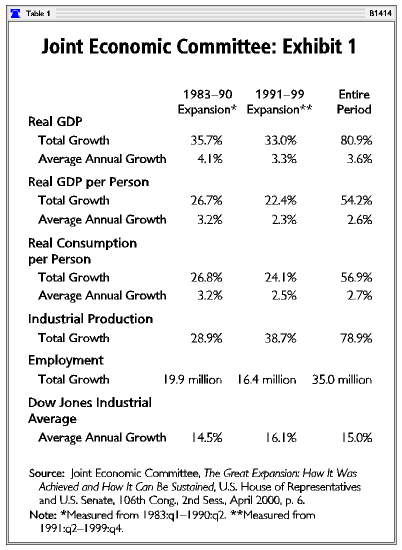
That’s what actually worked.
Free. Market. Capitalism. Works.

