New report compares cost of coal power to renewable wind and solar power

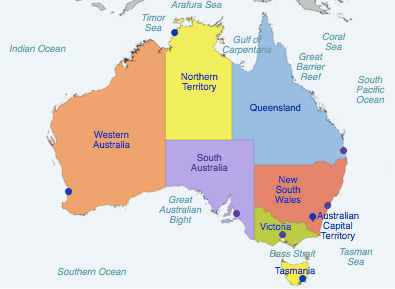
Map of Australia
Map of Australia

From the Victorian Auditor-General’s Report, April 2011. (H/T Joanne Nova)

Here’s the chart:
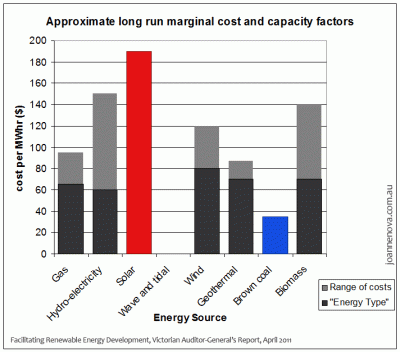
Cost of renewable wind and solar energy

Click here for a bigger version.

Compared to coal, wind power is incredibly expensive, and solar power is even worse.

What happened when the Canadians embraced wind and solar power?

What happened to consumer energy prices in Ontario when the Liberal government embraced unproven wind and solar power?

The Globe and Mail explains:

If you haven’t opened your September hydro bill yet, you’re in for a shock. Rates have risen 18 per cent this year to date, and that’s just the start. By this time next year – election time – Ontario power consumers will be forking over about twice as much (in nominal terms) as they did when Dalton McGuinty took office in 2003.

[…]Power expert Tom Adams may know more about this subject than any other living being. And he’s steamed. Ontario’s rates, he says, have already surpassed the U.S. average and are headed for European levels – “just because of public policy.”

The policy is to go all out on renewables – wind and solar– whether or not it makes sense. The province is paying sky-high rates for power it doesn’t need so we can have wind turbines marching on and on to the horizon, just like Denmark does. “Power demand has been dropping since 2005,” says Mr. Adams. In fact, we have so much excess supply that, from time to time, it threatens to crash the system. Because of this, we’re even paying the neighbours to take the power off our hands.

“Ontario will need new power supplies in the future,” Mr. Adams says. “But why not buy it when we need it?” Instead of waiting, the power authority is signing long-term contracts at the rate of about $1-billion a week, while paying enormous premiums to attract wind and solar producers. In other words, it’s making 20-year commitments to pay stunningly high prices for power we don’t need.

On top of that, the province is building new transmission lines to nowhere while neglecting to ensure that Toronto’s hospitals and banks can keep the lights on. In July, Toronto experienced what Mr. Adams calls “Ontario’s first green blackout.” That blackout occurred because the city’s downtown core is badly underpowered. It has the weakest power system of any financial centre in the developed world.

Why haven’t we done anything about it? Because the green lobby has been campaigning for conservation, instead. And so, when the government started picking sites for transmission upgrades, it decided to build a power line up the shore of Lake Nipigon to connect remote wind turbines to Thunder Bay.

Ever since the days of Adam Beck, the father of public power in Ontario, the province’s energy policy has been linked to economic policy. The motto was reliable power at cost. Now energy policy has been entirely decoupled from economic policy and attached to the runaway train of environmental policy. Everyone in the power system knows it. But they’re so terrified to raise their hands, most of the public is still in the dark.

The National Post wrote about how the Ontario government wastes taxpayer money to subsidize big corporations who experiment with unproven, expensive energy programs, like solar power.

Excerpt:

The Swedish retail giant IKEA announced yesterday it will invest $4.6-million to install 3,790 solar panels on three Toronto area stores, giving IKEA the electric-power-producing capacity of 960,000 kilowatt hours (kWh) per year. According to IKEA, that’s enough electricity to power 100 homes. Amazing development. Even more amazing is the economics of this project. Under the Ontario government’s feed-in-tariff solar power scheme, IKEA will receive 71.3¢ for each kilowatt of power produced, which works out to about $6,800 a year for each of the 100 hypothetical homes. Since the average Toronto home currently pays about $1,200 for the same quantity of electricity, that implies that IKEA is being overpaid by $5,400 per home equivalent.

Welcome to the wonderful world of green economics and the magical business of carbon emission reduction. Each year, IKEA will receive $684,408 under Premier Dalton McGuinty’s green energy monster — for power that today retails for about $115,000. At that rate, IKEA will recoup $4.6-million in less than seven years — not bad for an investment that can be amortized over 20.

No wonder solar power is such a hot industry. No wonder, too, that the province of Ontario is in a headlong rush into a likely economic crisis brought on by skyrocketing electricity prices. To make up the money paid to IKEA to promote itself as a carbon-free zone, Ontario consumers and industries are on their way to experiencing the highest electricity rates in North America, if not most of the world.
The government’s regulator, the Ontario Energy Board, has prepared secret forecasts of how much Ontario consumers are going to have to pay for electricity over the next five years. The government won’t allow the report to be released. The next best estimate comes from Aegent Energy Advisors Inc., in a study it did for the Canadian Manufactures and Exporters group. Residential rates are expected to jump by 60% between 2010 and 2015. Industrial customers will be looking at a 55% increase.

Going back to 2003, based on numbers dug up by consultant Tom Adams, the price of residential electricity in Ontario hovered around 8.5¢ a kWh in 2003 — the first year of the McGuinty Liberal regime. By 2015, Aegent Energy estimates the price will be up to 21¢, an increase of 135%. Doubling the price of electricity in a decade is no way to spur growth and investment. In this age of global economic competition IKEA may end up with fewer sales of its Billy bookshelves in Toronto because its customers will be bogged down with soaring power bills and a sliding economy.

How about wind power in a coastal province like New Brunswick? Is that any better? The National post explains the costs and drawbacks of wind power.

Excerpt:

A $200-million wind farm in northern New Brunswick is frozen solid, cutting off a potential supply of renewable energy for NB Power.

The 25-kilometre stretch of wind turbines, located 70 kilometres northwest of Bathurst, N.B. has been completely shutdown for several weeks due to heavy ice covering the blades.

[…]Wintery conditions also temporarily shutdown the site last winter, just months after its completion. Some or all of the turbines were offline for several days, with “particularly severe icing” blamed.

The accumulated ice alters the aerodynamics of the blades, rendering them ineffective as airfoils. The added weight further immobilizes the structures.

[…]Melissa Morton, a spokeswoman for the utility, says the contract isn’t based on power delivered during a specific period, but rather on an annual basis.

“Our hopes is that it will balance out over the 12-month period and, historically, that has been the case.”

Despite running into problems in consecutive winters, Ms. Morton says NB Power doesn’t have concerns about the reliability of the supply from the Caribou Mountain site.

It’s a waste of taxpayer money.

CIA Director Leon Panetta confirms that waterboarding led to Osama Bin Laden

CIA Director Leon Panetta confirms that waterboarding / enhanced interrogation techniques led to Osama Bin Laden, in this MSNBC interview by Brian Williams.

Excerpt:

Brian Williams: I’d like to ask you about the sourcing on the intel that ultimately led to this successful attack. Can you confirm that it was as a result of waterboarding that we learned what we needed to learn to go after Bin Laden?

Leon Panetta: You know, Brian, in the intelligence business you work from a lot of sources of information, and that was true here. We had a multiple series of sources that provided information with regards to this situation. Clearly, some of it came from detainees and the interrogation of detainees, but we also had information from other sources as well. So it’s a little difficult to say it was due just to one source of information that we got.

Williams: Turned around the other way, are you denying that waterboarding was in part among the tactics used to extract the intelligence that led to this successful mission?

Panetta: No, I think some of the detainees clearly were — you know, they used these enhanced interrogation techniques against some of these detainees. But I’m also saying that the debate about whether we would have gotten the same information through other approaches I think is always going to be an open question.

Williams: So, final point, one final time: enhanced interrogation techniques, which has always been kind of a handy euphemism in these post-9/11 years, that includes waterboarding.

Panetta: That’s correct.

This is the waterboarding that Obama opposed. Obama opposed enhanced interrogations. Obama opposed military tribunals. Obama opposed CIA prisons. Obama opposed Guantanamo Bay. Obama opposed counter-terrorism. I would not be surprised if the decision to kill Bin Laden was made in order to keep Obama from reading him his rights, giving him a civilian trial, bowing to him, etc.

Notice that the left-wing New York Times is in denial about the facts.

And don’t forget how waterboarding prevented a similar 9/11-style attack on Los Angeles.

Excerpt:

The Central Intelligence Agency told CNSNews.com today that it stands by the assertion made in a May 30, 2005 Justice Department memo that the use of “enhanced techniques” of interrogation on al Qaeda leader Khalid Sheik Mohammed (KSM) — including the use of waterboarding — caused KSM to reveal information that allowed the U.S. government to thwart a planned attack on Los Angeles.

Before he was waterboarded, when KSM was asked about planned attacks on the United States, he ominously told his CIA interrogators, “Soon, you will know.”

According to the previously classified May 30, 2005 Justice Department memo that was released by President Barack Obama last week, the thwarted attack — which KSM called the “Second Wave”– planned “ ‘to use East Asian operatives to crash a hijacked airliner into’ a building in Los Angeles.”

KSM was the mastermind of the first “hijacked-airliner” attacks on the United States, which struck the World Trade Center in New York and the Pentagon in Northern Virginia on Sept. 11, 2001.

After KSM was captured by the United States, he was not initially cooperative with CIA interrogators.  Nor was another top al Qaeda leader named Zubaydah.  KSM, Zubaydah, and a third terrorist named Nashiri were the only three persons ever subjected to waterboarding by the CIA.

I actually asked one person who thought waterboarding was “torture” who KSM was. She didn’t know! But this is like asking “who is buried in Grant’s tomb?” when it comes to intelligence matters. You can’t decide what to believe based on your feelings or the need to please others or to strike a pose with your peers to earn their approval. You have to have access to the facts, or you get taken in by conspiracy theories and sloganeering. You have to understand WHY Americans will use an Apache helicopter to attack a force of infantry armed with RPGs when a convoy of Hummers comes into their line of fire. It does no good to try to participate in debates on national security and foreign policy without knowing the facts. Feelings of envy and hatred for the United States are not arguments.

Let me be very very clear. To oppose the waterboarding of a terrorist like KSM is to favor the deaths of thousands of innocent Americans, thousands of innocent civilians in wars, and millions or even billions of dollars of financial losses. That is the “moral superiority” of the left. They would rather protect a guilty terrorist from a little discomfort than save huge numbers of innocent lives and protect the assets of huge numbers of innocent people. And they expect you to hold them in high regard for protecting evil, and punishing good. Apparently, this is considered as being the height of morality on the secular left, as Evan Sayet has pointed out. Despite what leftists believe, it is morally good for American soldiers kill a terrorist who has harmed innocent people or who is plotting an attack that will kill innocent people.

Thank you, President George W. Bush, for having a clear moral vision, and for making the hard, unpopular decisions that kept us safe.

Thank you, Central Intelligence Agency, for doing hard, unpopular things in order to protect us from terrorism and weapons of mass destruction.

Thank you, United States Armed Forces, for taking on the thankless task of protecting the people of the United States.

GOD BLESS AMERICA!

Related posts

William Dembski reviews a new book by two theistic evolutionists

From Patheos, an opening statement by William Dembski. This is the first part of a four-part debate with two scientists of the Biologos group, which advocates for theistic evolution. (And not to be confused with the Biologic Institute, which is supportive of intelligent design).

Excerpt:

Throughout their book, Giberson and Collins overconfidently proclaim that Darwinian evolution is a slam-dunk. Thus one reads, “There has been no scientific discovery since Darwin–not one–which has suggested that evolution is not the best explanation for the origin of species” (21-22). No theory is that good. Every theory admits anomalies. Every theory faces disconfirming evidence. Repeatedly readers are informed that mountains of overwhelming evidence support Darwin’s theory and that the authors are “unfamiliar with any premier scientists who reject evolution.” And just so there’s no doubt, in that same paragraph, they reiterate, “There are certainly a few scientists who reject evolution . . . But these are never premier scientists.”

Oh, you reject Darwinian evolution; you can’t be a premier scientist. What counterexample would convince Giberson and Collins to retract such a claim? How about Henry Schaefer’s signature on a “Dissent from Darwin” list? Schaefer heads the computational quantum chemistry lab at the University of Georgia, has published over a thousand peer-reviewed journal articles, and is one of the most widely cited chemists in the world. Then again, Giberson and Collins look askance at this list (according to them, it has too many emeriti professors and not enough biologists). But why engage in such posturing about scientific pecking order in the first place? The issue is not who’s doubting Darwinism, but what are the arguments for and against it and whether they have merit. Giberson and Collins’ constant drumming of mainstream and consensus science is beside the point–science progresses by diverging from the mainstream and by breaking with consensus.

Because Giberson and Collins assert that natural selection is such a powerful mechanism for driving evolution–and one that admits no reasoned dissent–it’s worth recounting here briefly why the intelligent design community is so skeptical of it. It’s not, as theistic evolutionists often suggest, that we have a desperate need to shore up faith and morality and are using ID as our instrument of choice to accomplish that end. Rather, it’s that natural selection is, in essence, a trial and error tinkering mechanism for which all evidence suggests that its power is quite limited. Trial and error works fine when you have something that’s functional and are trying to enhance it or adapt it to a new situation.

But for natural selection, as a trial and error mechanism, to traverse vast swatches of biological function space, we need to see an extended series of small gradual structural changes (under neo-Darwinism, these are genetic mutations leaving effects at the phenotypic level) that continually improve, or at least maintain, function, with evolving functions and evolving structures covarying and reinforcing each other. But we know of no detailed testable (macro-)evolutionary pathways like this in any field, whether in the evolution of living forms or in the evolution of language or in the evolution of technologies. In fact, when we can trace such evolutionary pathways, we find that significant change happens in creative leaps, not via trial and error tinkering.

Everyone who has read Dembski’s opening remarks in this four-part series is raving about the quality of what he’s written. I was hoping to wait for the response before publishing his opening salvo, so we could balance it, but no reply has appeared yet. For me, there is only one issue in the debate about the origin of life: if natural causes can create life from non-life with the time and resources available on the early Earth, then show me the mechanism. That’s all I want to see – the evidence that natural causes can do the creating that the naturalists say that it can do. I don’t want to hear about feelings, possibilities, what God could or couldn’t do, philosophy, what church you attend, your favorite hymn, the way you were raised, your religious experiences, etc. I just want to see you prove that nature can do all the creating that you say it can do.