Did Obama’s foreign policy make America more respected abroad?

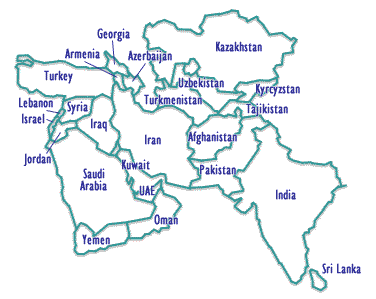
Map of the Middle East

From Investors Business Daily.

Excerpt:

In the Middle East, where U.S. military involvement and diplomacy are most closely watched, President Obama is held in lower regard in the Arab world than President Bush was in the last year of his presidency.

Obama is not only less liked than the supposedly hated Bush, he can’t even hold a candle to Iran’s grubby, menacing Mahmoud Ahmadinejad. Zogby reports that in Egypt, 31% of Egyptians agree with Iran’s policies compared with 3% for Obama’s, with similar figures in Jordan. Among Egyptians, just 5% hold a favorable attitude toward the U.S. compared with 9% in 2008.

[…]Clinton will do no better in bilateral talks with the Turks — a nation that has moved so far away from its long alliance with the U.S. it can only be called a former ally — on Syria, Iran and Israel/Palestine.

In these countries, Obama’s policy can be summed up in a litany of ineffectual maneuvers.

On Syria, the first move was to succor, then to scold as the dictatorship indifferently sheds streams of blood in the streets of Damascus — showing the fundamental disconnect between what the brutal Syrian regime is and what the Obama administration thinks it is.

After throwing Tunisia and Egypt, two pro-Western allies, overboard, the administration ineffectually grasps a problem in Syria as the bodies pile up.

On Iran, Obama policy shows even more weakness. The president wasted two years coddling the monster regime that threatens a region of more than a billion people. He missed a chance to support a student uprising in 2009 and now watches as Iran’s illegal nuclear program speeds ahead with little fear of consequences, more brazen and closer to realization.

Whatever this learning-curve policy amounts to, it garners no international respect.

Then there’s the stance the White House has taken on Israel, abusively telling its ally to retreat to 1967 borders. It emboldened provocations from Palestinian terrorist groups and showed the rest of the Arab world that it pays more to be America’s enemy than its friend. Now the Arab League is moving to recognize Palestine.

It turns out that what foreign powers respect is strength, not weakness.

Gary Habermas and a Duke University professor discuss the resurrection

About the speakers:

Gary Habermas

Chair, Department of Philosophy, Liberty University
Distinguished Research Professor

Ph.D., History and Philosophy of Religion, Michigan State University (1976)
M.A., Philosophical Theology, University of Detroit (1973)
B.R.E., Christian Education, Bible, Social Sciences; William Tyndale College (1972)

Distinguished Research Professor; Liberty Baptist Theological Seminary and Graduate School; Chair, Department of Philosophy and Theology, Liberty University; current appointment: teaching in PhD program, Liberty University, 1981-Present.

Joel Marcus

Professor of New Testament and Christian Origins, Duke University

B.A., New York University
M.A., M.Phil., Ph.D, Columbia University-Union Theological Seminary, New York

Joel Marcus teaches New Testament with an emphasis on the Gospels and the context of early Christianity in first-century Judaism. His publications include two monographs on Mark and a two-volume commentary on the same Gospel in the Anchor Bible series (Doubleday, 2000, 2009). His current research focuses on the parting of the ways between ancient Judaism and the Christianity of the first three centuries A.D.

This is MP3 audio of the discussion is in 3 parts.

Each part is 8 Mb. The last segment is Q&A with students.

Dr. Marcus is fairly moderate, definitely not an evangelical, so it makes for an interesting, but friendly, disagreement. Dr. Habermas is streaky. Sometimes he is hot and sometimes he is cold. This time, he is fairly hot.

Would the Republican “cut, cap and balance” plan solve the debt crisis?

Let’s take a look at the Republican “Cut, Cap and Balance” plan, as reported by CBS News.

Excerpt:

The House next week will take a vote to raise the debt ceiling and pass a balanced budget amendment, House Republican leaders said today.

The plan is unlikely to go anywhere, since a balanced budget amendment would likely fail in the Democrat-led Senate, but GOP leaders nevertheless called it a serious plan to raise the debt ceiling. They said President Obama and Democrats have failed to come up with an equally serious plan.

“We asked the president to lead,” House Speaker John Boehner said in a press conference today. “We asked him to put forward a plan — not a speech, a real plan — and he hasn’t. We will.”

The “cut, cap and balance” proposal would make raising the debt ceiling contingent on Congress sending a balanced budget amendment to the states. It would also cap government spending at 18 percent of Gross Domestic Product over the next 10 years.

The plan would raise the debt ceiling by $2.4 trillion, since that is the increase requested by the president. However, the plan would actually make even more in spending cuts — as much as $111 billion in 2012 alone.

[…]Boehner said the House would vote on the “cut, cap and balance” plan and then decide how to proceed from there.”I don’t want to preclude any chance of coming to an agreement, but [Democrats have] been unwilling to put a real plan on the table,” Boehner said. “Without serious spending cuts or real reform to entitlement programs, this problem is not going to be solved.”

That’s what the Republicans would do if they were in control. The balanced budget amendment would cap spending at 18% of GDP, so that we would never have a debt crisis ever again. That’s the right solution, except that the Democrats cannot give up the idea of buying votes with the money they steal from job creators. They just can control their addiction to spending.

Now, let’s take a look at who caused the debt crisis, with this House Budget Committee article by fiscal hawk Paul Ryan. (H/T Washington Post)

Excerpt:

While President Obama has recently professed a newfound — and vague — desire to cut government spending, it’s useful to recall what the President has actually done since taking office in 2009. The President signed into law a massive spending spree that plunged us deeper into debt, and failed to deliver on its promise to create jobs.

  • 24% Increase in Base Spending. Non-defense discretionary spending grew by 24% for the first two years of the Obama Administration, adding $734 billion in spending over the next 10 years.
  • Record Government Spending. The Federal government will spend $3.6 trillion this year, 24% of gross domestic product (GDP) and the highest burden on the economy since World War II. Spending has historically averaged a little over 20% of GDP.
  • President’s Budget Makes Matter Worse. According to CBO, the President’s budget never spends less than 23% of GDP and by the end of the decade rises to 24% of GDP. His budget’s failure to address the drivers of our debt threatens the health and retirement security of America’s seniors, and the economic security of all Americans. The President’s budget seeks to spend $46 trillion in government spending over the next decade, and has subsequently fought against House Republican efforts to restrain his spending appetite down to $43.5 trillion.

During the four years when Nancy Pelosi was the Speaker of the House, and Harry Reid was in control of the Senate, the Democrats packed 5.34 trillion dollars onto the national debt.