
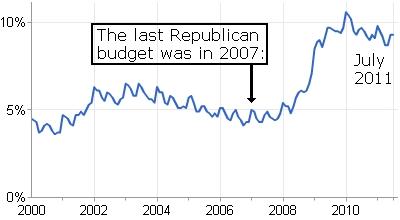
Household incomes fell and number of poor hit record 46 million in 2010

Unemployment Rate (Not seasonally adusted)

From Reuters:

The number of Americans living below the poverty line rose to a record 46 million last year, the government said on Tuesday, underscoring the challenges facing President Barack Obama and Congress as they try to tackle high unemployment and a moribund economy.

The Census Bureau’s annual report on income, poverty and health insurance coverage said the national poverty rate climbed for a third consecutive year to 15.1 percent in 2010 as the economy struggled to recover from the recession that began in December 2007 and ended in June 2009.

That marked a 0.8 percent increase from 2009, when there were 43.6 million Americans living in poverty.

The number of poor Americans in 2010 was the largest in the 52 years that the Census Bureau has been publishing poverty estimates, the report said, while the poverty rate was the highest since 1993.

The specter of economic deterioration also afflicted working Americans who saw their median income decline 2.3 percent to an annual $49,445.

From Bloomberg:

Since the low point in the labor market downturn in February 2010, nonfarm payrolls have increased by 1.9 million, showing that without stronger growth, it will take years to recoup about 8.7 million jobs lost as a result of the recession that began in December 2007 and ended in June 2009.

The jobless rate rose to 9.6 percent in 2010 from 9.3 percent in 2009. Long-term unemployment, the percent of those without a job for 27 weeks or longer, increased to 43 percent from 31 percent, according to the Washington-based Economic Policy Institute.

This is the third consecutive annual increase in the poverty rate. Keep in mind that the Democrats took over Congress in January of 2007 and their first budget was in 2008, the beginning of the recession. But at least we had turtle tunnels to nowhere.

What about Obama’s new 447-billion stimulus? Will it create jobs?

Let’s see, using this article from the Competitive Enterprise Institute.

Excerpt:

Tom Porcelli, an RBC Capital Markets analyst, told The Wall Street Journal that he expected it to have “little” effect on hiring. “Mr. Porcelli was skeptical that the short-term employer tax breaks would prompt job growth. ‘I don’t think that you’re at the stage where small businesses are incentivized to hire,’ because demand is still so low, he said. ‘These companies are basically still trying to hunker down and hope that they’re around in the next year.’”  “Larry Schaffert, owner of Schaffert Construction, said Obama is ‘totally clueless of what it takes to run a business.’”

Business leaders do not think Obama’s plan would succeed in getting America’s economy growing, nor do they think it would get “unemployed people back to work”: “Business executives say it will take more than tax credits proposed by President Barack Obama to convince them to expand their payrolls to help get thousands of unemployed people back to work. Instead, they’d prefer an easing of the regulatory environment and an overhauling of the business tax structure, which would lead to lower operating costs.”

Employers cited in The New York Times said Obama’s jobs plan would not result in their hiring any additional employees: “David Catalano, who helped found Modea, a digital advertising company in Blacksburg, Va., said that he was wary of the president’s pledge to ask the ‘wealthiest Americans and biggest corporations to pay their fair share.’ His company was organized as an S Corporation, in which profits are passed through to shareholders, so it would face higher taxes under the president’s proposal, he said. He added: ‘My partner and I have reinvested 100 percent of the profits that our agency has made over the last five years back into the company. If the government takes a bigger share of that from me, it directly impedes my ability to grow the agency.”

[…]People should take Obama’s claims about “job creation” with a grain of salt.  His earlier claims about creating jobs turned out to be false.  The Obama administration said that if the $800 billion stimulus package passed, unemployment would not go above 8 percent, but it actually skyrocketed to 10.3 percent less than a year later.  The “green jobs” the Obama Administration promised to create in the stimulus package are  largely non-existent. Indeed, the stimulus package’s green-jobs provisions ended up inadvertently outsourcing American jobs to China.   As the Associated Press notes, Obama is also not leveling with the American public when he minimizes the budget-busting nature of his so-called “American Jobs Act.”  That lack of fiscal honesty is nothing new for Obama, who falsely promised  a “net spending cut” in 2008, only to immediately propose massive budget increases once he was elected, including proposed budgets that would add $4.8 trillion to the national debt.

This is from Hans Bader, so I removed all his links – he likes to put lots of links to lots of facts, because he’s a lawyer. You have to click on his post to get all the links.

I don’t think numbers like those will help the Democrats. I am watching the election results come in for Anthony Weiner’s seat right now and the Democrat has lost in BROOKLYN and QUEEN’S. Can you believe that? New York is Republican. I wonder if M.C. Spinster is still a Democrat.

Woman who strangled newborn baby given suspended sentence with probation

Scheming unborn baby wants to be a judge when he grows up
Scheming unborn baby contemplates becoming a judge

From Yahoo News. (H/T Mary)

Excerpt:

An Alberta woman won’t be going to prison for strangling her newborn baby with her thong underwear.

Katrina Effert, 25, wiped away tears as an Edmonton judge ruled Friday she can serve a three-year suspended sentence with probation.

Effert was 19 when she secretly gave birth in her parent’s basement in Wetaskiwin, south of Edmonton, in April 2005. She then tossed the baby’s corpse over a fence into a neighbour’s backyard.

Court of Queen’s Bench Justice Joanne Veit said the public naturally grieves for the dead baby boy.

“But Canadians also grieve for the mother,” she said. “This is a classic infanticide case — killing a newborn after a hidden pregnancy by a mother who was alone and unsupported.”

Effert was twice convicted of second-degree murder and sentenced to life in prison with no possibility of parole for 10 years. But the Alberta Court of Appeal ruled earlier this year that the murder conviction was unreasonable and substituted one of infanticide.

Medical experts testified Effert had a disturbed mind when she killed her baby.

The Crown has already asked the Supreme Court of Canada to review the case.

Prosecutor John Laluk said Effert deserved four years in prison because she showed no remorse for her crime by lying to police and initially blaming her boyfriend for the killing.

The maximum sentence for infanticide is five years, but Veit said prison time is rarely handed out for such offences. She said the wildly inconsistent stories Effert gave police were actually “painful evidence” of her mental imbalance at the time.

As part of her probation, Effert must notify officials if she becomes pregnant again so she can receive assistance and counselling.

Veit described Effert as a person of good character with no prior criminal record who spent nearly six years living under restrictive bail conditions.

More from the judge from Life News.

Excerpt:

But part of the ruling that also has pro-life advocates troubled is Judge Veit’s decision that Canada’s acceptance of legalized abortion entitled Effert to kill her child. Judge Veit ruled, according to multiple media reports, that because Canada allows abortions it reflects how “while many Canadians undoubtedly view abortion as a less than ideal solution to unprotected sex and unwanted pregnancy, they generally understand, accept and sympathize with the onerous demands pregnancy and childbirth exact from mothers, especially mothers without support.”

“Naturally, Canadians are grieved by an infant’s death, especially at the hands of the infant’s mother, but Canadians also grieve for the mother,” said Veit, who said that, while what Effert did was “very grave,” there were no aggravating factors. Prosecutors said the aggravating factors included how Effert initially lied to police about whether she was a virgin and how she initially tried to blame the father of the child for her actions.

“I am of the view that those actions, along with the action of throwing her baby’s body over her back fence, are painful evidence of Ms. Effert’s irrational behavior as a result of her disturbed mind,”the judge said, according to the Sun News Network. “In summary, this is a classic infanticide case – the killing of a newborn or a justborn after a hidden pregnancy by a mother who was alone and unsupported.”

Ultimately, the judge rejected prosecutors’ call for a four-year prison term, saying the suspended sentence is “just” in the case.

At times like this, I think that it is a good thing for us to consider what it takes to make a judge like this, to see whether it might be possible to make one by having a plan. That way, instead of having a judge who opposes protecting unborn on the bench, we can have one who supports protecting the unborn instead. So how do we make our own judges?

How to make a judge

Let’s take a look at the judge’s credentials and see why she was picked to be a judge.

Details:

Born September 9, 1942 at Brantford, Ontario. Education at University of Ottawa; London School of Economics. Chair, Alberta Securities Commission 1977-81. Appointed judge of the Alberta Court of Queen’s Bench, and ex officio member of the Alberta Court of Appeal, June, 1981. Appointed deputy judge of the Superior Court of the Northwest Territories, August 21, 1991. Appointed judge of the Court Martial Appeal Court of Canada June 7, 1990.

Wow, she is a smart lady – she has a good resume, too. I don’t think that too many people have qualifications like hers. Making a good twin of her would be pretty tough to do, and there are no guarantees of success.

Here are some steps that I would recommend to Christian parents if they wanted to have a better than average chance to make a judge like this judge.

  1. The Christian man, when single, should study in a tough field, even if he hates it, like computer science.
  2. The Christian woman, when single, should study in a tough field, even if she hates it, like computer science.
  3. Both of them should work at jobs that pay well, even if they hate them, and save their money in preparation for their marriage.
  4. They should get married, and then she should stay at home to homeschool several children.
  5. They should try to be as frugal as possible so they can afford homeschooling, private schools and college tuition.
  6. They should teach their children about all the different areas in the world where the truth of Christianity or Christian values are being attacked by different ideologies and speculations, in this case, by feminism and abortion.
  7. They should analyze the skills and talents of each of their children, and try to lead them towards fields where they can have an influence on the world for truth and for goodness. The main criteria is not what the child wants, but what the child can do well, and what serves God the most. What the child wants is a factor, but not the main factor.
  8. One of the children might go on to become a judge.

Might this work? It seems to me that it is more likely to produce the judge than the alternative view, which is not studying hard topics, not taking hard jobs, not being frugal, not having a stay-at-home homeschooling mom, and not saving up college tuition. I don’t think it would be fun or easy, but it is the good and loving thing to do, if we care about what happens to little babies.

I remember taking second year calculus back when I was doing my undergraduate degree in computer science, (I also have the Masters degree in computer science), and I was crying because it was so hard for me to understand it. I failed my first calculus test in that class, and ended up with a B as a final grade. I remember that my Dad felt very badly about how hard it was for me, and he would keep bringing me tea and snacks and he would try to encourage me and drive me to my night classes and pick me up afterwards – even though he hated driving at night.

I graduated with highest honors. I was the first one in my family – a family of immigrants – to go on to graduate school, and graduated with a 3.9 GPA. But when I was crying, and there was no one to help me, I felt very sad about it. You do what you have to do, not what you want to do. And as a result of that suffering, I now have the money I need to pay for Christian scholars to come out to churches and universities where my friends have organized lectures and debates for people to see.

UPDATE: My buddy Justin tells me to link to this post at the Canadian bioethics site Unmasking Choice.

Which countries have the worst ratings for religious freedom?

From CNS News.

Excerpt:

Muslim-majority countries score worst across a range of measures in a comprehensive new study tracking government restrictions on religion as well as social hostilities involving religion around the world.

The study by the Pew Research Center’s Forum on Religion & Public Life, released Tuesday, found that nearly one-third of the world’s population lives in countries where religion-related government restrictions or social hostilities rose significantly between mid-2006 and mid-2009.

[…]A separate index in the Pew report graded countries according to levels of social hostility involving religion. Eight of the top ten countries in that index were Muslim-majority states – Iraq, Pakistan, Afghanistan, Somalia, Indonesia, Nigeria, Bangladesh and Egypt. The other two, India and Israel, have Hindu and Jewish majorities respectively, and large Muslim minorities.

In an index measuring official interference with religious practice, 18 out of 26 countries (69 percent) whose government “prohibits worship or religious practices of one or more religious groups as a general policy,” were OIC members – Brunei, Chad, Egypt, Indonesia, Iran, Iraq, Libya, Malaysia, Maldives, Mauritania, Pakistan, Saudi Arabia, Somalia, Syria, Tajikistan, Turkey, Turkmenistan and Uzbekistan.

The other eight were Burma, China, Eritrea, Laos, Madagascar, Monaco, Tuvalu and Vietnam.

A grading of countries where conversion from one religion to another is restricted was also dominated by Islamic states, accounting for 25 out of 29 countries listed (86 percent). They were Afghanistan, Algeria, Bangladesh, Comoros, Egypt, Indonesia, Iran, Jordan, Kuwait, Libya, Malaysia, Maldives, Mauritania, Oman, Pakistan, Qatar, Saudi Arabia, Somalia, Sudan, Syria, Tajikistan, Turkey, United Arab Emirates, Uzbekistan and Yemen.

The four non-Muslim countries were Eritrea, India, Israel and Vietnam.

Taking the conversion issue a step further, among 13 countries where there were incidents of physical violence over conversions from one religion to another, 10 (77 percent) were Muslim – Afghanistan, Bahrain, Bangladesh, Comoros, Egypt, Jordan, Nigeria, Pakistan, Somalia and Syria. The other three were India, Mongolia and Nepal.

I found it interesting that the tolerant religious pluralists in India are actually not very tolerant of conversions at all. You’ll recall that there are many Hindus who push for anti-conversion laws. That doesn’t sound like pluralism to me – it sounds like totalitarianism.

And more:

The Pew report also examined the issue of “defamation” of religion, tracking countries where various penalties are enforced for apostasy, blasphemy or criticism of religions.

“While such laws are sometimes promoted as a way to protect religion, in practice they often serve to punish religious minorities whose beliefs are deemed unorthodox or heretical,” it said.

It found 21 Muslim countries in that category – Afghanistan, Algeria, Bahrain, Brunei, Egypt, Indonesia, Iran, Iraq, Jordan, Kuwait, Maldives, Morocco, Pakistan, Qatar, Saudi Arabia, Somalia, Sudan, Tajikistan, Turkey, Western Sahara and Yemen.

The study also found 23 non-Muslim countries where penalties are enforced for such criticism of religion – Austria, Brazil, Burma, El Salvador, Ethiopia, France, Germany, Greece, Honduras, Iceland, India, Italy, Malta, Mauritius, Netherlands, Poland, Romania, Russia, Samoa, Singapore, Spain, Sweden and the United Kingdom.

This whole article is worth reading. Religious liberty is not as common as you might think if you are an American.