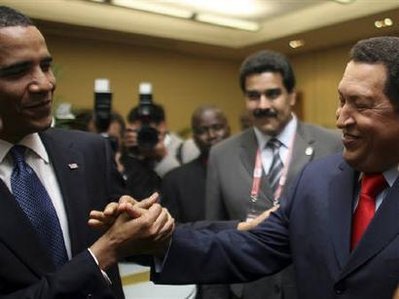
An honest look at the many contributions of Hugo Chavez to Venezuela

Are Barack Obama and Hugo Chavez very different?

From Reason magazine. (H/T Ian L.)

Excerpt: (links removed)

Hugo Chávez’ presidency has been a disaster for the Venezuelan people. Chávez’ “Socialism of the 21st Century” changed Venezuela from one of the most prosperous and politically free countries in Latin America to one of the least competitive and most repressive countries worldwide. Venezuelans who go to the polls today will ponder many of the President’s policy failures, including a long list of Chávez’nblunders in the last year alone.

Under Chávez’ rule, oil-rich Venezuela has become one of the least economically competitive countries in the world. In 2012, the country ranked 126 of 144 in a study by the World Economic Forum. According to the report, Venezuela now has some of the lowest scores worldwide in functioning of public institutions, trust in the justice system and domestic competition. It has some of the highest scores in terms of regulation, trade tariffs, and rules that deter foreign investment. The country has an inflation rate of 26 percent, and has also suffered several food shortages this year.

Venezuelan infrastructure has been falling apart under Chávez. On August 15th, the Cupira bridge near Caracas collapseddespite repeated warnings from engineers that it was in disrepair. Last month, poor drainage infrastructure led to nationwide flooding, resulting in over 400 families losing their homes and 1,500 people ending up in shelters. Chávez also mismanages Venezuela’s oil wealth. Since the government effectively took control of the national oil company in 2004, it has become much less efficient and production is 25 percent lower than when Chávez took office. Accidents are common—an offshore oil rig sank into the sea in 2010 and an oil refinery explosion in August killed at least 48 people. Despite sitting atop the world’s largest proven oil reserves, Venezuela nowimports and rations gasoline.

According to USA Today, Venezuela has the fourth highest murder rate in the world and is now the most violent South American country. Between the time Chávez took power in 1998 and 2012, kidnappings have risen from a few hundred annually to a record of 16,000 in 2011. Homicide rates have nearly tripled and suspect arrests have fallen by 61 percent. Only eight in every 100 murder investigations lead to an arrest. Murder of police officers has risen by 45 percent  in the last year alone. Violence is much worse for Venezuela’s inmates despite Chávez’ campaign promises of prison reform. A prison riot on August 24 left 26 people dead and 43 injured after inmates took over the compound and held it for four hours. Venezuelans are 20 times more likely to be killed in penitentiaries than outside of them. More than three hundred people have died and 572 have been injured in Venezuelan prisons this year alone.

Venezuelans have also witnessed alarming revocations of political liberties during Chávez’ presidency. On September 10th, Chávez decided to withdraw from the Inter-American Court of Human Rights. He regularly targets media who expose his failures. He recently arrested two journalists for writing a satirical article about his leadership. In addition, he demanded the names of voters who participated in the opposition’s primary election last February, just as he did to those who unsuccessfully voted to remove him from office in 2004. Chávez has banned foreign funding for civil society watch dogs, which will make electoral transparency in upcoming elections difficult.

UPDATE: Reformed Seth sent me this article from Human Rights Watch as well.

Excerpt:

Hugo Chávez’s presidency (1999-2013) was characterized by a dramatic concentration of power and open disregard for basic human rights guarantees.

After enacting a new constitution with ample human rights protections in 1999 – and surviving a short-lived coup d’état in 2002 – Chávez and his followers moved to concentrate power. They seized control of the Supreme Court and undercut the ability of journalists, human rights defenders, and other Venezuelans to exercise fundamental rights.

By his second full term in office, the concentration of power and erosion of human rights protections had given the government free rein to intimidate, censor, and prosecute Venezuelans who criticized the president or thwarted his political agenda. In recent years, the president and his followers used these powers in a wide range of prominent cases, whose damaging impact was felt by entire sectors of Venezuelan society.

Many Venezuelans continued to criticize the government. But the prospect of reprisals – in the form of arbitrary or abusive state action – forced journalists and human rights defenders to weigh the consequences of disseminating information and opinions critical of the government, and undercut the ability of judges to adjudicate politically sensitive cases.

[…]Chávez also rejected international efforts to promote human rights in other countries. In recent years, Venezuela consistently voted against UN General Assembly resolutions condemning abusive practices in North Korea, Burma, Iran, and Syria. Moreover, Chávez was a vocal supporter of Syria’s Bashar al-Assad, Libya’s Muammar Gaddafi, and Iran’s Mahmoud Ahmadinejad, bestowing upon each of these leaders the “Order of the Liberator,” Venezuela’s highest official honor.

Under Chávez, Venezuela’s closest ally was Cuba, the only country in Latin America that systematically represses virtually all forms of political dissent. Chávez identified Fidel Castro – who headed Cuba’s repressive government until his health deteriorated in 2006 – as his model and mentor.

That’s the dream of people on the left like Sean Penn. They love the idea of doing away with liberty and human rights. They want to force their secular leftist ideology on everyone at gunpoint.

Everyone who is praising this communist dictator today should be ashamed. None of them would move out of the United States to live in Venezuela – it’s nothing but hypocrisy.

Related posts

Book review: What is Marriage? Man and Woman: A Defense

This book review of a great recent book on marriage is worth reading in full.

Excerpt:

Why should the state have an interest in intimate personal relationships? Nowhere do the authors suggest that consenting adults should be prevented from forming whatever intense emotional bonds they please. But it is a fallacy to conflate the issue of freedom of sexual expression with the institution of marriage. The state has an interest in children, first of all because it has a responsibility to promote their welfare, and secondly because the common institutions of society have an interest in our common future. Marriage, the authors write,

is a bond of a special kind. It unites spouses in body as well as mind and heart, and it is especially apt for, and enriched by, procreation and family life. In light of both these facts, it alone objectively calls for commitments of permanence and exclusivity. Spouses vow their whole selves for their whole lives. This comprehensiveness puts the value of marriage in a class apart from the value of other relationships.

That is the conjugal view of marriage, in the authors’ definition. It is permanent and comprehensive, as opposed to an intense emotional bond, which may dissolve as quickly as it was formed. That may be convenient for lovers but catastrophic for their children.

Only the union of a man and woman can be comprehensive, the authors argue. The issue isn’t dignity, which all human beings deserve. Instead, the issue is what a married man and woman can do that no other human arrangement can do: “Marriage is ordered to family life because the act by which spouses make love also makes new life; one and the same act both seals a marriage and brings forth children. That is why marriage alone is the loving union of mind and body fulfilled by the procreation – and rearing – of whole new human beings.”

Across the ideological spectrum, researchers agree that “the family structure that helps children the most is a family headed by two biological parents in a low-conflict marriage. Children in single-parent families, children born to unmarried mothers, and children in stepfamilies or cohabiting relationships face higher risks of poorer outcomes,” as the research institution Child Trends concluded. And as Professor Bradford Wilcox of the University of Virginia’s National Marriage Project concluded, “The core message…is that the wealth of nations depends in no small part on the health of the family.”

Adoption by gay parents does not do as well: The authors present a wide range of research showing that “compared to children of parents at least one of whom had a gay or lesbian relationship, those reared by their married biological parents were found to have fared better on dozens of indicators”. Part of the reason that married biological parents do better may have to do with sexual exclusivity, which is virtually nonexistent in male homosexual relationships according to the standard research on the subject.

The state cannot help but take an interest, for it gets the bill for the damages when marriage breaks down. As George et al write, “Since a strong marriage culture is good for children, spouses, indeed our whole economy, and especially the poor, it also serves the cause of limited government. Most obviously, where marriages never form or easily break down, the state expands to fill the domestic vacuum by lawsuits to determine paternity, visitation rights, child support, and alimony.”

That is the fallacy of the libertarian argument in favor of absenting the state from all questions involving personal intimacy. Society can get along with a small government if it has strong private institutions: families, churches, charities, schools and volunteer associations. Among these the family has more weight than all the rest put together. The state, and above all a state that seeks self-limitation, needs the family to flourish.

This book review is a great summary of the history of marriage, the essential issue in the redefinition of marriage (the selfishness of adults), and why marriage matters to society. Really recommend this one! Everyone who defends marriage these days seems to get called every kind of name possible. We face all kinds of persecution from being put on trial to being harmed in the academy and the workplace. Largely because we cannot put our intuitions about the goodness of marriage into arguments, and then support them with evidence.

Related posts

Gay marriage debate: Michael Brown debates Eric Smaw on same-sex marriage

About the debate:

On April 21, 2011 at 7:30pm at UCF’s Health and Public Affairs Building (Room 119), Rollins College professor, Dr. Eric Smaw and author and seminary professor Dr. Michael L. Brown will debate the question “Should same sex marriage be legalized in America?” The event will be held at 4000 Central Florida Blvd and is open to the public. After the formal portion of the debate, Brown and Smaw will field questions from the audience.

About the speakers:

Dr. Smaw will be responding in the affirmative. He earned his Ph.D. in Philosophy of Law from the University of Kentucky in 2005. His areas of expertise are philosophy of law, international law, human rights, ethics, and modern philosophy. He has published articles on human rights, terrorism, and cosmopolitanism. His most recent publication is “Swaying in the Balance: Civil Liberties, National Security, and Justice in Times of Emergency”.

Dr. Brown will be responding in the negative. He earned his Ph.D. in Near Eastern Languages and Literatures from New York University and is a nationally known evangelical lecturer and radio host. He is the author of numerous scholarly articles and twenty books, including the recently published study “A Queer Thing Happened to America”, which is quickly being recognized as the definitive work on the history and effects of gay activism on American culture.

Here are the first two parts:

Part 1 of 10:

Part 2 of 10:

The rest of the segments are here.

Summaries of the opening speeches

Summary of Dr. Brown’s opening speech:

There is no compelling reasons by the state should change the definition of marriage

The reason the state conveys benefits for marriage is because marriage is beneficial for the state

Traditional marriage is recognized by the state for several reasons:
– it domesticates men
– it protects women
– it provides a stable, nurturing environment for children

Marriage has three public purposes:
– to bind men and women together for RESPONSIBLE procreation
– to get the benefit
– to provide children with two parents who are bonded to them biologically
– to create the next generation of people to keep the society going

Normally, opposite sex couples create children

Homosexual couples can NEVER create children together

Men and women are differences that are complementary

Monogamy is the norm for opposite sex couples.

For gay men, open relationships / cheating is the norm.
This is because women have a tempering effect on sexuality.

There is no evidence that recognizing same-sex civil unions and marriages have changed this trend.

Same-sex marriage guarantees that children will either not have a father or a mother
So which of the sexes is dispensable when raising children?

For example, consider Dawn Stefanowicz, who grew up with a gay father and no mother
She never got a chance to see a man model love and protect a women within a marriage
That makes an enormous difference in a woman’s life – in the way she relates to men

Even with scientific advancements, every baby has a mother and a father

If we change the definition of marriage so that it is based on consent, then why limit it to just two people
If marriage is not the union of male and female, then why have only TWO people
In Canada, you have civil liberties lawyers arguing for for polygamy
In the United States, Professor David Epstein was in a consensual relationship with his daughter
Should incestuous relationships also be celebrated as marriage? Why not?
Should polyamorous relationships also be celebrated as marriage? Why not?

Sexual orientation is not the same as race
Men are women are different in significant ways, but different races are not
You need separate bathrooms for men and women, but not for people of different races

Summary of Dr. Smaw’s opening speech: (He ended his speech after only 10 minutes)

You can redefine marriage so that it no longer based on the public purposes he mentioned (controlling procreation, fusing complementary male and female natures, providing children with mothers and fathers who are biologically linked to them, providing children with a comparatively stable development environment that offers comparatively less instability, promiscuity and domestic violence rates compared to cohabitation, etc.), but is instead based on consent and feelings, and that redefinition of marriage won’t open marriage up to polygamy, polyamory, etc.

If you like feminism, then you should allow same-sex marriage

If you like abortion rights, then you should allow same-sex marriage

Homosexuals participate in society by working at various jobs, so they are participating in society

Homosexuals should be given the same tax breaks as married people because they work at various jobs for money

Working at a job for money achieves the same public purpose as procreating and staying together to raise children in a stable environment

You can listen to the rest for the rebuttals, and cross-examination. Oh yes – there was cross-examination! It starts two thirds of the way through Part 5, if you want to jump to it. And sparks were flying! There is also Q&A from the audience of students.

This is such a great debate – I love to hear two passionate guys disagreeing about something. I love to hear both sides of the issues. There is always something to learn by listening to the other side. It makes me more effective and more tolerant when I stand up to defend my side of the argument.

By the way, my own secular case against same-sex marriage is right here, if you want to see how I would debate this issue. Also check out the recent studies on the effects of gay parenting on children.