What to do about Iraq: arm the Kurds and start air strikes against ISIS

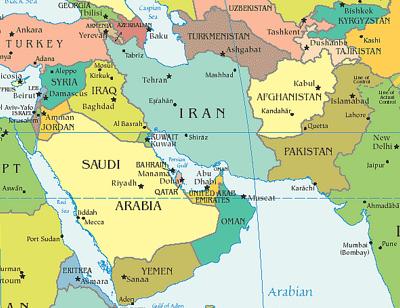
Map of the Middle East

Fox News reports.

Excerpt:

Iraqi militants seized control Thursday of the country’s largest Christian city — reportedly telling its residents to leave, convert or die — while members of another religious minority remained trapped on a mountain without enough food or water, circumstances that fueled calls for the U.S. and U.N. to get more involved.

[…]The takeover in Qaraqoush is the latest in a basket of foreign policy crises testing the Obama administration. Secretary of State John Kerry dropped into Afghanistan unannounced Thursday to meet with feuding presidential candidates, on the heels of a U.S. general’s murder at an army training post — while the White House plots its next move in a tense chess match over Ukraine with Russian President Vladimir Putin.

Meanwhile, one U.S. lawmaker is warning that the latest developments in Iraq could become a “genocide,” as the Islamic State (IS) — the militant group formerly known as ISIS — continues its march through the north, imposing its brand of Islam on Christians and other minorities.

“Genocide is taking place before our eyes — and on your watch — in Iraq,” Rep. Frank Wolf, R-Va., wrote in a letter earlier this week to Obama.

[…]In the latest development, IS militants overran a cluster of predominantly Christian villages alongside the country’s semi-autonomous Kurdish region, sending tens of thousands of civilians and Kurdish fighters fleeing from the area, according to several priests in northern Iraq.

The capture of Qaraqoush, Iraq’s biggest Christian city, and at least four other nearby hamlets, brings the group to the very edge of the Iraqi Kurdish territory and its regional capital, Irbil.

The Islamic State has already seized large chunks of northern and western Iraq in a blitz offensive in June, including Iraq’s second-largest city of Mosul. The onslaught has pushed Iraq into its worst crisis since the 2011 withdrawal of U.S. troops.

Last week, the Islamic State also seized the northwestern town of Sinjar, forcing tens of thousands of people from the ancient Yazidi minority to flee into the mountains and the Kurdish region.

According to the U.N., between 35,000 and 50,000 fled to nearby Mount Sinjar and other areas, “reportedly surrounded by ISIS armed elements” and lacking water and other aid.

The Washington Post detailed dire circumstances, reporting Thursday that thousands of families hiding on Mount Sinjar are desperate for help and that Iraqi government airdrops of aid are not sufficient.

CNN had some of the details of what ISIS is doing to Christians. (H/T WGB)

Excerpt:

If you’re following the news about ISIS, which now calls itself the Islamic State, you might think you’ve mistakenly clicked on a historical story about barbarians from millennia ago.

In a matter of months, the group seized territory in both Iraq and Syria and declared an Islamic caliphate, celebrating its own shocking slaughter along the way.

“I don’t see any attention from the rest of the world,” a member of the Yazidi minority in Iraq told the New Yorker. “In one day, they killed more than two thousand Yazidi in Sinjar, and the whole world says, ‘Save Gaza, save Gaza.'”

In Syria, the group hoisted some of its victims severed heads on poles. One of the latest videos of the savagery shows a Christian man forced to his knees, surrounded by masked militants, identified in the video as members of ISIS. They force the man at gunpoint to “convert” to Islam. Then, the group beheads him.

The solution is, of course, to immediately provide the Kurds with relief supplies and to begin air strikes against ISIS.

And CNN says as much:

“The world now faces two urgent challenges: to prevent the genocide of the Yazidis and to stop ISIS from continuing to conquer swaths of the Middle East,” global affairs columnist Frida Ghitis wrote on CNN.com. “Bombing ISIS positions would help save the Yazidis, but supporting the Kurds is key to success on both counts.”

The Iraqi Kurdish army, known as the Peshmerga, has fought ISIS but is “outgunned,” partly because the Iraqi army dropped its weapons “and fled when ISIS rolled in from Syria and captured Mosul,” Ghitis says.

Ghitis wants the United States to help arm the Kurds against ISIS.

[…]Filkins notes that Iraq has begun air strikes aimed at helping the Kurds — but, he says, “the Iraqi Army has proved itself utterly ineffectual in combating ISIS.”

The New Yorker has a very good story about a pro-US Iraqi who had to flee Sinjar, a city seized by ISIS.

I remember during the war, which I supported wholeheartedly, the anti-war/isolationist left kept crying for us to have an “exit strategy”. And this is exactly what they meant. They wanted this to happen. They voted for this to happen. You cannot influence the world  for good when you pull out of a war, and back away from evils, evils like radical Islam. We caused this, by refusing to stay the course in Afghanistan and Iraq – this is the “exit strategy” of the anti-war left: genocide against minorities by Muslim terrorists. We needed to stay and finish the job.

One other thing. In a situation like this, it’s not Code Pink or some other anti-war group that you call on to solve the problem. Air drops of food and water will be performed by the military. And that’s why we research weapons and fund a defense budget. A lot of people like to talk about problems in the world – especially on the left. But when it comes time to solve them, it often requires the work of brave men, armed and ready for battle.

I would recommend checking out The Weekly Standard podcast to get the real story on this, it’s my favorite political podcast and they have had wall-to-wall foreign policy for the last little while. You won’t have to wait long for them to post an episode, but it’s not up yet as of now (Thursday night).

Did your science textbook teach that peppered moths prove evolution?

Here’s a post by Jonathan Wells at Evolution News, which re-caps the history of the peppered moths experiment.

Excerpt: (links removed)

The peppered moth story is familiar — even overly familiar — to most readers of ENV, so I will summarize it only briefly here. Before the industrial revolution, most peppered moths in England were light-colored; but after tree trunks around cities were darkened by pollution, a dark-colored (“melanic”) variety became much more common (a phenomenon known as “industrial melanism”). In the 1950s, British physician Bernard Kettlewell performed some experiments that seemed to show that the proportion of melanic moths had increased because they were better camouflaged on darkened tree trunks and thus less likely to be eaten by predatory birds.

Kettlewell’s evidence soon became the classic textbook demonstration of natural selection in action — commonly illustrated with photos of peppered moths resting on light- and dark-colored tree trunks.

By the 1990s, however, biologists had discovered several discrepancies in the classic story– not the least of which was that peppered moths in the wild do not usually rest on tree trunks. Most of the textbook photos had been staged.

In the 2000s the story began disappearing from the textbooks. British biologist Michael Majerus then did some studies that he felt supported the camouflage-predation explanation. But before he died of cancer in 2009, he only managed to publish a report of his study in the Darwin lobby’s in-house magazine Evolution: Education and Outreach. Now four other British biologists have presented his results posthumously in the Royal Society’s peer-reviewed Biology Letters. In an accompanying supplement, the authors presented their version of what they call “the peppered moth debacle.” And a debacle it certainly is, but not in the way they think.

According to Charles Darwin, natural selection has been “the most important” factor in the descent with modification of all living things from one or a few common ancestors, yet he had no actual evidence for it. All he could offer in The Origin of Species were “one or two imaginary illustrations.” It wasn’t until almost a century later that Kettlewell seemed to provide “Darwin’s missing evidence” by marking and releasing light- and dark-colored moths in polluted and unpolluted woodlands and recovering some of them the next day. Consistent with the camouflage-predation explanation, the proportion of better-camouflaged moths increased between their release and recapture.

Throughout the 1970s and 1980s, however, researchers reported various problems with the camouflage-predation explanation, and in 1998 University of Massachusetts biologist Theodore Sargent and two colleagues published an article in volume 30 of Evolutionary Biology concluding “there is little persuasive evidence, in the form of rigorous and replicated observations and experiments, to support this explanation at the present time.” (p. 318)

The same year, Michael Majerus published a book in which he concluded that evidence gathered in the forty years since Kettlewell’s work showed that “the basic peppered moth story is wrong, inaccurate, or incomplete, with respect to most of the story’s component parts.” (p. 116) In a review of Majerus’s book published in Nature, University of Chicago evolutionary biologist Jerry Coyne wrote: “From time to time, evolutionists re-examine a classic experimental study and find, to their horror, that it is flawed or downright wrong.” According to Coyne, the fact that peppered moths in the wild rarely rest on tree trunks “alone invalidates Kettlewell’s release-and-recapture experiments, as moths were released by placing them directly onto tree trunks.”

In 1999, I published an article in The Scientist summarizing these and other criticisms of the peppered moth story, and in 2000 I included a chapter on peppered moths in my book Icons of Evolution. Then, in 2002, journalist Judith Hooper published a book about the controversy titled Of Moths and Men. Hooper accused Kettlewell of fraud, though I never did; my criticism was directed primarily at textbook writers who ignored problems with the story and continued to use staged photos even after they were known to misrepresent natural conditions.

Jonathan has actually written about a number of  misleading things that you may mind in Biology textbooks.

Here are the sections in his book “Icons of Evolution“:

  • The Miller-Urey Experiment
  • Darwin’s Tree of Life
  • Homology in Vertebrate Limbs
  • Haeckel’s Embroys
  • Archaeopteryx–The Missing Link
  • Peppered Moths
  • Darwin’s Finches
  • Four-Winged Fruit Flies
  • Fossil Horses and Directed Evolution
  • From Ape to Human: The Ultimate Icon

Dr. Wells holds a Ph.D in Molecular and Cell Biology from the University of California at Berkeley.

New study: relationships where babies are born before the marriage happens are more unstable

From Family Studies.

Excerpt:

New research on the marital prospects of single mothers published in the August issue of the journal Demography has good and bad news… The good news is that biological father marriages are more enduring than stepfather marriages. In other words, saying yes to her daughter’s father means that she is more likely to stay married than if she had said yes to someone else. The bad news is that even though she opted for the better bet, the odds are still stacked against her marriage lasting.

[…]“Among marriages that involved a black mother and a biological father,” she found, “20% had dissolved within five years, and 47% had dissolved within 10 years.”

Age and education of the mother did not do much to improve those odds.

More:

[…][V]ery few personal characteristics affected the divorce risk of women of any race in the study. Their husbands’ characteristics didn’t matter, either. Even though factors like age and education have been shown to matter quite a bit for ten-year divorce rates overall, they didn’t make a difference among the women that Gibson-Davis studied: those who gave birth outside of marriage.

[…]By showing that a single mother is most likely to marry her child’s biological father shortly after giving birth, and that such a marriage is less likely to end in divorce than marriage to another man, Gibson-Davis has provided some limited, encouraging evidence to those championing marriage promotion programs. Nevertheless, she correctly stresses that much work remains for those seeking to encourage single mothers to marry because enduring unions are relatively rare, even among biological parents. I have one window showing me why that is true. There are many others. The bottom line is that post-birth marriages are likely to be more difficult and less stable than others, and strengthening them is indeed an uphill battle.

If you’re like me, and you’re not having sex until you get married, now you know why. The old ways are best. Besides, when you take sex off the table, how the heck do you get a woman to like you? How does a woman get a man to like her? Oh, I have an idea. Men and women could think about how to show love for each other and how to help each other. Imagine that. That’s the way people used to have relationships. You actually had to put the work in then, and talk about things, instead of just jumping into bed after getting drunk with someone “hawt” that you just met at a party.