
Are libertarians right to say that lifting sanctions on evil regimes leads to liberalizing reforms?

Has liberalizing relations with China caused their government to introduce pro-liberty reforms? Libertarians like Rand Paul who cheered Obama’s appeasement of Cuba think that it has, but what are the facts?

This is a news article from the ultra-leftist UK Guardian.

Excerpt:

China’s drift towards a new authoritarianism under the unsmiling leadership of Xi Jinping has found new expression in a series of alarming year’s-end moves to curb personal freedoms and free speech. The country’s implacable president and Communist party chief is forcefully driving China towards economic and geopolitical superpower status. But the social cost is mounting steadily.

With the ruthless crackdown on dissent in Hong Kong still fresh in the memory, Xi’s latest anti-democratic coup came in the form of expanded action to block Gmail, Google’s email service, presumably because it gave users a degree of autonomy that Xi and his unelected party cadres find threatening. China already regularly blocks foreign websites such as Facebook and YouTube. Google pulled most of its business out of China in 2011 after a row over censorship.

Aspects of Xi’s policy of “autocracy with Chinese characteristics” are familiar to the country’s academic community, which is under renewed pressure to toe the party line. Instructions issued by the president after a higher education conference on Monday included the demand that universities do more to promote Marxist doctrine and Communist party ideological guidance, the Xinhua news agency reported.

“Enhancing [party] leadership and party-building in the higher learning institutions is a fundamental guarantee for running socialist universities with Chinese features well,” Xi was quoted as saying.

Political indoctrination is already a routine feature of university life for Chinese students, while their teachers are subject to monitoring to ensure political correctness. In an echo of the Stalinist era in the Soviet Union, this year reporters from state-controlled media were ordered to attend university lectures and detect and denounce teachers whose ideas might be considered “scornful of China” or pro-western.

Christians are hit especially hard:

China’s estimated 60-70 million Christians have not escaped persecution during the Christmas period, according to reports from Beijing suggesting their plight has worsened under the new leadership. Members of Shouwang, a Beijing Christian group, told Agence France-Presse that several pastors had been under house arrest since they tried to arrange Easter services in a public square in 2011.

Most Chinese Christians shun state-run churches and worship in “house churches” beyond government control. But official tolerance of such independent activity is waning, judging by a crackdown on 400 churches in eastern Zhejiang province, some of which were reportedly demolished.

Offering an insight into paranoid party thinking, an official recently told Beijing worshippers to “resolutely resist the use of Christianity by foreigners to infiltrate China”. Crosses have been torn down at many churches and at a nursing home. The authorities have made an issue out of Christmas lights, which are increasingly popular in Chinese cities, saying they may pose a safety hazard.

The ultra-leftist New York Times had more to say. (H/T Dennis Prager)

Excerpt:

They pounce on bloggers who dare mock their beloved Chairman Mao. They scour the nation’s classrooms and newspapers for strains of Western-inspired liberal heresies. And they have taken down professors, journalists and others deemed disloyal to Communist Party orthodoxy.

China’s Maoist ideologues are resurgent after languishing in the political desert, buoyed by President Xi Jinping’s traditionalist tilt and emboldened by internal party decrees that have declared open season on Chinese academics, artists and party cadres seen as insufficiently red.

Ideological vigilantes have played a pivotal role in the downfall of Wang Congsheng, a law professor in Beijing who was detained and then suspended from teaching after posting online criticisms of the party. Another target was Wang Yaofeng, a newspaper columnist who voiced support for the recent pro-democracy protests in Hong Kong and then found himself without a job.

“Since Xi came to power, the pressure and control over freethinkers has become really tight,” said Qiao Mu, a Beijing journalism professor who was demoted this fall, in part for publicly espousing multiparty elections and free speech. “More and more of my friends and colleagues are experiencing fear and harassment.”

Two years into a sweeping offensive against dissent, Mr. Xi has been intensifying his focus on perceived ideological opponents, sending ripples through universities, publishing houses and the news media and emboldening hard-liners who have hailed him as a worthy successor to Mao Zedong.

[…]Mr. Xi’s recent orders and the accompanying surge of pressure on political foes further dispelled initial suspicions that his ideological hardening was a feint to establish his credibility with traditionalists as he settled into power. Instead, his continuing campaign against Western-inspired ideas has emboldened traditional party leftists.

This is why libertarians like Rand Paul can never be the Republican candidate for President. Foreign policy is one of the main responsibilities of the President. When it comes to choosing our leaders, we have to choose someone who sees what has and has not worked in the past. Trade is not a solution to reining in strong anti-Western nations, something else (maybe like Reagan in the Cold War?) is needed to deal with evil regimes. We made a mistake throwing Cuba a lifeline just as we had them on the ropes. We have to look at the world and ask what comes after stage one of foreign policy decisions – for all parties. The trouble with libertarians is that they don’t apply the economic way of thinking to foreign policy.
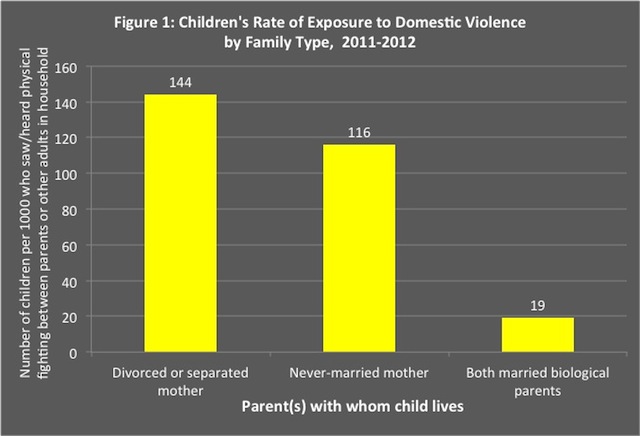
New study: children who grow up with single parents more likely to see domestic violence

Domestic violence least likely in married homes

This is from Family Studies. (H/T Brad Wilcox)

Excerpt:

In the 2011-2012 National Survey of Children’s Health, conducted by the U.S. National Center for Health Statistics, parents of 95,677 children aged 17 and under were asked whether their child had ever seen or heard “any parents, guardians, or any other adults in the home slap, hit, kick, punch, or beat each other up.” Among children living with both married biological parents, the rate of exposure to family violence was relatively low: for every 1,000 children in intact families, 19 had witnessed one or more violent struggles between parents or other household members. By comparison, among children living with a divorced or separated mother, the rate of witnessing domestic violence was seven times higher: 144 children per 1,000 had had one or more such experiences. (See Figure 1.) These comparisons are adjusted for differences across groups in the age, sex, and race/ethnicity of the child, family income and poverty status, and the parent’s education level.

One might suppose that women who had never married would be less likely to get into violent arguments with the fathers of their children than separated or divorced mothers. Yet the rate of witnessing domestic violence among children living with never-married mothers was also elevated. It was 116 per 1,000, six times higher than the rate for children in intact families. (Some of these fights involved subsequent partners or boyfriends of the mother, rather than the father of the child.) Even children living with both biological parents who were cohabiting—rather than married—had more than double the risk of domestic violence exposure as those with married birth parents: 45 out of 1,000 of these children had witnessed family fights that became physical. Note also that a child’s family structure was a better predictor of witnessing family violence than was her parents’ education, family income, poverty status, or race.

Experiencing family violence is stressful for children, undercuts their respect and admiration for parents who engage in abusive behavior, and is associated with increased rates of emotional and behavioral problems at home and in school. For example, among children of never-married mothers who had witnessed family violence, 58 percent had conduct or academic problems at school requiring parental contact. The rate of school behavior problems for those who had not been exposed to family fights was significantly lower, though still fairly high (36 percent). Likewise, among children of divorced or separated mothers, nearly half of those exposed to family violence—48 percent—had had conduct or academic problems at school. Even among the small number of children in intact families who had witnessed family violence, just over half—51 percent—presented problems at school. This was twice the rate of school problems among students from intact families who had not witnessed domestic violence. (See Figure 2.) These figures are also adjusted for differences across groups in age, sex, and race/ethnicity of children, family income and poverty, and parent education levels. Children experiencing domestic violence were also more likely to have repeated a grade in school and to have received psychological counseling for emotional or behavioral problems. This was true in intact as well as disrupted families.

A good book to read on this topic is Theodore Dalrymple’s “Life at the Bottom“, which offered this memorable anecdote about about how and why women choose men who abuse them.

Introduction:

The disastrous pattern of human relationships that exists in the underclass is also becoming common higher up the social scale. With increasing frequency I am consulted by nurses, who for the most part come from and were themselves traditionally members of (at least after Florence Nightingale) the respectable lower middle class, who have illegitimate children by men who first abuse and then abandon them. This abuse and later abandonment is usually all too predictable from the man’s previous history and character; but the nurses who have been treated in this way say they refrained from making a judgment about him because it is wrong to make judgments. But if they do not make a judgment about the man with whom they are going to live and by whom they are going to have a child, about what are they ever going to make a judgment?

“It just didn’t work out,” they say, the “it” in question being the relationship that they conceive of having an existence independent of the two people who form it, and that exerts an influence on their on their lives rather like an astral projection. Life is fate.

Chapter one:

All the more surprising is it to me, therefore, that the nurses perceive things differently. They do not see a man’s violence in his face, his gestures, his deportment, and his bodily adornments, even though they have the same experience of the patients as I. They hear the same stories, they see the same signs, but they do not make the same judgments. What’s more, they seem never to learn; for experience—like chance, in the famous dictum of Louis Pasteur—favors only the mind prepared. And when I guess at a glance that a man is an inveterate wife beater (I use the term “wife” loosely), they are appalled at the harshness of my judgment, even when it proves right once more.

This is not a matter of merely theoretical interest to the nurses, for many of them in their private lives have themselves been the compliant victims of violent men. For example, the lover of one of the senior nurses, an attractive and lively young woman, recently held her at gunpoint and threatened her with death, after having repeatedly blacked her eye during the previous months. I met him once when he came looking for her in the hospital: he was just the kind of ferocious young egotist to whom I would give a wide berth in the broadest daylight.

Why are the nurses so reluctant to come to the most inescapable of conclusions? Their training tells them, quite rightly, that it is their duty to care for everyone without regard for personal merit or deserts; but for them, there is no difference between suspending judgment for certain restricted purposes and making no judgment at all in any circumstances whatsoever. It is as if they were more afraid of passing an adverse verdict on someone than of getting a punch in the face—a likely enough consequence, incidentally, of their failure of discernment. Since it is scarcely possible to recognize a wife beater without inwardly condemning him, it is safer not to recognize him as one in the first place.

This failure of recognition is almost universal among my violently abused women patients, but its function for them is somewhat different from what it is for the nurses. The nurses need to retain a certain positive regard for their patients in order to do their job. But for the abused women, the failure to perceive in advance the violence of their chosen men serves to absolve them of all responsibility for whatever happens thereafter, allowing them to think of themselves as victims alone rather than the victims and accomplices they are. Moreover, it licenses them to obey their impulses and whims, allowing them to suppose that sexual attractiveness is the measure of all things and that prudence in the selection of a male companion is neither possible nor desirable.

Often, their imprudence would be laughable, were it not tragic: many times in my ward I’ve watched liaisons form between an abused female patient and an abusing male patient within half an hour of their striking up an acquaintance. By now, I can often predict the formation of such a liaison—and predict that it will as certainly end in violence as that the sun will rise tomorrow.

At first, of course, my female patients deny that the violence of their men was foreseeable. But when I ask them whether they think I would have recognized it in advance, the great majority—nine out of ten—reply, yes, of course. And when asked how they think I would have done so, they enumerate precisely the factors that would have led me to that conclusion. So their blindness is willful.

The blindness is wilful, because the emotions cannot be corrected by evidence. And everything in the culture affirms women in this craziness, even after they fail over and over again with men – cohabitating with the bad ones for years, and then turning away from the good ones. They freely choose the wrong men, and freely pass by the good ones. And almost no one tells them that it’s entirely their fault. Everyone just tells them “follow your heart”. This emotional craziness causes harm to innocent children, and it needs to stop. We have to stop the man-blaming and hold women accountable for making decisions with their emotions and then expecting craziness to “work out”.

You can read the Dalrymple book online for free in this post.

As Christianity declines in Europe, churches are put up for sale

This sad story is from the Wall Street Journal.

Excerpt:

Two dozen scruffy skateboarders launched perilous jumps in a soaring old church building here on a recent night, watched over by a mosaic likeness of Jesus and a solemn array of stone saints.

This is the Arnhem Skate Hall, an uneasy reincarnation of the Church of St. Joseph, which once rang with the prayers of nearly 1,000 worshipers.

It is one of hundreds of churches, closed or threatened by plunging membership, that pose a question for communities, and even governments, across Western Europe: What to do with once-holy, now-empty buildings that increasingly mark the countryside from Britain to Denmark?

[…]The closing of Europe’s churches reflects the rapid weakening of the faith in Europe, a phenomenon that is painful to both worshipers and others who see religion as a unifying factor in a disparate society.

[…]The Church of England closes about 20 churches a year. Roughly 200 Danish churches have been deemed nonviable or underused. The Roman Catholic Church in Germany has shut about 515 churches in the past decade.

But it is in the Netherlands where the trend appears to be most advanced. The country’s Roman Catholic leaders estimate that two-thirds of their 1,600 churches will be out of commission in a decade, and 700 of Holland’s Protestant churches are expected to close within four years.

[…]As communities struggle to reinvent their old churches, some solutions are less dignified than others. In Holland, one ex-church has become a supermarket, another is a florist, a third is a bookstore and a fourth is a gym. In Arnhem, a fashionable store called Humanoid occupies a church building dating to 1889, with racks of stylish women’s clothing arrayed under stained-glass windows.

In Bristol, England, the former St. Paul’s church has become the Circomedia circus training school. Operators say the high ceilings are perfect for aerial equipment like trapezes.

In Edinburgh, Scotland, a Lutheran church has become a Frankenstein-themed bar, featuring bubbling test tubes, lasers and a life-size Frankenstein’s monster descending from the ceiling at midnight.

Jason MacDonald, a supervisor at the pub, says he has never heard complaints about the reuse. “It’s for one simple reason: There are hundreds and hundreds of old churches and no one to go to them,” Mr. MacDonald said. “If they weren’t repurposed, they would just lie empty.”

Many churches, especially smaller ones, are becoming homes, and that has spawned an entire industry to connect would-be buyers with old churches.

The churches of England and Scotland list available properties online, with descriptions worthy of a realty firm. St. John’s church in Bacup, England, for example, is said to feature “a lofty nave as well as basement rooms with stone-vaulted ceilings,” and can be had for about $160,000.

There are many reasons why Christianity has declined in Europe, but surely the widespread embrace of left-wing economic policies – even by evangelical Christians – is one of the largest.

Here’s a fairly recent paper (PDF) that explains it:

What accounts for cross-national variation in religiosity as measured by church attendance and non-religious rates? Examining answers from both secularization theory and the religious economy perspective, we assert that cross-national variation in religious participation is a function of government welfare spending and provide a theory that links macro-sociological outcomes with individual rationality. Churches historically have provided social welfare. As governments gradually assume many of these welfare functions, individuals with elastic preferences for spiritual goods will reduce their level of participation since the desired welfare goods can be obtained from secular sources. Cross-national data on welfare spending and religious participation show a strong negative relationship between these two variables after controlling for other aspects of modernization.

I have many friends in the UK who classify themselves as evangelical Christians. They almost all embrace moderate to leftist economics, and they complain to me about why the church is in decline, why there is no interest in apologetics, why they can’t find Christian girlfriends, why they can’t get speaking engagements. The answer is, of course, that by majoring only in theology and apologetics, they have crafted the rope that their secular allies in government are using to hang them. Leftism is embraced by European Christians in part because they don’t want to be like those dastardly Americans with their free enterprise system and their rule of law and their private property and their law-abiding gun ownership.

It just goes to show you why Christianity suffers when we focus on piety at the expense of practicality. Too much A. W. Tozer, not enough F.A. Hayek. I doubt my well-meaning UK Christian friends – who are so proud of their laughable NHS health care – even know who F.A. Hayek is. To think that Lady Thatcher ones brandished “The Constitution of Liberty” by F.A. Hayek and declared “this is what we believe!”. But ordinary UK Christians do not believe what she believes, and now they must reap what they sowed with their knee-jerk rejection of the free enterprise system. Ignorance of economics killed Christianity in Europe, and pious, risk-averse Christians were willing participants in the murder.