After legalizing marijuana, Colorado sees higher number of “daily” users

Lee Strobel tweeted this story from the Denver Post.

Excerpt:

As marijuana legalization took hold in Colorado, the estimated percentage of regular cannabis users in the state jumped to the second-highest level in the country, according to new federal data.

When asked, roughly one out of every eight Colorado residents over the age of 12 reported using marijuana in the previous month. Only Rhode Island topped Colorado in the percentage of residents who reported using marijuana as frequently.

The results come from the National Survey on Drug Use and Health and represent the average of estimates gathered in 2012 and 2013.

[…]State-specific data from the survey are averaged over two-year periods to compensate for relatively small sample sizes.

For the 2011-12 period, 10.4 percent of Coloradans 12 and older reported using marijuana in the month prior to being surveyed. That placed Colorado seventh in the country for monthly marijuana use.

Monthly use in Colorado jumped to 12.7 percent — a 22 percent increase — in the 2012-13 data. The result means the survey estimates about 530,000 people in Colorado use marijuana at least once a month.

Nationally, monthly marijuana use by people 12 and older nudged upward by about 4 percent to 7.4 percent. In Washington state — which, like Colorado, in 2012 legalized marijuana use and limited possession for adults — monthly marijuana use rose by about 20 percent to 12.3 percent.

Kleiman said researchers will get a better idea about marijuana use in Colorado once they are able to zoom in on data showing how many people use marijuana daily. A study commissioned by Colorado’s Marijuana Enforcement Division this year found that people who use marijuana almost every day account for about 22 percent of cannabis users in Colorado but consume nearly 67 percent of the marijuana used. Other studies have warned about a possible uptick in heavy marijuana use.

“The fraction of people who are monthly users who are in fact daily users has gone way, way up,” Kleiman said.

Monthly marijuana use increased across all age groups in Colorado, according to the new survey numbers. The number of people who reported using marijuana in the past year also increased in Colorado in the 2012-13 data, but the state ranked only sixth nationally in the measurement. Measurements for alcohol consumption and illicit drug use increased, as well.

What will be interesting will be to see how this increased usage affects tax revenues and the crime rate. I think when more people use mind-altering drugs, it is going to harm their ability to get and keep jobs, which affects tax revenue. And when people are addicted to something, they are more inclined to take a risk on committing a crime to get the money to pay for their next fix. Should be interesting to learn from Colorado’s little experiment.

Related posts

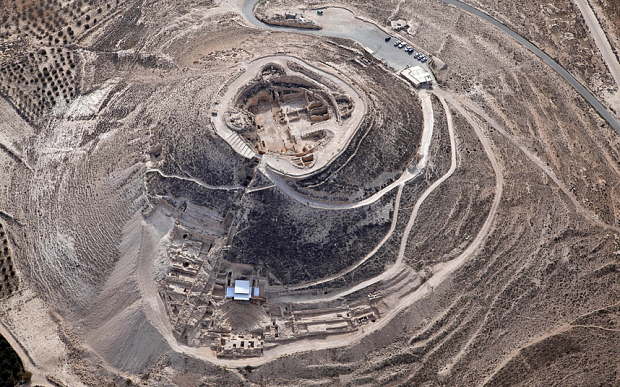
Archaeologists discover entrance to Herod’s palace near Bethlehem

Herod's palace
Herod’s palace

Baptist Press reports on the story.

Full text:

Israeli archeologists have uncovered an impressive entrance to Herod’s palace at Herodium. Located only three miles southeast of Bethlehem, Herodium played an important part in the events surrounding the early life of Christ.

The December announcement by Hebrew University archeologists Roi Porat, Yakov Kalman and Rachel Chachy dovetails well with the seasonal interest in the nativity accounts of Luke and Matthew in the New Testament.

While both Luke and Matthew wrote that King Herod governed Judea during the era of Jesus’ birth at Bethlehem (Luke 1:5, Matthew 2:1), they included nothing concerning Herod’s massive palace/fortress complex at nearby Herodium.

Herodium, like Herod’s other isolated palace/fortress complexes at Masada and Machaerus, was built on a mountain. To enhance its impressive scale, Herod artificially extended the height of the hill to make it the tallest mountain in the Judean desert.

While the site included the usual Herodian luxuries such as a palace, bathhouse, theatre and garden, Herodium was essentially a fortress, a place where Herod could find refuge if his people revolted.

Herod’s fear of a Jewish revolt led him to establish many fortresses in both urban centers (he maintained two in Jerusalem itself) and in isolated rural areas away from the urban centers.

A small community close to the fortress housed the construction teams and, later, the garrison soldiers and palace servants. The servants who waited on the king indeed worked in an impressive palace.

The newly uncovered entranceway apparently was still being constructed near the time of the monarch’s death.

As shown in one of the photographs, the entryway included three levels of arches in a 65-foot corridor that was 19 feet across and 65 feet in height leading to the palace’s courtyard. Curiously enough, the nearly completed entrance was abruptly stopped and backfilled around the time of Herod’s death. The archeologists speculated that the now-aging Herod instead sought to convert the entire palace into a memorial mound for his upcoming burial at the site.

Indeed, Herod’s plans for Herodium unfolded as Jesus was born and as He spent His early life in nearby Bethlehem. When the magi arrived in Jerusalem and announced they had come to worship the “king of the Jews,” Herod sent them to Bethlehem after learning the location of the Messiah’s birthplace from the chief priests and learned scholars. The monarch hoped to ascertain from the magi which of the town’s small children was the designated royal candidate. Then Herod hoped to execute the child (Matthew 2:1-8, 2:16).

When the magi failed to return with this information, Herod ordered his soldiers into Bethlehem to murder all children age 2 and under. Warned to flee to Egypt, the holy family escaped Herod’s plans, but an undisclosed number of children were killed by Herod’s soldiers. Although never stated in the biblical account, the soldiers who carried out the old king’s infamous order were either stationed in Jerusalem (seven miles from Bethlehem) or in the closer post at Herodium. In fact, Herodium overlooked Bethlehem and could have functioned as a convenient headquarters for Herod’s deadly operation.

While the holy family resided in Egypt, another Herodium connection to the early life of Christ took place. After a long and terribly painful illness, Herod died. His surviving eldest son (Herod had murdered his three oldest sons), Archelaus, then buried him in Herodium at a pre-selected tomb and gave his father an elaborate funeral at the site and spared no expense, according to the Jewish historian Josephus (Jewish War, 1,673).

Israeli archeologist Ehud Netzer claimed to have found Herod’s tomb and damaged sarcophagus (stone coffin) in 2007 at Herodium, but in 2013 and 2014 other archeologists have raised doubts about the tomb and the sarcophagus. Israeli archeologists Joseph Patrich and Benjamin Arubas largely based their doubts on the modest tomb site and the unimpressive sarcophagus. They believe that the mega-maniacal Herod would have commissioned a larger tomb and a more elaborate sarcophagus.

With Herod now buried in Herodium and with Archelaus eventually ruling over much of his father’s former kingdom as an “ethnarch” (“ruler of the people”), the New Testament noted the change in political leadership (Matthew 2:19-22). The change prompted Joseph to consider a move back to Judea (perhaps back to Bethlehem itself where the family had lived for about two years), but his misgivings about a Judea under the rule of an already unpopular Archelaus and a warning in a dream led him to reconsider. The decision was a wise one. A return to Bethlehem in the “shadow of Herodium” and the nearby royal city of Jerusalem placed the holy family at potential risk.

Instead, Joseph took his family back to Nazareth in Galilee (Matthew 2:22-23). Galilee was governed by Herod Antipas, the younger brother of Archelaus. At the time, this Herodian ruler, with the title of “tetrarch” (“ruler over a fourth”), was regarded as a milder alternative to the volatile Archelaus. Located far away from the recent unpleasant associations connected to Herodium and the slaughter of the children in Bethlehem, Joseph and Mary would raise Jesus in the peaceful surroundings of Nazareth.

The recent archeological find in Herodium and the continuing dispute concerning Herod’s tomb and sarcophagus calls attention to the background story of the early life of Christ as detailed in the Gospel of Matthew. Perhaps some further archeological discoveries at Herodium will uncover additional information about the familiar nativity narrative.

I liked this article on Baptist Press so much, I pasted it here in full – because of the links between history and the Bible. It’s also reported in secular news sources like NBC News and the UK Telegraph.

When I read stories like this, it really makes me question people who think that the New Testament books were not intended to be history. I think the default view has to be that the authors intended to write history, and then we do the work to see which parts pass historical tests – i.e. – how early, how many sources, how many eyewitnesses, etc. And, do we have archaeological evidence to corroborate the narrative.

Eric Metaxas: does science make the case for or against God?

This is from famous writer Eric Metaxas, writing in the Wall Street Journal, of all places. He talks about whether recent discoveries have made the world look more created/designed, or more eternal/undesigned.

In the beginning, there was the naturalism, and the naturalism said that habitable planets are common:

In 1966 Time magazine ran a cover story asking: Is God Dead? Many have accepted the cultural narrative that he’s obsolete—that as science progresses, there is less need for a “God” to explain the universe.

[…]The same year Time featured the now-famous headline, the astronomer Carl Sagan announced that there were two important criteria for a planet to support life: The right kind of star, and a planet the right distance from that star. Given the roughly octillion—1 followed by 24 zeros—planets in the universe, there should have been about septillion—1 followed by 21 zeros—planets capable of supporting life.

Then the science happened:

As our knowledge of the universe increased, it became clear that there were far more factors necessary for life than Sagan supposed. His two parameters grew to 10 and then 20 and then 50, and so the number of potentially life-supporting planets decreased accordingly. The number dropped to a few thousand planets and kept on plummeting.

Even SETI proponents acknowledged the problem. Peter Schenkel wrote in a 2006 piece for Skeptical Inquirer magazine: “In light of new findings and insights, it seems appropriate to put excessive euphoria to rest . . . . We should quietly admit that the early estimates . . . may no longer be tenable.”

As factors continued to be discovered, the number of possible planets hit zero, and kept going. In other words, the odds turned against any planet in the universe supporting life, including this one. Probability said that even we shouldn’t be here.

Today there are more than 200 known parameters necessary for a planet to support life—every single one of which must be perfectly met, or the whole thing falls apart. Without a massive planet like Jupiter nearby, whose gravity will draw away asteroids, a thousand times as many would hit Earth’s surface. The odds against life in the universe are simply astonishing.

And again, naturalism confounded by a stream of discoveries of cosmic fine-tuning:

The fine-tuning necessary for life to exist on a planet is nothing compared with the fine-tuning required for the universe to exist at all. For example, astrophysicists now know that the values of the four fundamental forces—gravity, the electromagnetic force, and the “strong” and “weak” nuclear forces—were determined less than one millionth of a second after the big bang. Alter any one value and the universe could not exist. For instance, if the ratio between the nuclear strong force and the electromagnetic force had been off by the tiniest fraction of the tiniest fraction—by even one part in 100,000,000,000,000,000—then no stars could have ever formed at all. Feel free to gulp.

Multiply that single parameter by all the other necessary conditions, and the odds against the universe existing are so heart-stoppingly astronomical that the notion that it all “just happened” defies common sense. It would be like tossing a coin and having it come up heads 10 quintillion times in a row. Really?

Fred Hoyle, the astronomer who coined the term “big bang,” said that his atheism was “greatly shaken” at these developments. He later wrote that “a common-sense interpretation of the facts suggests that a super-intellect has monkeyed with the physics, as well as with chemistry and biology . . . . The numbers one calculates from the facts seem to me so overwhelming as to put this conclusion almost beyond question.”

Theoretical physicist Paul Davies has said that “the appearance of design is overwhelming” and Oxford professor Dr. John Lennox has said “the more we get to know about our universe, the more the hypothesis that there is a Creator . . . gains in credibility as the best explanation of why we are here.”

The greatest miracle of all time, without any close seconds, is the universe. It is the miracle of all miracles, one that ineluctably points with the combined brightness of every star to something—or Someone—beyond itself.

My pastor reads the Wall Street Journal. I am pretty sure this is going to be in his Sunday sermon. It’s the #1 editorial on the Wall Street Journal right now, so he can’t miss it.

You know, as these scientific arguments become more and more mainstream, it really makes me wonder if there is anything more to atheism than some sort of traumatic childhood experience of wounded narcissism. The child experiences some desire for something, and expects God to meet that need. The need is not met. The child, now enraged that it is 1) not God and 2) not in control of God, rejects God. Or maybe it’s just the desire to not be punished for acting immorally. Or to appear “smart” to a crowd of peers. Whatever it is that causes people to believe in atheism, it sure isn’t science. If we are going strictly on the science, then the answer is God. But if the question of God’s existence is about feelings, then the answer is no God. It really is that simple.