
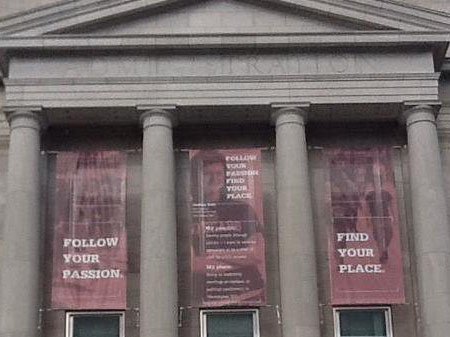
Gay activists target student leader Lindsey Kolb for defending religious liberty

A banner with Lindsey Kolb

Here’s the story from The College Fix.

Excerpt:

Members of the LGBT community at Missouri State University are demanding the school retaliate against a student leader for her off-campus activism against a local ordinance that could harm religious freedom.

[…]A petition posted Wednesday on Change.org, originally titled “#TakeLindseyOffCarrington” but since changed to “#AccurateRepresentationMSU,” asks the school to remove a banner from its signature building, Carrington Hall, depicting “university ambassador” Lindsey Kolb.

As of Sunday night, the petition had 873 signatures.

Providing little context for its subject or a clear articulation of its demand, the petition was posted the day after Springfield residents voted to repeal a city council ordinance that banned discrimination based on sexual orientation and gender.

Proponents of repeal have argued the ordinance did not provide substantial religious exemptions for businesses and individuals.

Removing the banner of Kolb would “send a message of cultural competence and not advertise someone who has no respect for a culture different from their own,” petition author and MSU student Connor Hayes wrote at Change.org.

Kolb told The College Fix her opponents have mischaracterized her beliefs and her faith.

“I advocated for repeal because I believe in religious freedom,” said Kolb in a statement. “A Church should not be forced to host a LGBTQ wedding. A cake shop should not be forced to make a cake for a LGBTQ couple’s wedding.”

Kolb wears many hats, according to her LinkedIn page: state chairman of the Missouri Federation of College Republicans and president of MSU’s chapter, receptionist for the dean of students and office of admissions, member of the student government cabinet, and even “campus ambassador” for a clothing brand.

What’s scary about this is the response of the gay activists:

She initially came under fire after taking issue with a satirical op-ed in The Standard by Caleb Hearon, which mocked Christians who favored of repeal of the Springfield ordinance.

“Repealing this protects religious freedom. It is my God-given right to hate whomever I want. Can I get a yee-yee?” Hearon wrote.

Caleb? What kind of name is Caleb for a secular leftist? That’s just weird.

More:

Though Hayes’ petition says its goal “is not to make Lindsey a scapegoat for the way the [Springfield ordinance repeal] vote turned out,” it continually returns to Kolb, calling her unfit to represent the university.

“Her remarks in the past do not exemplify an ethical leader by ostracizing and discriminating against current and prospective students who identify as member or ally of the LGBT+ community,” it states. “For Missouri State to continue to endorse her discriminatory views is effectively showing that they do not in fact value ethical leadership.”

Kolb told The Fix she feels “bullied” by the petition.

“The people who started this petition did not personally know me, my convictions, and completely took my views out of context,” she said.

Her opponents have taken to Twitter, using the hashtag #TakeLindseyOffCarrington and labeling her an “awful individual” and a “bigot”among other slurs.

I feel badly for her – trying to stand up for religious liberty using your real name is a disaster these days. It’s not safe. I do think that it’s extra good when a woman stands up for religious liberty, though. In my experience, women are more likely to want to hide their conservative beliefs from their peers – or even get rid of them completely in order to fit in. I feel really bad when that happens – I want to get in there and reinforce her so that she doesn’t feel pressured to change her values in order to fit in.

Look how tough Lindsey is:

And while Smart’s intervention on her behalf suggests Kolb’s banner will remain on Carrington Hall, “If it ever comes down to me having the freedom of speech and religion or having a banner on campus, I choose my faith and freedom every time,” Kolb told The Fix.

Fortunately, this story has a happy ending so far:

University President Clif Smart decried those attacking Kolb in a Wednesday night blog post.

“In the same way that discrimination will not be permitted at Missouri State, we will also not permit retaliation based on someone’s political or religious beliefs or advocacy efforts on this or any other political issue,” Smart wrote.

He said the university’s “public affairs” mission – the petition’s stated rationale for removing Kolb’s banner – “is not a weapon to be wielded when we work or study with those who have different ideas, beliefs or values than our own.”

Discouraging people from speaking openly is not what Missouri State is about, Smart continued: “We do not behave as ethical leaders when we seek to stifle free expression or punish those who advocate for particular viewpoints.”

And there is a counter-petition for you to sign to support Lindsey, as well. I posted this because my heart just went out to her trying to do the right thing and taking flak from the secular leftist mob. She is a very, very brave girl – I’m sure this experience has hurt her some. It’s scary – so many of our young people are like Crazy Caleb – even the ones raised in Christian homes. And there are so few Lindseys. The university is a very dark place right now. And yet it has so much influence in our society that we can’t abandon it, we have to keep trying to get a foothold.
Is Obama’s economy as good as the mainstream media are telling us?

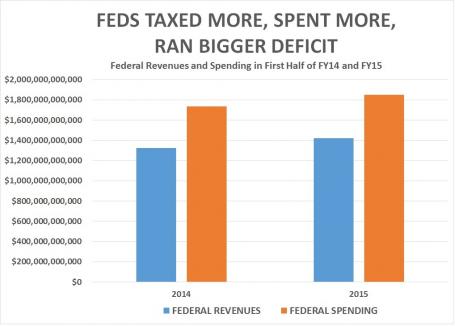
This article from CNS News was tweeted by GOP presidential candidate Carly Fiorina.

The economy is not good
This economy is not good (click for larger image)

It says:

The federal government taxed away more money, spent more money and ran a bigger deficit in the first half of fiscal 2015 than it did in the first half of fiscal 2014, according to the Congressional Budget Office.

“The federal government ran a budget deficit of $430 billion for the first half of fiscal year 2015, CBO estimates–$17 billion more than the shortfall recorded in the same span last year,” the CBO said in its Monthly Budget Review for March 2015, which was published April 8. “Both revenues and outlays were about 7 percent higher than the amounts recorded in the first six months of fiscal year 2014.”

Keep in mind that these deficit numbers are for half a year. In 2007, George W. Bush was running a deficit of $160 billion for an entire year.

And we’re being taxed more, too:

The biggest source of additional tax revenue for the federal government was the individual income tax. In the first six months of fiscal 2014, Americans paid the federal government approximately $585,000,000,000 in individual income taxes. In the first six months of fiscal 2015, Americans paid $642,000,000,000 in individual income taxes—an increase of $57 billion (or 9.7 percent) from fiscal 2014.

What’s the long-term forecast?

The Wall Street Journal has it:

Question: “How close are we from seeing entitlement programs like Medicare, Medicaid, and Social Security come into direct conflict with defense spending priorities? Defense spending is almost 20% of the Fed budget and nearly 60% of discretionary spending. Current cost of health care and an aging population are strong indicators this could happen sooner than later.”

Zumbrun: “I’d say we’re already seeing it now. As Nick noted above, the CBO projects that mandatory spending and spending on interest will climb, but that defense and nondefense discretionary spending will be squeezed. Anyone who doesn’t want to see that happen in the next decade needs some combination of higher revenue, much faster economic growth, or cuts to entitlement programs.

“The budget deal known as sequestration squeezed down both defense and non-defense discretionary spending. If, instead, everyone agreed it was okay to cut entitlements (which they obviously don’t), you wouldn’t have needed to squeeze that down. So I think it’s fair to say these things are already in conflict.”

Question: “Debt as long as partnered with productivity is no problem. From the looks of it, the U.S. might fall as an economy, but is now the time?”

Timiraos: “That’s a good point. One thing that’s a little bit troubling, however, is that estimates of the potential output of the U.S. economy have been revised down. What does that mean exactly? Instead of growing at a 2.7% rate from 2014-18, it now says the economy will grow at a 2.5% rate. That doesn’t sound too bad, but over time, it adds up.”

Question: “The U.S. has so far been capable of keeping its cost of borrowing at a remarkably low level. What about in the long term where it seems likely that servicing the debt will eat up a larger and larger percentage of government expenditures in an age of slowing growth?”

Zumbrun: “There’s actually decent reason to believe that if the economy slows down a lot then interest rates will stay very low. That’s basically the situation in Japan, right? They’re mired in decades of low growth, driven by aging demographics and a central bank that was really timid for a long time, but as a result of their permanently stagnant economy, interest rates are incredibly low. In the U.S., one scenario like this is known as secular stagnation.

Wow, if our economy starts to look like Japan, that will not be good. They have massive deficits, zero economic growth and a looming demographic crisis (few young workers, many older retirees). It’s a very bad situation that’s being masked by low interest rates and massive, massive borrowing.

The Brookings Institute agrees

Lest you think that this is just the conservative take on this, here’s the leftist Brookings Institute, writing about it just last week.

They say:

Debt figures tell part of the story. When the Great Recession hit, the federal debt was equal to about 40 percent of GDP. But to fight the recession, Congress enacted an $800 billion dollar stimulus bill. Stimulus spending, combined with already enacted spending and tax policy, resulted in four years of trillion dollar deficits. As a result, the debt ballooned to 78 percent of GDP in 2013, almost twice the pre-recession level. The annual deficit is now declining at a stately pace, but by 2016 it will begin increasing again, and by 2020 under CBO’s alternative fiscal scenario, we will once again return to annual deficits above a trillion dollars, thereby once again greatly increasing the national debt.

Oh come on – Obama says that he saved the economy, and everyone in the mainstream media agrees.

Did he?

What’s the word for our fiscal situation? Stunning? Shocking? Desperate? In recent testimony before the Senate Budget Committee, Boston University Economics Professor Laurence Kotlikoff, in effect, told the Committee that all of these terms are pathetically inadequate to describe our true fiscal situation. In compelling testimony, Kotlikoff argues that the federal fiscal situation is much worse than the CBO estimates let on. The reason is that CBO’s debt estimates do not take into account the full financial obligations the government is committed to honor, especially for future payments of Social Security, Medicare, and interest on the debt. He asserts that the federal government should help the public understand the nation’s true fiscal situation by using what economists call “the infinite-horizon fiscal gap,” defined as the value of all projected future expenditures minus the value of all projected future receipts using a reasonable discount rate.

If you’re going to be retirement age around 2030, you’d better do two things right now – first, don’t expect any help from the Federal government. I don’t care if you paid into their Ponzi scheme redistribution programs – there is no money for you there. Second, if you’re working till you’re retired, then expect the government to raise taxes even more on you.

Would you expect secularists to care about the next generation when this is the only life they have? I would not. Ideas have consequences.

Robin Collins lectures on the fine-tuning argument at Pepperdine University

A lecture on the fine-tuning argument by an expert.

Details:

Dr. Robin Collins is a Professor of Philosophy and Chair of the Department of Philosophy at Messiah College. Collins is the foremost defender of what is known as the teleological argument for the existence of God. He has a background in both physics and philosophy and will be discussing how the specific physical constants and conditions in the universe are finely-tuned for intelligent life and how this “fine-tuning” gives us reason to believe in a Creator.

Here is the video:

Topics:

  • the constants and quantities set at the origin of the universe is fine-tuned for conscious, embodied intelligences like us
  • three kinds of fine-tuning: 1) laws of nature, 2) constants, 3) quantities
  • examples of 1): gravity, electromagnetism, strong force, quantization, Pauli exclusion principle
  • examples of 2): gravitational constant, cosmological constant,
  • examples of 3):  initial distribution of mass-energy
  • in addition to fine-tuning for life, there is also fine-tuning for discoverability
  • Naturalistic response to the evidence: the multiverse hypothesis
  • problems with the multiverse hypothesis
  • additional topics

I put the ones I am ready to speak on in bold. I recommend you learn those as well in order to illustrate the fine-tuning with evidence when you present it. The evidence is important because I’ve never found a single atheist who I discussed this with who could properly state the argument or understand the evidence. They talk about it without really understanding it, which is why we need to be ready to explain it to them.