Gov. Greg Abbott launched a new set of proposals Friday to defund Planned Parenthood and pass restrictions on the collection of fetal tissue.
[…]On Friday, Gov. Abbott announced a new initiative in response under the acronym “LIFE.”
“Gruesome – and potentially illegal – harvesting of baby body parts by Planned Parenthood cannot be allowed in Texas,” Abbott said in a statement accompanying the announcement. “Treating unborn children as commodities to be sold is an abomination. The barbaric practice of harvesting and selling baby body parts must end.”
The initiative states, “Laws must be changed to make it a felony under Texas law to perform a partial-birth abortion; and make it illegal for abortion doctors to risk a woman’s health by altering the procedure to preserve fetal body parts.”
[…]It further states, “Funding for Planned Parenthood and other abortion providers out of taxpayer money must be eliminated completely, both at the State and local levels.” Public funding has already been cut off in Texas, where affiliates don’t even participate in tissue donation.
Finally, the governor proposes to “eliminate and criminalize any sale or transaction of fetal tissue by an abortion clinic for any purpose whatsoever,” which would restrict tissue collection largely to hospitals.
Texas is a red state, although they have lots of blue major cities with Democrat mayors – yuck.
Meanwhile, there’s more good news from Nebraska – another red state.
Five state lawmakers already have approached Nebraska Right to Life this summer about sponsoring anti-abortion bills next year, according to Julie Schmit-Albin, the group’s executive director.
“I’ve had more interest,” Schmit-Albin said last week.
Among those is Bellevue Sen. Tommy Garrett’s planned measure to target so-called “dismemberment abortions,” a term used to describe a dilation and evacuation procedure that is standard practice in abortions beginning 12 weeks after conception.
Schmit-Albin described so-called dismemberment abortion bans as “another chipping away” at the U.S. Supreme Court’s 1973 decision in Roe v. Wade guaranteeing women the right to abortion.
In 2010, Nebraska became the first state in the nation to ban most abortions beginning at 20 weeks. The change was based on the theory that by that point, a fetus has the capacity to feel pain. More than a dozen states have since passed similar bans.
Garrett is also a Republican.
LIfe News notes that Nebraska is not the first to propose a ban on dismemberment abortions:
Earlier this year, Oklahoma became the second state in the nation to protect unborn children from dismemberment abortions that tear them apart limb from limb. Previous to that Kansas Gov. Sam Brownback signed similar legislation prohibiting dismemberment abortions in the state. Model legislation provided by National Right to Life is also under consideration in the legislatures of Missouri and South Carolina.
The Democrats would love to roll back all of these restrictions at the state and local level, but for now they don’t have control of the House and Senate to push their bill to do that through to Obama, who would undoubtedly sign such a bill.
(Note: Chicago is one of the most anti-gun cities in the United States, if not the most anti-gun)
This is from the leftist New York Times, so I’ll have to separate fact from fiction.
Here’s some fact:
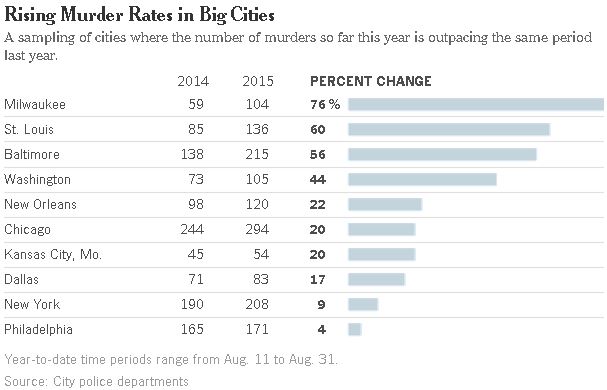
Cities across the nation are seeing a startling rise in murders after years of declines, and few places have witnessed a shift as precipitous as this city. With the summer not yet over, 104 people have been killed this year — after 86 homicides in all of 2014.
More than 30 other cities have also reported increases in violence from a year ago. In New Orleans, 120 people had been killed by late August, compared with 98 during the same period a year earlier. In Baltimore, homicides had hit 215, up from 138 at the same point in 2014. In Washington, the toll was 105, compared with 73 people a year ago. And in St. Louis, 136 people had been killed this year, a 60 percent rise from the 85 murders the city had by the same time last year.
Now, non-Americans might be tempted to think that America is filled with gun violence, but actually, the gun violence is relegated to the major cities, which are run by Democrats. And sometimes, like with Detroit, there has not been a Republican running things for years. Cities like Washington and Chicago have very, very anti-gun policies, so criminals understand that they can commit crimes with impunity – their victims are likely to be unarmed. The only thing standing between law-abiding citizens and crime are the police and the prisons. Unfortunately, liberals are opposed to both the police and the prison system. They want to handicap the police by crying “racism” all the time, and they want to release criminals from the prisons. Bottom line: in cities run by Democrats, there is no deterrent.
President Obama has been particularly hard on police officers, claiming that their attempts to enforce the law are motivated by racism. And Obama’s supporters are getting the message.
Warning: Strong language here.
Let’s talk a look at some rhetoric from a radio show.
One of the F***YoFlag organizers is called “Sunshine.” She has a radio blog show hosted from Texas called, “Sunshine’s F***ing Opinion Radio Show.”
[…]During the show, callers clearly call for “lynching” and “killing” of white people.
Callers:
They conspired that if “cops started losing people,” then “there will be a state of emergency.”
[…]Another black man spoke up saying they needed to kill “cops that are killing us. The first black male said, “That will be the best method right there.”
So there are actually police officers getting killed. Here’s one story from Reuters:
Houston-area officials on Saturday blamed the shooting death of a sheriff’s deputy on anti-police sentiment around the country over policing and race.
[…]Harris County deputy Darren Goforth, in uniform, was pumping gas into his patrol car on Friday night when the gunman approached from behind and fired several shots, sheriff’s officials said. No motive has been reported.
[…]”Our system of justice absolutely requires a law enforcement presence to protect our communities, so at any point where the rhetoric ramps up to the point where calculated cold-blooded assassination of police officers happen(s). This rhetoric has gotten out of control,” Hickman said.
[…]The suspect in video of the Goforth shooting appeared to be black. The deputy was white.
Television stations showed footage provided by police, from a gas station surveillance video that caught the ambush of Goforth, a 10-year veteran of the sheriff’s department, who left behind a wife and two young children.
Now it’s important to note that in this Houston killing, we don’t have the clear motive yet that we had in the case of the two New York police officers who were murdered. In fact, the shooter here has a history of medical illness. Still, this event will have an affect on police.
What happens to police officers in the face of these murders, and in the face of this rhetoric, and in the face of these Democrat politicians like Obama and Holder blaming police for enforcing the law? Well, the police naturally start to wonder whether it’s worth it to risk their lives so much.
In Alabama, one white police officer was so scared about being perceived as racist, that he let a black criminal take his gun and pistol whip him. The UK Daily Mail explains:
Alabama police are outraged after photos of a detective beaten bloody by a suspect who stole his gun during a traffic stop were shared by witnesses and praised on social media.
The suspect, 34-year-old Janard Cunningham, is charged with attempted murder for allegedly assaulting the six-year veteran following a traffic stop at a shopping center in Roebuck around 11am Friday.
[…]During the traffic stop, the detective pulled over Cunningham’s SUV and told him to stay in the car while he waited for backup to arrive.
Cunningham is said to have fled the scene after beating the officer until he didn’t move anymore. A second suspect was released without any charges
The suspect disobeyed that order, questioned why he had been stopped and then struck the officer in the head with his own weapon, AL.com reported.
The beating reportedly continued until the officer was no longer moving, with Cunningham then fleeing the scene.
[…]After the arrest, photos of the bloodied detective began popping up on social media, with some commenters applauding what happened.
Other Alabama officers were angered by the outpouring of support for the suspect.
Birmingham police Sgt Heath Boackle, president of the Fraternal Order of Police, said: ‘He was laying there lifeless and people were standing around taking pictures.
‘If the tables were turned, and that was a suspect lying there, they would be rioting.’
So what does this all mean? Well, to me it means that I need to be very careful about where I am going to live, because I can’t count on the police to come and rescue me as much as I could before. They are seeing what is happening, and they don’t want to die for people who don’t respect them. What is interesting is that the epidemic of black on black crime is going to get worse if police withdraw. And I think they should really think twice about stopping crimes in places where they are likely to get into trouble. Eventually, people will get the message. I would also say that now would be a good time to move to states that allow you to own firearms, and allow you to use them – i.e., states dominated by Republicans. The Democrat plan to control crime is this: you can’t own guns, and the police need to be intimidated into not doing their jobs. And it doesn’t help that Democrats keep encouraging fatherlessness by paying women to have babies before they get married. Fatherless men commit more crimes.
So, this is just an advice post for doing apologetics.
Here are three situations I’ve run into while doing apologetics in the last month.
First situation. I was talking with a lady who is an atheist. I had a copy of “God’s Crime Scene” in my hand, and she asked me about it. I told her that it was a book written by the guy who solved the homicide case that I asked her to watch on Dateline. She remembered – it was the two-hour special on the woman who was killed with a garrotte. She pointed at the book and said “what’s in it?” I said, it has 8 pieces of evidence that fit better with a theistic worldview than with an atheistic one, and some of them scientific. Her reply to me was – literally – “which denomination do you want me to join?”
Second situation. I was talking with a friend of mine who teaches in a Catholic school. She was telling that she got the opportunity to talk to her students about God, and found out that some of them were not even theists, and many of them had questions. So she asked them for questions and got a list. The list included many hard cases, like “what about the Bible and slavery” and “why do Christians oppose gay marriage?” and so on.
Third situation. Talking to a grad student about God’s existence. I’m laying out my scientific arguments for her, holding up the peer-reviewed papers for each discovery. I get to the Doug Axe paper on protein folding probabilities, and she holds up her hand. One question: “Am I going to Hell?”
So think about those three situations. In each case, the opponent is trying to reject Christianity by jumping way, way ahead to the very end of the process. When you do Christian apologetics, you do not take the bait and jump to the end of the process dealing with nitty gritty details until you have made your case for the core of the Christian worldview using your strongest evidence. Let me explain.
So, your strongest evidence as a Christian are the scientific arguments, along with the moral argument. Those would include (for starters) the following:
kalam cosmological argument
cosmic fine-tuning
galactic and stellar habitability
origin of life / DNA
molecular machines / irreducible complexity
the moral argument
The problem I am seeing today is that atheists are rejecting discussions about evidence because they think that all we are interested in is getting them to become Christians. Well, yes. I want you to become a Christian. But I know perfectly well what that entails – it entails a change of life priorities. Both of the women I spoke to are living with their boyfriends, and the kids in the Catholic school just want to have fun. None of them wants to believe in a God who will require self-denial, self-control, and self-sacrifice. Nobody wants God to be in that leader position in their lives. Christianity is 100% reversed from today’s me-first, fun-seeking, thrill-seeking, fear-of-missing-out travel spirit of the age.
So, how to answer all these late-game questions? The answer is simple. You don’t answer any late-game questions until the person you are talking with accounts for the widely-accepted data in your list. These are things that have got to be accepted before any discussion about minor issues like one angel vs two angels at the empty tomb can occur. When we discuss all the basic issues where the evidence is the strongest, then we can go on to discuss issues where the evidence is debatable, then finally, in the last bits before the end, we can discuss these other kinds of questions.
How to explain why this process must be followed to the person who asks specific questions about minor issues? Simple. You explain that your goal is not to get them to become a Christian right now. That you want to let them believe anything thing they want. That’s right. They can believe anything they want to believe. As long as what they believe is consistent with the evidence. And what I am going to do is give them the evidence, and then they can believe whatever they want – so long as it’s consistent with the evidence.
So, for example, I’m going to tell them 3 pieces of evidence for a cosmic beginning of the universe: the expanding universe (redshift), the cosmic microwave background radiation, and the light element abundances. That’s mainstream science that shows that the universe came into being out of nothing, a finite time in the past. And I will charge them not to believe in any religion that assumes that the universe has always been here. For example, Mormonism is ruled out, they believe in eternally existing matter. See how that works? Hey, Ms. Atheist. You can believe anything you want. As long as what you believe is consistent with the evidence.
I think this approach of not letting them rush you to the end at the beginning is important for two reasons. First, we can get our foot in the door to talk about things that are interesting to everyone, in a non-stressed environment. Everyone can talk about evidence comfortably. Second, we show that we hold our beliefs because we are simply letting evidence set boundaries for us on what we are allowed to believe. We can’t believe not-Christianity, because not-Christianity is not consistent with the evidence. And you start with the most well-supported evidence, and eliminate worldviews that are falsified by the most well-supported evidence. Atheism actually gets falsified pretty quickly, because of the scientific evidence.
So, that’s my advice. Had a friend of mine named William try this out about a week ago. It went down like this:
William to me:
This guy I know messaged me and bragged for a while about how easy he can dismantle Christianity. He said: “present the gospel to me as you understand it. I’ll simply ask questions to demonstrate it is not worth your belief.”
WK to William:
First of all, he isn’t allowed to just sit there and poke holes in your case, he has to present a positive case for atheism. Second, don’t discuss Christianity with him at all until you first discuss the evidence for theism – start with the good scientific evidence.
And William wrote this to his friend:
The way I’m wired is that I process all competing theories and go with the best one. By doing a comparative analysis of worldviews I find that Christian theology easily explains the most about the world I find myself living in.
I’m pretty sure that a God of some sort exists because of the scientific evidence for the origin of the universe and the fine tuning in physics. From there I find it quite intuitive that if a God went through the trouble of creating and tuning a universe for life that this God likely has some sort of interest in it and has revealed Himself to humanity in some way.
From there I can look at the major world religions and compare them to see which one explains the past and the present the best. Christianity easily comes out on top.
And then a few days later, I got this from William:
I finally got the agnostic to tell me what he thinks about origin and fine tuning. When I started pointing out that his views were unscientific, he blew a basket, called me dishonest and told me he didn’t want to discuss anything further.
And that’s where you want to be. Cut off all discussions where the challenger tries to jump to the end and get you to debate the very last steps of your case. Present the strongest evidence for your core claims, and get him to account for this evidence within his own worldview. Lead the discussion with public, testable evidence. All warfare depends on picking the terrain, weapons and tactics that allow you to match your strength against your opponent’s weakness.



 WINTERY KNIGHT